






.png?width=869&height=597&name=image%20(5).png)


-1.png?width=486&height=315&name=IDC%20Banner%20(1)-1.png)



.png?width=300&height=175&name=Rectangle%2034624433%20(2).png)














IT operations teams often face a familiar problem: too much noise, too little clarity. They spend hours filtering symptoms from overlapping alerts, duplicated logs, and unclear priorities, often at the expense of solving root causes. Over time, that leads to slower incident resolution, growing backlogs, and over-reliance on a shrinking pool of experienced engineers.
AIOps addresses this by applying machine learning to reduce alert fatigue and surface what actually requires attention. Instead of reacting to everything, teams can focus on high-impact problems earlier in the cycle. When properly integrated, AIOps does not replace your systems; it reduces the friction between them.
The sections that follow focus on specific improvements: faster triage, less operational waste, fewer manual tasks, and more time for engineering work that moves the business forward.
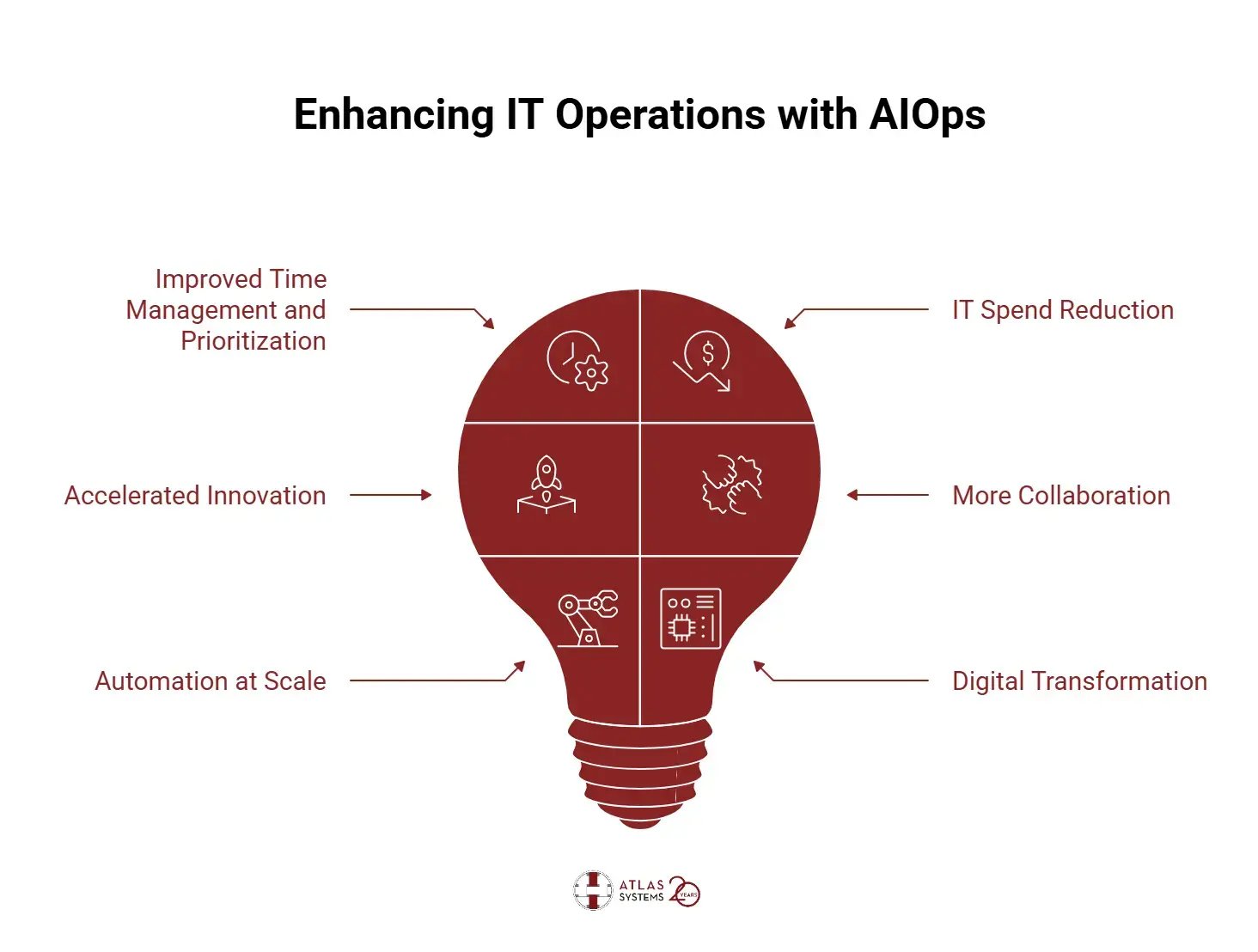
Improved Time Management and Prioritization
Engineers do not get bogged down because alerts are rare. They get stuck because alerts do not know when to shut up. Most monitoring systems operate on thresholds and static rules. A spike hits, a disk slows, a retry loop starts, and suddenly, five tools are raising tickets. All of them say something's wrong. None of them says what.
That noise multiplies as environments grow. Add another microservice, another integration, another vendor, and the signals start to overlap. Eventually, response time has less to do with problem-solving and more to do with untangling the mess.
AIOps reduces that tangle by changing how incoming signals are processed. Instead of firing alerts as soon as an anomaly is detected, it waits. It compares current activity to similar incidents from the past. It looks at timing, frequency, downstream effects, and suppression history. The system then applies machine learning models, mostly classification and clustering, to decide what type of event this is and whether it deserves attention.
The goal is prioritization based on pattern recognition, not just filtering. For example:
- If five alerts come in within two seconds and resemble a previously tagged “false positive storm,” they are grouped and deprioritized.
- If a low-priority alert matches the early pattern of a known escalation path, the system elevates its severity and attaches incident history for faster triage.
- If two monitoring tools flag the same behavior with different languages, AIOps correlates them under a single root condition.
This process is not magic. It is statistics and context, layered over time. Each new incident teaches the system what normal looks like, what failure feels like early on, and which alerts help versus distract.
That gives teams three things: fewer alerts overall, better signal-to-noise ratio, and a head start on the response process. You do not begin every ticket from zero. The metadata, logs, and suggested response actions come attached, ready before someone even opens the ticket.
What changes is the shape of the work and not the number of notifications. With AIOps, now engineers can regain their time by avoiding what didn’t need their time in the first place.
IT Spend Reduction
Most enterprises lack visibility into how those tools drain budgets over time. Licenses pile up, monitoring overlaps, and compute gets over-provisioned “just in case.” The bill that arrives rarely reflects the actual need. That is where AIOps starts paying for itself.
Let's take real waste like bloated cloud costs, unnecessary staff, or false positives, and shift that money into resources that actually drive progress. Machine learning spots this waste by flagging what could fail and points out where your money is not tied to actual results.
Here’s how that works in practice:
1. Over-provisioning gets surfaced early
AIOps engines track usage patterns continuously. When a node consistently runs at 12% capacity or storage gets allocated but never consumed, it gets flagged. That data helps you scale down with confidence, not guesswork.
2. License sprawl becomes measurable
ML models cluster alert types across tooling. If four tools fire the same alert from the same incident, AIOps correlates it as a single event. Over time, this reveals which tools overlap, which ones never contribute unique insights, and which you can sunset.
3. Automation removes low-value labor
Triage, ticket routing, and log aggregation still eat up hours. AIOps takes those cycles off human plates. That shift does not reduce headcount; it lets your team stop babysitting alerts and start fixing what actually matters.
4. Event noise reduction stops unnecessary escalation
Without AIOps, noise becomes the reason more staff gets hired. But the volume is not the problem; the context is. ML cuts the noise by clustering events into cause-effect threads. That stops issues from being handled five different times by five different people.
The point is not that AIOps "saves money." It stops you from losing it in ways you could not see before. And in operations, visibility is the first step to control.
Accelerated Innovation
Innovation rarely stalls because teams lack ideas. It stalls because those ideas wait behind a queue of outages, regression bugs, and incidents no one can fully explain. If your top engineers spend more time writing postmortems than shipping upgrades, you are trapped. AIOps breaks that loop by removing the friction that slows delivery.
Instead of reacting to every alert, your teams start with better context. ML-powered monitoring links root cause across logs, metrics, and dependencies that would take days to untangle manually, and you are skipping the bottlenecks that usually follow them.
This shift changes where engineering time goes:
- Build cycles recover lost hours
When incident response runs on auto-classified severity and real-time correlation, teams no longer burn half the sprint on rework. They get to focus on pushing new functionality, not patching broken pipelines. - Regression risks shrink
Faster feedback loops mean fixes go out sooner, and changes are validated against a more complete view of system behavior. That reduces rollback frequency and the defensive coding habits that come with it. - CI/CD pipelines run cleaner
With less manual intervention between code commit and deploy, integration gets safer. AIOps feeds into these flows by supplying telemetry that flags issues during test runs, not after release.
This is not about velocity for its own sake. It is about keeping your most capable engineers focused on work that compounds, features that ship, systems that evolve, and problems that stay fixed the first time.
Keeping your most capable engineers focused on work that compounds, features that ship, systems that evolve, and problems that stay fixed the first time should be the priority, not velocity.
More Collaboration Between Dev and Ops
Misalignment between development and operations is a contextual problem. Engineers build, operators stabilize. When incidents hit, both sides bring knowledge, but rarely a shared timeline. What looks like a slow fix to one team may be the result of incomplete data on the other. AIOps clears that fog by making context continuous, not piecemeal.
Every alert it processes carries a signature: what changed, what broke, what pattern matched previous failures. That information flows into shared dashboards where both sides see the same timeline, the same severity, and the same dependencies. Here is where the shift shows up:
- Incident retros run on facts, not memory
AIOps preserves causality. If a deployment triggered a fault downstream, the chain is visible. There is no guesswork about whether the infrastructure lagged or the code shipped too fast. - Platform teams get operational closure
When alerts auto-resolve or never fire thanks to upstream automation, SREs stop chasing ghosts. They track actual disruptions, not noise passed along Slack threads. - Dev teams regain trust in observability
No one wants to hear “works on my machine.” AIOps validates incidents against correlated data, not just logs. If a bug propagates, developers see how and where to intervene upstream.
This is not a kumbaya collaboration. It is mechanical sympathy. Dev and ops stop operating in parallel. They solve the same problems from the same source of truth, and the results show in uptime, delivery speed, and system clarity.
Automation at Scale
Automation earns its keep when it handles the problems you already know how to fix. The goal is not novelty, it is relief, removing toil that burns hours but teaches nothing. AIOps recognizes these patterns across systems and translates them into repeatable logic that holds up under pressure, across stacks, and over time.
At the core, it starts with machine learning classifiers that parse event logs and historical incidents to identify recurring triggers. These are not surface-level signatures; they are clusters of telemetry anomalies tied to specific outcomes, like degraded API response, memory overcommitment, or failed deployment rollbacks. Once identified, those clusters form the basis of automated workflows that evolve without needing to be rewritten from scratch every quarter.
Automation at this level takes three primary forms:
- Event-driven remediation:
Instead of waiting for someone to acknowledge a spike in CPU or latency, AIOps routes the event through a decision model trained on previous resolutions. If the system has seen this before and the fix is held, it executes it. If it diverges, it escalates, but with enriched context that cuts triage time down to what matters. - Dynamic incident workflows:
The path from alert to resolution is never static. AIOps systems conditionally chain response steps based on current state, past effectiveness, and system topology. Restarting a pod might solve the issue on one cluster. On another, it flags deeper capacity limits. The logic adapts, not just reacts. - Cross-environment compatibility:
Whether you are running containerized microservices, VMs on a hybrid setup, or legacy systems tied to mainframe dependencies, AIOps accommodates the variation. Its models focus on behavior, not stack-specific traits. That abstraction allows workflows to remain stable even as your environment changes underneath them.
Self-healing systems are not theoretical in this model. They are practical responses to known pain points, refined over time and deployed at speed. The automation is not ornamental. It carries forward institutional memory, frees up senior engineers for architectural work, and raises the floor on operational maturity without increasing headcount.
The Digital Transformation Link
Digital transformation sounds clean in slides. In production environments, it means pushing every system to operate faster, more reliably, and with fewer people in the loop. That shift does not just strain infrastructure, it exposes how many day-to-day processes still depend on someone checking a dashboard, forwarding an alert, or piecing together information across tools that were never designed to work together.
Shifting to platform-centric architectures and expanding into multi-cloud setups often happens faster than process discipline can keep up. Dependencies multiply. Teams end up managing complexity they did not plan for, under pressure to maintain uptime and meet aggressive rollout timelines. AIOps steps in as a practical necessity that helps systems respond faster than humans can coordinate across fragmented environments.
AIOps builds continuity across the change curve:
- Real-time insights replace after-action reports. Issues are flagged with context the moment they surface, not hours into a delay spiral.
- Root cause analysis becomes embedded, not optional. As deployments grow more frequent and dependencies more nested, teams cannot afford to guess their way through a rollback.
- Incident response automation moves decisions closer to the data. Instead of command chains, response logic travels with the telemetry.
- Business continuity stops depending on heroic recoveries. Instead, it relies on systems that respond in real-time, escalate only when needed, and maintain service levels even during heavy system flux.
The organizations that pull ahead are not the ones with the newest tools. They are the ones that embed response into the fabric of operations, where intelligence meets action, and uptime does not rely on the availability of a single engineer at 3 AM.
Manual Operations vs AIOps-Enhanced Operations
|
Area |
Manual Operations |
AIOps-Enhanced Operations |
|
Incident Detection |
Relies on static thresholds, manual checks, and cross-tool verification |
Detects anomalies in real time using ML models trained on past behavior |
|
Noise Handling |
Every alert is surfaced, even duplicates and low-priority events |
Alerts are correlated and filtered automatically to surface root-level signals |
|
Root Cause Analysis |
Involves log-digging, war rooms, and trial-and-error triage |
Suggests probable causes using cross-system event correlation and historical patterns |
|
Escalation & Routing |
Ticket routing depends on predefined rules or human judgment |
Incidents auto-route to the right owner based on context and service mapping |
|
Remediation |
Handled by engineers through runbooks or memory |
Repeats are auto-remediated; new issues suggest next actions or rollback sequences |
|
Reporting |
Dashboards are updated manually and only after resolution |
Trends and insights surface as events unfold, with decision context built in |
|
Team Time |
Consumed by false positives, redundant diagnostics, and handoffs |
Redirected to backlog, automation development, and feature delivery |
|
Scalability |
Requires more people to manage more systems |
Handles scale through learning models that adapt to volume and complexity |
Why Teams Choose Atlas Systems for Real-World AIOps
Atlas Systems tackles the daily operational grind: alert fatigue, root cause ambiguity, and fragmented visibility, without asking you to tear down what you already use. It plugs into your existing monitoring, logging, and ITSM ecosystem to bring clarity, speed, and scale to your workflows.
With machine learning at its core, AInfinity clusters related incidents, filters low-value noise, and pinpoints where breakdowns start, not just where they show up. It builds behavior models over time, surfaces early signs of degradation, and lets you act before users notice a thing. Tickets assign themselves, runbooks execute autonomously, and your teams spend less time fighting fires.
The platform supports hybrid environments, handles multi-tenancy, and works across regulated industries, whether you are managing uptime for clinical systems or enforcing SLAs in banking.
Want to see how this fits into your stack? Connect with our AIOps experts today.
Frequently Asked Questions (FAQs) About AIOps
1. What are the most important AIOps benefits for enterprise IT?
It reduces alert overload, speeds up resolution, and prevents problems from snowballing. Teams shift focus from firefighting to actual engineering.
2. Can AIOps reduce the workload on IT support teams?
Yes. It cuts noise, automates repeat incidents, and frees up support to handle issues that need judgment.
3. How is AIOps different from traditional monitoring tools?
Monitoring shows what happened; AIOps explains why, connects the dots, and often handles the fix. It adds intelligence, not just visibility.
4. What kinds of industries benefit most from AIOps?
Finance, healthcare, SaaS, and retail see the strongest ROI, but any team running complex, high-volume systems will.
5. Does AIOps require replacing existing tools or infrastructure?
No. It integrates with current systems, using their data to drive smarter responses without major retooling.

Related Reading
Blogs