.webp?width=387&height=387&name=headless-tprm%20(1).webp)


















Third-Party Risk Management
ComplyScore® Launches World’s First Headless TPRM, Bringing Conversational AI to Compliance Management. 
ComplyScore® Launches World’s First Headless TPRM, Bringing Conversational AI to Compliance Management.




In 2026, third-party risk does not wait for your next annual review, and neither do regulators or attackers. Your vendors touch customer data daily, compliance expectations demand continuous oversight, and one missed signal can turn into a breach, outage, or audit finding fast. That is why choosing the right TPRM tool is no longer just a platform decision. It decides whether you manage vendor risk in real time or discover problems only after damage is done.
We evaluated platforms on how well they adapt to shifting requirements, including DORA, India’s DPDP Act, the UK’s UK GDPR and FCA outsourcing and third-party risk expectations, and US requirements such as the SEC cybersecurity disclosure rules and sector-specific expectations like HIPAA and GLBA. We also assessed whether they deliver measurable outcomes across the full third-party risk lifecycle and scale without multiplying headcount as your vendor list grows.
This guide breaks down 10 solutions that meet those standards, shows you how to assess them against your risk profile, and helps you build a budget-ready business case.
TPRM tools help you identify, assess, monitor, and reduce vendor risk. They automate questionnaires, evidence collection, compliance checks, and continuous monitoring so teams can manage third parties at scale. Examples include OneTrust, SecurityScorecard, BitSight, UpGuard, RiskRecon, ProcessUnity, and Panorays.
Gartner reports that 40% of compliance leaders classify between 11% and 40% of their third parties as high-risk. Proactive handling of scope changes can improve outcomes by up to 36%, which means the platform you choose directly affects whether you catch issues during the relationship or explain them to regulators after the fact.
The difference between legacy tools and modern platforms comes down to three factors: how fast they surface material changes, how well they align effort to actual exposure, and whether remediation moves to closure or drifts across inboxes.
Not every tool on this list solves the same problem, even though all ten get called "TPRM software." Most fall into one of three categories.
Ratings-first tools score vendors using externally observable data, with no vendor participation required. These are strong for continuous monitoring and fast initial screening, but thinner on lifecycle workflow and internal assessment depth.
GRC-first platforms treat vendor risk as one module inside a broader governance and compliance system. These work well for organizations that need vendor risk tied to privacy, policy, and audit programs in one place, but they can add complexity if TPRM is your primary need rather than one piece of a larger GRC rollout.
Unified TPRM platforms are built to cover the full lifecycle in one system: identification, assessment, continuous monitoring, and remediation, without stitching a ratings tool to a GRC tool to a spreadsheet.
Which category fits you depends less on company size and more on what you're solving for right now: fast vendor screening, governance consolidation, or full-lifecycle ownership.
We evaluated each platform against the complete vendor risk lifecycle, testing how well it handles discovery through offboarding without forcing teams to reconcile data across tools.
Platforms were scored on their ability to identify vendors including shadow IT, assess risk across multiple domains, monitor continuously with actionable alerts, automate workflows, and deliver measurable improvements in assessment speed and vendor coverage.
We analyzed verified G2, Gartner Peer Insights, and Capterra reviews to validate real-world adoption and customer satisfaction.
Every platform was rated on a 1-to-5 scale across five weighted dimensions:
Third-Party Risk Identification (25%): Automated vendor discovery, profile enrichment from authoritative sources, intelligent tiering based on data sensitivity and criticality, and ability to extend oversight beyond Tier I vendors.
Third-Party Risk Analysis (25%): Assessment depth across cyber, financial, operational, regulatory, and ESG domains, with AI-assisted questionnaires, evidence parsing for gap detection, and transparent risk scoring.
Third-Party Risk Monitoring (20%): Real-time monitoring frequency, signal quality from cyber posture feeds and threat intelligence, automated alert routing into workflows with owners and SLAs.
TPRM Process Automation (15%): End-to-end workflow automation from intake through remediation, pre-configured compliance alignment (ISO 27001, GDPR, HIPAA, SOC 2, NIST), complete audit trails, and integration depth with GRC and ERP systems.
Performance and Usability (15%): User-friendly interfaces for risk teams and vendors, realistic time to first assessment, quality of customer support, and risk scoring accuracy validated against external threat data.
This scorecard ensures each recommendation is transparent and helps you identify which platforms match your organization's size, industry, and program maturity.
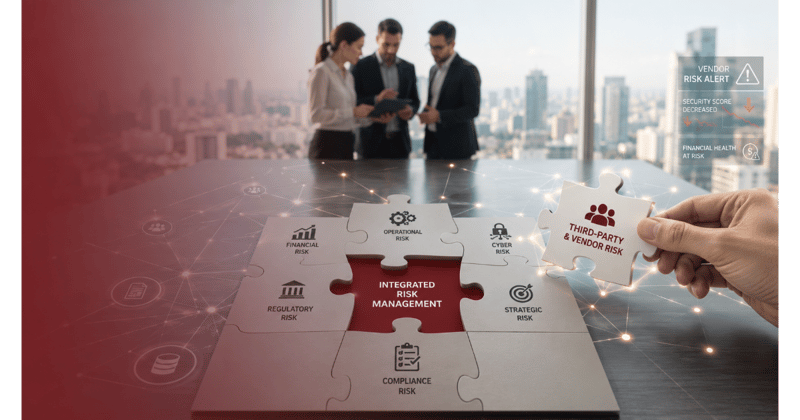
Modern TPRM platforms address six risk categories that, left unmanaged, lead to breaches, fines, and operational failure.
Cybersecurity risk arises when vendor vulnerabilities expose your environment to phishing, malware, or unpatched systems. TPRM software enforces security standards, monitors posture continuously, and flags degradation before attacks occur.
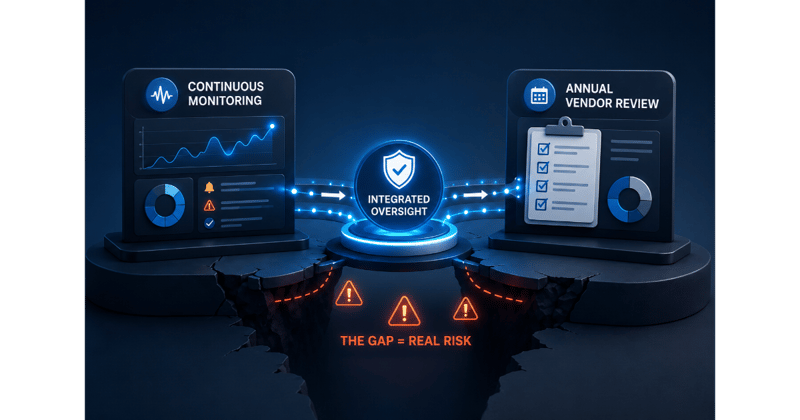
Data breaches can increasingly originate through third-party vendors and supply chains. According to Verizon’s 2026 Data Breach Investigations Report, breaches involving third parties increased by 60%, now accounting for 48% of all breaches. This highlights the need for organizations to continuously assess vendor security, monitor vulnerabilities, evaluate data-handling practices, and understand subprocessor and supply-chain dependencies rather than relying solely on annual vendor assessments.
Regulatory compliance failures result when vendors don't meet GDPR, HIPAA, DORA, or DPDP requirements. TPRM tools map vendor controls to frameworks, generate audit-ready reports, and alert you to gaps before regulators find them.
Operational disruption occurs when critical vendor outages halt your business. Software that tracks business continuity plans, monitors for service failures, and simulates supply chain weak points helps you maintain resilience.
Reputational damage spreads when a vendor's misconduct, security incident, or unethical practice erodes customer trust. Platforms that screen for sanctions, ESG violations, and adverse media help you avoid association with problematic partners.
Financial risk includes losses from vendor insolvency, performance failures, or the cost of managing incidents. Continuous financial monitoring and credit tracking provide early warning when vendor stability declines.
|
Name |
Best For |
Standout Feature |
Pricing |
|
ComplyScore® by Atlas Systems |
Complex vendor ecosystems requiring autonomous TPRM |
AI-powered lifecycle automation with engagement-aware tiering |
Custom, based on vendor volume and complexity |
|
UpGuard |
IT security teams focused on attack surface monitoring |
Real-time security ratings with automated vendor discovery |
Custom, 7-day free trial available |
|
SecurityScorecard |
Continuous cyber risk monitoring at scale |
Security ratings refreshed multiple times daily |
Custom, request demo |
|
OneTrust |
Privacy-focused organizations managing GDPR and CCPA |
Unified platform for privacy, GRC, and vendor risk |
Custom, request demo |
|
Bitsight |
CISOs prioritizing quantifiable security performance |
Security ratings with financial impact correlation |
Custom, request demo |
|
Prevalent |
Procurement and risk leaders managing scalable ecosystems |
Vendor risk intelligence network with 10,000+ assessed vendors |
Custom, request demo |
|
Panorays |
Security teams needing rapid third-party assessments |
Automated security questionnaires with built-in remediation |
Custom, request demo |
|
ProcessUnity |
Large enterprises managing complex vendor portfolios |
Global risk exchange with 15,000+ validated assessments |
Custom, request demo |
|
Venminder |
Mid-market companies seeking end-to-end vendor lifecycle management |
30,000+ annual risk-rated assessments and managed services |
Custom, request demo |
|
LogicGate |
Risk teams aligning to industry frameworks like SIG and NIST |
No-code workflow customization with Monte Carlo risk quantification |
Custom, request demo |
ComplyScore® delivers autonomous TPRM that stays current by design, centralizing the vendor lifecycle from intake through continuous monitoring into governed workflows.
Third-Party Risk Identification: Vendor Profile Intelligence auto-enriches records from D&B, RiskRecon, and public registries. Engagement-aware tiering scores each relationship by scope, data sensitivity, criticality, and regulatory footprint.
Third-Party Risk Analysis: AI-prefilled questionnaires align to SIG, SOC 2, ISO 27001, and HIPAA standards. Evidence Review scans SOC reports to flag gaps and draft remediation steps. Scoring covers cyber, financial, operational, regulatory, and ESG domains with clear attribution.
Third-Party Risk Monitoring: Continuous monitoring ingests cyber posture, credit, and breach signals, converting material changes into assigned tasks with owners and SLAs. Policy-driven thresholds filter noise and route only actionable alerts.
TPRM Process Automation: Automated workflows handle intake enrichment, tier-based routing, evidence parsing, remediation tracking, and audit-ready close-out reports with full trail documentation.
Performance Metrics:
Best for: Organizations needing audit-ready TPRM with managed services for scale.
Category: Unified TPRM platform
Pricing: Custom pricing based on vendor count and managed services.
Key TPRM Features:
UpGuard combines attack surface monitoring with vendor risk management, scanning external footprints multiple times daily for real-time security visibility.
Third-Party Risk Identification: Automated vendor discovery analyzes digital footprints to identify third parties, including shadow IT. The platform assigns immediate security ratings based on externally observable data without vendor participation.
Third-Party Risk Analysis: AI-powered assessments use questionnaires aligned to NIST, ISO 27001, and SIG Lite. Trust Exchange lets vendors share evidence once and reuse it across assessments. Scorecards provide instant comparative rankings against industry benchmarks.
Third-Party Risk Monitoring: Real-time ratings update multiple times daily, detecting vulnerabilities, breaches, and configuration changes. Monitors DNS health, certificate validity, patching cadence, and exposed services continuously.
TPRM Process Automation: Breach detection alerts trigger automatically when vendors experience incidents. Integrations with OneTrust and ServiceNow synchronize risk data and enable automated task creation.
Performance Metrics:
Best for: Organizations prioritizing real-time attack surface visibility and automated discovery.
Category: Ratings-first
Pricing: Custom pricing with 7-day free trial.
Key TPRM Features:
SecurityScorecard delivers continuous security ratings based on externally observable data, scanning billions of signals weekly to generate objective vendor risk assessments.
Third-Party Risk Identification: Automatically rates any organization with internet presence across ten risk factors: network security, DNS health, patching, endpoint security, IP reputation, application security, cubit score, hacker chatter, information leak, and social engineering. Atlas View maps fourth-party relationships.
Third-Party Risk Analysis: A to F ratings reflect breach likelihood—F-rated companies are 13.8x more likely to breach than A-rated peers. HyperComply acquisition adds AI questionnaire automation that parses responses and flags inconsistencies.
Third-Party Risk Monitoring: BreachSight delivers real-time alerts on vendor incidents, data leaks, and vulnerability disclosures. Continuous scanning across all ten factors updates ratings as security posture evolves.
TPRM Process Automation: GPT-4 powered natural language search lets teams query conversationally ("show me critical vendors breached in past year"). Integrations with ServiceNow, Splunk, and CrowdStrike automate remediation routing.
Performance Metrics:
Best for: Teams needing objective, externally-validated security ratings with threat intelligence.
Category: Ratings-first
Pricing: Custom pricing with free tier for basic ratings.
Key TPRM Features:
OneTrust delivers enterprise-scale TPRM within OneTrust's broader GRC ecosystem, connecting vendor risk to privacy, ethics, and ESG programs.
Third-Party Risk Identification: Configurable intake workflows capture vendor details aligned to GDPR, CCPA, and SOX requirements. Risk scoring evaluates criticality, data access, and jurisdiction-specific compliance obligations.
Third-Party Risk Analysis: Pre-built questionnaires with AI-powered validation accelerate assessments. Vendorpedia Exchange functions as a shared repository where vendors upload evidence once and grant access to multiple customers.
Third-Party Risk Monitoring: Continuous monitoring tracks certifications, incidents, and regulatory changes, routing alerts to risk owners. Automatically monitors compliance status across global data protection frameworks.
TPRM Process Automation: Full lifecycle automation with role-based access and audit trails. Integration within OneTrust's GRC ecosystem creates unified governance, while external connections to SAP, ServiceNow, and Salesforce synchronize enterprise data.
Performance Metrics:
Best for: Enterprises needing integrated GRC with vendor risk tied to privacy and ESG programs.
Category: GRC-first
Pricing: Custom enterprise pricing based on vendor count and modules.
Key TPRM Features:
BitSight pioneered security ratings, quantifying cyber risk through data-driven scores that translate technical vulnerabilities into business impact.
Third-Party Risk Identification: Monitors security performance across nine categories: compromised systems, diligence, user behavior, DNS health, patching, mobile security, application security, endpoint security, and network perimeter. Relationship mapping identifies concentration risk.
Third-Party Risk Analysis: Daily rating updates based on external observations create objective measures without internal access. Financial quantification model translates ratings into probable breach cost for procurement decisions.
Third-Party Risk Monitoring: Cyber Risk Monitoring tracks performance against SLA thresholds, triggering alerts when ratings drop. Detects compromised systems, malware infections, and botnet activity in near real-time.
TPRM Process Automation: Automated questionnaire management and evidence collection reduce overhead. API integrations with GRC platforms, SIEM systems, and procurement tools enable automated decision-making based on ratings.
Performance Metrics:
Best for: Organizations requiring quantitative cyber risk measurement with financial impact modeling.
Category: Ratings-first
Pricing: Custom enterprise pricing with free security rating lookups.
Key TPRM Features:
Prevalent (Mitratech) combines assessment automation with risk quantification across cyber, operational, financial, and regulatory domains.
Third-Party Risk Identification: Universal Assessment Questionnaire aggregates NIST, ISO, and SIG frameworks into a single instrument adapting to vendor tier and risk profile. Tiering evaluates criticality, data sensitivity, and regulatory requirements.
Third-Party Risk Analysis: Risk quantification engine converts qualitative responses into quantitative scores across cybersecurity, operational resilience, financial stability, and regulatory compliance. Shared assessment library lets vendors complete once and share with multiple customers.
Third-Party Risk Monitoring: Continuous monitoring layers on threat intelligence, financial data, and certification tracking. Automatically monitors credit ratings, adverse media, and sanctions lists.
TPRM Process Automation: Remediation workflows route findings to vendors with tracking, escalation, and closure. Managed assessment services provide analyst-led evaluations for capacity constraints. Integrations with Archer, ServiceNow, and Salesforce synchronize GRC data.
Performance Metrics:
Best for: Organizations needing comprehensive quantification across cyber, operational, financial, and regulatory domains.
Category: Unified TPRM platform
Pricing: Custom pricing based on vendor count, assessment volume, and managed services.
Key TPRM Features:
Panorays offers lightweight, fast-to-deploy TPRM with emphasis on external attack surface monitoring and intuitive vendor collaboration.
Third-Party Risk Identification: Automated vendor discovery integrates with procurement, finance, and IT systems. Attack Surface Intelligence continuously monitors external footprint for open ports, misconfigurations, and exposed credentials.
Third-Party Risk Analysis: Smart questionnaires adapt based on responses, skipping irrelevant sections. Security ratings combine external scans with questionnaire responses. Cyber Supply Chain Intelligence provides contextual threat intelligence including dark web mentions.
Third-Party Risk Monitoring: Continuous external scanning detects vulnerabilities, certificate expirations, and configuration changes. Dark web monitoring alerts to credential leaks and data exposures.
TPRM Process Automation: Vendor collaboration portal lets third parties upload evidence, respond to assessments, and track remediation in a shared workspace. Business Risk Context tagging enables criticality flagging. Integrations with Slack, Jira, and ServiceNow embed risk into daily workflows.
Performance Metrics:
Best for: Mid-market organizations seeking fast deployment and intuitive vendor risk management.
Pricing: Subscription-based with tiered plans; free trial available.
Key TPRM Features:
ProcessUnity delivers a unified GRC where TPRM shares a common data model and workflow engine with policy management, audit, and compliance tracking.
Third-Party Risk Identification: Configurable intake forms capture vendor details aligned to organizational requirements. Risk-based tiering uses customizable criteria to classify vendors and determine assessment depth.
Third-Party Risk Analysis: Assessment libraries include templates for NIST CSF, ISO 27001, SOC 2, HIPAA, GDPR, and custom frameworks. Conditional logic tailors questionnaires to vendor type and risk level.
Third-Party Risk Monitoring: Continuous monitoring connects to security rating services, news feeds, and regulatory databases. Contract management integration tracks agreement expirations and renewal dates.
TPRM Process Automation: Flexible workflow engine models complex approval chains, exception processes, and remediation paths without custom development. Pre-built integrations with GRC vendors, ERPs, and contract systems synchronize data. Open APIs enable custom connections.
Performance Metrics:
Best for: Enterprises with mature GRC programs needing unified risk management across vendors, policies, and audits.
Category: GRC-first
Pricing: Custom enterprise pricing based on users, vendor count, and modules.
Key TPRM Features:
Venminder pairs TPRM software with built-in expert guidance, offering risk management resources, templates, and advisory support alongside technology.
Third-Party Risk Identification: Risk-based questionnaires with 1,000+ questions mapped to regulatory frameworks adjust depth based on criticality. Strong alignment to OCC, FDIC, FFIEC, and NCUA guidelines serves financial services compliance.
Third-Party Risk Analysis: Assessment templates for common vendor types accelerate evaluations while maintaining regulatory coverage. VendorInsight module supplements assessments with credit monitoring, adverse media scanning, and sanctions screening.
Third-Party Risk Monitoring: Centralized Document Repository stores contracts, certifications, insurance policies, and SOC reports with automated expiration tracking. Continuous monitoring alerts to document expirations and certification lapses.
TPRM Process Automation: Issue tracking workflows manage remediation with escalation paths. Document review and control validation services provide expert analysis when internal resources lack specialized knowledge.
Performance Metrics:
Best for: Financial institutions and healthcare organizations needing regulatory guidance alongside TPRM software.
Category: Unified TPRM platform
Pricing: Subscription-based with tiered plans based on vendor count and advisory services.
Key TPRM Features:
LogicGate offers a flexible, low-code platform where organizations build custom GRC applications, including TPRM workflows tailored to specific needs.
Third-Party Risk Identification: Drag-and-drop form builders create custom vendor intake workflows. Teams configure their own tiering methodologies and risk criteria rather than adapting to predefined templates.
Third-Party Risk Analysis: Organizations design custom risk assessment questionnaires using the form builder and logic engine. Risk register connects vendor risks to enterprise risk management programs. Starter templates provide frameworks for modification.
Third-Party Risk Monitoring: Scheduled assessments and alert routing automate monitoring cadences. Integration APIs connect LogicGate to external data sources for automated risk signal ingestion.
TPRM Process Automation: Configurable approval workflows and escalation paths adapt to organizational hierarchies without coding. Automation includes scheduled tasks, alert routing, and assignment based on custom business rules.
Performance Metrics:
Best for: Organizations seeking customizable, low-code GRC platform to build tailored TPRM workflows.
Category: GRC-first
Pricing: Subscription-based with pricing tied to users and application complexity.
Key TPRM Features:
Modern TPRM platforms deliver measurable improvements across onboarding speed, risk visibility, compliance readiness, and cost efficiency.
Traditional onboarding takes 45-60 days. TPRM platforms cut that to 10-14 days by automating vendor profiling, prefilling questionnaires, and routing assessments to the right reviewers. Faster onboarding means procurement doesn't wait on risk, and vendors start delivering value sooner.
Platforms that enrich vendor records automatically using external data eliminate the back-and-forth over basic information. Centralized workflows ensure nothing stalls because someone missed an email.
Most organizations assess 25-30% of their vendor base, leaving Tier II and III vendors unmonitored. TPRM softwares extends coverage to 90-95% by automating assessments and applying intelligence selectively based on risk tier.
Continuous monitoring ensures you see material changes as they happen, not months later during reassessment. Platforms that correlate signals across cyber, financial, and compliance domains surface interdependencies that manual reviews miss.
Audit-ready doesn't mean scrambling for evidence at quarter-end. Platforms that map controls to frameworks like GDPR, HIPAA, DORA, and ISO 27001 as work happens generate compliance packs on demand.
Close-out reports generated from live workflows show residual risk, maturity scores, and remediation status without manual reconciliation. Auditors get clear trails; teams avoid last-minute rework.
Automation reduces manual effort, but smart tiering reduces unnecessary spend. Platforms that apply paid intelligence only where exposure warrants it lower cost per assessment while maintaining coverage.
For example, a Tier III vendor providing office supplies doesn't need continuous cyber posture monitoring. A Tier I cloud provider hosting sensitive data does. Right-sizing effort and intelligence spend improves unit economics without compromising oversight.
Industry average SLA adherence sits at 50-65%. Platforms with automated workflows, clear ownership, and escalation paths drive adherence above 90% by making overdue items visible and routing them to leadership when thresholds are breached.
Remediation doesn't drift when every finding has an owner, deadline, and audit trail. Teams spend less time chasing status and more time addressing risk.
Getting a budget approved requires quantifying current pain, aligning stakeholders, demonstrating ROI, and presenting a clear path to value.
Start by documenting what vendor risk management costs today. Calculate analyst hours spent on manual intake, questionnaire follow-up, evidence review, and remediation tracking. Multiply by loaded labor rates.
Add the cost of incomplete coverage: if you're assessing 30% of vendors, what's the exposure from the 70% you're not monitoring? Include near-miss incidents, audit findings, and regulatory warnings tied to third-party gaps.
Quantify cycle time delays. If procurement waits 45 days for risk approval, calculate the revenue impact of delayed vendor onboarding. For a SaaS company, that might mean delayed feature launches or lost customer commitments.
TPRM software affects procurement, risk, compliance, IT security, and leadership. Engage each group early to understand their pain points and desired outcomes.
Procurement wants faster onboarding without sacrificing due diligence. Risk teams want better coverage without adding headcount. Compliance needs audit-ready reporting. IT security wants continuous monitoring.
Frame the business case around outcomes each stakeholder cares about. Show procurement how automation cuts onboarding from 45 to 10 days. Show compliance how built-in framework mapping eliminates quarter-end scrambles. Show leadership how extending coverage from 30% to 90% reduces regulatory exposure.
Build a model comparing current-state costs to future-state costs post-implementation. Include hard savings (reduced labor, lower external intelligence spend) and soft savings (faster onboarding, fewer audit findings, avoided incidents).
Example calculation:
Include time-to-value. Platforms that go live in weeks deliver ROI faster than those requiring six-month implementations.
Present the business case as a structured narrative: here's the problem (quantified), here's how it affects the business (revenue delays, regulatory risk, incomplete coverage), here's the solution (specific platform capabilities), and here's the ROI (hard numbers, timeframe).
Use a pilot if possible. Propose running 50-100 vendors through the platform to demonstrate cycle time improvement and cost reduction before scaling.
Include vendor references and analyst validation (Gartner, Forrester mentions, G2 reviews) to reduce perceived risk. Decision-makers approve platforms with proof, not just promises.
Choosing the right platform requires evaluating usability, customization, integration, cost, and support.
Adoption fails when platforms are too complex. Look for intuitive navigation, clean dashboards, and built-in guides. A quick onboarding process reduces time-to-value and increases team buy-in.
Test the vendor portal. If vendors struggle to complete assessments, you'll spend time on support instead of risk analysis.
Every organization has unique risk frameworks, tiering models, and workflows. Your platform should adapt to your structure, not force you into rigid templates.
Look for customizable fields to categorize vendors by region, business unit, or risk type. The platform should support your preferred risk framework (ISO 31000, COSO, NIST) and let you adjust scoring models as regulations change.
For example, a global company managing region-specific compliance (GDPR in Europe, DPDP in India, CCPA in California) needs geo-aware workflows that apply the right requirements automatically.
TPRM platforms should connect seamlessly with ERP, CRM, GRC, and procurement systems. Platforms operating in isolation create data silos and require manual reconciliation.
Look for native integrations with tools you already use (SAP, Oracle, Coupa, Archer, ServiceNow). API flexibility matters for custom connections.
Integration lets you automatically pull vendor records from procurement, push findings into GRC platforms, and trigger workflows based on events in other systems.
Price matters, but value determines ROI. Compare upfront fees, subscription plans, and hidden costs for add-ons or support.
Ask these questions: What's included in base pricing versus premium tiers? Are external intelligence feeds (BitSight, D&B) included or additional? What's the cost per vendor, and how does it scale?
Cheaper platforms with limited features may cost more long-term if they require manual workarounds or additional tools. Evaluate total cost of ownership over three years, not just Year 1.
Even advanced platforms are only as good as the teams using them. Look for vendors offering robust training resources: online tutorials, user forums, live support.
Test support responsiveness during the evaluation. Vendors that invest in customer success deliver better outcomes than those treating support as an afterthought.
The TPRM landscape is shifting toward automation, regulatory expansion, and deeper integration of AI.
Regulatory mandates are tightening globally. DORA in Europe requires financial institutions to manage ICT third-party risk with strict oversight. India's DPDP Act imposes accountability for data processors. SAMA in Saudi Arabia and MAS in Singapore enforce continuous vendor monitoring. Expect more jurisdictions to follow.
AI-driven automation is moving from prefill to decision support. Early platforms automated questionnaire distribution. Modern tools now parse evidence, draft remediation steps, and generate residual risk reports. The next phase: predictive risk scoring that flags vendors likely to degrade before scores drop.
Continuous monitoring is becoming table stakes. Annual assessments no longer meet regulatory expectations or business needs. Platforms that don't offer real-time cyber, financial, and compliance monitoring will fall behind.
ESG risk is entering vendor evaluations. Investors, regulators, and customers expect companies to manage ESG exposure across supply chains. TPRM platforms are adding ESG modules that track vendor carbon footprint, labor practices, and governance.
Fourth-party risk (vendors' vendors) is gaining attention. Breaches increasingly originate from subcontractors, not direct vendors. Platforms that map fourth-party dependencies and assess downstream risk will differentiate.
Integration with procurement and contract lifecycle management is deepening. TPRM no longer operates separately from sourcing. Platforms that embed risk into procurement workflows ensure contracts don't move without risk context.
Managing vendor risk at scale requires more than software. It requires a partner with deep expertise, proven outcomes, and the flexibility to adapt as your program matures.
Atlas Systems brings 20+ years of TPRM experience across financial services, healthcare, life sciences, and technology. We've supported 45,000+ vendors across 40+ countries with 4 ERP integrations, giving us insight into what works across industries and jurisdictions.
ComplyScore delivers everything in one governed platform: automated onboarding, engagement-aware tiering, guided assessments, AI-assisted evidence review, continuous monitoring, and close-out reporting. You get a unified system, not fragmented tools.
We tailor the platform to your needs. Whether you're managing 50 vendors or 5,000, operating under GDPR, HIPAA, DPDP, or DORA, we configure tiering models, scoring algorithms, and workflows to match your risk profile and regulatory requirements.
Our managed services option adds certified analysts who run assessments, monitor vendors, and handle remediation follow-up on your instance, under your policies. You scale coverage without hiring.
For example, a U.S. regional bank using ComplyScore Managed Services cut information security review cycles by 70% while achieving 95% vendor coverage. A global biopharma client reduced onboarding from 38 to 14 days and redeployed two FTEs to strategic analytics.
Atlas Systems is recognized as a Representative Vendor in the 2025 Gartner® Market Guide for Third-Party Risk Management Solutions and maintains active membership in the Third-Party Risk Association (TPRA).
When you partner with Atlas, you're not just buying software. You're gaining a team committed to measurable outcomes, regulatory alignment, and long-term program success.
Ready to see how ComplyScore transforms third-party risk from reactive reviews into continuous, governed workflows? Schedule a demo with our team.
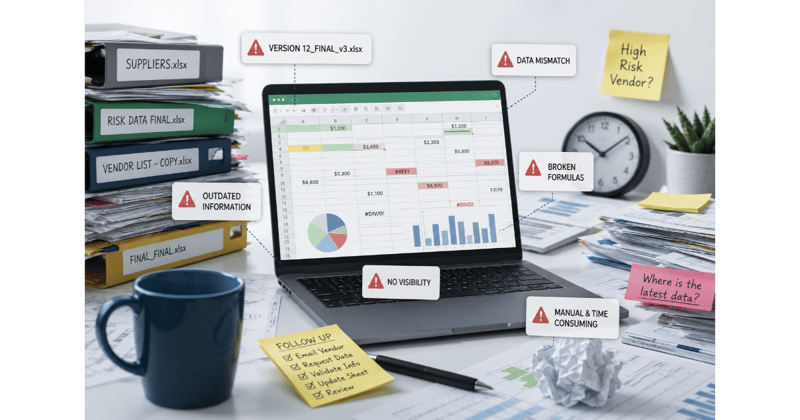
Third-party risk management software centralizes how you identify, assess, and monitor risks tied to vendors, suppliers, and business partners. Unlike spreadsheets or point solutions, modern TPRM platforms connect onboarding, due diligence, continuous monitoring, and remediation into governed workflows that stay current as risks shift.
Usability varies by platform and your vendor ecosystem's complexity. Modern TPRM platforms prioritize intuitive interfaces, role-based dashboards, and guided workflows to reduce training time. Look for solutions offering vendor self-service portals, automated questionnaires, and built-in tutorials. The best platforms let non-technical teams adjust policies and workflows without vendor support.
Yes. TPRM software helps small businesses identify and address vendor risks without overwhelming limited resources. Many platforms offer tiered pricing or modules scaled to smaller vendor counts. Even with fewer vendors, small businesses face the same regulatory requirements and breach risks as larger organizations. The right platform makes compliance manageable.
TPRM software centralizes risk assessments, monitoring, and remediation, giving you a complete view of vendor performance and exposure. It improves communication by providing vendors with clear requirements, real-time feedback on control gaps, and transparent remediation tracking. When vendors understand expectations and see progress, relationships strengthen.
Yes. Modern platforms automate questionnaire distribution, prefill responses using prior data and public signals, parse uploaded evidence like SOC 2 reports, and draft remediation recommendations. Automation reduces manual effort and accelerates assessments, but human oversight remains essential for high-risk decisions and exceptions.
Most TPRM solutions integrate with procurement systems, GRC platforms, ERP tools, and security assessment systems. Native integrations with SAP, Oracle, Coupa, Archer, ServiceNow, and MetricStream are common. API flexibility allows custom connections. Integration ensures vendor data stays synchronized across systems and eliminates manual data transfers.
Costs vary based on vendor count, risk domains, features, and service models. Pricing typically ranges from per-vendor fees to enterprise licenses. Some platforms charge for external intelligence feeds separately. Request custom quotes from vendors and compare total cost of ownership, including implementation, training, and ongoing support, over three years.
%20(1).jpg)