

.webp?width=387&height=387&name=headless-tprm%20(1).webp)




















Third-Party Risk Management
ComplyScore® Launches World’s First Headless TPRM, Bringing Conversational AI to Compliance Management. 
ComplyScore® Launches World’s First Headless TPRM, Bringing Conversational AI to Compliance Management.



Most third-party risk programs discover their documentation gaps during audits rather than before them. Evidence exists across email threads, shared drives, and multiple systems. Remediation trails are incomplete. Compliance mapping gets assembled reactively when auditors request it.
According to Gartner's 2024 research, between 11% and 40% of third parties are classified as high-risk across organizations, yet many programs lack the systematic documentation auditors demand. The cost shows up in extended audit timelines, repeated information requests, and findings that could have been prevented with proper evidence management.
A third-party risk audit readiness checklist solves this problem. It consolidates what auditors will examine, ensures evidence stays current, and turns compliance from a scramble into a repeatable process.
A third-party risk audit readiness checklist is a structured inventory of documentation, controls, and evidence needed to demonstrate effective vendor risk management to auditors and regulators. It covers vendor identification, risk assessment records, ongoing monitoring, remediation tracking, and compliance mapping across your entire third-party ecosystem.
The checklist serves three purposes:
Pre-audit preparation: Teams use it to verify completeness before auditors arrive, closing gaps while there's still time to fix them.
Continuous compliance: Rather than treating audits as isolated events, the checklist becomes a living document that keeps programs ready year-round.
Cross-functional alignment: It clarifies who owns what evidence, reducing the confusion that slows down audit responses when procurement, risk, legal, and IT all manage pieces of vendor oversight.
Organizations that maintain audit-ready documentation report 40% lower audit preparation effort compared to those compiling evidence reactively.
Audit readiness is not a single-owner responsibility. It requires coordination across multiple functions that touch vendor relationships at different lifecycle stages.
Risk and compliance teams own the central repository and ensure the checklist stays current. They define what gets documented, set retention policies, and maintain the audit trail.
Procurement provides contract terms, vendor contact information, and service scope documentation that auditors use to understand the business relationship.
IT and security supply technical assessments, access logs, security questionnaire responses, and evidence of vulnerability remediation for technology vendors.
Legal contributes data processing agreements, liability terms, and regulatory compliance clauses that demonstrate governance over vendor obligations.
Business unit owners validate service criticality, approve risk exceptions, and document operational dependencies that inform risk tiering.
When these functions work in silos, evidence fragments across systems and ownership becomes unclear. Successful programs designate a single system of record where all vendor evidence flows regardless of which team generates it. This centralization makes the audit response faster and more complete.
Not every vendor requires the same audit documentation depth, but your checklist should account for all vendors within regulatory scope.
Start with regulatory definitions. Frameworks like DORA in Europe, RBI guidelines in India, and MAS Technology Risk Management in Singapore explicitly define which vendor relationships require documented oversight. If a vendor processes customer data, provides critical infrastructure, or accesses regulated systems, they're in scope.
Include high-risk and critical vendors. These vendors warrant comprehensive documentation:
Don't ignore Tier II and III vendors. While high-risk vendors demand deeper evidence, auditors increasingly examine whether programs have visibility across the full vendor population. According to Verizon's 2025 Data Breach Investigations Report, breaches linked to third-party involvement have doubled year-over-year, with many originating from overlooked lower-tier vendors.
Your checklist should differentiate evidence requirements by tier. Tier I vendors need full assessment documentation, continuous monitoring records, and detailed remediation trails. Tier II and III vendors may require lighter-touch evidence like basic risk screening, periodic questionnaires, and standard contract reviews.
Organizations achieving 90-95% vendor coverage maintain tiered checklists that scale documentation requirements to actual risk exposure rather than applying uniform standards that become unmanageable.
Auditors approach vendor risk reviews with specific evidence expectations that vary by framework but share common elements.
Auditors want proof you know who your vendors are and what they do. Your checklist should include:
For each vendor in scope, auditors expect documented risk assessment:
Static assessments age quickly. Auditors look for evidence of continuous oversight:
When vendors don't meet requirements, auditors want to see how you handled it:
Your program must demonstrate alignment to applicable regulations:
Auditors verify that legal terms support your risk controls:
Vendor relationships end. Auditors check that you manage the exit securely:
Maintaining this evidence in a centralized, auditable repository transforms audit response from a multi-week exercise into a structured export process.
Point-in-time assessments create audit vulnerabilities. A vendor may pass initial due diligence but experience a breach, financial distress, or compliance violation months later. Auditors increasingly expect programs to demonstrate real-time awareness of vendor risk posture.
Continuous monitoring addresses this by ingesting risk signals as they occur:
Cybersecurity posture monitoring tracks external attack surface, vulnerability disclosures, and security incidents through feeds like SecurityScorecard, RiskRecon, or Shodan.
Financial health monitoring watches for credit rating changes, bankruptcy filings, or significant financial events via services like Dun & Bradstreet.
Compliance and legal monitoring alerts on regulatory penalties, lawsuits, sanctions screening hits, or adverse media through tools like World-Check or Dow Jones Risk & Compliance.
Operational monitoring flags service disruptions, SLA breaches, or performance degradation that signal vendor stress.
The value for audit readiness is threefold:
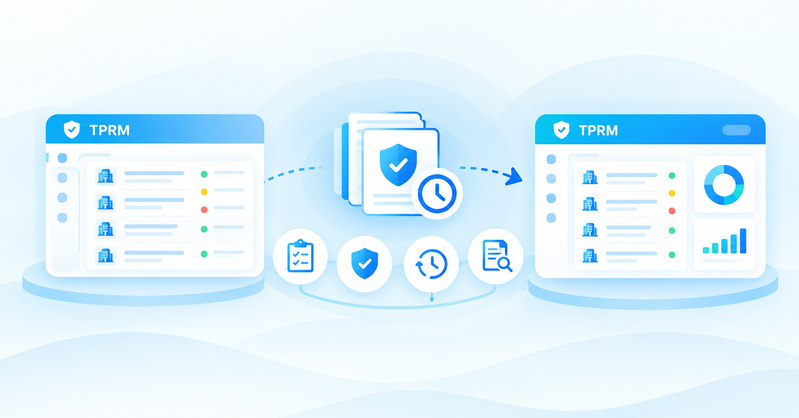
ComplyScore® automates audit readiness into your daily workflow. Vendor profiles enrich automatically on intake using authoritative data sources, so basic vendor information stays current without manual updates. Engagement-aware tiering scores each vendor-service relationship by scope, data sensitivity, criticality, and regulatory footprint, ensuring risk classifications remain defensible.
Guided assessments arrive prefilled with known facts and align to standards like SIG, SOC 2, ISO 27001, and HIPAA, reducing vendor burden while ensuring consistent evidence collection. AI-assisted evidence review scans uploaded documents like SOC reports to flag gaps and draft findings for analyst validation, accelerating review cycles while maintaining quality.
Continuous monitoring wires directly into workflows. Risk signals from cyber, financial, and legal feeds route automatically into governed tasks with owners, due dates, and SLAs rather than landing in inboxes where they get lost. Remediation and exception handling enforces explicit approvals, partial acceptances, and full audit trails so nothing closes without documentation.
When audit time arrives, close-out reports generate automatically with residual risk summaries, maturity scores, and compliance mappings. Executive dashboards provide live KPIs showing coverage, cycle time, alert-to-action conversion, and SLA adherence, so leadership can verify program health before auditors do.
The result: programs routinely complete assessments in under 10 days, achieve 90-95% vendor coverage, and maintain above 90% SLA adherence while reducing audit preparation effort by 40% or more.
Schedule a demo to see how ComplyScore® keeps your program audit-ready without the manual overhead.
Treat your checklist as a living document that updates continuously rather than on a fixed schedule. Vendor records should refresh when relationships change, assessments complete, or monitoring alerts trigger. At minimum, conduct a full checklist review quarterly to verify completeness, but design your program so evidence collection happens in real time rather than in preparation for the next audit.
A vendor risk assessment checklist guides the evaluation of an individual vendor's controls and risk profile. An audit readiness checklist is broader; it encompasses documentation across your entire vendor portfolio that auditors will examine, including assessments, monitoring, remediation, contracts, and compliance mapping. The assessment checklist is one component within the larger audit readiness framework.
Most regulated industries mandate vendor oversight documentation. GDPR and DPDP require data processor due diligence. HIPAA demands business associate assessments. SOC 2 includes vendor management in its trust services criteria. DORA in Europe explicitly requires ICT third-party risk management documentation. MAS in Singapore and RBI in India have detailed technology risk management guidelines covering vendors. Check your specific regulatory obligations, but assume that if you operate in a regulated industry, auditors will examine your vendor risk documentation.
Focus resources where risk is highest. Tier I vendors need comprehensive documentation. Tier II and III vendors can follow lighter-touch processes with basic screening, standard questionnaires, and periodic reviews. Automate evidence collection wherever possible—use platform-based assessments that capture responses in a central repository rather than email. Establish clear ownership so documentation responsibility doesn't fall entirely on the risk team. Even lean programs can maintain audit readiness by right-sizing effort to actual risk exposure.
Auditors frequently cite incomplete vendor inventories, missing due diligence for high-risk vendors, inadequate ongoing monitoring, poor remediation tracking with unclear ownership, stale documentation that hasn't been updated in over a year, and lack of compliance mapping showing how vendor controls align to regulatory requirements. Programs with centralized evidence repositories and continuous monitoring address these findings before auditors arrive.
%20(1).jpg)