





.webp?width=387&height=387&name=headless-tprm%20(1).webp)






































Operational-risk-management
ComplyScore® Launches World’s First Headless TPRM, Bringing Conversational AI to Compliance Management. 
ComplyScore® Launches World’s First Headless TPRM, Bringing Conversational AI to Compliance Management.



Operational audits exist for a reason: they surface control gaps and operational problems that don't show up in routine compliance monitoring. But effectiveness depends entirely on whether you're auditing the right areas with the right depth. An audit that focuses on the wrong processes or applies cursory attention where it should dig deep misses the exposure that matters most.
The real constraint isn't audit capability. It's audit capacity. You can't audit everything equally. You have to choose where to focus your effort. Those choices determine whether you catch actual problems or document routine processes that are already working fine. Most organizations make those choices based on habit or calendar, not based on where risk actually sits.
That's where operational risk assessment changes the equation. Instead of deciding what to audit based on tradition or a fixed schedule, you identify where real operational exposure exists and design your audit scope around that evidence.
Risk assessment in operational auditing is your process for identifying which operational areas carry the most exposure and deserve audit attention. It's the work you do before you audit, not the work you do while auditing.
Most teams skip this step entirely. They have:
The issue is treating all processes equally when some carry far more risk than others. You spend audit time on stable, well-controlled processes while missing areas where actual failures could have business impact.
Risk assessment surfaces three critical things:
1. Which operations matter most to business continuity and revenue
2. Where controls are actually weakest based on current conditions
3. Where external factors have increased exposure recently
Then you design your audit scope around those findings instead of around a calendar.
An operational audit without risk assessment is like inventory without prioritization. You're checking on everything when you should be focusing on what breaks if it fails.
Risk assessment forces you to think about the consequences before you think about the process. Key questions:
Those questions change your audit priorities. A payment processing operation that handles millions daily carries different audit risks than a filing system in a back office, even if both have control gaps.
The assessment also surfaces when you need to audit more frequently. Some areas need:
Risk assessment drives the audit frequency rather than a standard calendar approach.
A solid risk assessment for operational audits has five core components:
|
Component |
Purpose |
Output |
|
Process Mapping |
Document what the operation actually does (not what procedures say) |
Visual workflows, data flows, transaction volumes |
|
Inherent Risk Evaluation |
Where is the operation exposed before controls? What could go wrong? |
Risk catalogue specific to that operation |
|
Control Effectiveness Assessment |
Do existing controls actually prevent or detect problems? |
Control inventory with effectiveness ratings |
|
External Factor Analysis |
Have regulations changed? Business environment? New threats? |
Impact assessment of external changes |
|
Risk Rating |
Combine all inputs into a clear risk picture |
Overall risk score; tier assignment |
You don't need to be exhaustive. You need to be accurate about which operations carry genuine exposure and which are stable.
Talk to the people running the operation, not the people who designed it. Ask:
Front-line staff usually know where the real risk sits before auditors do.
Transaction volumes. Error rates. System downtime. Customer complaints. Regulatory findings from prior audits. That data tells you whether the operation is stable or deteriorating. Look for trends, not just snapshots.
External context changes what matters.
You're not looking for a perfect risk score. You're looking for clarity on whether this operation is stable, requires attention, or is at risk of breakdown. That clarity drives everything downstream.
Many organizations use risk and control self-assessment (RCSA) as part of their audit planning. Here's how it works:
Self-assessment accelerates the audit planning process because management is already thinking through risk before the auditor arrives. It also surfaces areas where management's confidence in controls may exceed reality; that's where you should dig.
Audit risk is the risk that your audit will fail to detect a material weakness in controls.
If your audit design doesn't reach the areas where problems actually exist, you have high audit risk. You could complete the audit and miss everything that matters.
Risk assessment reduces audit risk by helping you focus your audit on the places where control failures would matter most.
Risk-based auditing improves outcomes in multiple ways:
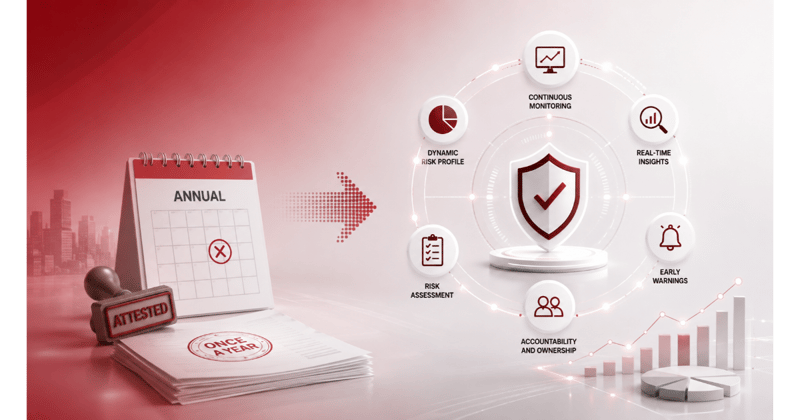
Operational risk assessment requires aggregating data from multiple sources: transaction systems, control documentation, regulatory requirements, prior audit findings. Most teams do this manually, which means assessments are incomplete or outdated by the time the audit starts.
ComplyScore® centralizes operational risk data so audit teams can assess operational risk continuously rather than once a year during audit planning:
Organizations looking to run a complete program from audit planning through remediation use dedicated operational risk management software to centralize risk data, automate control mapping, and keep audit evidence current without manual compilation.
At minimum, annually before you finalize your audit plan. In practice, operational risk changes more frequently. The best practice is quarterly or event-driven assessment, where you reassess whenever you identify a material change (staffing shift, volume change, control breakdown, regulatory change).
Ideally, all three groups contribute to the assessment.
Risk assessment identifies where problems could occur and how significant they would be. Control testing verifies whether existing controls actually work. You do assessment first to design efficient testing. Testing validates the conclusions from assessment.
Some operational risks are real but hard to measure in numbers (reputational risk, customer experience risk, regulatory relationship risk). Use qualitative scoring alongside quantitative data. Ask stakeholders to rate impact and likelihood. Combine that with any quantifiable metrics you have.
No. The framework should be consistent, but the criteria change. A financial processing operation and a customer service operation have different risk drivers. Your assessment should account for those differences rather than forcing them into a one-size-fits-all model.

%20(1).jpg)