When a vendor causes a breach, the first question leadership asks is not "which vendor." It is "who was responsible for monitoring them?"
If that question does not have a clear answer, your TPRM program has a role problem, not a vendor problem. In healthcare alone, 55% of organizations have experienced a third-party data breach, and 90% of the largest healthcare data breaches stem from business associates rather than the covered entities themselves. In most of those cases, the exposure existed because no one owned continuous vendor oversight.
Why Do Most TPRM Programs Fail and How Does Role Ambiguity Drive That Failure?
When no one owns the program end-to-end, vendor assessments stall in handoff gaps. Remediation findings bounce between IT, procurement, and compliance until a deadline expires. Monitoring alerts surface but go unacknowledged because three teams each assumed another was watching.
The result is accountability diffusion. Every function thinks vendor risk belongs partly to them. That means, in practice, it belongs fully to no one. Defining who owns what before onboarding a single vendor is the structural prerequisite for everything else.
The core insight: Role clarity is what determines whether your audit findings get closed or just get documented.
What Are the Core TPRM Roles and Responsibilities Every Organization Must Define Before Onboarding a Single Vendor?
Here are the six roles that must exist, whether or not they carry dedicated headcount.
|
Role
|
Primary Ownership
|
|
TPRM Program Lead
|
End-to-end program governance, board reporting, policy ownership
|
|
CISO
|
Cybersecurity risk across the full vendor portfolio
|
|
CRO / CCO
|
Risk appetite framework, regulatory alignment, executive reporting
|
|
Procurement Lead / CPO
|
Vendor selection, contract negotiation, pre-signing security requirements
|
|
Legal and Compliance
|
Vendor agreements, breach notification, audit rights, data processing terms
|
|
Business Unit / Relationship Owner
|
Day-to-day interactions, operational risk signals, first-line escalation
|
One role that is consistently underinvested: the business unit owner. The team that uses a vendor every day is the first to notice performance gaps, scope creep, or behavior that should trigger a reassessment. Treating them only as service consumers, not risk signal sources, creates a blind spot no assessment tool can compensate for.
How Do TPRM Roles and Responsibilities Differ Across the Three Lines of Defense and Who Owns What?
The three lines of defense model prevents any single function from being both player and referee.
First line: Operational management and business units
Procurement specialists and vendor relationship managers sit here. They manage day-to-day vendor interactions, conduct initial risk identification, and complete assessments according to policy. Their job is to flag what they find, not to set the standard for what to look for.
Second line: TPRM program, risk, and compliance functions
The TPRM Program Lead, CRO, and compliance officers govern the framework, set methodology, define risk appetite, and review first-line outputs. This line governs. It does not execute individual assessments.
Third line: Internal and external audit
This line provides independent assurance that the framework actually works. Internal auditors verify whether first-line teams follow second-line policies. The CISO and CRO receive findings and own the path to the CEO and board.
Design trap to avoid: Many organizations build all three lines on paper but staff only the second. When the first line has no training on what to escalate and the third line arrives to audit an empty trail, the model fails before any vendor risk is actually managed.
Who Should Own TPRM in Manufacturing, BFSI, Healthcare, and Life Sciences?
Industry context changes ownership. The right answer is not the same across sectors, and copying a structure from one vertical to another is one of the most common reasons TPRM programs inherit accountability gaps from day one.
Manufacturing and services: Supplier risk dominates the risk landscape here. Procurement and supply chain teams sit at the center of every vendor relationship, but they rarely own security or compliance assessment. The most effective ownership model in manufacturing assigns a TPRM Program Lead who sits between procurement and IT, with formal sign-off authority over supplier onboarding and a direct escalation path to the COO when a critical supplier's risk posture changes. ESG and supply chain compliance obligations (CSDDD, UFLPA) are increasingly adding a regulatory affairs dimension that procurement alone cannot manage.
BFSI: Regulatory obligations under DORA, RBI, and MAS TRM make the CRO the natural program owner. Operational resilience and regulatory defensibility are the primary obligations, and both require enterprise-level risk authority that a CISO or procurement lead cannot independently exercise. The CISO owns the cybersecurity dimension within that structure, but does not own the program.
Healthcare: Where each third-party data breach costs an average of over $10 million per incident, the CISO typically leads TPRM because cybersecurity and HIPAA compliance are the dominant accountability areas. Clinical and operational leaders provide a second ownership dimension that purely technical roles cannot cover. A Compliance Officer owns BAA management and regulatory audit preparation as a distinct function alongside, not under, the CISO.
Life sciences: Vendor governance sits across three distinct functions that rarely report to the same leader: procurement (CRO and CDMO selection), regulatory affairs (GMP compliance and data integrity), and IT (system validation and access controls). A mature model assigns a named owner to each dimension with defined handoff points, and a cross-functional governance committee that holds authority over decisions none of the three functions can make unilaterally.
How Does Cross-Functional Collaboration Between IT, Legal, and Compliance Strengthen Your TPRM Framework?
IT assesses technical controls but cannot evaluate contract enforceability. Legal drafts strong vendor agreements but cannot verify whether a vendor's encryption practices actually satisfy them. Compliance maps regulatory obligations but cannot assess operational resilience without IT input.
When these functions work in silos, findings fall into the gaps. A vendor's lapsed SOC 2 surfaces in an IT assessment. No one notifies legal to enforce the certification clause in the contract. The finding sits documented but unresolved.
The fix is a TPRM governance committee with members from IT, legal, compliance, procurement, and key business units. It needs a defined meeting cadence, clear escalation authority, and a mechanism for translating findings across functions. Not every meeting needs every function. But every material finding needs a defined path to each relevant stakeholder.
What Happens to Your TPRM Structure When Your Vendor Ecosystem Scales?
Most role structures break at scale. A program designed for 50 critical vendors fails visibly at 300.
The average company today works with 286 vendors, up 21% year over year. 94% of organizations are not assessing all the vendors they want to because they lack the resources.
Role clarity alone cannot solve that gap. Scale requires both ownership design and tooling that enforces it at portfolio level.
Three structural adjustments become necessary as ecosystems grow:
- Tier vendors by risk. Distribute operational monitoring for lower-tier vendors to business units while centralizing policy governance in the second line
- Define explicit escalation thresholds so frontline owners know exactly when to escalate, without judgment calls each time
- Automate monitoring and exception alerts for lower tiers so analyst capacity concentrates on critical-tier decisions
How Can a Centralized TPRM Platform Remove Accountability Gaps Without Adding Headcount?
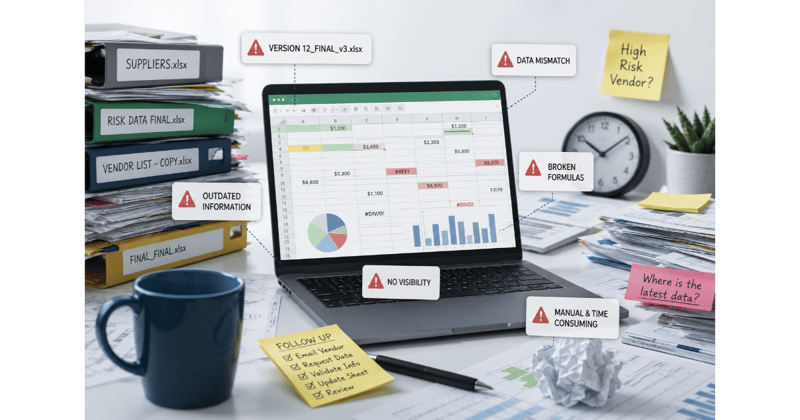
The accountability gap in most programs is a workflow visibility problem. When findings live in email, assessments sit in spreadsheets, and remediation owners are tracked in shared folders, no one has a complete view of what is owned, what is overdue, or where escalation is pending.
A centralized TPRM platform makes ownership structural rather than individual. Every assessment generates an owned task. Every finding carries a named owner and a deadline. Every exception requires documented approval. No finding can exist in the system without accountability attached.
ComplyScore® operationalizes this across the full TPRM lifecycle. Engagement-aware tiering automatically assigns assessment depth based on scope, data sensitivity, business criticality, and regulatory footprint. Workflow-based remediation assigns every finding an owner with an SLA-governed deadline, escalating automatically when either goes unmet. Executive dashboards give leadership a live view of who owns what, what is overdue, and where accountability has broken down, without anyone manually pulling a status report. Organizations running on ComplyScore® maintain above 90% SLA adherence on remediation workflows.
See how ComplyScore® structures TPRM roles and accountability across your vendor portfolio. Request a demo.
FAQs
What are TPRM roles and responsibilities?
TPRM roles and responsibilities define who in an organization is accountable for identifying, assessing, monitoring, and remediating risks from third-party vendors. They span the CISO, CRO, procurement, legal, compliance, IT, and business units. Each function owns a defined portion of the vendor lifecycle. Without explicit ownership, findings go unresolved regardless of how good the assessment framework is.
Who is responsible for third-party risk management in an organization?
TPRM is a shared responsibility but requires a single accountable owner. In BFSI, that is typically the CRO. In healthcare, it tends to be the CISO. What does not vary is the need for one person to be ultimately accountable when a vendor incident occurs.
What is the role of the CISO in a TPRM program?
The CISO owns the cybersecurity dimension of third-party risk: evaluating vendor security controls, ensuring vendor posture meets organizational standards, and managing escalation when a vendor's certification status creates material exposure. In organizations without a dedicated CRO, the CISO typically holds broader TPRM accountability.
What is the three lines of defense model in TPRM?
The three lines distribute accountability across: operational teams and business units (first line), the TPRM program, risk, and compliance functions (second line), and internal and external audit (third line). Each line has distinct ownership with no overlap in core accountability.
How should TPRM responsibilities be divided between IT and procurement?
Procurement owns vendor selection, contract negotiation, and embedding security requirements before signing. IT owns technical security assessment, access control evaluation, and ongoing security monitoring. Both functions must coordinate at onboarding, at assessment completion, and at offboarding. Without that coordination, security requirements agreed at contract rarely get verified in practice.




.webp?width=387&height=387&name=headless-tprm%20(1).webp)



























%20(1).jpg)