Most organizations believe their TPRM program is more mature than it actually is. They have questionnaires, they have a vendor list, and they have a CISO who owns vendor risk on paper. What they do not have is a structured, consistently applied, evidence-backed program that can withstand a regulatory examination. Organizations are only managing about 40% of their vendor population in mature TPRM programs, leaving the majority of suppliers outside structured risk oversight.
The gap between what teams think they are doing and what they can prove they are doing is the maturity gap. This article shows you where you sit and how to close it.
What Is a Third Party Risk Management Maturity Model?
A third party risk management maturity model is a structured framework that helps organizations assess the current state of their TPRM capabilities, identify gaps, and build a clear roadmap for improvement. It moves TPRM from a subjective assessment ("we think we're doing okay") to an objective benchmark ("we are at level 2 in monitoring and level 3 in governance, and here is what level 4 requires").
Without a maturity model, organizations optimize the wrong things. They invest in questionnaire tooling while their governance structure is undefined. They add analysts to a program that has no escalation policy. The maturity model prevents that by making every investment decision relative to the program's actual current state, not its perceived one.
What Are the 5 Stages of Third Party Risk Management Maturity
The five stages span from ad hoc reactions to predictive, fully integrated risk management. Here is what each looks like in practice.
Level 1: Initial (Ad hoc)
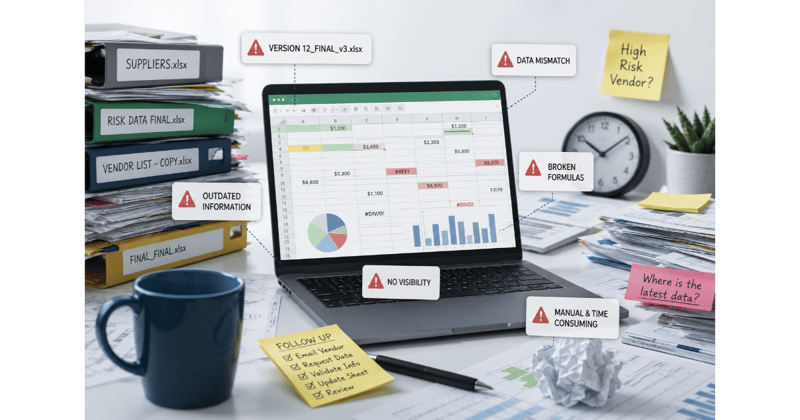
TPRM activities are unstructured, reactive, and undocumented. Vendor risk is managed case-by-case. There is no consistent methodology, no defined roles, and no formal vendor inventory. Risk awareness exists but is not operationalized.
Level 2: Developing (Compliance-driven)
Basic processes are formalized, typically in response to a regulatory requirement or audit finding. Due diligence is applied to high-risk vendors only. Some documentation exists, but it is inconsistent and rarely updated between assessments. Most organizations entering a regulated industry start here.
Level 3: Defined (Risk-based)
Standardized processes apply across the vendor portfolio. A vendor registry exists. Risk-based tiering determines assessment depth. Governance structures, defined roles, and documented policies are in place. Periodic monitoring replaces purely reactive oversight.
Level 4: Managed (Data-driven)
TPRM is measured and controlled using metrics and performance indicators. Continuous monitoring replaces periodic reviews. The program integrates with other enterprise risk functions. Remediation workflows are governed and tracked. Most dedicated TPRM software users have reached this stage, having moved away from spreadsheets in the past two years.
Level 5: Optimized (Predictive and resilient)
Advanced analytics and automation enable proactive risk identification before incidents occur. TPRM is fully integrated into strategic decision-making. The program continuously improves based on quantitative feedback, incident data, and evolving regulatory signals. This level is where TPRM becomes a genuine competitive and operational differentiator.
Where most organizations get stuck: The transition from Level 2 to Level 3 is where programs stall most often. The jump from compliance-driven to risk-based requires defining a consistent methodology, tiering every vendor, and distributing ownership across functions, all while managing ongoing assessment backlogs with limited staff. 63% of TPRM teams report understaffing in 2025, which makes this transition the hardest without automation.
How Do You Honestly Assess Where Your TPRM Program Falls on the Maturity Scale?
Honest self-assessment starts with seven questions. Answer each one against evidence, not intention.
- Do you have a complete, current vendor inventory with risk tier classifications?
- Is your assessment methodology documented and applied consistently across all vendors in the same tier?
- Do you have defined roles and responsibilities with named owners for each program function?
- Can you produce a remediation audit trail for any finding raised in the last 12 months?
- Does your monitoring update in real time, or only when someone manually triggers a review?
- Can you map your vendor controls to the regulatory frameworks applicable to your business?
- Do your leadership dashboards reflect live data or periodic exports?
If you answered "no" or "partially" to four or more of these, your program is operating at Level 2, regardless of how long it has been running.
What Does a Level 1 or Level 2 TPRM Maturity Program Really Look Like in Regulated Industries?
At Level 1 in a regulated industry, TPRM is triggered by incidents, not by policy. A vendor makes the news, and the team scrambles to assess whether that vendor is in the portfolio. Questionnaires go out on an ad hoc basis and responses sit in email folders. There is no record of what was assessed, when, or what findings were raised.
At Level 2, the organization can say it has a TPRM process, but that process covers only the top 20 or 30 critical vendors, applies inconsistently, and produces documentation that satisfies a checkbox rather than demonstrating actual risk reduction. For financial institutions under DORA or RBI TPRM guidelines, a Level 2 program creates significant supervisory exposure. For healthcare organizations under HIPAA, the lack of documented business associate risk management represents a compliance gap with enforcement consequences.
How Do Manufacturing, BFSI, Healthcare, and Life Sciences Organizations Approach TPRM Maturity Differently?
The five maturity levels are universal. The path through them is not. Each industry hits different walls at different stages, and knowing which wall is coming helps teams prepare for it rather than discover it mid-program.
Manufacturing and services: Most manufacturing organizations start at Level 1 or 2 because supplier risk has historically been managed through procurement contracts and quality audits, not a structured TPRM program. The jump to Level 3 requires the hardest organizational change in manufacturing: convincing supply chain and procurement functions that risk management is not the same as vendor performance management. ESG and supply chain traceability regulations (CSDDD, Germany's Supply Chain Act) are now creating external pressure that accelerates this shift in ways that internal advocacy alone rarely achieves.
BFSI organizations advance through the maturity levels faster than most industries because regulatory timelines impose the pace. DORA, RBI, and MAS TRM requirements specify not just what must be done but what documentation must prove it was done. Mature BFSI TPRM programs reach Level 4 earlier than other industries because regulatory examinations create a forcing function that compliance-led programs must respond to directly, regardless of internal readiness.
Healthcare organizations face a specific maturity challenge at Level 3. Vendor diversity is extreme: clinical device vendors, EHR providers, billing processors, and facilities services all sit in the same portfolio but carry radically different risk profiles and regulatory requirements. Building a tiering methodology sophisticated enough to handle that diversity without creating an unsustainable assessment burden is the defining Level 2 to Level 3 transition challenge in healthcare.
Life sciences organizations typically stall at Level 2 because of fragmented program ownership rather than a lack of risk awareness. Regulatory affairs, IT, procurement, and manufacturing quality each assess vendors under different frameworks and report findings to different leaders. Advancing to Level 3 requires reconciling those frameworks into a single governed methodology, which is a change management problem before it is a TPRM methodology problem.
What Role Does Vendor Tiering and Risk Classification Play in Advancing Your TPRM Maturity?
Vendor tiering is the mechanism that makes Level 3 possible. Without a tiering model, organizations apply the same assessment depth to every vendor, which is either too light for critical vendors or too burdensome for low-risk ones. Both outcomes reduce maturity: the first creates hidden risk, the second creates unsustainable process overhead.
A mature tiering model classifies vendors by four dimensions: scope of services, data sensitivity, business criticality, and regulatory footprint. The tier drives assessment depth, evidence requirements, monitoring frequency, and remediation SLA.
Once tiering is defined in policy and applied consistently, every subsequent program decision, like assessment scheduling, monitoring investment, and remediation prioritization becomes a policy execution rather than a judgment call.
This is also what makes advancing from Level 3 to Level 4 structurally achievable: when tier definitions are embedded in your tooling, the program scales without requiring proportional headcount growth.
How Does AI-Driven Automation Accelerate the Jump from Manual to Managed TPRM Maturity?
The transition from Level 2 to Level 3 is primarily a governance problem. The transition from Level 3 to Level 4 is primarily a scale problem, and that is where automation changes the calculus.
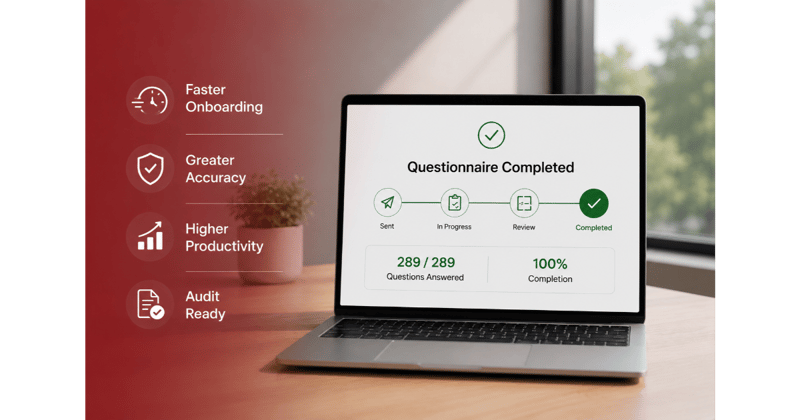
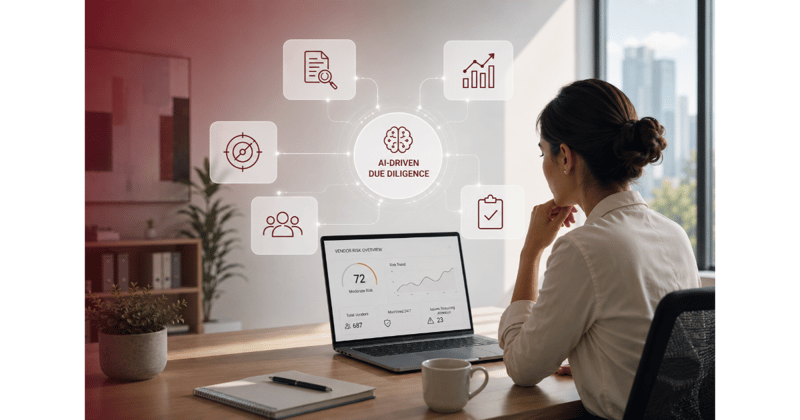
Manual programs assess an average of 25–30% of their vendor portfolio. AI-powered TPRM programs achieve 90%+ vendor coverage without proportional analyst growth, because AI handles questionnaire prefill, evidence extraction, control mapping, and initial risk scoring. This leaves analysts to focus on judgment-heavy decisions rather than administrative tasks. Organizations implementing AI-powered onboarding report 40–50% reduction in onboarding time and fewer email exchanges with vendors.
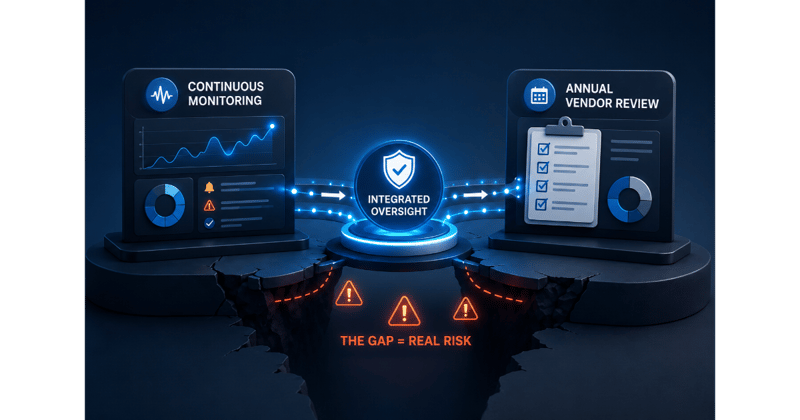
At Level 4, automation does not just accelerate existing processes; it enables continuous monitoring that Level 3 programs cannot sustain manually. Score updates trigger automatically when a vendor breach is reported, a credit rating changes, or a certification lapses. Remediation workflows escalate without human intervention when deadlines are missed.
What Does a Level 4 or Level 5 Third Party Risk Management Maturity Program Look Like in Practice?
At Level 4, a TPRM program lead can open a dashboard on any given morning and see: which vendors' risk scores changed since yesterday and why, which remediation items are overdue and who owns them, which assessment cycles are approaching and what evidence has already been collected, and how overall program SLA adherence compares to the prior quarter.
No one sends a status update to produce this view. The data exists because the workflow enforces it.
At Level 5, the program stops reacting to what happened and starts anticipating what is likely. Predictive models flag vendors showing early-warning patterns like declining financial signals, certificate lapses accumulating, and security posture deteriorating gradually, before any of those signals individually would trigger a manual review. Risk management becomes proactive, and the program serves as a strategic input to vendor selection and contract decisions, not just a compliance backstop.
ComplyScore® is built to accelerate this progression. Engagement-aware tiering closes the Level 2 to Level 3 gap by making risk-based assessment consistent and automatic. AI-assisted assessment, continuous monitoring, and governed remediation workflows move programs toward Level 4 without requiring proportional headcount. Organizations running ComplyScore® complete assessments in under 10 days and cover 90–95% of their vendor portfolio, which is the operational hallmarks of a Level 4 program.
See where your program sits on the maturity scale and how ComplyScore® helps advance it. Request a demo.
FAQs
What is a third party risk management maturity model?
A TPRM maturity model is a framework that organizations use to assess the current state of their vendor risk program, identify gaps, and build a structured roadmap for improvement. It defines discrete maturity levels, each with specific capabilities, process characteristics, and governance requirements, so organizations can benchmark their current state and set measurable targets.
How many maturity levels does a TPRM maturity model have?
Most established TPRM maturity models including the Shared Assessments Vendor Risk Management Maturity Model (VRMMM) define five levels, ranging from ad hoc and reactive at Level 1 to fully optimized, predictive, and continuously improving at Level 5. Some models use four levels; the specific number matters less than whether each level is defined with concrete, observable criteria rather than general descriptions.
How do I know which TPRM maturity level my organization is at?
Assess against evidence, not aspiration. Ask whether your vendor inventory is complete and current, whether your assessment methodology is documented and consistently applied, whether remediation findings have named owners with audit trails, and whether your monitoring updates continuously or only when manually triggered. Programs that cannot produce evidence for each of these questions are typically operating at Level 2 or below, regardless of how long the program has existed.
What are the most common signs of a low-maturity TPRM program?
A vendor registry that is incomplete or updated only when a new vendor is onboarded, questionnaires that are the same for all vendors regardless of risk tier, remediation findings tracked in email threads without named owners or deadlines, monitoring that happens only at the next annual assessment cycle, and leadership reporting that requires manual assembly before each board meeting. Any one of these signals Level 2 maturity; all five together signal Level 1.
What is the difference between TPRM maturity and TPRM compliance?
TPRM compliance means meeting the minimum requirements specified by applicable regulations, like having documented policies, conducting required assessments, and maintaining vendor records. TPRM maturity means having a program that is risk-based, consistently applied, measurably effective, and continuously improving. A program can be compliant without being mature. Maturity is the goal compliance is designed to support, not a synonym for it.






.webp?width=387&height=387&name=headless-tprm%20(1).webp)










































%20(1).jpg)