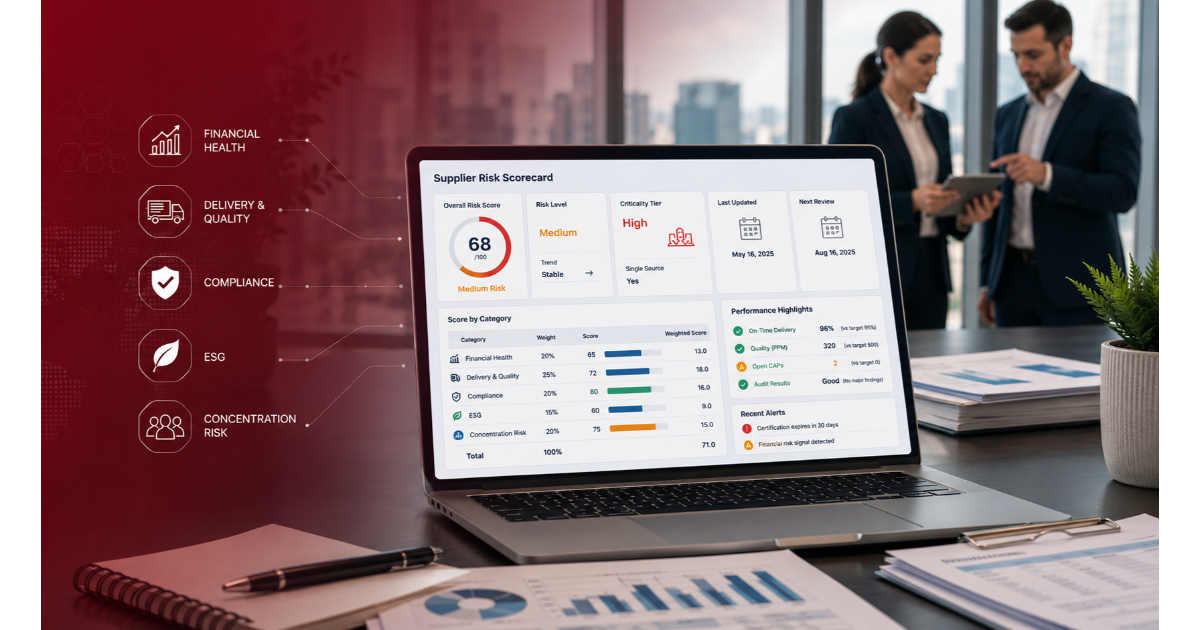
The most expensive supply chain failures in recent years did not start inside the companies that felt them. They arrived through subcontractor relationships that had been assessed, approved, and largely forgotten.
That is the subcontractor problem in plain terms. Your Tier 1 suppliers are documented, contracted, and reviewed. What sits below them, the components suppliers, specialist fabricators, and logistics subcontractors your Tier 1 depends on, is typically visible in name only. And in manufacturing, that invisible tier is where production lines stop.
Supplier risk management for OEMs requires a fundamentally different approach than traditional third-party risk programs, because the relationships that create the most operational exposure are rarely the ones that procurement manages directly.
What Makes OEM Supplier Risk Different from Standard TPRM
Supplier risk management for OEMs means covering a supply chain that extends three, four, and sometimes five tiers deep across multiple geographies, ERP environments, and regulatory jurisdictions. Standard third-party risk programs were built for organizations that want to assess the vendors they directly contract with. OEMs need to understand the health of the vendors their vendors use.
The distinction matters because the failure path is different. In financial services, a vendor risk failure typically looks like a data breach or a compliance gap at a direct third party. In manufacturing, it looks like a component shortage that traces back to a subcontractor your Tier 1 supplier chose without your input, or a quality failure at a fabricator three tiers removed from your procurement team.
Most OEM procurement functions are being held accountable for supply chain outcomes they have no systematic mechanism to prevent, because their risk programs were designed for direct relationships, not extended supply chains. Closing that gap requires rethinking what "covered" means in a vendor risk program.
The Warning Signals That Were Already There
One of the consistent findings in post-incident supply chain analysis is that the warning signals preceding major failures were publicly available, sometimes months or years before the disruption occurred. The gap was not information. The gap was a system for acting on information.
Consider how this plays out in practice. An automotive Tier 2 supplier running unpatched remote access software with a known critical vulnerability receives a cybersecurity advisory from the relevant national cert organization. The vulnerability is publicly catalogued. The OEM that depends on that supplier, through their Tier 1, has no mechanism for monitoring their subcontractor's patching posture because the subcontractor does not sit in their vendor management system. The advisory goes unread at the right level, the vulnerability goes unpatched, and the production line that stops four weeks later does so for entirely preventable reasons.
The organizations that weather supply chain disruptions with the least impact are not better resourced than their peers. They have built a monitoring system that connects available signals to procurement decisions before the disruption, not after.
The signals themselves are rarely hidden. Financial distress in a subcontractor appears in extended payment terms, reduced order quantities, and key personnel departures. Regulatory risk in a material supply chain appears in public consultation documents, enforcement timelines, and supplier discontinuation announcements. Cybersecurity exposure appears in public CVE databases and national cert advisories. The question is whether your vendor risk program is watching for these signals across the full supplier tier through targeted risk intelligence, or only within the relationships your procurement team directly manages.
Where OEM Vendor Programs Typically Break
Here are the four most common points of failure in supplier risk management for OEMs, drawn from publicly documented incidents and the patterns that appear repeatedly in multi-tier supply chain failures.
The ERP coverage gap. Enterprise resource planning systems were designed to manage procurement transactions. They capture what was ordered, from whom, and whether it arrived on time. They were never built to flag that a supplier's financial health has deteriorated by 40% over two quarters, or that a subcontractor in your Tier 1's network is concentrated in a geopolitical zone that just announced export restrictions. The manufacturers who entered 2025 with multi-tier visibility gaps found this out when rare earth export restrictions hit gallium and germanium supply chains that had been documented as managed. The gap was not ignorance of the dependency. It was the absence of a monitoring mechanism connected to that knowledge.
The annual assessment cycle. A supplier that passes a risk assessment in Q1 can change materially by Q3. Key person departures, financial distress, cyber incidents at their own subcontractors, and regulatory changes all happen between assessment cycles. A program built on annual point-in-time reviews produces a risk record that reflects what was true on a specific date, which may bear little relationship to what is actually running inside a supplier's operation when the question becomes urgent.
Tier 1 dependency on self-reported subcontractor data. Most contractual risk flow-downs require Tier 1 suppliers to maintain and report on their own subcontractor compliance. In practice, this creates a reporting chain that has neither the incentive nor the mechanism to surface problems before they affect you. A Tier 1 supplier managing their own supply chain relationships will not proactively flag that one of their key subcontractors has a deteriorating financial position, because doing so invites scrutiny of their own supplier selection. Closing this visibility gap requires independent vendor intelligence drawn from sources outside the Tier 1 reporting chain.
Offboarding blindness. When a supplier relationship ends, the risk associated with that relationship does not end automatically. A subcontractor with access to tooling specifications, quality data, or production process documentation continues to hold that information after the contract terminates. Absent a structured offboarding process with automated close-out documentation, credential revocation, and validation that data has been retrieved or destroyed, the risk exposure created during the relationship persists indefinitely. In a multi-tier OEM supply chain where subcontractor relationships shift frequently, this creates a growing inventory of unmanaged residual risk.
What a Working Program Looks Like
The manufacturers that navigated the last two years of supply chain disruption with the least operational impact had recognizable characteristics in their vendor risk programs. None of them were running perfect systems. What distinguished them was that their procurement functions had built continuous monitoring into the vendor relationship structure rather than treating risk assessment as a periodic activity.
Practically, that means several things. When a regulatory change is announced that affects materials used by any supplier in the portfolio, the procurement lead responsible for those relationships receives the signal within days. When a Tier 1 supplier's financial metrics begin to deteriorate, the conversation about contingency sourcing starts before the first missed delivery target. When a CVE is published for software known to be in use by a key subcontractor, the assessment follow-up is triggered by the publication, not by the next scheduled review date.
The operational difference between a reactive and a proactive program is not the quality of the risk framework. It is whether the system generates signals that procurement can act on before the disruption, or evidence that procurement presents after it.
A global industrial manufacturer managing 25,000 active vendors across 31 countries and three separate ERP systems implemented this kind of approach using a phased, division-by-division rollout. No historical data migration was required. The first division was live in weeks. The coverage question, previously answered by counting how many vendors had completed an annual assessment, shifted to a continuous monitoring posture that connected financial health signals, cybersecurity advisories, and regulatory changes to the specific vendor relationships where they were relevant.
The comparison that matters from that implementation is not between the old system and the new one. It is between what the procurement function could answer before and what it can answer now. "Which of our Tier 2 subcontractors are running unpatched remote access software?" now has an answer. Before, it did not.
Building the Program: Where to Start
For OEM procurement leaders looking to build or rebuild supplier risk management for a multi-tier supply chain, the most effective starting point is not a technology selection. It is a coverage audit.
Map your actual risk exposure before choosing tools. Identify which Tier 2 and Tier 3 relationships create single points of failure in your production or supply chain. Where is your Tier 1 supplier's subcontractor base geographically concentrated? Which material categories have limited alternative sourcing? Where have quality, delivery, or compliance failures originated in the last 24 months? That map tells you where the program needs to provide coverage, which shapes every subsequent decision about process, tooling, and resourcing.
The second step is separating onboarding risk from lifecycle risk. Most vendor programs treat the assessment at onboarding as the primary risk event. For OEMs with long supplier relationships and complex subcontractor networks, the risk that accumulates over the life of the relationship is typically larger than the risk present at the point of onboarding. A program that invests heavily in intake assessment but runs annual reviews as its primary ongoing mechanism will miss the majority of the risk it is designed to manage.
The third step is connecting monitoring to action. Continuous monitoring without a structured path from signal to procurement decision produces alerts that get reviewed, noted, and filed. The organizations that benefit from monitoring have built the workflow-based remediation layer that turns a financial distress signal or a CVE publication into a specific task with an owner and a deadline. The monitoring system and the vendor management workflow need to be connected, not parallel.
The Accountability Shift Already Happening
CPOs in manufacturing are being asked to answer for supply chain outcomes that extend beyond the relationships their procurement functions directly manage. Regulators examining a post-incident supply chain, enterprise customers conducting vendor due diligence, and boards reviewing operational risk exposure are all asking whether the vendor risk program covers the full supply chain tier, not just the Tier 1 relationships that procurement contracts with.
That accountability shift is real, and it is accelerating. The EU's Corporate Sustainability Due Diligence Directive, supply chain transparency requirements embedded in ESG reporting frameworks, and the increasing tendency of regulators to trace incidents through the full supply chain rather than stopping at the primary vendor relationship are all moving in the same direction.
A procurement function that can demonstrate continuous monitoring of the extended supplier network, produce current evidence of that monitoring on demand, and show a clear path from signal to action is positioned very differently in that environment than one that cannot.
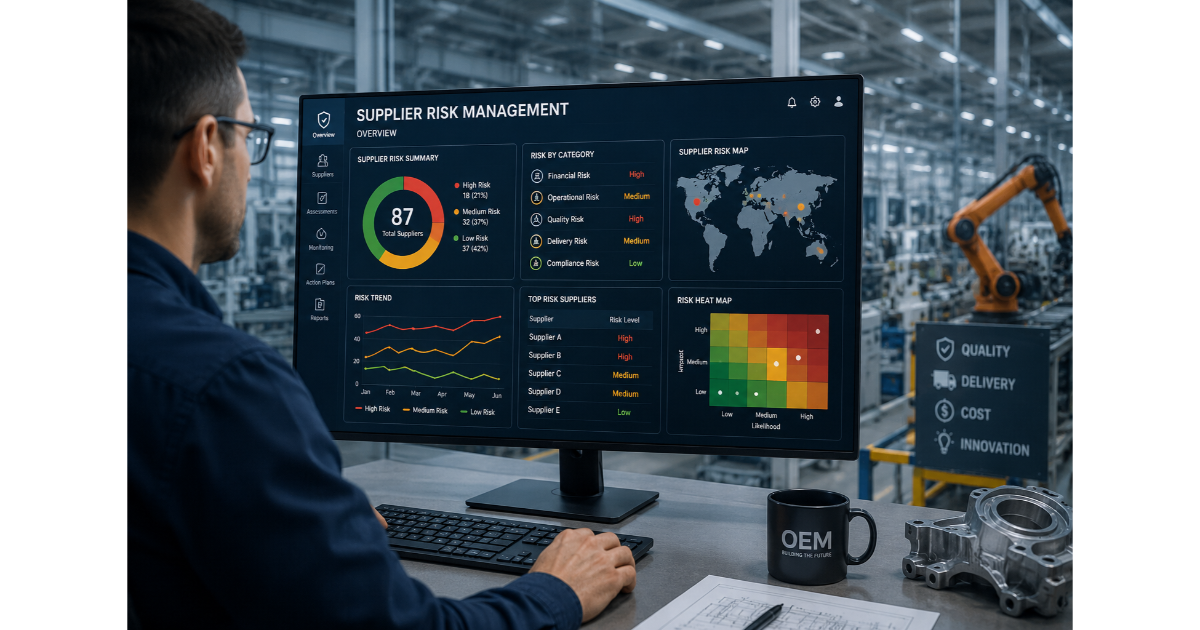
If you have built the coverage audit, separated onboarding risk from lifecycle risk, and connected monitoring to action, and you are still managing the process manually across spreadsheets and email threads at scale, that is the specific wall that ComplyScore® was built to help OEM procurement teams through. The supplier risk management platform automates vendor intake and risk tiering, runs continuous monitoring across financial health, cybersecurity, and regulatory signals, integrates with the ERP environments OEMs already use, and supports phased implementation by division so business continuity is never disrupted during rollout.
Frequently Asked Questions
What is the difference between TPRM and supplier risk management for OEMs?
Traditional TPRM focuses on the direct third-party relationships an organization contracts with, covering cybersecurity, compliance, and operational risk at the vendor level. Supplier risk management for OEMs extends that coverage to the multi-tier supply chain, monitoring subcontractor risk, material concentration, regulatory exposure, and financial health across the full supplier network, not only the vendors procurement directly manages.
How do OEMs manage vendor risk across multiple ERP systems?
OEMs running multiple ERP environments across divisions or geographies typically face fragmented vendor master data and inconsistent risk processes across their supplier base. The most effective approach is a vendor risk platform that integrates with each ERP through an API-first architecture and provides a unified risk view across the full portfolio, with phased implementation by division to preserve business continuity during rollout.
What are the most common signals of Tier 2 supplier risk?
The signals that most consistently precede Tier 2 failures are publicly available but rarely monitored systematically. Financial distress typically appears as extended payment terms, reduced order quantities, and key personnel departures before it shows in formal filings. Cybersecurity exposure appears in CVE databases and national cert advisories. Regulatory risk appears in public consultation documents, enforcement timelines, and supplier discontinuation announcements. A continuous monitoring program watches for these signals across the full portfolio.
How long does it take to implement a multi-tier supplier risk program?
Implementation timelines vary significantly based on vendor portfolio size, number of ERP systems, and geographic scope. For large OEMs, the most practical approach is a phased rollout by division rather than a simultaneous go-live across the full portfolio. A well-structured phased implementation can deliver the first division live in weeks while subsequent divisions are configured in parallel.
What data does a supplier risk program need from subcontractors?
The most effective OEM supplier risk programs do not rely exclusively on subcontractor self-reporting for their risk data. They combine vendor-provided information with external signals, including financial health feeds, cybersecurity ratings, sanctions and sanctions-proximity screening, regulatory filing monitoring, and news intelligence, to build a risk profile that reflects actual conditions rather than what subcontractors choose to disclose.

.webp?width=387&height=387&name=headless-tprm%20(1).webp)





















%20(1).jpg)

.webp)
.webp)
.webp)