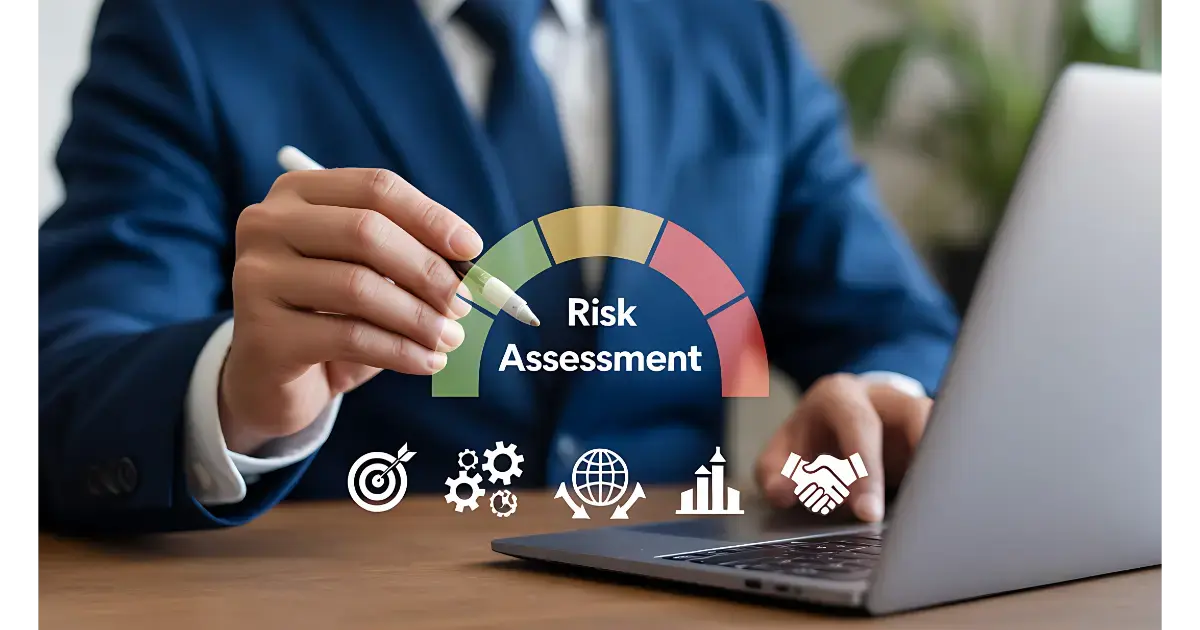
Most TPRM programs have scores. That is not the problem. The problem is that the scores do not drive decisions. Consider a vendor that lands at 68 out of 100.
Should they be onboarded? Monitored monthly or quarterly? Escalated to the CISO?
If your team cannot answer those questions from the score alone, you have a number without a model.
This guide is about building vendor risk scoring that tells people what to do next, not just how a vendor ranked.
Importance of Calculating Vendor Risk Scores
Vendor risk scoring converts assessment data into a quantified, comparable measure of the risk a third-party vendor poses to your organization. A well-built score covers cybersecurity posture, compliance status, financial stability, and operational exposure. This makes it possible to tier vendors, set monitoring frequency, and allocate assessment resources consistently, without making the same judgment call twice.
The business case is clear. According to Gartner, 40% of compliance leaders say between 11% and 40% of their third parties are high-risk. Without a consistent scoring model, identifying which vendors fall into that bracket becomes a negotiation between team members rather than a policy decision. Auditors and regulators notice the inconsistency, and a score that cannot be explained to a board offers compliance theater, not risk management.
How Vendor Risk Scoring Is Used in Vendor Risk Management
Scoring is the connective tissue across the full TPRM lifecycle. It answers four questions that no other output from your program can answer consistently. Who enters a full due diligence cycle, and at what assessment depth? How often does a given vendor get reassessed? Which findings get prioritized in remediation queues? And what happens automatically when a vendor's score drops?
Every operational decision downstream, like monitoring cadence, remediation SLA, and contract terms should trace back to a score. For how those remediation queues are structured, see our guide on vendor risk remediation.
Key Components of Vendor Risk Scores
Here are the five inputs that separate a defensible vendor risk score from a questionnaire completion metric.
Questionnaire responses and self-attestation
The most widely used input is what vendors say about their own controls and practices. Directionally useful, but subjective by design. Self-attestation data must be cross-validated against at least one external or documentary source to carry meaningful scoring weight.
External security signals
Continuous feeds from security ratings providers contribute externally verifiable data, including exposed ports, certificate lapses, known vulnerabilities. These signals update without vendor involvement, making them valuable for detecting score drift between assessment cycles. See the next section for their limitations.
Evidence and certification status
Active SOC 2 Type II reports, ISO 27001 certifications, and HIPAA audit records represent third-party validation of stated controls. A lapsed certification should trigger an automatic score penalty, not a manual review request. Certification status should consistently outweigh self-attestation in scoring weight.
Business criticality and engagement context
A cloud provider processing regulated personal data warrants a higher score baseline than the same vendor providing non-integrated professional services. The same logic applies to physical suppliers: a single-source manufacturing supplier carries a different risk baseline than a vendor providing back-office software, which is why a dedicated supplier risk management software applies separate scoring weights for supply chain-specific factors like concentration risk and production continuity. Engagement context determines how much weight each risk dimension carries in the final composite. For how risk categories map to engagement type, see our guide on vendor risk assessment criteria.
Financial and reputational signals
Credit ratings, financial statements, and adverse media monitoring contribute to the operational and reputational dimensions. Financial instability at a critical vendor is a service continuity risk that cybersecurity-only scoring models miss entirely.
Methods for Scoring Vendor Risk
Here are the three primary methods, with a practical breakdown of when each applies.
|
Method
|
Best for
|
Key limitation
|
|
Likelihood × Impact
|
Programs building their first structured model
|
Scoring consistency depends on calibrated inputs
|
|
Weighted scoring
|
Programs with defined risk priorities by engagement type
|
Weights require policy-level governance to apply consistently
|
|
Composite multi-source
|
Programs with access to external feeds and evidence data
|
Requires integration of multiple data sources
|
The weighted scoring model is the most commonly used approach in mature TPRM programs. It reflects actual exposure rather than category averages. A healthcare organization might weight data privacy at 30% and cybersecurity at 35%; a financial institution might shift those weights toward regulatory compliance and operational resilience. Weights must be set at policy level, not determined per assessment by the analyst reviewing the vendor.
The composite model is the most accurate because it reduces reliance on any single data source. Organizations using multi-factor scoring models detect high-risk vendors 4.2 times faster than those using single-metric approaches.
How Accurate Are Security Ratings for Vendor Risk Scoring
Security ratings measure what is observable from outside a vendor's environment, like exposed services, certificate health, DNS misconfigurations, and known vulnerabilities. For high-tier vendors, they are a valuable and continuously updated signal layer.
They are not a vendor risk score on their own. A vendor with an "A" rating from a security ratings provider can still carry an expired SOC 2 report, a financial stability problem, or no tested business continuity plan. Ratings capture external-facing posture. They do not capture internal controls, compliance documentation, or sub-processor exposure.
The practical guidance: Use security ratings as one weighted input in a composite model, not as a substitute for one. The strongest scoring models weight external ratings at around 35-40% alongside questionnaire data and business context.
Pro tip: Ask any security ratings vendor what percentage of their score is derived from externally observable signals versus self-reported data. The answer tells you exactly how much independent verification is actually in the number.
Steps to Implement Vendor Risk Scoring
Follow these six steps to build a vendor risk scoring model your team applies consistently and your auditors can follow.
Step 1: Define risk dimensions and data inputs. Determine which risk categories your model will score and which data type feeds each one. Document this in policy; not in a spreadsheet.
Step 2: Set engagement-based weights before the first assessment. Weights should be determined by engagement type, not per vendor. If your team cannot state the weight applied to a specific score without looking it up, the weights are not operationalized.
Step 3: Choose your scale and define operational consequences per tier. Select a scale (0–100, 1–5, A–F) and define exactly what each range means, including what assessment depth, monitoring frequency, and SLA window it triggers. A score without operational consequences is a metric, not a management tool.
Step 4: Integrate multiple data sources. Combine questionnaire data, external security signals, and evidence quality into the composite. Run the first cycle against a defined vendor set and audit whether scores reflect what experienced team judgment would produce.
Step 5: Validate and calibrate. Compare model outputs against independent assessments for 10–20 vendors. Document the calibration process; this is what regulators ask for.
Step 6: Build score refresh triggers. Scores should update on schedule (quarterly for critical-tier vendors) and on event triggers, like a vendor breach, a credit downgrade, a material change in engagement scope. Organizations that monitor vendor score trends prevent 84% more security incidents than those relying on point-in-time assessments.
Trap to avoid: Building a scoring model in a spreadsheet. Spreadsheet-based scoring cannot enforce consistent weights, cannot trigger automatic updates, and cannot produce an audit trail that shows who changed a score and why.
Common Vendor Risk Scoring Mistakes
Treating questionnaire completion as a proxy for risk posture. A fully completed questionnaire is not a low-risk vendor signal; it may just mean the vendor has a team skilled at completing questionnaires. Weight evidence and external validation accordingly.
Using one scoring model for all vendor types. A SaaS vendor processing financial data and a logistics partner do not share the same risk profile. Identical weights produce scores that are internally consistent but analytically meaningless.
Conflating inherent and residual risk in a single score. Inherent risk is what a vendor poses before your controls are applied. Residual risk is what remains after. Combining them in one number obscures both and makes it impossible to show the value your TPRM program is delivering.
Scores that do not map to decisions. If your team cannot articulate what a score of 68 versus 72 means for monitoring frequency or contract terms, the model is not operationalized.
Vendor Risk Scoring Best Practices
Report both inherent and residual scores. The gap between them quantifies what your TPRM program is delivering. Reporting only one hides that value from leadership.
Set a score floor for onboarding. Define a minimum acceptable residual risk score in policy and enforce it through your onboarding workflow. Scores that have no contractual or operational consequence are advisory, not governing.
Include score trajectory in executive reporting. Vendors showing consistent score improvement over six months experience 67% fewer security incidents than those with declining or static scores. A vendor dropping from 85 to 71 over 12 weeks is a materially different conversation than a vendor sitting at 71 with no trend.
How ComplyScore® Structures Vendor Risk Scoring
If your scoring model is well-designed on paper but runs on spreadsheets, manual inputs, and annual-only updates, the gap between what your model says and what your risk actually is grows every day you do not refresh it.
ComplyScore® builds engagement-aware scoring directly into the assessment lifecycle. Each vendor-service relationship is scored by scope, data sensitivity, business criticality, and regulatory footprint, so dimension weights calibrate to actual exposure, not a generic template. AI-prefilled questionnaires reduces the self-attestation inflation that pushes scores upward based on completion rather than control quality. Evidence review then checks uploaded documents against the specific criteria being scored, flagging gaps before they produce a misleading number.
External signals from providers like D&B, RiskRecon, and SecurityScorecard apply only where engagement risk warrants the investment, not uniformly across the entire portfolio. Scores refresh when material signals arrive, like breach alerts, financial changes, and domain posture shifts. Executive dashboards show inherent and residual scores side by side, with score movement by vendor tier and the gap your program is closing.
Organizations running on ComplyScore® achieve 90–95% vendor coverage while completing assessment cycles in under 10 days, making engagement-aware, continuously updated scoring practical at portfolio scale.
See how ComplyScore® structures vendor risk scoring for your portfolio. Book a demo.
FAQs
What is the difference between inherent risk and residual risk in vendor scoring?
Inherent risk is the raw exposure a vendor represents before any of your controls, contract terms, or monitoring are applied. Residual risk is what remains after those controls are factored in. Both should appear in your scoring model and executive reporting. The gap between them is the value your TPRM program delivers; a mature model tracks and reports both separately.
How often should vendor risk scores be updated?
Scores should update on two tracks: scheduled (quarterly for critical-tier, annually for low-tier) and event-triggered (immediately on a reported breach, a certification lapse, a credit rating change, or a material scope expansion). Annual-only updates create risk visibility gaps that regulators, particularly under DORA, are increasingly flagging.
What dimensions should a vendor risk scoring model include?
At minimum: cybersecurity posture, compliance and certification status, financial stability, operational resilience, and data privacy controls. Each dimension's weight should vary by engagement type. For a full breakdown of how risk categories map to scoring inputs, see our guide on vendor risk assessment criteria.
How do you weigh different risk dimensions in a scoring model?
Weights should be set at policy level by engagement type, not determined per vendor by the reviewing analyst. Start with your most demanding regulatory obligation that framework signals which dimension warrants the highest weight. A healthcare organization prioritizes data privacy and HIPAA alignment; a DORA-regulated institution prioritizes operational resilience and ICT controls. Document the weighting rationale as auditors will ask for it.
Can the same vendor have different risk scores for different engagements?
Yes, and they should. A single vendor providing both a cloud hosting service for regulated data and a professional services engagement with no system access carries fundamentally different exposure in each relationship. Engagement-aware scoring models assign separate scores per vendor-service relationship, with weights calibrated to the specific scope and data sensitivity of each.
How accurate are security ratings for vendor risk scoring?
Accurate for external-facing posture like exposed services, certificate health, known vulnerabilities. Not accurate for internal controls, compliance documentation, financial health, or sub-processor risk. Use security ratings as one weighted input in a composite score, at around 35-40% weight, alongside questionnaire responses and business context. A security rating used as a standalone vendor risk score overstates cybersecurity dimensions and misses every other risk category.
What role does AI play in vendor risk scoring?
- AI accelerates data collection by pulling vendor information from registries, past assessments, and uploaded documents.
- It improves questionnaire accuracy; questionnaires that arrive at vendors already 60–70% pre-filled using publicly available information and prior responses reduces blank-slate self-attestation.
- It enables continuous score recalibration. Predictive models identify which early indicators precede vendor incidents, improving accuracy from roughly 60% to 80–85% as the model processes more assessment outcomes. The analyst still owns material decisions; automation removes the manual bottleneck that prevents consistent scoring at scale.








.webp?width=387&height=387&name=headless-tprm%20(1).webp)














































%20(1).jpg)