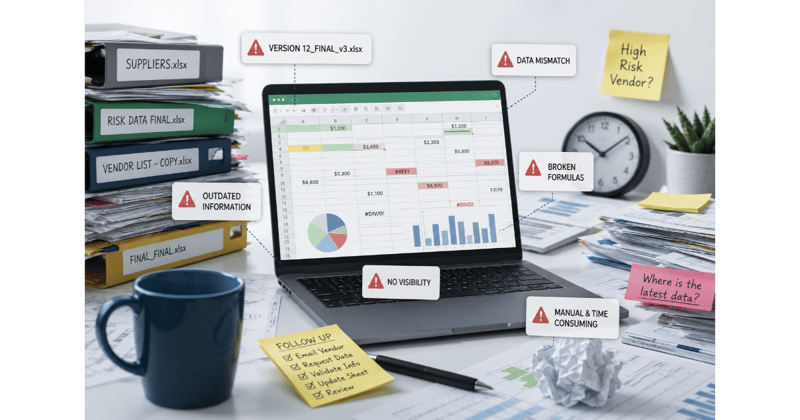
When Delta Air Lines' crew-tracking software failed during the 2024 CrowdStrike outage, the airline faced an estimated $350 million in losses from a single vendor incident. That is roughly 7% of annual net income, erased because of one third-party dependency. For most organizations, the honest reason it was not caught earlier is not that the risk was unforeseeable. It is that the program was not built to catch it.
This guide covers what makes a TPRM program actually work, and how to build one that scales as your vendor ecosystem grows.
What Is a TPRM Program?
A TPRM program is a formalized, repeatable process for identifying, assessing, monitoring, and remediating risk from every third-party vendor across the full relationship lifecycle. It replaces ad hoc, point-in-time vendor checks with a structured system that ties vendor risk directly to onboarding, contracting, monitoring, and remediation decisions.
What Makes a TPRM Program Truly Effective and How Does Yours Compare?
An effective TPRM program consistently does four things: maintains a complete, current vendor inventory; assesses vendors at a depth proportional to their actual risk; monitors continuously rather than annually; and closes findings with a documented audit trail.
Any program missing more than one of these is producing risk documentation, not risk reduction.
The numbers show how far most programs fall short. The average company now works with 286 vendors, up 21% in a single year. 70% of those organizations have experienced a data breach in the last three years, with 77% of those breaches originating from a third party.
The gap between vendor ecosystem size and program capability is not a future problem. It is a current exposure most organizations are managing inadequately.
How Does a Risk-Based Approach Transform Your TPRM Program from Reactive to Resilient?
Most programs start reactive. They assess vendors after an incident, after an audit finding, or when a regulator asks. A risk-based approach inverts that logic.
It identifies which vendors carry the most exposure before anything goes wrong and concentrates assessment depth, monitoring frequency, and remediation effort on that subset. The mechanism is vendor tiering, which classifies every vendor across four dimensions:
- Scope of services: What the vendor actually does for your organization
- Data sensitivity: Whether personal, financial, or health data is involved
- Business criticality: Operational impact if the service fails
- Regulatory footprint: Which compliance obligations apply to the engagement
Tier 1 vendors get continuous monitoring, deep assessments, and tight remediation SLAs. Tier 3 vendors get periodic checks and automated exception-based alerts. The same analyst hours produce dramatically different risk outcomes depending on whether they are targeted by tier or distributed evenly. For organizations with physical supply chains, this tiering logic matters even more: a supplier risk management software needs to weight concentration risk and production continuity alongside the standard four dimensions, since a single-source manufacturing supplier failing has a very different operational impact than a software vendor with equivalent scope.
What Are the Core Components Every Mature TPRM Program Must Have in 2026?
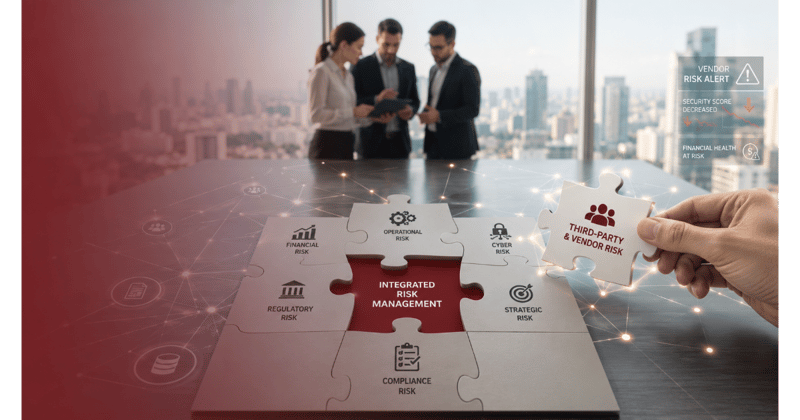
A mature program is not a checklist. It is a connected system where each component feeds the next.
|
Component
|
What It Delivers
|
|
Vendor inventory and risk classification
|
Complete, tiered registry of every third-party relationship
|
|
Due diligence and assessment workflow
|
Consistent methodology aligned to SIG, SOC 2, ISO 27001, HIPAA
|
|
Engagement-aware tiering
|
Assessment depth scaled to actual exposure, not a uniform approach
|
|
Continuous monitoring
|
Real-time signals that update vendor profiles between assessment cycles
|
|
Governed remediation
|
Named owners, tier-based deadlines, and full audit trails per finding
|
|
Regulatory alignment
|
Controls mapped to DORA, HIPAA, RBI as assessments happen
|
|
Board-level reporting
|
Live dashboards showing exposure by tier, cycle status, and overdue items
|
The most common gap in programs that otherwise look complete: regulatory alignment treated as a separate workstream rather than embedded into every assessment. Teams that map controls retroactively before each audit produce documentation that is always one cycle behind the current regulatory state.
How Can Automating Your TPRM Program Reduce Vendor Risk Without Slowing Down the Business?
The objection most TPRM teams hear from business units is that vendor risk assessment creates friction that slows onboarding. The data tells a different story. Manual TPRM is the source of friction, because every step requires analyst time that is structurally in short supply.
94% of organizations are not assessing all the vendors they want to because they lack the time and resources to do so. Automation closes that gap without proportional headcount growth.
Here is where automation delivers the most concrete impact across the vendor lifecycle:
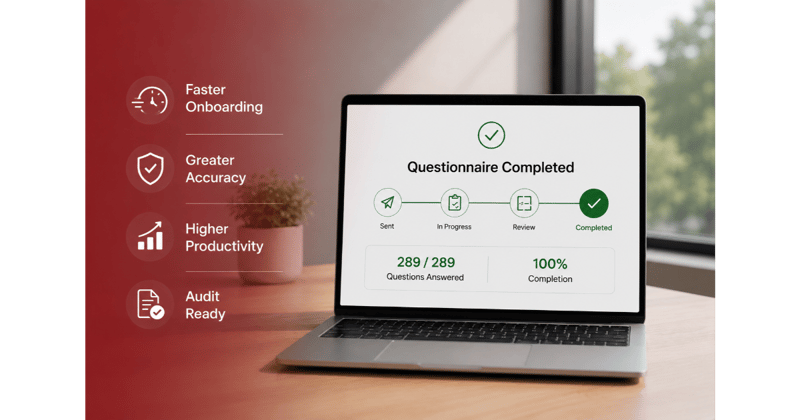
At onboarding: Security questionnaire automation reduces vendor completion time by eliminating blank-slate submissions. Vendors receive assessments already populated from prior responses and public data sources.
At assessment: Evidence review tools scan uploaded documents against specific criteria and flag gaps before they reach an analyst's queue, cutting revision cycles.
At monitoring: Material risk signals route automatically as owned tasks with deadlines, without anyone manually pulling a report or checking a dashboard.
The result is faster onboarding, broader portfolio coverage, and analyst time redirected from administrative work to judgment-heavy decisions about actual risk.
Is Your TPRM Program Built to Handle Evolving Regulatory Demands?
Regulatory expectations for third-party oversight are tightening across every major market, and the pace is not slowing.
DORA, fully in force since January 2025, requires EU financial entities to maintain ICT third-party risk registers, embed specific TPRM obligations in vendor contracts, and demonstrate documented remediation progress on demand to supervisors. RBI guidelines require Indian financial institutions to conduct risk-based due diligence and maintain board-approved outsourcing policies. MAS TRM guidelines in Singapore require risk-based assessment frequency and continuous monitoring evidence.
A program built for last year's regulatory baseline is already behind. The practical requirement is a program where regulatory evidence is captured as part of normal assessment workflow, not assembled in a sprint before each examination.
How Does Continuous Vendor Monitoring Strengthen Your TPRM Program Beyond Onboarding?
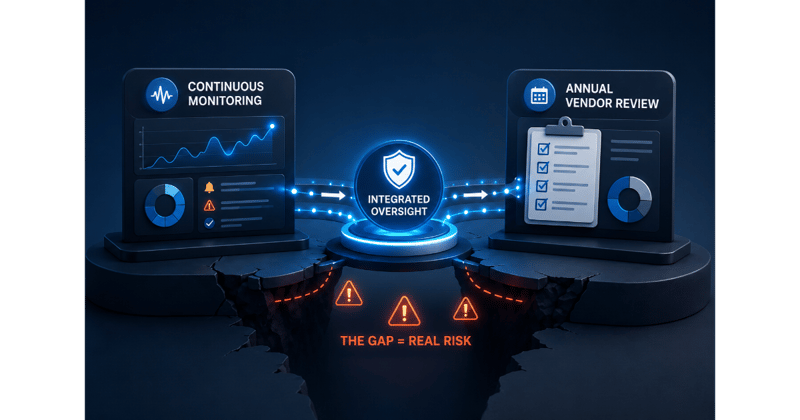
Onboarding due diligence tells you about a vendor's risk profile on the day you assessed them. Continuous monitoring tells you whether that profile is still accurate six months later.
A vendor that passes onboarding with a clean SOC 2 Type II report can experience a breach, a credit downgrade, a leadership change, or a certification lapse before the next annual assessment. Without continuous monitoring, your team discovers these changes when the vendor discloses them, often long after the risk has materialized.
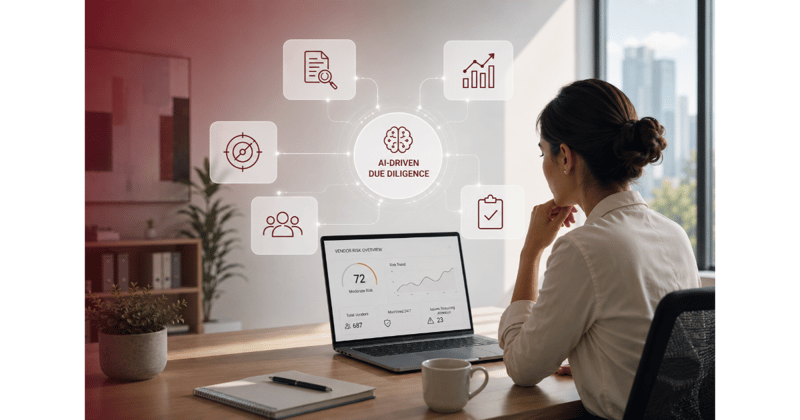
Effective continuous monitoring combines external signal feeds (RiskRecon, SecurityScorecard, D&B) with internal triggers such as contract renewal dates, re-tiering events, and open finding status changes. Monitoring without a routing mechanism produces alerts. Alerts without owners produce nothing.
What Governance Model Should Your TPRM Program Follow: Centralized, Federated, or Hybrid?
|
Model
|
Best for
|
Main risk
|
|
Centralized
|
Under 200 vendors, uniform regulatory obligations
|
Does not scale without proportional headcount
|
|
Federated
|
Large, complex organizations with many business units
|
Consistency breaks when central policy lacks enforcement authority
|
|
Hybrid
|
Most mature programs at scale
|
Requires clear policy handoff points and escalation rules
|
The hybrid model centralizes policy, methodology, and tooling while distributing execution to business units using centrally defined standards. The TPRM program team audits consistency and owns escalation decisions. It is the model that scales without either over-centralizing on a small team or losing consistency to independent business unit judgment.
How Do You Measure the ROI and Performance of a High-Impact TPRM Program?
A TPRM program that cannot demonstrate its own value will not survive the next budget cycle. Three categories of metrics drive the conversation leadership actually responds to.
Operational efficiency: Assessment cycle time (best-in-class: under 10 days vs. an industry average of 30 to 45 days), vendor coverage rate, onboarding time, and cost per assessment.
Risk reduction: Critical findings closed per cycle, average days to remediation by severity tier, and vendor score trajectory across the portfolio.
Regulatory readiness: Audit preparation time, regulatory examination findings per cycle, and percentage of controls with current evidence on file.
Organizations running ComplyScore® consistently achieve sub-10-day assessment cycles, 90 to 95% vendor coverage, and above 90% SLA adherence. (Proprietary benchmark, Atlas Systems.)
See how ComplyScore® can scale your TPRM program without scaling your headcount. Request a demo.
FAQs
What are the core components of an effective TPRM program?
A complete vendor inventory classified by risk tier, a consistent assessment methodology, engagement-aware tiering, continuous monitoring, governed remediation with named owners and audit trails, regulatory framework alignment embedded in every assessment, and board-level reporting that reflects live program performance.
How is a TPRM program different from traditional vendor management?
Traditional vendor management covers procurement, contract administration, and SLA performance. TPRM extends that to include cybersecurity posture, data privacy compliance, financial stability, operational resilience, and regulatory alignment, applied continuously across the vendor lifecycle rather than only at contract signing.
How often should vendor risk assessments be conducted in a TPRM program?
Assessment frequency should match risk tier. Critical-tier vendors need continuous monitoring plus formal reassessment at least annually and immediately after any material risk event. High-tier vendors need annual assessments with quarterly monitoring reviews. Medium and low-tier vendors can operate on longer cycles with automated exception alerts.






.webp?width=387&height=387&name=headless-tprm%20(1).webp)

































%20(1).jpg)