Third-party risk doesn't follow an annual calendar.
A vendor can shift from stable to exposed in weeks when their security posture deteriorates, when regulations change, or when critical personnel leave. An operational process can move from low-risk to high-risk when volumes spike or when staffing constraints force workarounds. Regulatory priorities shift with enforcement announcements and policy changes.
Your risk environment is constantly moving.
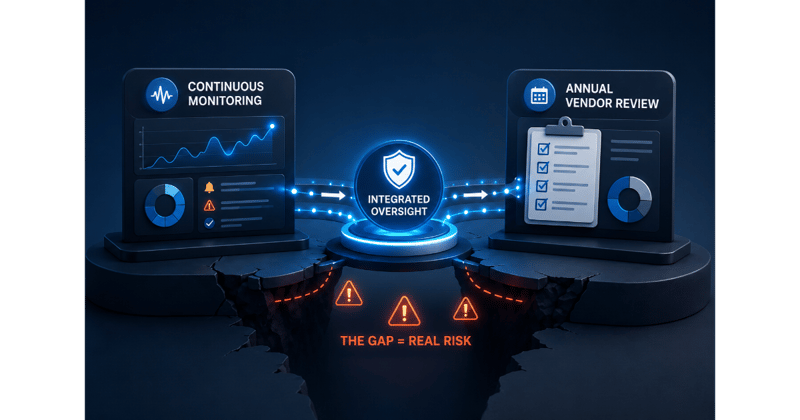
Yet most organizations assess risk annually and treat those assessments as durable for the full year. A risk rating from January sits in a document while conditions change throughout the year. By the time your next assessment cycle arrives, your audit plans are based on yesterday's understanding. You're reacting to risks instead of preparing for them.
Dynamic assessment inverts that model. Instead of freezing your risk picture annually, you're continuously asking whether anything has shifted and updating your understanding accordingly.
What is Dynamic Risk Assessment?
Dynamic risk assessment is an ongoing process where you're constantly feeding new information into your risk model and adjusting your risk ratings as that information changes. It's not a one-time evaluation that sits on a shelf. It's a living assessment that evolves as your environment changes.
Data Sources Feed Continuously
The assessment considers multiple data sources:
- What's happening with your vendors? (security posture, financial status, breach incidents)
- What are regulators focused on? (enforcement actions, new rules)
- What's the threat landscape? (disclosed vulnerabilities, attack trends)
- What's changing in your operations? (staffing, volumes, systems)
All of that feeds into real-time risk evaluation.
How Dynamic Assessment Differs From Static Assessment
Static Assessment: Snapshot in Time
- Evaluate your risk profile at a point in time
- Based on the information you have then
- Assign risk ratings
- Document them
- Move on until next scheduled assessment
- Everything sits on a shelf getting stale
Dynamic Assessment: Continuous Evaluation
- Constantly ask whether anything has changed
- Vendor fails a control? Rating adjusts.
- New regulations announced? Risk ratings for affected areas shift.
- Business changes? Risk dimensions adapt.
- The question is not "what's our risk" once a year, but continuously throughout the year.
When to Use Dynamic Risk Assessment
Perfect Use Cases
- Vendor Risk: Vendors get acquired, security posture changes, or when new threats emerge. You can't assess a vendor once and assume the rating holds for a year.
- Regulatory Risk: Requirements change, enforcement priorities shift, or new rules are announced. Your regulatory risk profile is constantly changing.
- Threat-Based Risk: Vulnerabilities are disclosed, attack trends shift, or new threat actors emerge. The threat landscape is fluid.
When Annual Assessment Might Suffice
For operational risk in stable processes with limited external change, annual assessment might be sufficient. But even then, event-driven reassessment makes sense when something material changes.
How to Conduct Dynamic Risk Assessment Step by Step
Step 1: Define Data Sources
What feeds into your risk assessment?
- Vendor monitoring data (SecurityScorecard, RiskRecon, etc.)
- Regulatory updates (new laws, enforcement actions)
- Threat intelligence (vulnerability databases, attack trends)
- Transaction data (volumes, error rates, anomalies)
- System logs (uptime, performance, security events)
You need reliable visibility into these sources.
Step 2: Establish Risk Dimensions
What factors matter for your risk assessment?
For vendors, it might be:
- Security posture
- Financial stability
- Regulatory status
- Criticality to your operations
- Data access level
Define what signals affect each dimension.
Step 3: Set Triggers
What changes would cause you to reassess?
Examples:
- Vendor's SOC 2 expires
- A critical control fails
- Regulatory requirement changes
- A threat is disclosed affecting the vendor's technology
- Financial metrics deteriorate
Define the triggers that prompt reassessment.
Step 4: Implement the Mechanism
How do you capture these signals and route them for reassessment?
- Is it automated? (Preferred: system watches for triggers)
- Is it manual? (Less reliable: depends on someone remembering)
- Is it hybrid? (Common: automated capture, manual decision on response)
You need a reliable way to ensure assessment happens when it should.
Step 5: Establish Response Protocols
When a risk rating changes, what happens?
- Do you alert stakeholders?
- Do you adjust your audit plans?
- Do you change your vendor interactions?
- Do you escalate?
Define the response for different types of changes.
Key Benefits of Dynamic Risk Assessment for Organizations
- Speed: You respond faster to emerging risks. Not waiting for the next assessment cycle. You know immediately and can react.
- Accuracy: Your risk ratings reflect current reality rather than last quarter's assumptions. Decisions based on current risk ratings are better informed.
- Proactive Risk Management: You reduce surprise failures. Monitoring continuously rather than hoping you catch problems during periodic reviews. Issues surface earlier.
- Smart Resource Allocation: Audit effort, vendor focus, control investments all track to current risk rather than historical risk. You're spending effort where it matters most right now.
Who Is Responsible for Dynamic Risk Assessment
Primary Owners by Domain
- Vendor risk: Procurement and vendor management
- Operational risk: Operations management
- Regulatory risk: Compliance
- Information security risk: Security team
Shared Responsibility
But all of these areas need access to current data and the ability to reassess when that data changes. Nobody can own dynamic assessment completely alone. It requires coordinated contribution from multiple teams.
How ComplyScore® Enables Dynamic Risk Assessment
Dynamic assessment requires continuous data integration and real-time analysis. You need to know immediately when:
- A vendor's security posture changes
- Regulatory requirements shift
- Monitoring alerts suggest new exposure
What ComplyScore® Does
ComplyScore® ingests continuously:
- Vendor monitoring data
- Regulatory updates
- Threat intelligence
- Control status
When any input changes, the system automatically recalculates vendor risk ratings. You're not manually reassessing hundreds of vendors based on changing data. The platform does that continuously.
Result: Your dashboard always shows current risk. Your audit plans reflect current priorities. Your vendor interactions are based on current exposure, not last quarter's assessment.
Ready to Move Beyond Annual Risk Snapshots?
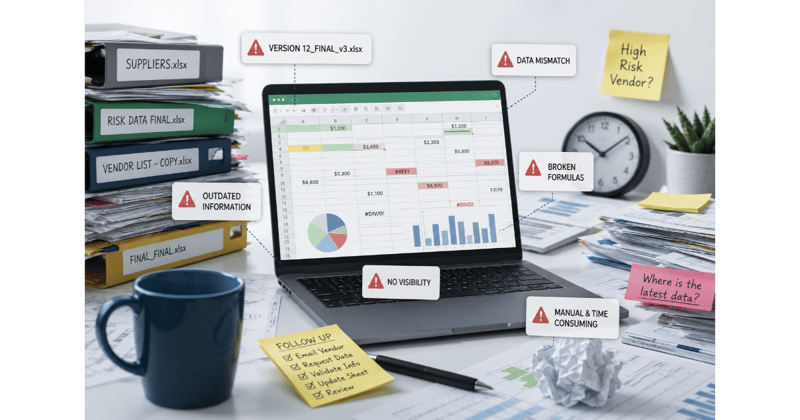
Dynamic assessment only works when your data infrastructure keeps up. If your team is still manually tracking vendor changes across spreadsheets, the model breaks before it starts.
See how ComplyScore® keeps your risk ratings current → Book a Demo
FAQs: Dynamic Risk Assessment
1. How often should you recalculate risk ratings in a dynamic model?
Depends on how frequently your data changes. For vendor risk with continuous monitoring data, daily or weekly recalculation makes sense. For less frequently changing risks, monthly or quarterly might be appropriate. The key is that changes trigger recalculation, not that you recalculate on a fixed schedule.
2. How do you prevent assessment fatigue when risk is constantly changing?
Focus on material changes. Not every small change in data should trigger reassessment and response. Set thresholds so assessment happens when changes are significant.
Example: A vendor's security score drops 2 points probably no action. Drops 20 points definitely act.
3. What's the difference between dynamic assessment and continuous monitoring?
Continuous monitoring watches for issues. Dynamic assessment evaluates what those issues mean for risk. You might monitor hundreds of data points. You assess risk on specific risk dimensions. Assessment uses monitoring data as input.
4. How do you handle assessment when data is incomplete or uncertain?
Rate risk based on available data. Flag uncertainty in your ratings. When data improves, update. When data is missing, that itself might be a risk signal that affects your assessment (unknown = riskier).
5. Can you have dynamic assessment for qualitative risks like reputational risk?
Yes, though it's more challenging than quantitative risks. Identify signals that suggest reputational risk is changing:
- Media coverage
- Customer feedback
- Employee sentiment
- Social media mentions
Track those signals and reassess when they shift. Less precise than quantitative assessment, but still possible.






.webp?width=387&height=387&name=headless-tprm%20(1).webp)











































%20(1).jpg)