






.webp?width=387&height=387&name=Medtech%20Breakthrough%20Award%20Winner%20(1).webp)



























Provider Lifecycle Management


TL;DR
- 2.78 claims denied weekly: MGMA data shows 2.78 claims per full-time physician denied weekly due to missing credentialing information, causing reimbursement delays and unnecessary hiring hurdles.
- 52% face directory errors: AMA found 52% of physicians report patients encounter coverage issues monthly from inaccurate provider directories, with 80%+ mental health providers listed being unreachable or not in-network.
- CMS secret shopper mandate: Starting 2025, CMS requires federal exchange health plans to use third-party secret shoppers simulating patient calls, verifying listed providers are actually reachable, accepting patients, and in-network.
- Daily monitoring closes gaps: Traditional verification only at hire and renewal leaves compliance gaps—modern organizations verify monthly or daily catching license suspensions before they create patient safety risks.
Summarize This Article With
When a healthcare organization brings a new provider on board, verifying their qualifications is one of the first steps that cannot be overlooked. Primary source verification (PSV) is about going straight to the original institutions to check a provider's credentials firsthand, leaving no room for assumptions.
Without careful PSV, there's no guarantee that doctors, nurses, or specialists are properly licensed or prepared to deliver care. Small gaps in verification can lead to bigger problems down the line.
Credentialing involves many moving parts, and PSV is one area where early mistakes create consequences that reach patients directly. A 2023 U.S. Senate Finance Committee investigation found that more than 80% of listed in-network mental health providers were unreachable, not accepting new patients, or not actually in-network when contacted directly, according to the American Medical Association. A November 2024 study in the American Journal of Managed Care found that 40% of provider directory inaccuracies remained uncorrected after 540 days on average. These gaps interrupt reimbursements, slow down hiring, and create hurdles that trace straight back to breakdowns in credential verification.
This guide will walk through how PSV works, the challenges teams face, and practical steps to strengthen verification efforts from the start.
What is Primary Source Verification (PSV)?
When your team verifies a provider's credentials, you need to know the information came from the right place. That means reaching out to the source that originally issued the license, degree, or certification. This step is called primary source verification, and it serves as a core function in provider credentialing.
Rather than accepting a scanned copy of a diploma, you would contact the medical school directly. If a provider lists a board certification, you check with the board itself. The same applies to licenses, residency training, and other professional records.
What you verify often depends on your organization’s policies. Most credentialing teams check education, active licensure, and board certification. Others include work history, malpractice background, or disciplinary actions.
The goal is to confirm that each provider has the qualifications they claim. Done right, primary source verification keeps your data accurate and helps reduce risks tied to credentialing errors or missing information.
Why is Primary Source Verification Important?
The AMA found that 52% of physicians reported their patients faced coverage issues at least once a month because of inaccurate provider directory information. Another study revealed that over 80% of in-network mental health providers listed in directories were either unreachable, not accepting new patients, or not actually in-network. These gaps show why getting credentialing right matters.

Primary source verification protects patients by making sure only qualified providers deliver care. It also keeps your organization in line with accreditation standards and reduces risks tied to credentialing mistakes. Here's why PSV should remain a priority:
- Strengthens patient safety: Checking credentials directly with the source prevents unqualified or misrepresented providers from entering your network.
- Reduces legal and financial risks: Mistakes in credentialing can lead to lawsuits, malpractice claims, or fines. PSV acts as a safeguard, helping you avoid expensive errors.
- Supports compliance with accreditation standards: Organizations like The Joint Commission and NCQA expect provider credentials to be verified properly. Missed verifications can affect accreditation and disrupt payer relationships.
- Protects revenue: Errors in provider information often cause payment delays or denials. Getting verification right speeds up enrollment with payers and stabilizes revenue flow.
- Builds trust across the network: When payers, partners, and patients know you verify providers thoroughly, it strengthens confidence in your organization.
Alongside PSV, health plans now have a new tool to check the accuracy of their provider directories: secret shopper surveys. Starting in 2025, the CMS will require plans to use independent third parties to pose as patients and call providers listed in their directories. These surveys uncover whether a provider is actually taking appointments and still in-network, an important cross-check that reinforces the need for timely credential verification. Atlas Systems helps organizations run these surveys effectively, supporting both compliance and better member experiences.
PSV works best when it's embedded inside provider credentialing software, so verification results flow directly into credentialing decisions without separate systems, spreadsheets, or duplicate data entry.
Differences Between Primary and Secondary Sources
Primary source verification (PSV) involves contacting the organization that originally issued a provider's credentials to confirm accuracy. Secondary sources collect or display information that was gathered from another entity, not directly from the issuing source. Both types of information play roles in healthcare credentialing, but they differ in purpose, reliability, and usage.
Here is a detailed breakdown:
|
Aspect |
Primary Source |
Secondary Source |
|
What it does |
Provides direct confirmation of a provider’s qualifications, licensure, and certifications from the issuing authority |
Shares provider information collected from other records or external databases, not necessarily verified directly. |
|
Purpose |
Verifies the authenticity and accuracy of provider credentials for credentialing, compliance, and regulatory audits. |
Offers supplementary or reference information that can assist in preliminary reviews or internal updates. |
|
Information Origin |
Original issuer, such as a licensing board, university registrar, or certifying body. |
Aggregated from multiple sources or from publicly available data without direct verification. |
|
Use in Credentialing |
Required for formal credentialing processes, payer enrollment, and regulatory compliance. |
Helpful for internal tracking or pre-screening, but insufficient alone for final credentialing decisions. |
|
Reliability |
High; direct confirmation minimizes errors and outdated information. |
Variable; risk of outdated, incomplete, or inaccurate records increases without direct issuer validation. |
|
Common Examples |
Verifying licensure status with a state medical board, confirming a degree with a university. |
Checking a provider directory, using summaries from credentialing software, or referencing employment history lists. |
|
Documentation Quality |
Full records including verification date, source contact, and method of verification. |
Often lacks verifiable timestamps or direct confirmation details. |
Understanding the distinction between primary and secondary sources helps your team apply the right method depending on whether you need direct verification or general reference information.
PSV Requirements by Accreditation Body
The specific rules your credentialing team follows depend on which accrediting body oversees your organization. Each one sets its own expectations for how often PSV happens and what has to be documented.
The Joint Commission
Hospitals accredited by The Joint Commission must complete PSV at initial appointment and again at reappointment, with credentialing files subject to review during survey cycles. Documentation has to show the source contacted, the date, and the outcome for every credential checked.
NCQA
Health plans and provider organizations following NCQA standards recredential providers on a recurring cycle, with PSV required for licensure, board certification, and sanctions checks against sources like the NPDB and OIG LEIE. NCQA audits look specifically for a complete, timestamped verification trail, not just a completed checklist.
DNV Healthcare
DNV accreditation is built around CMS Conditions of Participation, so PSV documentation needs to demonstrate compliance with those federal requirements directly rather than a separate DNV-specific standard layered on top.
HFAP
HFAP accreditation, also CMS-deemed, follows a similar model to DNV: credentialing and PSV requirements track closely to CMS Conditions of Participation, with an emphasis on consistent documentation across survey cycles.
Primary Source Verification (PSV) Process
Traditional methods of PSV
%20Process%20-%20visual%20selection%20(1).webp?width=651&height=653&name=Primary%20Source%20Verification%20(PSV)%20Process%20-%20visual%20selection%20(1).webp)
You are expected to follow credentialing rules set by organizations like The Joint Commission, DNV, and HFAP. These standards require PSV at the time of hire and again when a provider's credentials come up for renewal. In most organizations, your human resources or administrative teams usually handle this task.
Traditionally, you would check licensing board websites or certification databases. Without online systems, you would need to verify a provider's status by making phone calls, sending faxes, or mailing written requests. Keeping a record of each verification, including the date and the source contacted, is important for audit and regulatory purposes.
Verifying credentials only at hire or renewal can leave compliance gaps. A license might be suspended or revoked between these checks, and without frequent monitoring, you might not catch it in time.
Modern methods: Increasing verification frequency
Today, many healthcare organizations verify credentials more often to close these gaps. Instead of waiting for scheduled renewals, you can check monthly or even daily. Frequent verification makes it easier to catch changes in licensure status before they create risks for your patients or your facility.
Daily monitoring helps you react quickly if a provider loses a license, faces restrictions, or experiences other credentialing issues. This proactive approach strengthens your compliance efforts and protects patient safety.
Outsourcing primary source verification to CVOs
You can also partner with a Credentials Verification Organization (CVO) to manage PSV tasks. CVOs specialize in confirming licenses, certifications, and registrations across departments or facilities. Outsourcing can make your credentialing process more efficient, especially if you are working with multiple locations or a stretched internal team.
A CVO brings dedicated expertise and offers centralized systems to track verifications consistently. This partnership can ease your administrative burden while improving the accuracy and speed of credentialing.
When PSV runs on a daily cadence rather than every three years, it becomes provider monitoring software, the workflow that catches license suspensions, sanctions, and exclusions the moment they appear on any authoritative source.
Automation in primary source verification
Automation tools have made PSV faster and more reliable. Instead of manually checking websites or making phone calls, you can use automated systems that pull credential data straight from licensing boards and certification agencies.
With automation, you can:
- Save time: Complete verifications in seconds instead of minutes.
- Lower risk: Frequent, automated checks help you catch credential issues early.
- Cut costs: Reducing manual work lets your team focus on higher-priority tasks.
How Long Does PSV Take
Turnaround time for PSV depends heavily on the verification method, and the gap between the slowest and fastest approach is significant enough to shape how organizations staff and budget for credentialing.
Manual verification
Phone, fax, and mail-based verification depends on how quickly the issuing source responds, and that pace varies by state board, certification body, and time of year. A single credential can take anywhere from a few days to several weeks to confirm, and a full provider file with multiple credentials compounds that timeline.
Automated verification
Platforms that connect directly to licensing boards and certification databases through APIs can confirm many credentials in minutes rather than days, since the check runs against a live data source instead of waiting on a person to respond.
What slows it down
Turnaround stretches when a credential requires contacting an out-of-state board, when a source only accepts mail or fax, or when a provider's submitted information does not match what the issuing source has on file and needs manual follow-up to resolve.
How Atlas Systems Verifies Primary Sources
Atlas Systems brings a modern approach to primary source verification (PSV) by combining automation, direct communication, and continuous monitoring. Here’s how the process works:
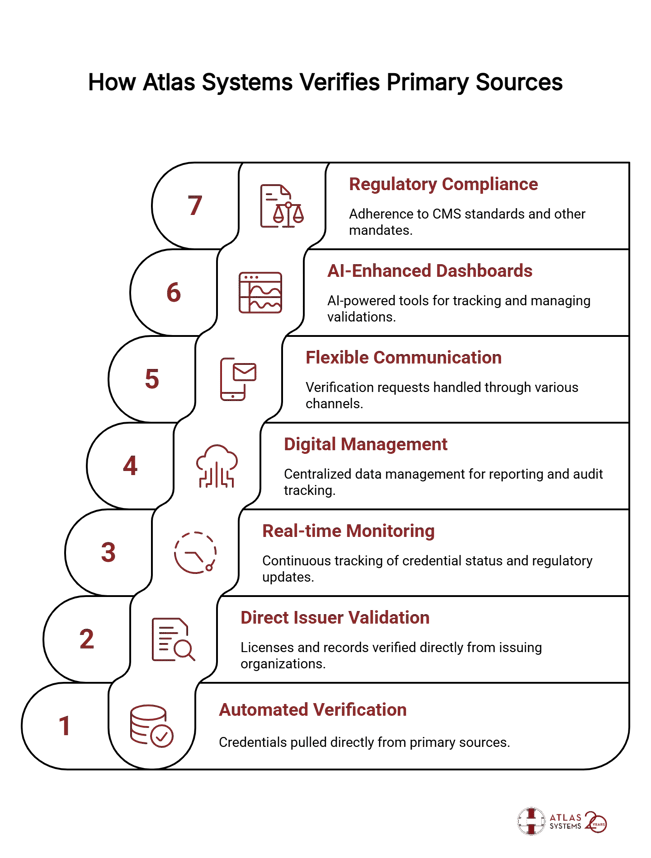
- Automated verification: Credentials are pulled directly from licensing boards, certification agencies, and issuing authorities without relying on secondary sources.
- Direct issuer validation: Licenses, education records, work history, and certifications are verified straight from the organization that issued them, ensuring authenticity.
- Real-time monitoring: Atlas tracks expiration dates, credential status changes, and regulatory updates, allowing organizations to maintain continuous compliance.
- Digital credential management: Provider data is centralized through a secure platform that automates reporting, document storage, and audit tracking.
- Flexible communication channels: Verification requests are handled via phone calls, self-service portals, roster submissions, or direct API integrations based on provider preference.
- AI-enhanced dashboards: Internal teams can view credential statuses, track progress, and manage validations through Atlas’ AI-powered dashboard.
- Regulatory compliance alignment: The verification process adheres to CMS standards, state mandates like CA SB137, the No Surprises Act, and FHIR interoperability standards.
Atlas Systems’ approach reduces manual workload, shortens credentialing timelines, and helps healthcare organizations stay audit-ready with minimal administrative effort.
Types of Credentials Verified Through Primary Source Verification (PSV)
Primary source verification (PSV) covers a range of credentials that must be confirmed directly with the issuing authority. Organizations review these credentials to verify that individuals meet licensing or certification standards before starting roles that involve regulated responsibilities.
Professional licenses
Hospitals, clinics, law firms, and engineering companies confirm licenses for physicians, nurses, attorneys, engineers, pilots, and other regulated professionals.
Educational degrees
Schools and universities verify degrees, diplomas, and academic certifications to confirm that individuals have completed required programs.
Board certifications
Healthcare facilities review board certifications for physicians, specialists, and advanced practice providers to validate specialized qualifications.
Residency and fellowship training
Hospitals check residency and fellowship training records to confirm that physicians completed specialized clinical programs.
Work history
Employers validate prior job roles by checking employment history to confirm responsibilities and tenure.
Professional references
Organizations contact listed references to gain feedback on an individual's work ethic, reliability, and experience.
Malpractice history
Credentialing teams check malpractice claims histories to identify any previous settlements, judgments, or disciplinary actions against healthcare providers.
DEA registration and controlled substance authorization
Healthcare organizations confirm active DEA registrations when credentialing providers authorized to prescribe controlled substances.
Specialty certifications and technical credentials
Companies in fields such as technology, aviation, or construction validate certifications in cybersecurity, flight operations, or engineering specialties.
Benefits of Vendor Performance Management
Vendor performance management (VPM) gives healthcare organizations a structured way to review how credentialing vendors handle primary source verification (PSV). By tracking progress and pinpointing issues, teams can maintain operational oversight and improve the quality of credentialing activities.
Improving credentialing accuracy
Reviewing vendor work helps healthcare teams spot errors or missing information early. Fixing issues during credentialing avoids bigger problems later.
Identifying workflow gaps
When PSV tasks create delays, performance tracking makes it easier to locate and resolve specific workflow issues. Adjustments made at this stage help teams work more efficiently.
Strengthening compliance efforts
Regular reviews of vendor activity give organizations a clear view of how credentialing documentation and timelines align with accreditation standards from groups like The Joint Commission and NCQA.
Managing costs effectively
Evaluating performance against service agreements gives organizations clarity on vendor value. This insight can lead to renegotiated contracts or better vendor choices.
Controlling credentialing risks
Frequent checks reduce the chances of overlooked renewals or outdated provider information. Active monitoring supports consistent credentialing and lowers exposure to risk.
Applications of Primary Source Verification (PSV)
Primary source verification (PSV) is used across healthcare organizations to validate credentials wherever formal qualifications are required. From onboarding to payer enrollment, PSV helps confirm that individuals meet the standards tied to regulatory or contractual requirements.
Provider onboarding and re-credentialing
Healthcare systems verify a provider’s education, licenses, training, and board certifications during the onboarding process. These checks are repeated at regular intervals to meet credentialing timelines and safety expectations.
Payer enrollment
Before submitting provider information for enrollment, health plans and networks verify licensing and certifications to prevent errors that cause delays or rejections.
Delegated credentialing oversight
When credentialing is outsourced, the responsibility for accuracy still falls on the organization. PSV helps confirm that all delegated decisions are based on verified data.
Telehealth expansion
As providers work across state lines, PSV confirms active state licenses and helps track compliance with telemedicine requirements.
Workforce mobility and temporary staffing
For temporary providers such as travel nurses or locum tenens clinicians, PSV speeds up the process of confirming required credentials before they are placed.
Accreditation and regulatory readiness
Organizations use PSV to support documentation requirements for accreditation and regulatory audits. Verification records help show that credentialing decisions are based on original source data and meet expectations from agencies like The Joint Commission and NCQA.
Step-by-Step Process of Primary Source Verification (PSV)
%20-%20visual%20selection.webp?width=1202&height=1468&name=Step-by-Step%20Process%20of%20Primary%20Source%20Verification%20(PSV)%20-%20visual%20selection.webp)
1. Collect credential information
The credentialing team starts by requesting and compiling provider documents. These often include state licenses, board certifications, education records, training details, and past employment history. Each item is reviewed to identify what needs formal verification.
2. Identify verification sources
For each document, the team determines where to send the verification request. Depending on the credential type, this might be a state licensing board, an academic registrar, a certification body, or a previous employer. They use trusted directories or databases to confirm source legitimacy.
3. Initiate contact with the primary source
Next, the team contacts the selected sources using their preferred method—phone, email, portal submission, or fax. Communication details depend on the protocols set by each organization.
4. Submit credential verification request
They submit each request with all necessary information, such as ID numbers, names, and dates tied to training or licensure. Providing complete details helps prevent processing delays.
5. Receive and review verification response
Once responses arrive, the team cross-checks them with the original documents. They review the credential status, issue dates, and any relevant notations like sanctions or restrictions. Anything unclear gets flagged for clarification.
6. Document and Store Verification Results
The team uploads each response into the credentialing system. Every record includes the source name, date of verification, and outcome to support traceability and audit preparation.
7. Recheck and follow up when needed
If a response takes too long or arrives with gaps, the team follows up to close those items. A tracking system helps ensure nothing is missed.
8. Final review and compliance check
Before approving the provider for onboarding or enrollment, credentialing leads review the full file. This step confirms that all credentials have been verified and meet internal policy and external regulatory requirements.
Best Practices for Primary Source Verification (PSV)
Strong primary source verification (PSV) practices reduce delays, strengthen compliance, and improve credentialing outcomes. Adopting the right habits helps credentialing teams keep pace with regulatory standards and maintain accuracy across provider records.
Use reliable source directories
Before initiating verification, teams should confirm the legitimacy of the issuing body. National registries, state licensing databases, and accreditation directories help avoid outdated or unrecognized sources.
Document every step of the process
Each interaction, whether an email, phone call, portal access, or fax, should be logged. Capturing dates, responses, and contact names supports transparency and simplifies audits.
Verify in real time when possible
Credentialing teams benefit from online portals or databases that offer immediate license and certification validation. Accessing real-time systems helps prevent delays tied to manual follow-ups.
Standardize internal checklists
Establish a consistent template or checklist for verifying each type of credential. This helps ensure teams apply the same level of scrutiny to all providers, regardless of role or location.
Monitor credential expiration and updates
Maintaining a calendar for license expirations, certification renewals, and training cycles allows teams to schedule re-verification in advance. This keeps records current and reduces last-minute verification issues.
Follow up promptly on gaps or delays
If a source does not respond within a set timeframe, teams should reach out again using alternate contact methods. Proactive follow-up avoids bottlenecks during onboarding or renewal.
Review for completeness before final approval
Before moving a file forward, teams should double-check that each credential has been verified with the correct source. This step prevents compliance gaps and ensures credentialing decisions are fully supported.
Add secret shopper surveys to your toolkit
These surveys act as a real-world test of provider access. Conducted by third-party teams, they simulate patient calls to see if listed providers are reachable, available, and in-network. It’s now a CMS requirement, and it’s a smart way to catch discrepancies before they cause member frustration or compliance trouble.
Tools and Methods for Conducting Primary Source Verification (PSV)
Credentialing teams rely on a range of tools and methods to carry out primary source verification (PSV). From manual outreach to digital integration, each method plays a role in confirming the accuracy and validity of provider credentials.
Online verification portals
Many credentialing teams use online databases maintained by state boards or certifying bodies to check licenses. These portals often provide real-time details like license status or disciplinary flags, allowing staff to validate credentials quickly and confidently.
Automated credentialing software
Credentialing systems with built-in PSV modules can streamline verification by connecting directly with source databases. These platforms reduce manual data entry and flag any discrepancies between submitted documents and official records.
Credentialing verification organizations (CVOs)
Some healthcare organizations outsource PSV to third-party verification partners. CVOs manage direct source contact, documentation, and turnaround tracking, especially useful when dealing with high volumes or multi-state credentialing.
Secure email and fax communications
In cases where online portals are unavailable, teams contact issuing authorities via secure email or fax. While more time-consuming, this method remains a reliable fallback for institutions without digital infrastructure.
Phone-based verification
For certain credentials or when a response is overdue, teams may call the issuing source directly. Speaking with licensing or credentialing staff helps resolve questions and ensures documentation is current.
API integrations with licensing databases
Some advanced credentialing platforms use API connections to sync directly with licensing boards. These integrations support automated re-verification and reduce the need for manual follow-up.
Audit trails and digital storage
Tools that provide built-in logging and document retention make it easier to demonstrate compliance. Audit trails should capture verification dates, methods used, and source contact details.
By combining these methods, credentialing teams can maintain a reliable PSV process that supports provider readiness and meets both organizational and regulatory standards.
Challenges in Primary Source Verification (PSV)
Credentialing teams recognize that primary source verification (PSV) is essential, but carrying it out often presents day-to-day challenges. Delays from issuing authorities, differences in how credentials are submitted, and inconsistent access to source systems can all slow down progress.
Limited access to issuing authorities
Not all sources maintain online portals or standardized verification procedures. Teams may encounter institutions that rely on outdated communication methods or lack responsiveness, leading to delays and incomplete responses.
Inconsistent data formats
Credentialing information is often submitted in a range of formats, including scanned documents, PDFs, and spreadsheets. When data lacks standardization, it becomes harder to match provider-submitted credentials with official records.
Time-consuming manual follow-ups
When responses are missing or unclear, teams must contact the issuing body again. These follow-ups require time, persistence, and tracking, especially if the verification must happen across time zones or jurisdictions.
Verifying credentials for international providers
Global verification introduces complexity. Different countries have unique licensing structures, languages, and response timelines. Some issuing authorities require paper forms or notarized requests, extending the timeline significantly.
Changing regulatory expectations
As standards evolve, credentialing teams must stay informed of updates from The Joint Commission, CMS, and state boards. Failure to adapt quickly can lead to missed requirements or inconsistent audit readiness.
One growing challenge is verifying whether listed providers are truly available to patients. In fact, for health plans operating on the federal exchange, CMS is introducing mandatory secret shopper surveys in 2025. These surveys simulate real patient calls to assess appointment availability and timeliness, helping verify the accuracy of provider directories. Atlas Systems supports these efforts with end-to-end survey design, execution, and compliance reporting.
Credential expiration tracking
Verifying a credential once is not enough. Teams must track expiration dates and ensure re-verification happens before the license or certification lapses. Missed renewals may affect provider status or contract eligibility.
System and resource limitations
Not every organization has access to advanced credentialing platforms or integrations. Smaller teams may rely on spreadsheets or shared drives, which increases the risk of oversight or inconsistent documentation.
Organizations can improve how they manage PSV by adopting tools like Atlas PRIME that support credential tracking and reduce manual tasks. Equipping teams with reliable systems, regular training, and a clear escalation process for delayed responses helps them stay organized and ready for audits. Atlas Systems supports this approach by offering technology and services tailored to the needs of credentialing teams.
Simplify Primary Source Verification with Atlas PRIME®
Streamlining Primary Source Verification (PSV) doesn’t have to mean complex systems or fragmented workflows. With Atlas PRIME®, credentialing teams get a solution that moves at their pace, offering real-time visibility, automated verification, and seamless coordination across departments and locations. And with CMS introducing secret shopper survey requirements for certain health plans in 2025, PRIME is already helping organizations get ahead of the curve, making it easier to stay compliant, accurate, and audit-ready.
Explore how PRIME has helped credentialing teams simplify operations, reduce errors in provider records, and meet regulatory expectations with less manual effort.
Want personalized guidance or a hands-on look at how PRIME can work for your team? Let's talk.

%20(1).jpg)

Related Reading

Provider Lifecycle Management
Automated Provider Data Management: A Practical Playbook
Read the blog →
Provider Lifecycle Management
The Complete Guide to Provider Data Management Automation
Read the blog →
Provider Lifecycle Management
Why Behavioral Health Providers Are the Hardest AWT Surveys to Close
Read the blog →
Provider Lifecycle Management
Best Provider Network Management Platforms for Payers and Providers in 2026
Read the blog →
Provider Lifecycle Management