






.webp?width=387&height=387&name=Medtech%20Breakthrough%20Award%20Winner%20(1).webp)
























Provider Data Validation That Goes
Six Layers Deep, Not One Pass Deep

Minutes, Not Weeks

95%+ Accuracy | 6-Layer Verification

Complete Audit Trails
Provider Data Changes
Every 90 Days.
One Source Is Never Enough.

Quarterly Cycles That Fall Behind
Practices move, licenses lapse, and acceptance status shifts between validation runs. By the time updates publish, the records are already stale.
Documentation That Takes Days to Assemble
When a regulatory review arrives, most organizations spend days reconstructing verification records that should have been logged automatically.
Single-Source Verification Leaves Gaps
Checking one database confirms one data point. It misses the revoked license on a state board or the sanction that only appears on a federal exclusion list.

A structured, repeatable verification framework that produces accurate records and the documentation to prove it.
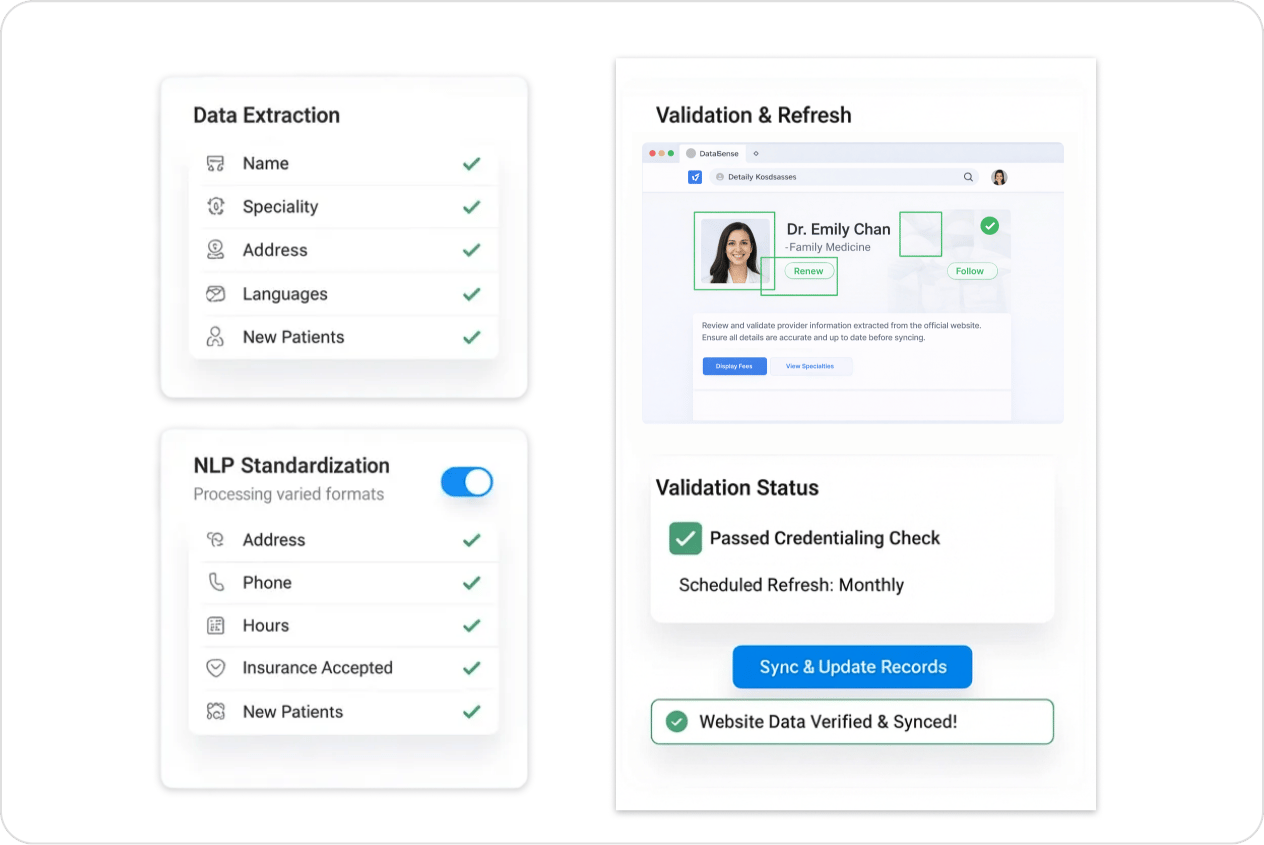
[01] Provider Website
The Most Current Source Available
- Providers update their own sites before notifying anyone else
- Captures name, specialty, address, phone, hours, and insurance accepted
- Most accurate starting point because the provider controls it directly
- Produces a timestamped record of what was confirmed and when
[02] Public and Government Sources
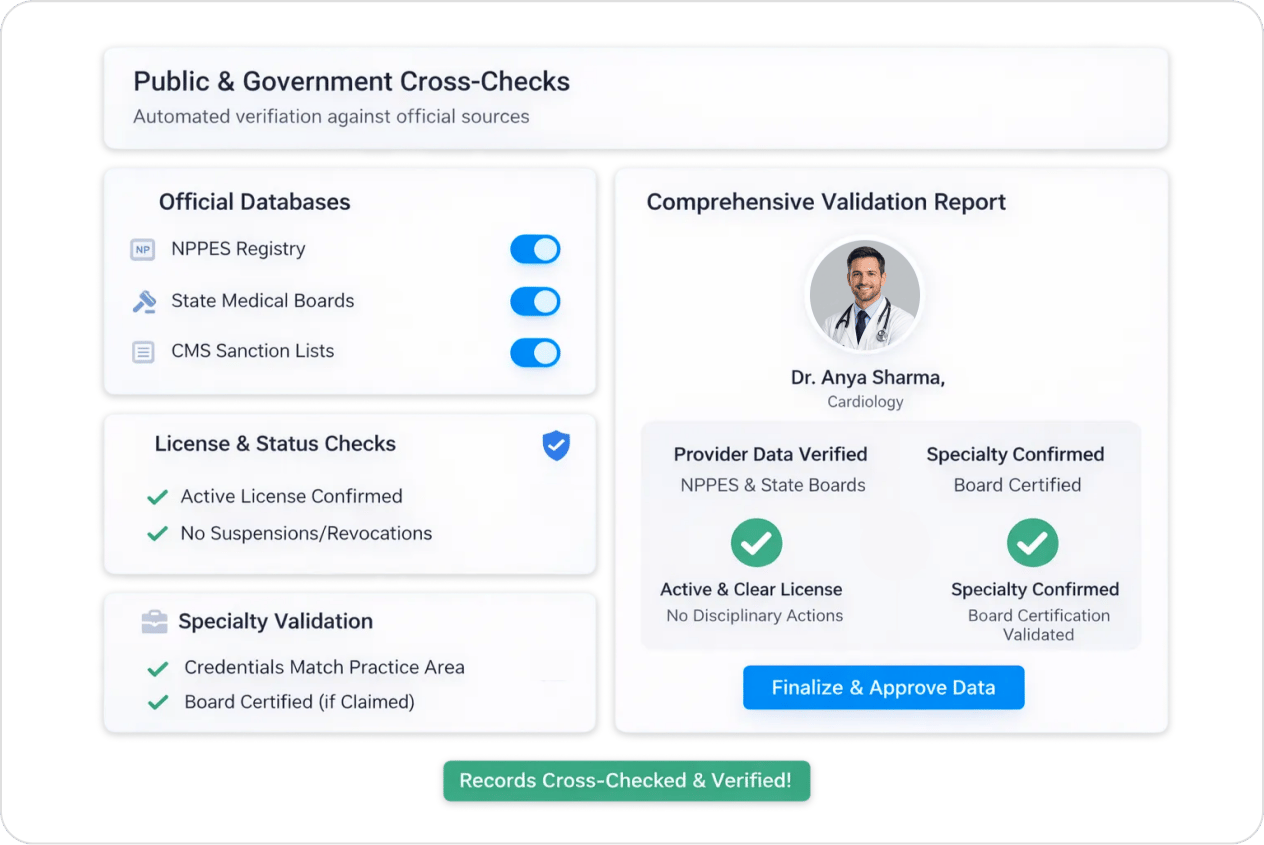
NPI, Licensure, and Regulatory Validation
- Validates NPI and specialty against NPPES and state medical license boards
- Confirms license status, expiration dates, and any disciplinary actions on record
- Checks Medicare acceptance and group affiliation via CMS Care Compare
- Catches problems a practice website will never disclose
[03] Background and Sanctions Check
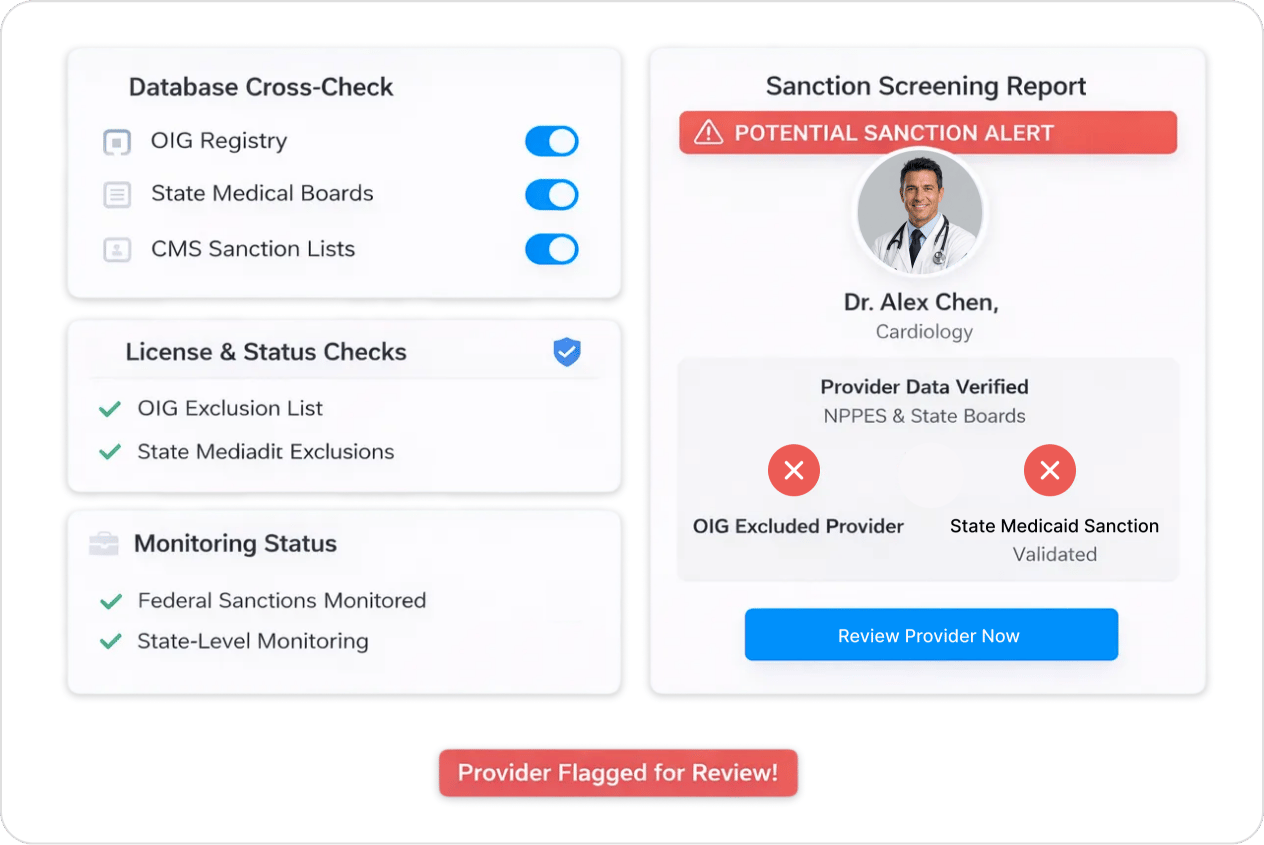
Federal and State Exclusion Screening
- Screens against OIG LEIE, SAM.gov, FDA, DEA, and DOJ exclusion lists
- Covers all 50 state Medicaid exclusion databases and board disciplinary records
- Identifies sanctioned or excluded providers before they appear in any directory
- Flags issues at scale across thousands of records simultaneously
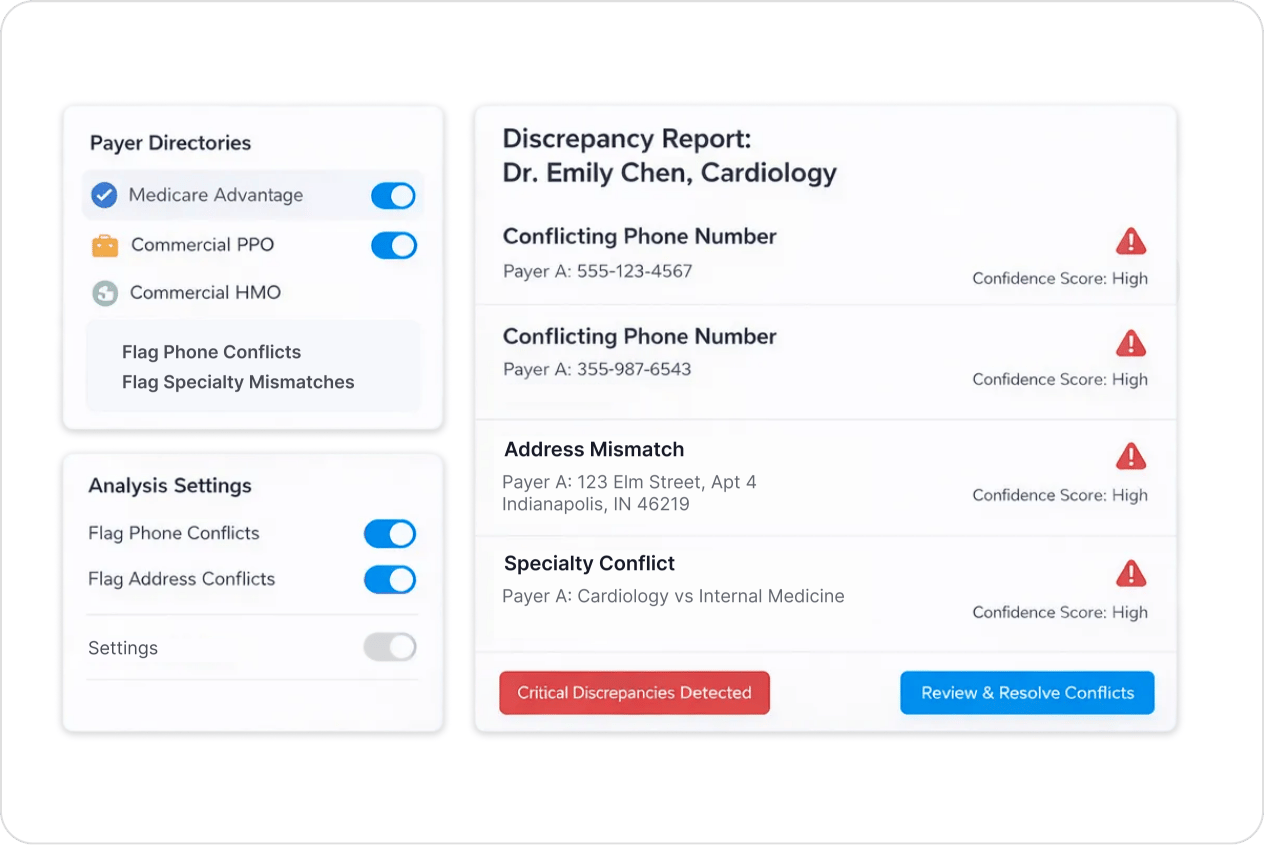
[04] Cross-Directory Consistency
Network-Wide Discrepancy Detection
- Compares provider details across multiple payer and plan directories in the same region
- Surfaces conflicting phone numbers, addresses, or specialties that single-source checks miss
- Applies confidence scoring to prioritize which discrepancies need human attention
- Catches delegated data inconsistencies before they reach downstream systems
[05] Agentic AI Outreach
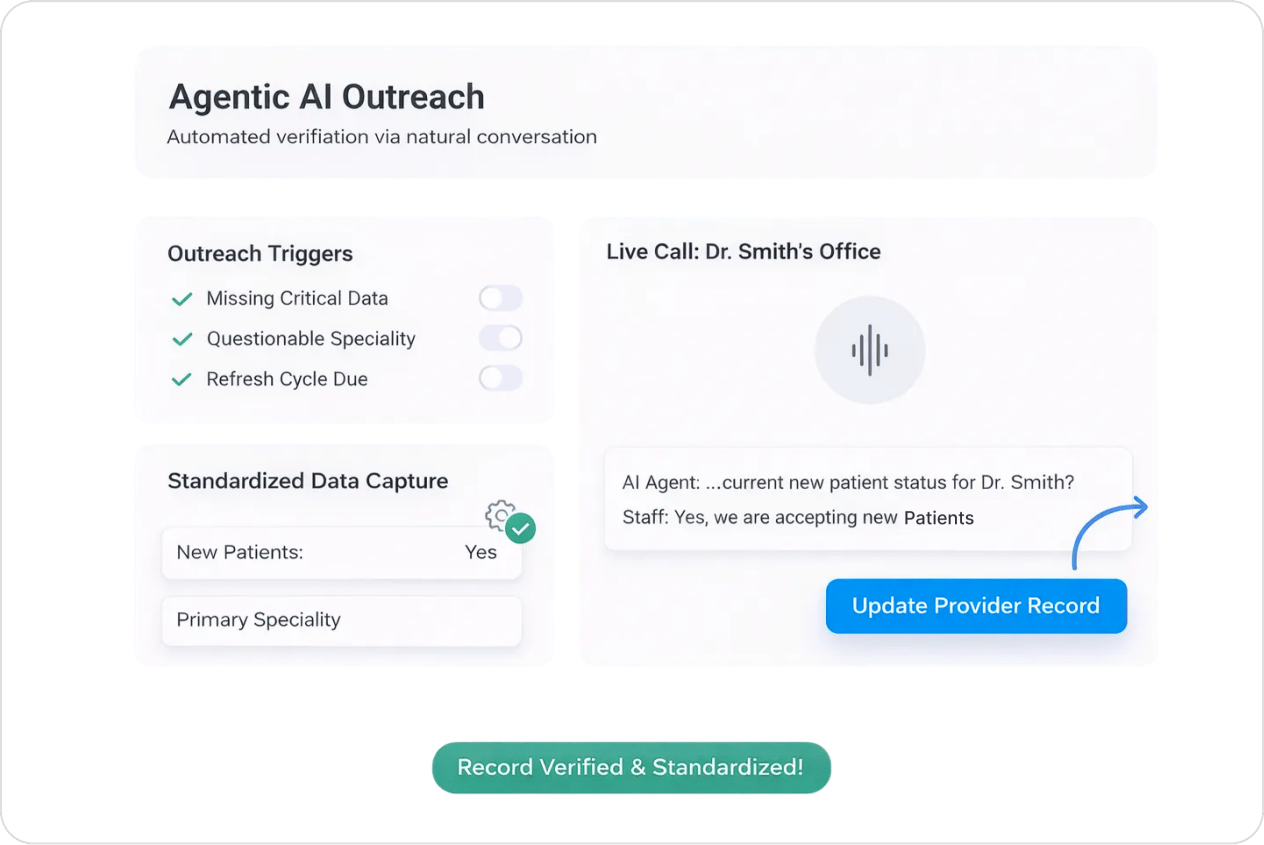
Automated Calls to Provider Offices
- AI places calls to provider offices to confirm availability, telehealth status, and hours
- Collects missing data points that no public source can supply
- Converts office responses into standardized, logged data fields automatically
- Resolves the majority of outstanding questions without requiring a human agent
[06] Human Call Center
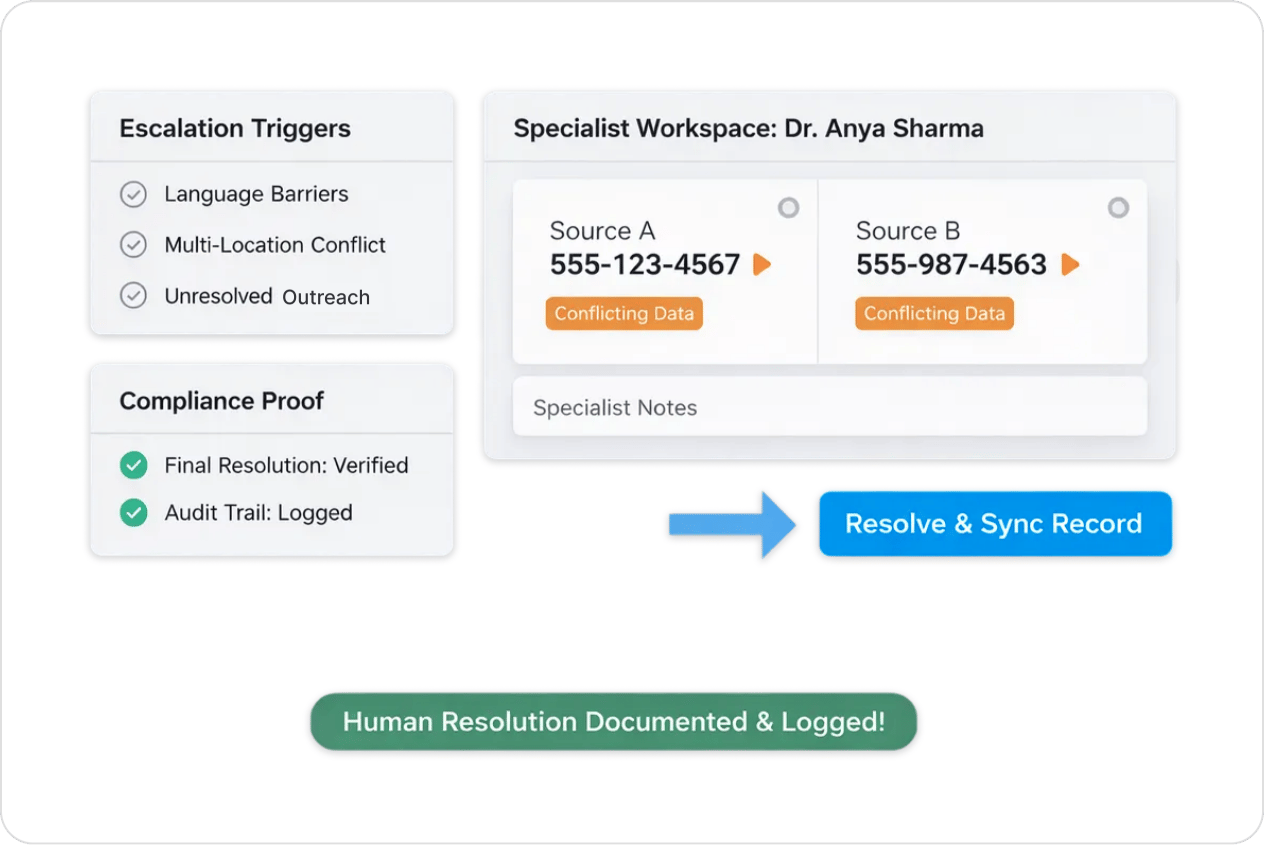
Expert Escalation for Complex Cases
- Unresolved discrepancies and failed AI outreach escalate to trained human agents
- Agents handle multi-location providers, language barriers, and conflicting records
- Every human interaction is logged with findings, resolution, and source confirmation
- Human agents handle exceptions only, keeping the process efficient and auditable
Continuous and Scheduled Validation
Continuous and Scheduled Validation
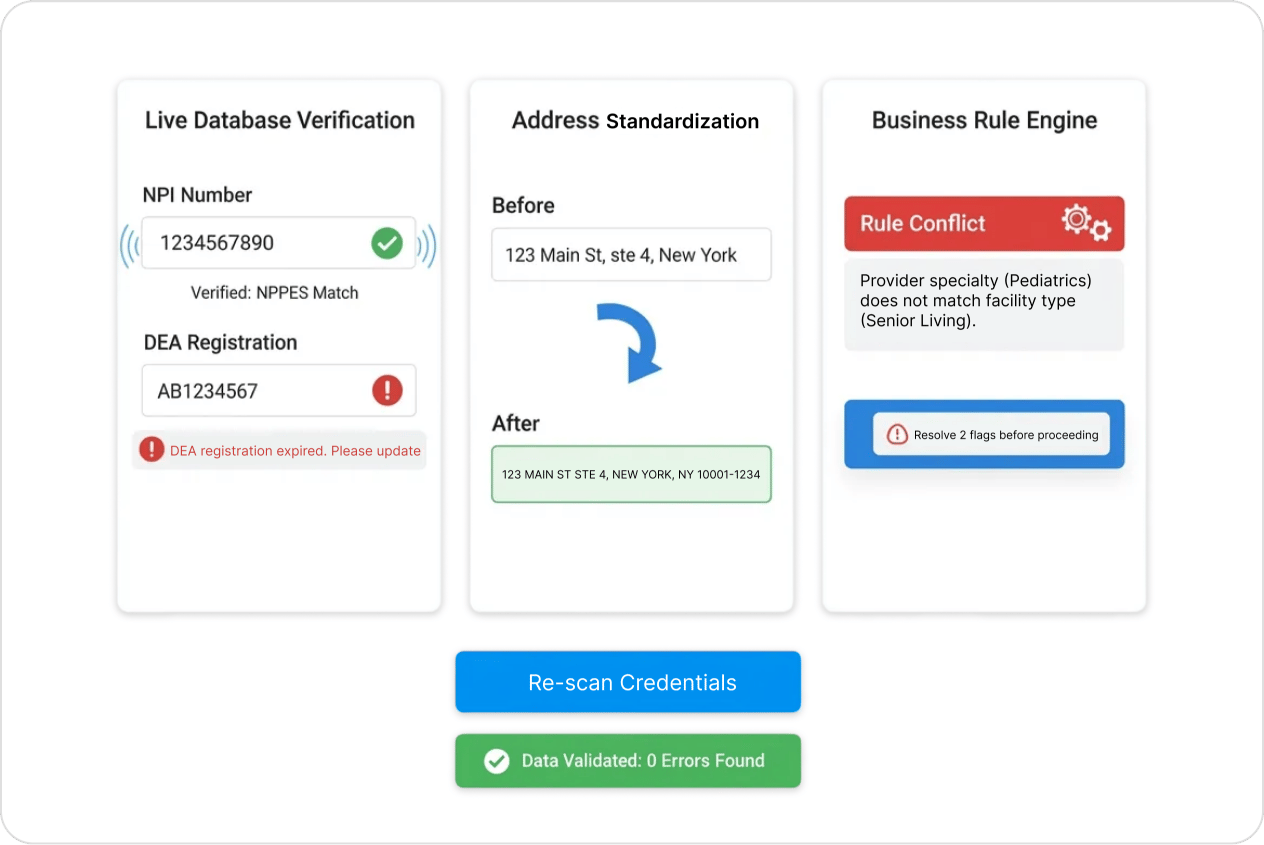
- Scheduled cycles validate all providers through six layers and create audit-ready documentation
- Results sync automatically with credentialing systems, directories, and claims platforms
- Continuous monitoring tracks provider websites, license boards, and the Death Master File
- Detected changes trigger instant re-validation, keeping data accurate and up to date
Validation-Driven Results
Accuracy at scale, with the documentation to support it.

Provider Data Accuracy
Achieved across validated provider networks

Continuous Validation
Triggered the moment a record changes

6-Layer Validation
From primary source to human expert

Lower Cost
Automated layers replace outsourced verification
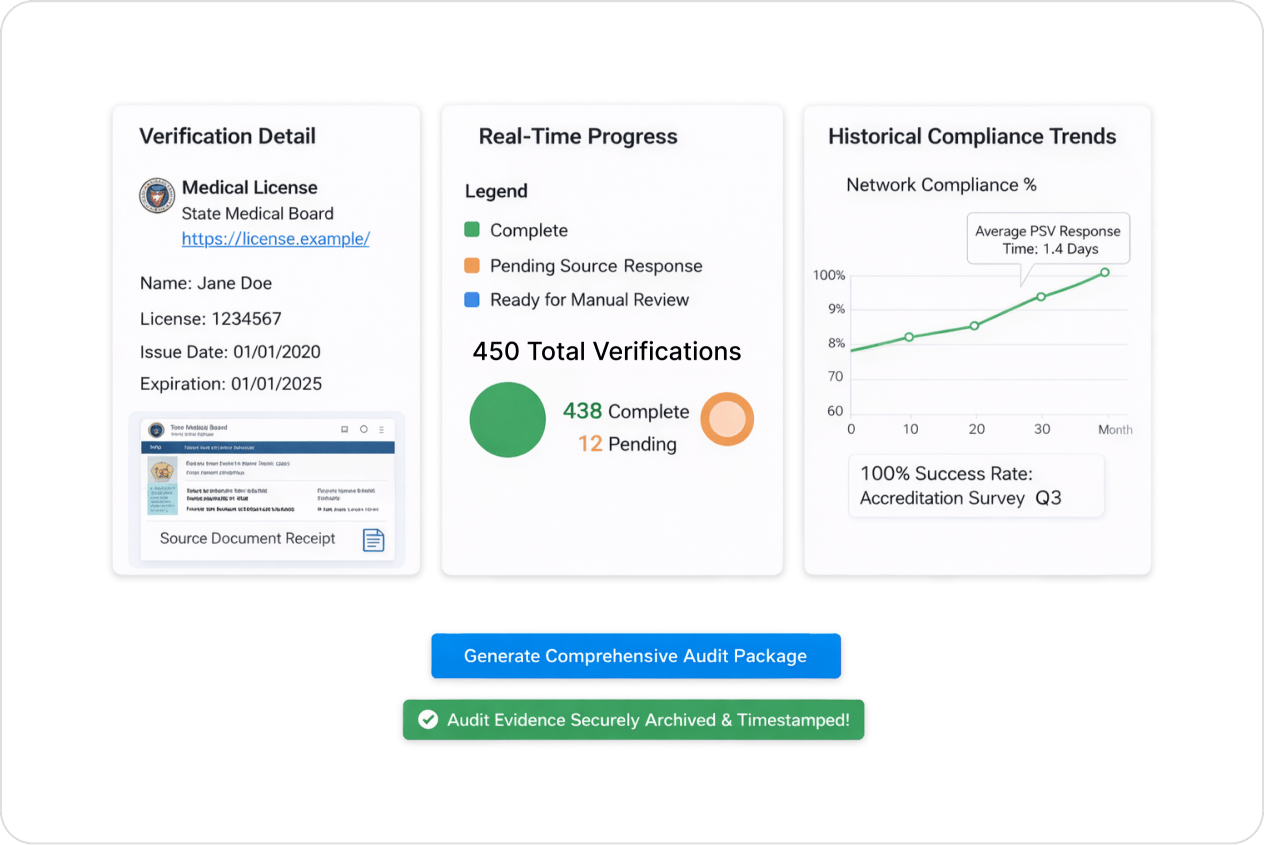
Complete Documentation
- Audit trails with validation methodology, source attribution, and timestamped evidence per record
- Call recordings and query logs from every automated and human outreach step
- Exception flags and resolution records for every case escalated to human review
- Continuous monitoring logs showing validation frequency and change history per provider