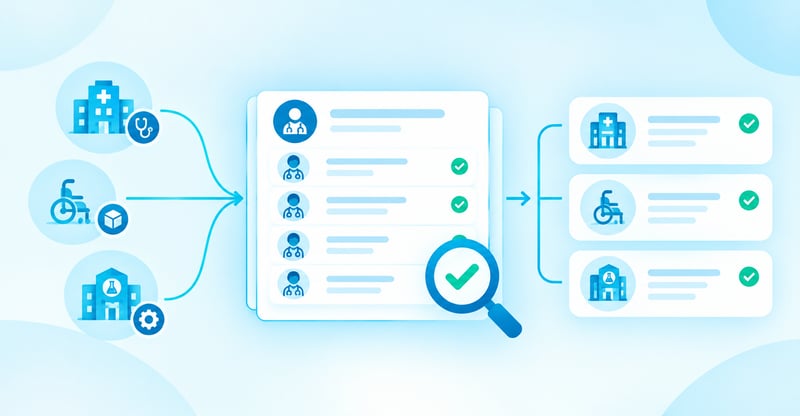
Accurate provider directories are no longer a back-office obligation. They are a visible measure of how well a health plan operates. CMS has outlined clear expectations for maintaining current, reliable provider information, and plans are expected to demonstrate ongoing compliance.
Yet many organizations find that meeting the letter of the requirement is different from sustaining day-to-day accuracy. Validation cycles, data dependencies, delegated credentialing models, and operational silos all influence directory performance. When these factors are not aligned, even well-intentioned processes can fall short.
This guide explains what CMS requires, where common validation approaches create friction, and how health plans are improving directory accuracy while reducing operational strain. The focus is practical: building repeatable processes that support compliance and strengthen member confidence.
What Are CMS Provider Directory Requirements?
CMS provider directory requirements are regulatory rules that require health plans to maintain accurate, up-to-date provider directories that include provider contact information, specialties, network status, and accessibility information.
Why Directory Accuracy Is a Compliance and Trust Issue
Provider directories operate at the intersection of regulation and member experience. They inform care decisions, support network adequacy reporting, and directly affect Star ratings and complaint trends. According to Atlas Systems’ 2025 Member Experience Monitor, 58% of members report encountering incorrect information in a provider directory at least once.
Accuracy, therefore, is not only about avoiding findings. It is about ensuring members can confidently access care based on the information provided.
The downstream effects compound quickly. When members find errors, 80% report decreased trust in their health plan. Meanwhile, 71% now use Google to search for providers instead of plan directories, and 40% believe these alternative sources are more accurate.
CMS enforcement reflects this reality. The Interoperability and Patient Access Final Rule established strict standards, and audits now carry penalties from $25,000 to several million dollars depending on severity.
Core CMS Provider Directory Requirements
Understanding CMS requirements is your starting point. These span the Interoperability Final Rule, network adequacy standards, and Medicare Advantage rules.
What You Must Include
Every provider directory must contain specific verified information:
- Provider name, credentials, and specialty (including sub-specialties)
- Practice location addresses with suite numbers
- Direct appointment phone numbers
- Accepting new patients status
- Languages spoken at the practice
- Accessibility features for patients with disabilities
- Network status and participation dates
- Hospital affiliations for physicians
Missing even one element for a single provider triggers compliance findings during audits.
Update Frequency and Real-Time Changes
CMS requires directory updates at least every 90 days for standard data. Critical changes need immediate updates: provider terminations, location closures, and new patient acceptance changes must be reflected within days, not months.
The 90-day standard creates a fundamental problem. Provider data changes constantly. A physician accepting new patients in January may close their practice by March. Plans validating quarterly are guaranteed to show outdated information during each cycle.
FHIR API Requirements
Plans must provide machine-readable provider data through an FHIR-compliant API. This ensures members and third-party applications can access current information in standardized formats.
The API must include Practitioner, PractitionerRole, Organization, Location, and HealthcareService resources. Data returned through the API must match your public directory exactly.
Key insight: CMS requires accuracy and documentation but doesn't mandate specific validation methods. Plans that pass audits use upstream validation at the source, not downstream verification after errors enter systems.
Why Plans Fail: The Implementation Gap
Most network teams understand CMS requirements perfectly. The breakdown happens when theoretical compliance meets operational reality.
Manual Validation Cannot Scale
A mid-sized plan with 8,000 providers needs 2,000 verification calls monthly to maintain the 90-day standard. At 15 minutes per call (including busy signals and documentation), that's 500 staff hours monthly just for basic verification.
Most plans spend 200+ hours monthly on manual validation and still achieve only 60-70% accuracy. Staff burnout runs high, audit trails are incomplete, and CMS still finds errors because data changes between validation cycles. The math doesn't work. Manual calling is always reactive, always behind, and never comprehensive enough.
Delegated Groups Create Data Black Holes
Delegated provider groups create the biggest directory accuracy challenge. In a practical example from a large New York payer, delegated groups represented 40% of their network but accounted for 73% of directory errors.
The problem: no two groups submit data the same way. One sends Excel files monthly, another provides quarterly PDFs, a third emails Word documents with incomplete information. Legacy systems can't ingest these varied formats without manual re-keying.
Staff spend hours reformatting and cleaning delegated data. By the time it reaches the directory, information is weeks old. Updates arrive on different schedules, creating a patchwork where some data is current while other sections are months outdated.
Downstream Verification Always Arrives Too Late
Traditional validation verifies data after it enters the directory. This downstream model guarantees a lag between when errors appear and when you catch them. Members experience problems first. Complaints get filed. CMS sees noncompliance during audits.
Even aggressive downstream schedules mean you're always chasing errors instead of preventing them. The only sustainable approach is upstream validation that verifies accuracy at the source before data flows into your systems.
How Leading Plans Achieve Consistent Compliance
Health plans that consistently pass CMS audits share common characteristics. They've moved beyond manual processes to automated validation frameworks that prevent errors rather than react to them.
Multi-Layer Validation Framework
The most effective strategies use multiple data sources in layers, creating redundancy and cross-verification:
Layer 1: Provider Websites as Primary Source. Automated tools pull data from provider websites weekly. Practices update their sites first when information changes because they control them directly.
Layer 2: Public and Government Sources. Cross-reference against NPPES for NPI validation, state medical boards for licenses, and CMS Care Compare for hospital affiliations.
Layer 3: Sanction Screening. Run providers through OIG LEIE exclusions, SAM.gov debarments, and state Medicaid exclusions.
Layer 4: Network Consistency Checks. Compare provider details across multiple payer directories in your region. When five other plans list the same provider at a different address, investigate further.
Layer 5: Automated Outreach. AI systems call provider offices to verify accepting new patients status, office hours, and insurance participation without consuming staff time.
Layer 6: Exception-Based Human Verification. Reserve call center staff for exceptions where automated layers find discrepancies. This reduces manual work by 80% while maintaining accuracy for complex cases.
This layered approach is what continuous provider data validation looks like in practice, source-backed and automated rather than dependent on quarterly manual calls.
Plans using multi-layer validation with PRIME® achieve 95%+ accuracy compared to 42% for manual-only approaches. The framework also creates audit trails showing when each data point was validated, from which source, and who reviewed exceptions.
API-First Architecture
Modern provider data management requires systems that ingest data from multiple sources and push updates to multiple destinations automatically. FHIR-compliant APIs enable bidirectional sync between your credentialing platform, claims system, and public directory.
When a provider group sends an updated roster, your system should automatically clean the data, validate against authoritative sources, flag exceptions, and push approved updates to all connected systems. This real-time flow eliminates compliance lag.
API integration solves the delegated data problem. Build intake APIs that accept Excel, CSV, PDF, even screenshots. Rules engines normalize data automatically regardless of input format.
PRIME®: Upstream Validation at Scale
If you've evaluated upstream validation strategies and still face manual reconciliation challenges, you need purpose-built technology. PRIME® by Atlas Systems implements the six-layer framework above, starting with automated collection from provider websites as the primary source.
The platform cross-references information against NPPES, state medical boards, OIG exclusions, and other authoritative sources to build comprehensive validation records. For delegated groups, PRIME® ingests files in any format without pre-cleaning.
AI-powered outreach places calls to verify accepting new patients status and office hours. When AI can't resolve an issue, the platform escalates to human agents. This achieves 95%+ accuracy while reducing manual calling by 80%.
Every validation step creates timestamped audit logs showing what was verified, when, and from which source. When CMS audits your directory, you provide complete documentation without scrambling to reconstruct what you did months ago.
From Compliance Burden to Competitive Advantage
Plans that meet CMS standards do more than avoid penalties. They build member trust, reduce call center costs from directory complaints, and create better retention. Accurate directories directly impact member satisfaction.
When members reliably find in-network providers actually accepting new patients at listed locations, they trust their health plan. That trust translates into better retention during annual enrollment and positive word-of-mouth that drives growth.
Traditional manual validation cannot deliver the accuracy CMS requires. Upstream validation frameworks that verify data at the source create sustainable compliance. Whether you're facing a CMS audit, preparing for Stars improvement, or exhausted by manual verification, start by assessing your current accuracy.
Request a free directory accuracy audit to understand your baseline and identify high-risk provider segments. Or get a demo to see how PRIME® handles delegated data in a 20-minute demo focused on your specific challenges.
Frequently Asked Questions
1. What are the key CMS requirements for provider directories?
CMS requires health plans to maintain accurate provider directories including name, specialty, location, phone numbers, accepting new patients status, and languages spoken. Data must be validated at least every 90 days and made available via FHIR-compliant API. Plans must document validation methods and provide evidence during audits.
2. How often should provider directories be updated for CMS compliance?
CMS requires updates at least every 90 days for most data elements. Critical changes like provider terminations, location closures, and accepting new patients changes must be reflected within days. Plans updating only quarterly risk showing outdated information for extended periods, creating compliance violations.
3. What penalties can health plans face for directory inaccuracy?
CMS can impose penalties from $25,000 to several million dollars for directory accuracy violations. Beyond fines, plans face member complaints that lower Star ratings, reduced enrollment, and increased regulatory scrutiny. Research shows directory errors cause 80% of affected members to trust their health plan less.
4. What is upstream provider data validation?
Upstream validation verifies provider information at the source before it enters your directory. This includes automated collection from provider websites, direct feeds from practice management systems, and real-time roster updates from delegated groups. Unlike downstream validation that calls providers after errors appear, upstream validation prevents inaccuracies.
5. How can health plans reduce manual directory validation work?
Multi-layer validation frameworks automate 80% of verification by combining AI-powered collection from provider websites, public source validation through NPPES and state boards, automated outreach, and exception-based human calling only when needed. This achieves 95%+ accuracy while reducing staff hours from 200+ monthly to under 40.








.webp?width=387&height=387&name=Medtech%20Breakthrough%20Award%20Winner%20(1).webp)





























%20(1).jpg)