Network complexity has outpaced internal IT capacity at most organizations. Managed NOC services have become the answer many companies land on, but the decision deserves more than a vendor comparison spreadsheet.
What Are Managed NOC Services?
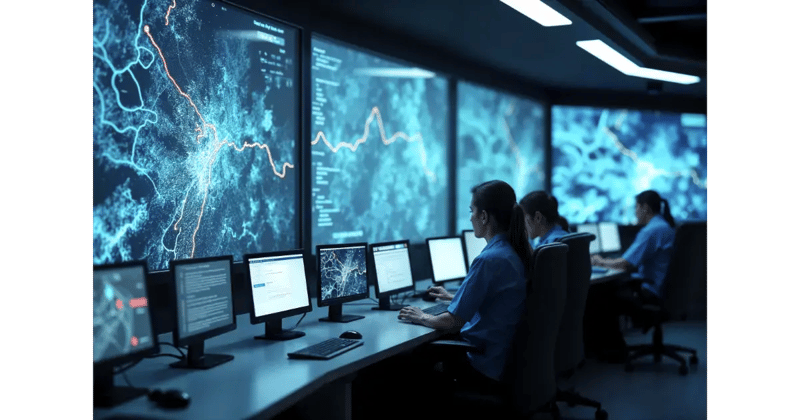
A Network Operations Center (NOC) is where IT professionals monitor, manage, and respond to network events. When that function is outsourced to a third party, it becomes a managed NOC service.
At its core, a managed NOC handles continuous monitoring of your network devices, servers, applications, and connectivity, then responds according to defined procedures. Depending on scope, this also covers patch management, vendor coordination, capacity planning, and reporting.
What separates managed NOC services from basic monitoring is the human layer. Alerts without interpretation are just noise. A managed NOC filters, classifies, and acts. Managed services remain among the fastest-growing segments of IT spending, driven largely by hybrid and multi-cloud complexity.
Why Do Companies Outsource Their NOC?
The business case usually comes from one of three directions.
Staffing gaps: Building a 24x7x365 internal NOC requires 12 to 15 full-time engineers when you factor in shifts, vacations, and turnover. For most mid-sized organizations, that math simply doesn't work.
Multi-vendor expertise: Enterprise environments run Cisco, Palo Alto, Aruba, Fortinet, and others simultaneously. Maintaining current certifications across all of them internally is unsustainable for most teams.
Cost predictability: Capital expenditure on monitoring infrastructure plus headcount creates budget variability that's hard to forecast. Managed NOC converts that into a predictable monthly operating expense. According to several reports, organizations using managed infrastructure services report 20 to 30 percent reductions in IT operational costs on average.
There's also the strategic dimension. When internal IT teams are consumed by alert triage and incident response, architecture and transformation work stalls. Outsourcing NOC services frees that capacity.
The Tiers of Managed NOC Services
Most managed NOC providers use a three-tier model.
L1 engineers
handle alert triage, basic troubleshooting, and runbook-based resolution. A well-run NOC targets a first-contact resolution rate of 70 percent or higher at this level, meaning most issues never escalate further.
L2 engineers
are senior specialists who handle vendor coordination, deeper diagnostics, and configuration-level troubleshooting. They typically engage within 30 to 60 minutes of escalation.
L3 support
involves subject matter experts and architects, usually on-call, handling architecture-level problems and complex issues requiring direct vendor escalation. Response at this tier starts within one to four hours depending on severity.
Above the technical tiers sits a support lead responsible for operational oversight, SLA adherence, and client communication. A clear management escalation path, where Severity 1 incidents auto-route to senior leadership within defined timeframes, is what makes a NOC genuinely accountable for your uptime.
How Does Pricing Work?
Managed NOC pricing has more variables than most buyers expect, and proposals from different vendors are hard to compare without understanding what's driving the numbers.
Device-based pricing is most common for network-focused NOC services, typically ranging from $15 to $75 per device per month depending on monitoring depth and provider.
Flat-fee tiered models bundle monitoring, incident response, and reporting into a monthly fee based on environment size, offering better cost predictability.
Add-on services create most of the pricing complexity. Patch management, on-site hands and feet support, and advanced analytics are often scoped separately. Ask every provider where the included-versus-billed line sits before signing anything.
Geographic coverage affects cost significantly. Global follow-the-sun coverage across Americas, EMEA, and APAC requires more staffing than regional support. If your organization operates internationally and your provider only guarantees U.S. business hours escalation coverage, that gap will surface at the worst possible time.
What Problems Does Managed NOC Actually Solve?
1. Alert fatigue:
Large environments generate thousands of alerts daily. Operations teams spend a significant portion of time managing false positives. A properly tuned NOC uses multi-source correlation and automated filtering to ensure engineers only see alerts that matter.
2. After-hours coverage with accountability:
A 2 AM outage either waits until morning or pulls an on-call engineer out of bed with limited context. A managed NOC with documented runbooks and direct device access resolves most incidents without touching your internal team.
3. Vendor coordination burden:
Opening and tracking TAC cases with Cisco or Palo Alto takes time that your engineers should spend on resolution, not paperwork. A managed NOC provider with pre-established support contracts handles this on your behalf.
4. Consistency under pressure:
Internal teams handle incidents differently depending on who's on shift. A managed NOC enforces standardized procedures across every severity level, every shift, every time.
5. Compliance readiness:
For regulated industries, documented incident tracking, change management records, and compliance monitoring are non-negotiable. A SOC 2 certified NOC provider generates that audit trail without your team building it from scratch.
How Atlas Systems Delivers Managed NOC
Atlas Systems has been delivering 24x7x365 global NOC support to enterprise clients for over 20 years. For organizations evaluating managed NOC partners, here's what Atlas Systems brings to the table specifically.
Certified multi-vendor expertise: Atlas engineers hold current certifications across Palo Alto (PCNSA, PCNSE), Cisco (CCNA, CCNP, CCIE), and HP Aruba Silver Peak. Support spans the full stack, from Cisco Catalyst and Nexus switching, to Palo Alto NGFW and VM-Series, to Silver Peak SD-WAN edge appliances.
PRTG-based enterprise monitoring: Atlas leverages PRTG as its monitoring platform, supporting 10,000+ sensors with one-minute polling intervals and 365-day data retention. It integrates directly with ServiceNow, Jira, Sumo Logic SIEM, and Microsoft Teams for automated ticket creation and real-time notifications. Clients get read-only dashboard access and customizable views, so visibility is never gated behind a support call.
Structured SLA commitments with financial accountability: Atlas operates a four-tier severity model: Critical (S1) incidents receive a 15-minute response with non-stop resolution until the issue is closed or a workaround is established. High (S2) incidents get a one-hour response. Atlas targets greater than 95 percent SLA compliance, greater than 90 percent CSAT scores, and a year-over-year reduction of at least 5 percent in recurring tickets.
Global follow-the-sun delivery: Centralized NOC operations cover North America, Europe, and APAC with dedicated teams providing continuous coverage. Management escalation triggers are defined and documented: 15 minutes for automatic escalation to support lead and client managers, four hours to VP level with customer briefing, eight hours to C-level notification.
Hands and feet support: Atlas owns and orchestrates on-site support globally through an established network of field service partners. Annual packages include 80 hours of on-site support, with additional hours billed transparently. Single-point accountability through the Atlas NOC means one contact for all on-site requests regardless of geography.
ComplyScore® for continuous compliance: Atlas's proprietary risk and compliance monitoring platform provides real-time vendor risk assessment, automated compliance tracking, and executive dashboards for ongoing visibility into your security posture.
Proven at scale. For a global sporting goods company with 2,500+ network devices across 150+ locations, Atlas delivered a 90 percent reduction in downtime through 24x7 NOC, SD-WAN migration, and real-time monitoring with PRTG and LogicMonitor. For a global investment firm with 12+ offices, Atlas implemented centralized Silver Peak SD-WAN, Palo Alto firewall management via Panorama, and Cisco Meraki wireless standardization with 24x7 support and measurable uptime improvement.
Machine Learning and Automation in the NOC
This is where the gap between what providers claim and what they actually run varies most.
Alert correlation is the most widely deployed application. ML models group related alerts, suppress known false positives, and surface probable root causes rather than flooding engineers with raw events.
Dynamic threshold anomaly detection learns baseline behavior per device and alerts when deviation is statistically significant, catching degradation that static thresholds miss entirely. As per Gartner insights, 40 percent of enterprises supplement or replace infrastructure monitoring with AIOps platforms.
AI-driven runbooks surface documented resolution steps for similar past incidents the moment a ticket opens, accelerating L1 resolution and reducing knowledge gaps between engineers. A mature NOC should be resolving 50 percent or more of incidents through automation-assisted runbooks.
Automated ticket creation and routing eliminates the manual step of translating a monitoring alert into a properly classified ticket. When monitoring integrates with your ITSM via API, tickets are created in seconds with diagnostics already attached.
What automation does not replace is judgment on novel incidents. Experienced engineers, institutional environment knowledge, and direct vendor relationships remain essential for the hard cases. The best NOC operations use automation as a filter and accelerator, not a substitute.
What to Look for in a NOC Provider
Beyond the sales deck, four things separate good providers from average ones.
- Certifications that actually work your tickets. Ask how many engineers hold the certifications relevant to your environment and whether those engineers handle live incidents or are just on a capabilities list.
- SLA terms with financial consequences. Any provider can publish targets. Ask what happens contractually when they miss them.
- Team stability. Engineers who know your environment handle incidents faster. Ask about average engineer tenure, documentation practices, and how institutional knowledge is preserved through staff changes.
- Security model for remote access. Your NOC provider will have deep access to your infrastructure. Providers who operate through client-controlled VPN and managed devices reduce your attack surface significantly compared to those routing through their own network.
Ready to Rethink Your NOC?
Atlas Systems delivers comprehensive 24x7x365 managed NOC support for global enterprises, with certified multi-vendor engineers, SOC 2 Type II certification, ITIL-compliant processes, and SLA commitments backed by financial guarantees.
Whether you're dealing with alert overload, coverage gaps, or a network environment that's grown faster than your team can manage, Atlas brings the expertise, tooling, and accountability structure to close that gap.
Talk to Atlas about your NOC requirements and see how the team that has supported global investment firms, sporting goods companies, and Fortune-class enterprises can do the same for yours.
FAQs: Managed NOC Services
1. What does a managed NOC service include?
24x7 network monitoring, alert response, incident management, patch coordination, vendor escalation, and reporting, delivered by a third-party team on your behalf.
2. How is a managed NOC different from basic monitoring?
Monitoring generates alerts. A managed NOC filters, classifies, and acts on them, with documented procedures and accountable response times.
3. How much do managed NOC services cost?
Most providers price between $15 and $75 per device per month depending on monitoring depth, coverage geography, and included services.
4. What's the minimum response time I should expect from a NOC provider?
For Critical (S1) incidents, 15 minutes or less. Anything slower for a full outage is too slow.
5. Do I lose visibility into my own network when I outsource NOC?
No. Reputable providers offer client-facing dashboards and real-time portal access so you always have visibility without managing the operation yourself.

.svg)

.svg)


.webp?width=869&height=597&name=image%20(5).webp)


-1.png?width=486&height=315&name=IDC%20Banner%20(1)-1.png)



.png?width=300&height=175&name=Rectangle%2034624433%20(2).png)


.webp?width=1280&height=720&name=Medtech%20Breakthrough%20Award%20Winner%20(1).webp)















%20(1).jpg)