







.webp?width=387&height=387&name=Medtech%20Breakthrough%20Award%20Winner%20(1).webp)



























Provider Lifecycle Management


TL;DR
- Value-based care shift: Healthcare moving from fee-for-service to value-based models where providers earn rewards for patient outcomes, cost efficiency, and satisfaction
- Four key benefits: Improved patient outcomes through reduced administrative delays, decreased costs from streamlined processes, enhanced care coordination, and more efficient resource utilization
- Traditional model challenges: Misaligned incentives promote volume over value, lack of data integration causes fragmented care, manual administrative processes introduce errors and inefficiencies
- Joint platform advantage: Provider-payer platforms enable real-time data sharing, collaborative decision-making, reduced administrative disputes, and better cost transparency for seamless patient experiences
Summarize This Article With
Picture this scenario: Sarah, who needs surgery, gets stuck with a $6,000 bill because her doctor and insurance can’t agree. She skips buying medicine to save money as her doctor fights for approval. She has to deal with delayed care and a whole lot of stress—because her doctor and insurance disagree. Sounds familiar?
This is what misalignment between payers and providers can do.
Payer-provider collaboration is crucial because it dictates whether the healthcare system works for patients or against them. When insurance companies and healthcare providers work together, they reduce costs and improve patient health outcomes. There’s no fighting over reimbursements or approvals; patients get the right care at the right time.
Definition of payer-provider collaboration
Payer-provider collaboration refers to the relationship between healthcare payers (insurance companies, government programs) and providers (hospitals, doctors, clinics). Collaboration between these parties improves patient care, minimizes costs, and enhances healthcare efficiency.
Payers and providers should work together to create value-based care models, share information, and align goals to deliver high-quality, cost-effective care. Collaboration involves data sharing and joint strategies for transparent communication. It benefits both parties and improves patient outcomes.
Importance of collaboration in the healthcare ecosystem
When healthcare providers, insurance companies, pharmaceutical companies, and technology providers work together, they boost operational efficiency, foster innovation, and expand access to care.
Payer-provider collaboration allows healthcare professionals to merge their expertise to enhance communication, reduce medical errors, and efficiently use resources. Working together as a team optimizes care delivery and patient well-being.
Streamlined processes resulting from collaboration prevent duplicative efforts, helping healthcare institutions save money while making healthcare more affordable and sustainable. And as professionals in different disciplines exchange ideas and expertise, innovation goes up. Modern healthcare systems are highly interconnected, making collaboration crucial for creating a resilient and adaptable healthcare ecosystem.
Collaboration is also vital for public health and crisis management. When healthcare facilities, government agencies, and community organizations build strong partnerships, it’s easier to manage disease outbreaks, solve public health challenges, and implement preventive care strategies. Stakeholders in the healthcare ecosystem must work together to build a more efficient, patient-focused system that prioritizes everyone’s well-being.
Enrollment is the most frequent operational touchpoint between providers and payers. Payer enrollment software standardizes that exchange, so registration data, application status, and revalidation requirements flow through one channel rather than dozens of payer portals.
The Current Landscape of Payer-Provider Relationships
Payer-provider relationships evolve as healthcare systems shift toward value-based care and cost efficiency. Here’s how the current landscape looks: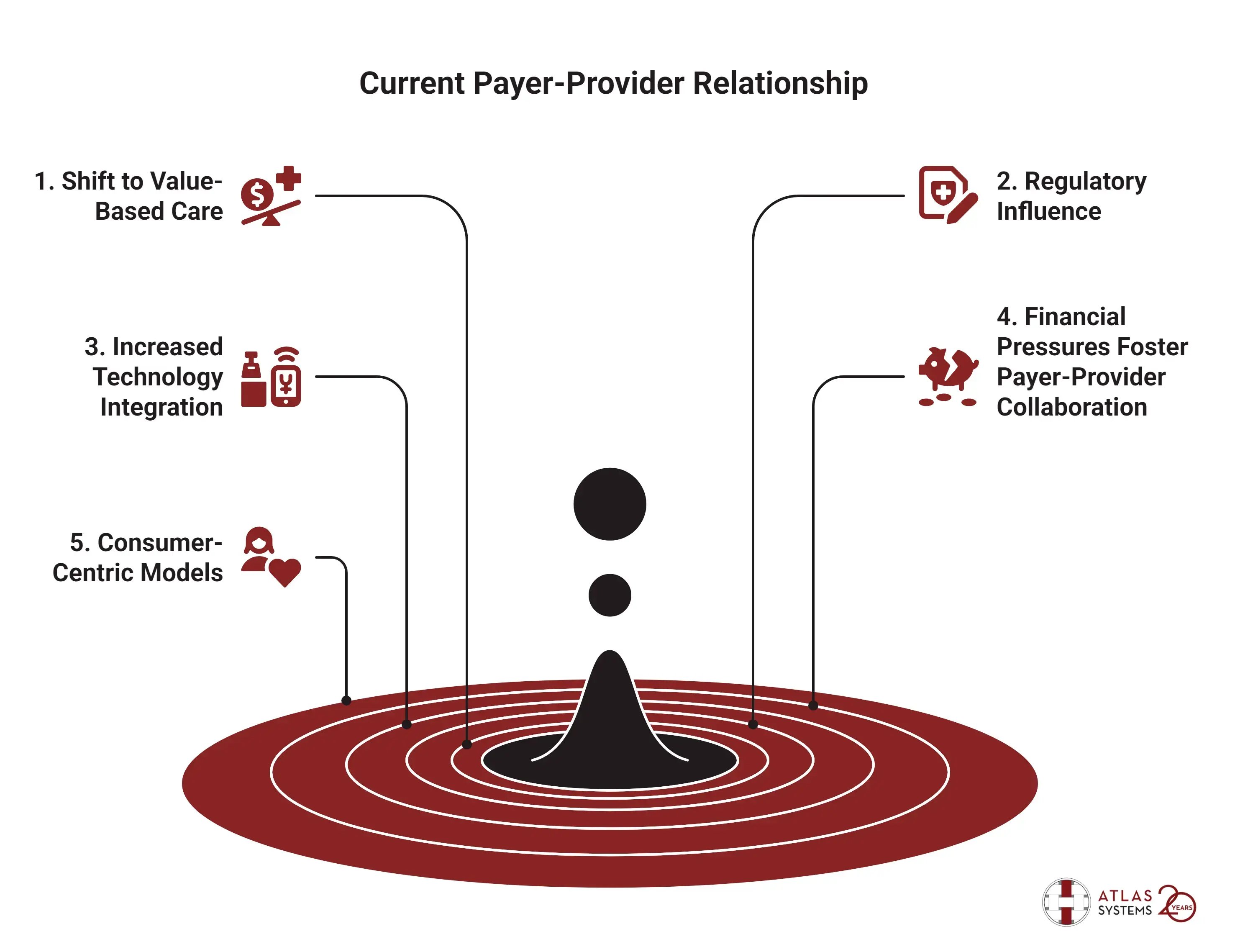
1. Shift to Value-Based Care (VBC):
Value-based care models are replacing fee-for-service models as payers incentivize providers through models like Accountable Care Organizations (ACOs) and bundled payments. Reimbursements are now linked to outcomes, cost efficiency, and patient satisfaction. For example, Medicare’s Direct Contracting Model allows healthcare providers to take on financial risk but also earn rewards for keeping patients healthy and reducing unnecessary costs.
2. Regulatory influence
Payer-provider relationships are highly influenced by regulations like the Affordable Care Act (ACA), which promotes coordinated care and preventive services. Some regulations, like the CMS’s 2021 mandate Price Transparency Rules, ensure providers and payers disclose costs to empower consumers.
3. Increased technology integration
Payers and providers must now adhere to interoperability regulations like the 21st Century Cures Act, which requires seamless data sharing between EHRs and payer systems to lower administrative burdens. And post-pandemic, many payers now cover telehealth services, which has prompted providers to invest in digital infrastructure.
Automated roster management sits at the center of this interoperability mandate, turning what used to be spreadsheet-and-email reconciliation into real-time, FHIR-based data exchange between provider groups and health plans.
4. Financial pressures foster payer-provider collaboration
Declining reimbursements, rising operational costs, and increased chronic diseases have made payers and providers collaborate to save money and achieve sustainable margins. Payers have shifted from fee-for-service models to value-based arrangements to mitigate financial risk.
Providers now partner with payers to reduce avoidable hospitalizations and improve patient outcomes, boosting their bottom line as there are no denied claims. Predictive analytics enable both payers and providers to identify high-risk patients for proactive care management.
5. Consumer-centric models
Consumer-centric models prioritize patient outcomes, creating shared goals for improving care and reducing costs. As patients demand more transparency, payers and providers must work together to streamline services and improve care coordination.
Value-based care models, telehealth, and predictive data foster collaboration to enhance patient engagement and satisfaction. Payers and providers now align goals around consumer needs to offer integrated care solutions that improve health access and reduce costs.
Challenges:
- Regulatory complexity: Constantly evolving regulations create administrative burdens and require ongoing adjustments to billing and care delivery processes.
- Data privacy concerns: Strict regulations like HIPAA require strong data protection measures, complicating data sharing and interoperability efforts.
- Misaligned priorities: These often create conflicts over cost control, reimbursement models, and care quality. Payers focus on controlling costs, while providers focus on care quality—which can lead to disputes over delays in care, payment structures, and administrative burdens.

Benefits of Payer-Provider Relationships
Payer-provider partnerships offer numerous benefits to everyone involved as they greatly enhance the healthcare system's efficiency and effectiveness. Here are some top benefits:
1. Improved patient outcomes
Collaboration between payers and providers cuts the red tape—specialist referrals don’t get stuck in a month-long approval limbo. Both parties prioritize preventive care initiatives and address health risks before they escalate into more serious conditions. This approach improves population health and reduces healthcare costs.
2. Decreased costs
Payers and providers minimize administrative burdens when processes like prior authorizations and referrals are streamlined. Providers focus on their patients' needs, which improves population health. A healthy population needs less medical care, and this reduces payers’ costs. The healthcare system becomes more effective and efficient.
3. Value-based care
Value-based care focuses on quality over quantity, and providers are rewarded for keeping patients healthy and improving outcomes. Healthier patients mean lower payer expenses. Payers and providers should work together to deliver preventive care and eliminate unnecessary procedures. This enhances patient experiences, lowers administrative burdens, and creates a more efficient healthcare system.
4. Enhanced care coordination
Strong payer-provider relationships improve care coordination. Patient information flows seamlessly, ensuring healthcare teams streamline referrals, develop unified care plans, and prevent unnecessary hospital visits. Payers help providers identify high-risk patients, track outcomes, and implement preventative measures. By sharing information and aligning goals, both parties prioritize patients’ well-being.
5. More efficient resource utilization
Solid payer-provider partnerships optimize care delivery by ensuring medical services are only used where they are most effective. Both parties use up-to-date patient information to identify high-risk patients, prevent unnecessary procedures, and allocate resources strategically. The well-coordinated system benefits everyone—staff, equipment, and treatments are used efficiently.
Challenges with Traditional Payer-Provider Models
Traditional models have many challenges that hinder efficiency, cost-effectiveness, and patient outcomes. Let’s look at some of them:
1. Misaligned incentives
Traditional models promote volume-based care rather than value-based care, leading to unnecessary treatments and higher costs. On the other hand, value-based models align incentives with patient outcomes, so providers are only rewarded for delivering high-quality, cost-effective care.
2. Lack of data integration
When payers and providers use different systems, data sharing isn’t seamless, which leads to fragmented care and errors. Both sides struggle with inaccurate patient records and limited insights. Collaborative models focus on interoperability to improve patient outcomes.
3. Limited patient-centric care
Traditional healthcare models prioritize costs over patient satisfaction and health outcomes, resulting in higher readmission rates and increased costs (for the payer). Providers focus on volume rather than quality care, and payers struggle to manage costs. This misalignment fosters distrust, hindering the delivery of high-quality care that benefits patients and the healthcare system.
4. Manual administrative processes
Manual processes, such as claims submissions and prior authorizations, introduce errors and inefficiencies, increasing administrative burdens. Payers can deny claims or underpay, and providers may have to divert resources from patient care. Manual processes also foster mistrust between payers and providers, making it difficult for them to manage their revenue cycles effectively.
Strategies for Better Payer-Provider Relationships
Strong payer-provider relationships can transform healthcare, sparing patients from the effects of a disconnected system. Here are the top strategies for better payer-provider relationships:
1. Transparent communication
Payers and providers must establish regular, honest dialogue to prevent misunderstandings and misalignments. This is crucial for building trust. Proactive outreach can help them address potential issues before they escalate, like reasons for claim denials and appeals. Clear communication channels keep both sides aligned on goals, policies, and expectations.
2. Effective data sharing and analysis
When payers and providers securely exchange patient health data, claims information, and treatment insights, they have a clearer picture of patient needs and reduce unnecessary medical processes. Providers get rewarded for delivering quality treatment rather than just high service volumes. Both parties align on goals, streamline processes, and create a seamless patient healthcare experience.
3. Use a joint payer-provider platform
A joint payer-provider platform strengthens partnerships by facilitating real-time data sharing, collaborative decision-making, and increased transparency for better patient care coordination and cost optimization. Physicians can see what’s covered, and insurers can see patient progress. Payers don’t get a surprise bill for a test they should have known about. This reduces administrative burdens, minimizes disputes, and aligns goals.
4. Value-based contracts
Value-based contracts focus on patient outcomes rather than service volume, aligning incentives between payers and providers. Providers are rewarded for delivering high-quality, cost-effective care. A good example is when Blue Cross Blue Shield of Illinois partnered with Advocate Health Care in a value-based contract focused on reducing hospital readmissions and improving preventive care. This partnership proved that aligning financial incentives with care quality can benefit patients and enhance payer-provider relationships.
5. Continuous engagement and education
The healthcare landscape constantly evolves as new regulations, technologies, and best practices emerge. Regular training programs and joint educational initiatives can help payers and providers stay updated and adapt to changes together. This minimizes misunderstandings, improves efficiency, and promotes a culture of continuous improvement.
Future Outlook for Payer-Provider Partnerships
The future of payer-provider partnerships looks promising. There’ll be a shift towards value-based care and technology adoption. Here’s what the future looks like:
- Higher adoption of value-based care: As more healthcare institutions embrace value-based care models, payers and providers will work together more effectively to improve patient outcomes and reduce healthcare costs.
- Consumer-centric innovation: Joint investments in health platforms, SDOH interventions, and price transparency tools will ensure payers and providers prioritize holistic, patient-centered care.
- Increased technological adoption: More payers and providers will adopt digital technologies like FHIR-based transactions to enhance data exchange and collaboration.
- More partnered insurance products: Partnered insurance solutions will be widely adopted as payers and providers seek to reduce costs and improve care coordination.
- Regulatory and policy changes: Stricter antitrust scrutiny and price transparency rules could reshape contracting dynamics. New policies promoting health equity may push payer-provider partnerships to address inconsistencies through data-sharing and community resource networks.
- Financial resilience: Payers and providers will explore joint ventures (such as payer-provider mergers) and deepen risk-sharing agreements (like offering bundled payments for episodes of care) to stabilize margins.
Let Atlas Systems Streamline Your Payer-Provider Relationships
The complexities of payer-provider relationships demand a solution that can bridge gaps, align incentives, and drive results. Atlas Systems offers tailored solutions to unlock efficiencies. We empower payer and provider organizations to streamline workflows, reduce administrative friction, and prioritize patient outcomes.
Use our platform to navigate regulatory complexities and optimize financial performance. We provide the technology and expertise you need to thrive in a rapidly evolving healthcare landscape. Contact us today to discover how Atlas Systems can future-proof your payer-provider partnership.
FAQs on Payer-Provider Collaboration
1. How does data sharing enhance payer-provider collaboration?
Data sharing aligns payer and provider goals by giving both parties a comprehensive view of a patient's health information. Both sides get a clearer picture, make informed decisions together, and coordinate care effectively. This improves patient outcomes while reducing healthcare costs.
2. What impact do regulatory policies have on payer-provider collaboration?
Regulatory policies influence how payers and providers work together by establishing rules on data sharing, patient care standards, and reimbursement. They determine how the two entities align to deliver patient care effectively. Good policies support collaboration by improving transparency, while stricter regulations make it hard for payers and providers to align on cost, quality, and patient outcomes.
3. How can payers and providers align their goals?
To align goals, payers and providers should focus on shared priorities like reducing costs and improving patient outcomes. They should collaborate through initiatives that reward quality over quantity, such as value-based care models and transparent data sharing. There should be a shift from "fee-for-service" healthcare to value-based care, and both parties will benefit from keeping patients healthier.

%20(1).jpg)

Related Reading

Provider Lifecycle Management
Automated Provider Data Management: A Practical Playbook
Read the blog →
Provider Lifecycle Management
The Complete Guide to Provider Data Management Automation
Read the blog →
Provider Lifecycle Management
Why Behavioral Health Providers Are the Hardest AWT Surveys to Close
Read the blog →
Provider Lifecycle Management
Best Provider Network Management Platforms for Payers and Providers in 2026
Read the blog →
Provider Lifecycle Management