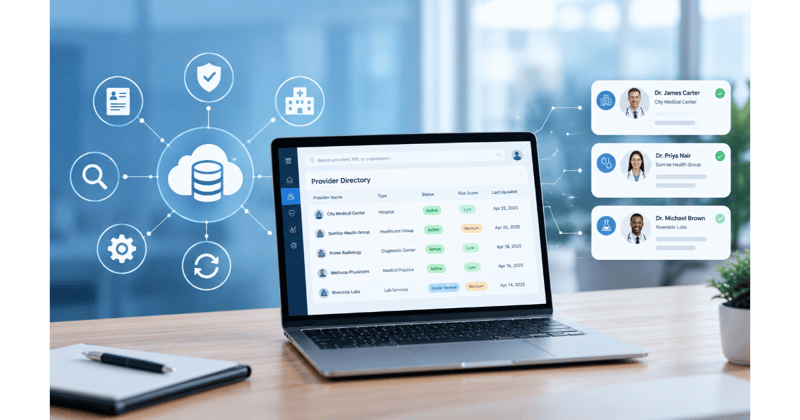
Provider data management has become one of the most expensive operational bottlenecks in healthcare. According to the 2025 Member Experience Monitor research, 58% of health plan members have encountered incorrect information in provider directories at least once. Perhaps more concerning, 80% of those who found errors reported reduced trust in their health plan.
Healthcare payer operations encompass the systems and processes that keep health plans running: provider data management, network maintenance, claims processing, compliance monitoring, and member services. Most organizations have multiple sources of provider information and several platforms designed to manage it.
The real problem is that these systems don't talk to each other effectively, data quality degrades at every handoff, and manual reconciliation becomes the default solution when automation fails.
Closing this gap starts with provider-payer roster management software that automates roster submissions, reconciliations, and updates across payer systems so teams are no longer reconciling spreadsheets line by line.
Why Interoperability Rules Changed Everything
CMS interoperability mandates fundamentally reshaped how payers must handle provider data. Plans must make provider directory information available via standardized APIs, maintain accuracy within specific timeframes, and prove their verification methods during audits.
The practical impact goes beyond compliance checkboxes. Payers must update directory information within two business days of receiving changes and verify all provider information at least every 90 days.
Plans that fail directory accuracy standards face corrective action plans and potential financial penalties. More importantly, directory errors now trigger member complaints that CMS tracks and uses in Star Ratings calculations.
Technical Standards Creating Integration Headaches
The technical infrastructure supporting modern payer operations must handle multiple data standards simultaneously. FHIR (Fast Healthcare Interoperability Resources) has become the backbone for provider data exchange, but most payers still operate legacy systems built on older standards that were never designed to communicate with each other.
Your credentialing system speaks one language, your claims engine another, and your public-facing directory a third. Provider groups send data in dozens of formats, from Excel spreadsheets to PDF attachments and even screenshots. Someone on your team must manually translate, clean, and route every file that doesn't match expected formats.
The technical debt compounds over time. Each workaround creates another failure point. IT teams build custom scripts to bridge system gaps, but these scripts break when vendors update their platforms.
Data normalization becomes the hidden cost killer. A single provider group might send "Dr. Jane A. Smith, MD" in one file, "Smith, Jane" in another, and "J. Smith" in claims data. Your systems must recognize these as the same person, match the correct NPI, verify the license, check for sanctions, and update everywhere simultaneously.
Six Major Challenges in Healthcare Payer Operations
1. Delegated data arrives as chaos
Provider groups send roster updates in any format they choose. Operations teams receive Excel files with merged cells that break import scripts, PDFs requiring manual transcription, and Word documents with unparseable tables. A regional health plan managing 50 to 100 delegated relationships potentially handles 1,200 files annually that each require human review.
2. Data quality degrades across system handoffs
Information flows from provider groups to credentialing, then to claims, then to directories, and finally to member-facing applications. At each handoff, data gets reformatted or mismatched. A provider's office hours might read "Mon-Fri 8am-5pm" in the source file and display incorrectly in the member portal after multiple system translations.
3. No single source of truth exists
CAQH might have one address, the provider's website another, and your claims data a third. Operations staff make judgment calls that create inconsistency. Network managers stop trusting system reports and build shadow Excel trackers.
4. Validation happens too late
Most plans verify provider data quarterly or when prompted by member complaints. By the time you discover an error, members have already experienced frustration. CMS audits measure accuracy at the moment of inspection, and a 30% error rate triggers corrective action.
5. Analytics remain reactive
Executive dashboards show lagging indicators: last quarter's complaints, last month's denials, last week's cycle times. Quality assurance requires predictive capabilities that identify which provider records are likely to be inaccurate before members encounter problems.
6. Integration complexity scales exponentially
Every new system requires custom integration work. Low-code and no-code platforms promise easier integration, but they often lack the sophisticated data validation logic that healthcare payers need.
What Best-in-Class Operations Look Like
Organizations at the highest performance levels have automated provider data ingestion and validation. When operations teams receive roster updates from delegated groups, files trigger automated processing regardless of format. Within minutes, data is cleaned, normalized, matched to existing records, validated against public sources, and flagged only when human judgment is needed.
Credentialing teams see only records requiring actual decision-making: potential duplicate NPIs, providers with recent license changes, or addresses that don't match public databases.
Health analytics reveal patterns invisible with manual processes. Directory accuracy typically reaches 95% or higher. Member complaints about provider access drop significantly. When CMS audits, these organizations produce complete validation logs showing verification dates, sources checked, discrepancies found, and approvals.
Why Starting Early Matters
Operational debt grows faster than most executives realize. Every month without addressing core issues, teams build more workarounds, data quality degrades, and integration complexity increases.
If operations teams spend 200 hours monthly on manual data cleanup at $75 per hour, that's $180,000 annually for one type of rework. Add claims reconciliation, member service inquiries, provider outreach, and compliance reporting, and the hidden cost easily reaches seven figures for a mid-size regional plan.
Better data quality improves member retention. Efficient operations free up staff for strategic network development. Predictive analytics help organizations fix problems before members encounter them.
How to Build Modern Systems
Start by mapping actual data flows. Follow a single provider record from credentialing through directory publication, claims processing, and member search. Document every manual touchpoint and reformatting step. Most organizations discover two to three times more manual work than expected.
Next, establish data governance standards. Define which system owns which data elements. Create explicit rules for resolving conflicts. Build audit trails tracking every change with timestamps and user attribution.
Focus on your biggest pain point first, typically delegated provider data or directory accuracy. Don't fix everything simultaneously. Pick one workflow causing the most pain and fix it thoroughly before moving to the next.
Track three metrics:
- Data accuracy rates (percentage of records with zero errors)
- Operational efficiency (staff hours per provider record)
- Member experience (directory-related complaints per 1,000 members)
Advanced organizations implement predictive quality scoring using historical patterns to identify which provider records are likely to be inaccurate, then validate those records proactively. Automation comes last, after you've optimized manual processes and implemented governance.
When you've followed these steps and still face bottlenecks around provider data validation or delegated roster management, purpose-built platforms make sense.
PRIME® Provider Data Management ingests any file format, normalizes inconsistent data automatically, validates against multiple authoritative sources, and pushes clean data to downstream systems.
PRIME®’s Provider-Payer Connect module for delegated data management, handling roster files regardless of format. It validates against NPPES, state medical boards, OIG LEIE, SAM.gov, and other sources, then resolves discrepancies using configurable business rules.
Organizations using PRIME® typically reduce manual data processing time by 60% to 80%, improve directory accuracy to 95% or higher, and cut member complaints about provider access by 50%.
Moving Forward
The difference between struggling payer operations and high-performing operations comes down to systematic approaches to data management, provider relationship management, and continuous quality improvement.
Modern healthcare payer operations analytics provide predictive power instead of just historical reporting. Provider network management becomes proactive instead of reactive. Quality assurance catches errors before members encounter them.
If you're interested in seeing what operational excellence looks like in practice, schedule a demo of PRIME® to explore how automated provider data validation can transform your operations. Or start with a free provider directory accuracy audit where we'll analyze a sample of your directory data and show you exactly where the errors are hiding.
Frequently Asked Questions
1. What is provider data management (PDM) in payer operations?
Provider data management refers to the systems and processes health plans use to collect, validate, maintain, and distribute information about in-network healthcare providers. This includes demographic data, credentialing information, network participation details, and specialty classifications.
2. How does provider network management (PNM) improve payer operations?
Provider network management goes beyond basic data maintenance to actively monitor and optimize network composition, adequacy, and performance. This includes tracking geographic coverage against regulatory standards, identifying gaps in specialty availability, monitoring provider utilization patterns, and analyzing appointment wait times. Advanced PNM systems use analytics to identify network optimization opportunities and transform network management from an administrative function into a strategic capability.
3. What features should I look for in PDM solutions?
The most critical capability is flexible data ingestion, meaning the ability to accept provider data in any format without requiring source systems to change. Look for automated validation against multiple authoritative sources including NPPES, state medical boards, and OIG LEIE. The system should resolve common data quality issues automatically while flagging genuine exceptions. Integration capabilities matter enormously. The solution must push clean data to your credentialing system, claims platforms, directories, and analytics tools without custom development for each connection.
4. What are the benefits of provider relationship management (PRM) for payers?
Provider relationship management creates systematic approaches to provider engagement beyond basic contract administration. Strong PRM capabilities help payers reduce provider turnover, which directly impacts network stability and member satisfaction. When providers feel valued and communication flows smoothly, they're more likely to renew contracts and accept new patients. PRM systems also track provider performance on quality metrics, patient satisfaction scores, and cost efficiency.
5. How do PNM and PRM systems help maintain provider network accuracy?
Network accuracy depends on catching changes before members encounter problems. PNM systems continuously monitor signals that might indicate provider data has changed: drops in claim volume, member complaints about access, and mismatches between different data sources. When these signals appear, the system triggers targeted outreach to verify current information. This proactive validation catches roughly 70% of data errors before they appear in member-facing directories.
6. Can low-code/no-code platforms streamline payer operations?
Low-code and no-code platforms can accelerate certain operational workflows, particularly for building internal dashboards and simple approval processes. However, they typically struggle with the complex data validation logic that payer operations require. The most effective approach combines low-code platforms for user-facing workflows with purpose-built provider data management solution that handle complex validation, normalization, and integration logic.








.webp?width=387&height=387&name=Medtech%20Breakthrough%20Award%20Winner%20(1).webp)




























%20(1).jpg)