







.webp?width=387&height=387&name=Medtech%20Breakthrough%20Award%20Winner%20(1).webp)



























Provider Lifecycle Management
Summarize This Article With
The average health plan manages provider information across credentialing systems, directory tools, claims engines, and CRM platforms that rarely agree on the same record. When a cardiologist updates her office address, three of those systems might catch the change within a week, while the fourth misses it for over a year. That single inconsistency generates denied claims, surprise bills, and audit findings that surface long after the original mistake.
Provider data standardization is the discipline that closes that gap. Health plans that get it right protect revenue and member trust. Plans that still rely on quarterly batch updates are already losing both.
What Is Provider Data Standardization and Why Are Health Plans Losing Millions Without It?
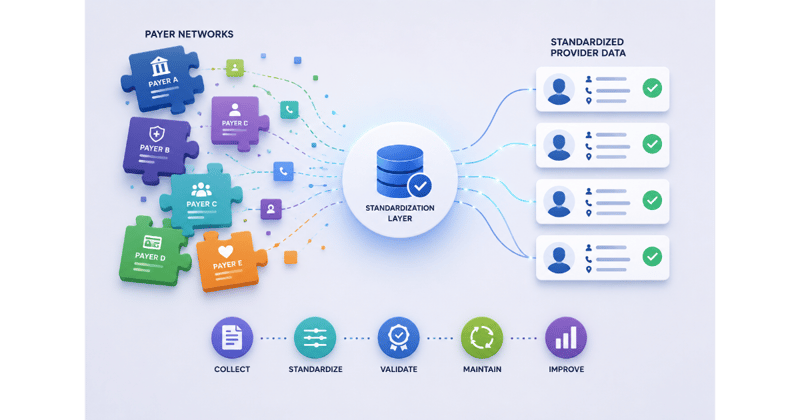
Provider data standardization is the process of cleansing, validating, and structuring provider information into a consistent format across every system that uses it. It converts fragmented credentialing, directory, and claims records into one reliable dataset, which reduces denials, supports compliance, and protects health plans from ghost network exposure.
The cost of getting this wrong is well-documented. A 2024 AJMC study found that 40% of provider directory inaccuracies persist for an average of 540 days, well beyond the 90-day window mandated under the No Surprises Act. Behind those persistent errors sit denied claims, member complaints, and remediation costs that quietly compound every quarter the data goes unfixed.
Most claim denials and compliance failures trace back to inconsistencies between systems, not to a single bad record. A provider terminated in credentialing may remain active in the directory. A specialty change captured in the CRM may never reach the claims engine.
Each gap creates a different downstream consequence, from clean-claim failures to regulatory exposure.
What Core Elements Define a High-Performing Provider Data Standardization Framework?
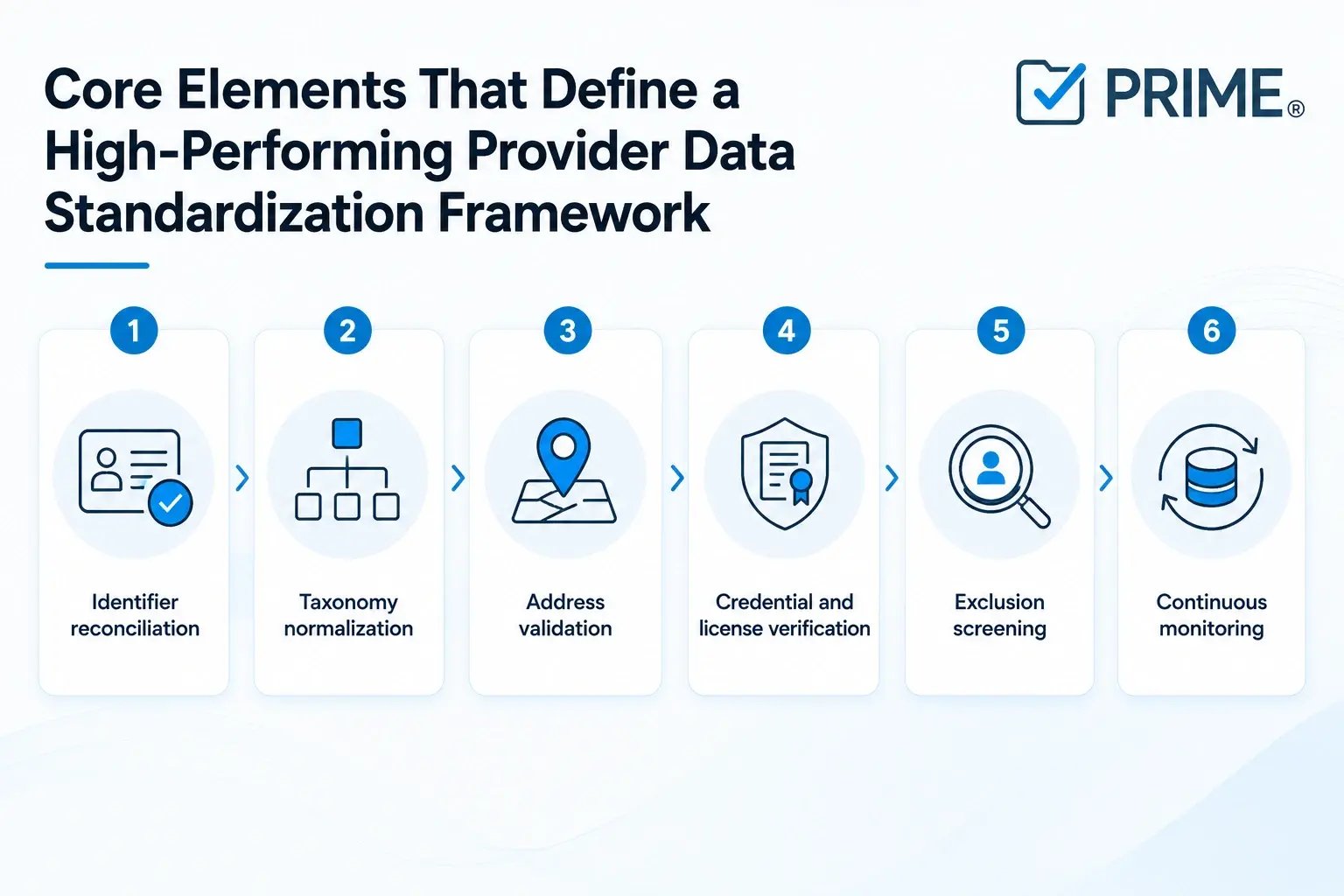
A standardization framework is only as good as the data layers it touches. Strong frameworks share six elements that work in sequence rather than in isolation.
|
Element |
What it does |
|
Identifier reconciliation |
Matches NPI, Tax ID, and license numbers across systems to prevent duplicate or split records |
|
Taxonomy normalization |
Maps specialty codes to standardized values using NUCC taxonomy and CMS specialty crosswalks |
|
Address validation |
Verifies practice locations against USPS standards and provider-attested sources |
|
Credential and license verification |
Confirms current licensure and board certification against state boards and CAQH |
|
Exclusion screening |
Checks OIG LEIE, SAM.gov, and state Medicaid exclusion lists at every refresh cycle |
|
Continuous monitoring |
Captures changes between cycles and tags each record with source attribution and timestamp |
The order matters. Skipping identifier reconciliation upstream forces every downstream layer to work against a moving target.
What Role Does Automation Play in Scaling Provider Data Standardization Across Payer Networks?
Manual standardization stops working once your network crosses a few thousand providers. Automation handles the volume by applying validation rules consistently, normalizing inputs from delegated groups regardless of format, and flagging discrepancies for human review only when rules cannot resolve them.
The 2025 CAQH Index reports that more than 50% of health plans and 25% of provider organizations now use AI tools in administrative workflows, driven by a remaining $21 billion savings opportunity in manual transactions. The point of automation is not to replace operations staff. It is to free them from rekeying and reformatting so they can focus on the 5% of cases that actually need judgment.
How Can Standardizing Provider Data Eliminate Directory Errors and Rebuild Member Trust?
Member trust erodes the moment someone calls a listed provider and learns the practice closed two years ago. The Atlas Systems 2025 Member Experience Monitor found that 58% of provider directory users have encountered incorrect information at least once, and 80% of those who found errors said the mistakes made them less likely to trust the health plan involved.
Standardization addresses this at the source. When every system pulls from the same validated record, members see the same provider information whether they search online, call member services, or check a printed directory. The trust rebuild does not require a marketing campaign. It requires data that holds up the first time a member acts on it.
What Are the Biggest Challenges in Provider Data Standardization and How Do Leading Payers Overcome Them?
The hardest challenge is rarely technical. It is governance. Delegated credentialing arrangements, vendor data feeds, and internal system owners each operate on different cadences, with different definitions of "current." Without source attribution at the record level, fixing an error becomes guesswork.
Leading health plans and payer organizations solve this by tagging every record with its source, timestamp, and confidence score, then giving operations teams the authority to override delegated feeds when they fail accuracy thresholds.
The second challenge is variability in delegated data formats. Provider groups send Excel, PDF, and copy-paste text in inconsistent structures, so the standardization layer has to ingest any format and apply rules at the point of intake.
How Do You Evaluate and Choose the Right Provider Data Standardization Solution for Your Health Plan?
Five questions separate solutions that will hold up from those that will not.
- Does the platform ingest delegated data in any format without manual pre-cleaning
- Can it produce a timestamped audit trail with source attribution at the record level
- Does it support FHIR R4 and the Da Vinci PlanNet implementation guide natively
- Does it integrate with your credentialing, directory, claims, and CRM systems through APIs or webhooks
- Can it demonstrate a documented accuracy baseline against your current data before implementation
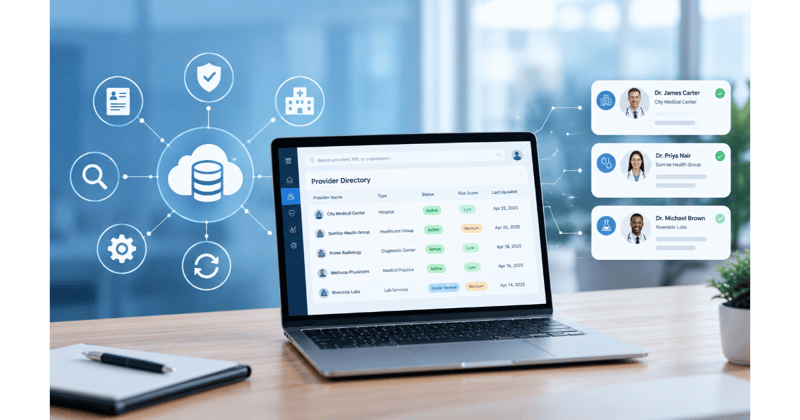
PRIME® by Atlas Systems was built around these five requirements. The platform standardizes provider data across all sources, validates it through a six-layer verification framework, and pushes clean records to every downstream system with full traceability.

%20(1).jpg)

Related Reading

Provider Lifecycle Management
The Complete Guide to Provider Data Management Automation
Read the blog →
Provider Lifecycle Management
Why Behavioral Health Providers Are the Hardest AWT Surveys to Close
Read the blog →
Provider Lifecycle Management
Best Provider Network Management Platforms for Payers and Providers in 2026
Read the blog →
Provider Lifecycle Management
Best Provider Directory Validation Companies for Health Plans in 2026
Read the blog →