Atlas Systems Named a Representative Vendor in 2025 Gartner® Market Guide for TPRM Technology Solutions → Read More
AI-Powered Continuous Monitoring for Third-Party Risk

6 min read | Last Updated: 10 Dec, 2025
Point-in-time vendor assessments miss risks that emerge between reviews. Most risk teams subscribe to monitoring feeds for security threats, credit changes, and breach alerts. But more monitoring creates a different problem: feeds light up with hundreds of alerts daily, analysts spend hours triaging noise, and critical signals get buried.
You complete a comprehensive security assessment of a payment processing vendor in January. The vendor passes every control. SOC 2 report shows no exceptions. Financial health looks solid. You classify them as low risk and schedule the next review for January of the following year.
In March, their SSL certificate expires. In April, a critical vulnerability appears in their authentication system. In May, their credit rating drops two levels after losing a major customer. In June, they experience a data breach affecting 50,000 records.
You discover these events during your next annual review. Or from a news alert. Or when customers start asking questions.
Why Point-in-Time Assessments Create Blind Spots
Quarterly or annual vendor reviews capture what was true at a specific moment. Vendor risk doesn't operate on your review calendar. The gap between assessment cycles creates exposure where material risks develop unnoticed.
What Actually Changes Between Reviews
Security posture shifts constantly:
- SSL certificates expire every 90 days
- Critical vulnerabilities disclosed weekly across common software
- Infrastructure migrations and feature launches expand attack surfaces
- M&A activity introduces new risk profiles
Financial health evolves gradually:
- Credit ratings move through incremental downgrades over months
- Revenue declines appear in quarterly results before bankruptcy filings
- Customer concentration risks surface when major contracts end
- Cost-cutting often hits security spending first
Compliance status changes unpredictably:
- ISO 27001 and SOC 2 certifications expire annually
- Regulatory violations appear weeks or months after incidents
- New regulations take effect on schedules misaligned with your reviews
- Data processing agreements become outdated with new subprocessors
Operational incidents signal deeper issues:
- Service outages indicate infrastructure problems
- Leadership departures suggest strategic uncertainty
- M&A activity shifts priorities and introduces integration risks
Vendors experiencing financial pressure might delay security patching. Compliance lapses often indicate broader governance problems. Operational incidents frequently precede security events. Changes in one risk dimension predict problems in others, but only if you're watching continuously.
The Alert Overload Problem
Risk teams subscribe to threat intelligence feeds, credit monitoring, breach databases, and news alerts hoping to catch changes between reviews. The result is information overload:
- Typical program monitoring 500 vendors receives 200+ alerts daily
- Same vendor breach reported by 5 services = 5 separate notifications
- Certificate warnings arrive for every vendor regardless of tier
- Subsidiary credit changes trigger alerts even when parent stays stable
- Every software security advisory generates notifications regardless of actual usage
The impossible triage decisions:
- Which of today's 200 alerts actually require action?
- Which represent material changes versus routine noise?
- Which vendors to contact first?
- Who owns follow-up: security, compliance, or vendor management?
Manual processes break down under this volume. Analysts spend hours researching context. By the time triage completes, new alerts accumulate. Critical signals get lost. Alert fatigue sets in. Teams start ignoring feeds entirely.
The fundamental problem: alerts provide raw signals, not actionable intelligence. Five alerts about the same breach don't make the risk five times greater, they just waste analyst time. Without correlation, prioritization, and automated workflow, more monitoring feeds just create more noise.
How AI Transforms Monitoring Into Intelligence
AI-powered continuous monitoring solves volume and correlation problems. Instead of more noise, you get fewer but actionable signals routed to the right people with necessary context.
- Multi-source signal ingestion Automatically pulls data across risk dimensions:
- Security: BitSight, SecurityScorecard, breach databases, certificate authorities
- Financial: Credit monitoring services, D&B
- Compliance: Regulatory violation databases
- Operational: News aggregators for M&A, leadership changes, service disruptions
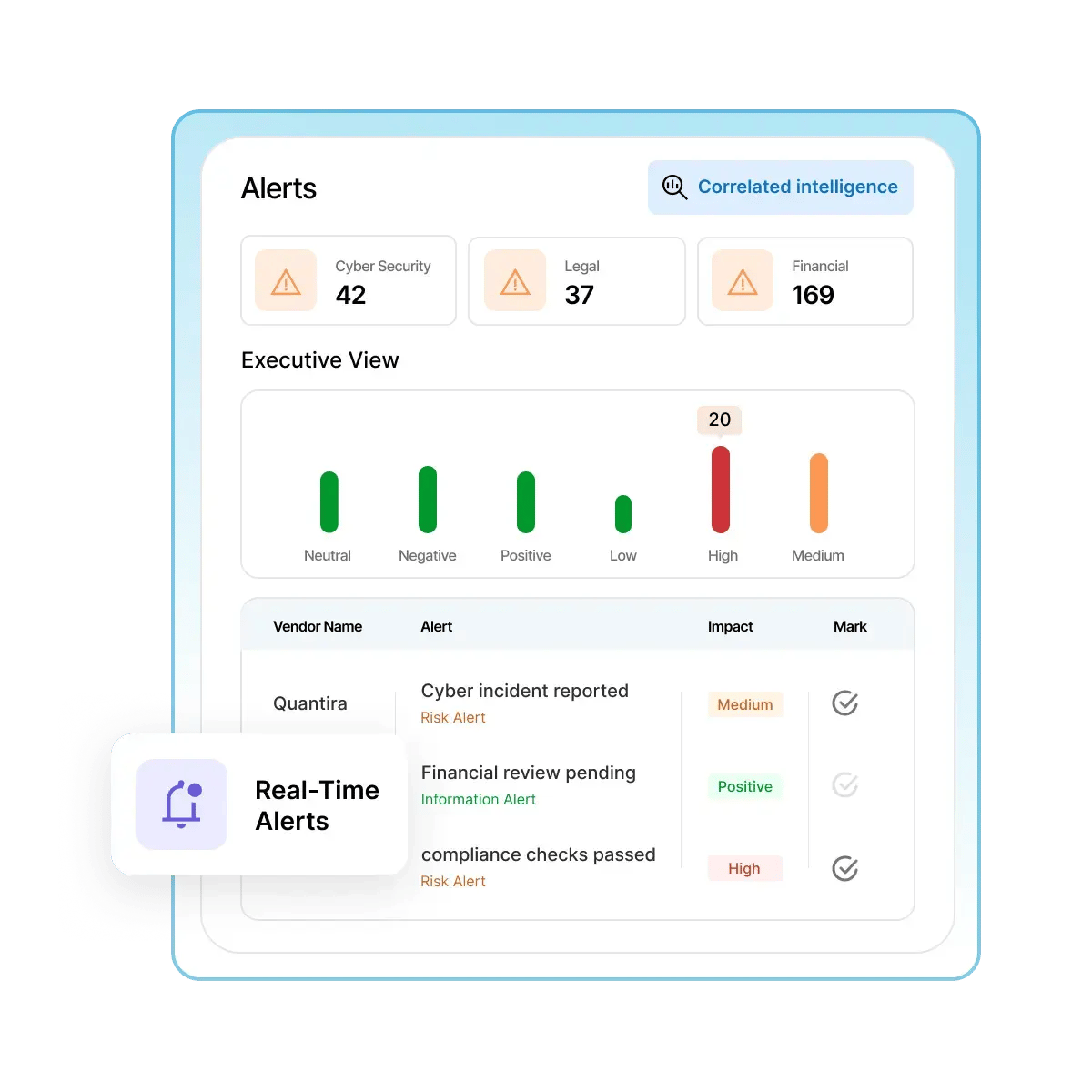
- Intelligent deduplication When five services report the same vendor breach, AI recognizes the identical event and creates one notification with attribution to all sources. When parent and subsidiary alerts reference the same incident, the system groups them. Deduplication typically reduces alert volume by 90-95% without losing information.
- Cross-dimensional correlation Connects signals that appear unrelated in isolation:
- Declining credit rating + increasing customer complaints + slower security patching = financial stress driving operational and security deterioration
- AI identifies these patterns so you see compound risks, not isolated data points
- Materiality scoring Prioritizes based on vendor context:
- Critical vulnerability in Tier 1 payment processor = high-priority alert, immediate action
- Same vulnerability in Tier 3 marketing vendor with no data access = lower-priority, quarterly review
- Expiring certificate for mission-critical service = immediate escalation
- Same event for rarely-used tool = standard workflow
Scoring considers vendor tier, data sensitivity, service criticality, regulatory requirements, and technical severity to calculate actual risk, not just theoretical threat.
- Automated workflow routing Converts material alerts into assigned work:
- High-priority security findings → security ops teams with 24-hour SLAs
- Financial distress signals → vendor management to verify continuity plans
- Compliance violations → legal review of contractual obligations
- Each task includes context, supporting evidence, and accountability
The transformation: 200 daily alerts become 8-10 assigned tasks with clear owners and deadlines. Analysts spend time investigating and responding to material risks instead of triaging noise.
Measuring Monitoring Effectiveness
Track metrics that indicate whether monitoring creates better outcomes:
Mean time to detection measures the gap between when a vendor risk event occurs and when you become aware. Traditional quarterly reviews create 30-90 day lags. Continuous monitoring should reduce this to under 5 days for security incidents and under 15 days for financial or operational changes.
Signal-to-action conversion rate tracks what percentage of material alerts result in assigned work. Low conversion (under 50%) indicates poor signal quality or broken workflows. High conversion (above 90%) indicates effective filtering. Monitor by alert source to identify which feeds provide intelligence versus noise.

False positive rate reveals quality issues. When alerts create work that investigation determines wasn't material, you're wasting time. Track by signal type and vendor tier. High false positive rates indicate tuning opportunities.
Coverage percentage shows what portion of your vendor portfolio receives continuous monitoring. Manual processes typically cover 20-30% (Tier 1 only). Effective AI-powered monitoring should extend to 90%+ including Tier 2 and 3 vendors.
When Manual Monitoring Becomes Insufficient
Three situations indicate you need platform capabilities:
Vendor count exceeds 200 with multiple risk teams. Coordinating alert triage across security, compliance, and vendor management through email and spreadsheets breaks down at scale. When multiple people might receive the same alert or no one receives alerts about specific categories, automated routing becomes necessary.
Material risk events discovered through news. If you learn about vendor breaches, financial problems, or compliance violations from press coverage instead of your monitoring feeds, your approach has blind spots. AI correlation typically surfaces these signals days or weeks earlier than news reports.
Analysts spend more time triaging than responding. When investigation and remediation take less time than figuring out which alerts warrant investigation, the process is inverted. Effective monitoring should minimize triage time and maximize response effectiveness.
Moving Forward
Continuous vendor risk monitoring addresses the fundamental limitation of point-in-time assessments by detecting changes as they occur. AI transforms this from an overwhelming data problem into actionable intelligence through deduplication, correlation, materiality scoring, and automated routing.
The shift from quarterly reviews to continuous monitoring doesn't replace formal assessments. Annual or biennial in-depth reviews still establish baseline risk posture. Continuous monitoring maintains visibility between assessments, ensuring material changes trigger timely response.
For comprehensive coverage of how AI applies across the complete vendor lifecycle, explore our guide to AI in third-party risk management. Ready to see continuous monitoring in your environment? Request a demo with your specific vendor portfolio and monitoring requirements.
Jump to section
How Audit-Ready Is Your SQL Environment?
Get the complete SQL Server 2016 End-of-Life Checklist Kit
Get the Kit