ComplyScore® Launches World’s First Headless TPRM, Bringing Conversational AI to Compliance Management. 






































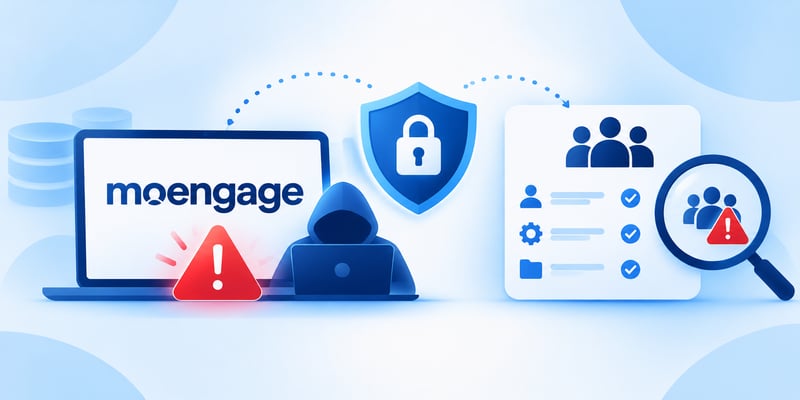
What the MoEngage Breach Teaches You About Vendor Access Risk


9 min read | Last Updated: 23 Nov, 2026
If you look after vendor risk, you probably know which vendors keep you up at night, such as your cloud host or your payment processor. The tool that sends your customers app alerts and promotional emails rarely makes that list.
In November 2026, a tool like that sat at the center of a breach that reached users of two Indian crypto exchanges. Neither exchange was hacked. The attacker got in through a company two steps removed from them, and their customers' details still ended up exposed.
This article walks through what happened in plain terms, why it can happen to any company that shares customer data with outside tools, and the practical steps your team can take this quarter.
What Happened in the MoEngage Breach?
The MoEngage breach began when an attacker used a stolen login from one of MoEngage's own service providers to get into part of its cloud systems. Fewer than 1% of MoEngage's customer accounts were affected, and crypto exchanges ZebPay and WazirX later told users that some of their personal details were exposed.
MoEngage is a platform that brands use to message their own customers through app alerts, emails, and SMS. To do that job, it holds those customers' names, contact details, and recent activity.
For ZebPay users, the exposed details included contact information, device data, and their latest account activity. Both exchanges said wallets, trading systems, and customer funds stayed safe.
MoEngage says it contained the incident in late October and brought in outside security experts to check its work. It also says its service never went down, though The Economic Times reported that some businesses couldn't log in for nearly a week.
The exchanges' own systems held up, and their customers were still exposed. That is the hard part of vendor risk.
Why Do Tools Like This Get Overlooked?
It's easy to see why messaging tools end up near the bottom of a vendor list. They don't move money or run your core systems, so a quick review usually rates them as low risk.
Now think about what they hold. A name, a phone number, and a recent transaction are all a scammer needs to make a fake call sound real. MoEngage also wasn't the first case this autumn. A few weeks earlier, some CoinDCX users had their names, email IDs, and linked bank names exposed through Plotline, another messaging vendor, and CoinDCX has since started reviewing that vendor's security (Inc42).
Who is the vendor's vendor?
Your vendors rely on vendors of their own, and security teams call these fourth parties. In this case, the company whose login was stolen worked for MoEngage, so it sat outside the companies ZebPay and WazirX had contracts with. Most vendor checks stop at the companies you sign with, which leaves these logins out of view.
What does the law expect from you?
In India, the Digital Personal Data Protection Act keeps you responsible for customer data that a vendor handles for you, whatever your contract says. It also expects you to tell the Data Protection Board and each affected person after a breach. The DPDP Rules, 2025 bring these duties in over the coming months (PIB).
Judge each vendor by the customer data it holds and what someone could do with it, whichever team bought the tool.
How Can Your Team Reduce Vendor Access Risk?
You don't need a new program to act on this. Here are five practical steps, each with a simple way to track progress and a tip for when things get stuck.
1. Find the vendors that hold customer details
Start with a simple list of every tool that stores your customers' names, contact details, or activity. Messaging, analytics, and customer support tools usually top it. Give every vendor on that list the same level of review as your most important technology vendors.
- Track: How many of these vendors now get your highest level of review
- If it gets stuck: Start with the tools that message your customers, since they hold the details a scammer finds most useful
2. Ask who else can log in to your data
Ask each of these vendors a plain question. Which outside companies have logins to the systems that hold your data? Then ask how those logins are protected, for example with a second sign-in step, regular reviews, and quick removal when a contract ends.
- Track: How many vendors have told you which outside companies can reach your data
- If it gets stuck: Send a short checklist, since vendors answer those faster than open questions
3. Share only what each vendor needs
A messaging tool needs a name and a way to reach someone. It rarely needs bank details or a full transaction history, and every extra piece of data you share is one more thing that can leak.
- Track: The data you send each vendor compared with what it actually uses
- If it gets stuck: Remove bank and ID details first, then review the rest when the contract comes up for renewal
4. Keep an eye on vendors between reviews
MoEngage says it contained the incident in late October, and its email to customers went out on November 20. A problem at a vendor can go unnoticed for weeks, so set up alerts for your most important vendors and send each alert to the person who manages that vendor.
- Track: How long it takes your team to hear about a vendor incident and start looking into it
- If it gets stuck: When alerts pile up, watch fewer vendors and focus on the ones that hold customer data
5. Write your customer message before you need it
ZebPay's notice told users exactly what its staff would never ask for, such as passwords, one-time codes, or money transfers. Draft a message like that now and get legal to approve it. Then ask your key vendors to commit, in the contract, to telling you about incidents within a set time.
- Track: The hours between a vendor telling you about an incident and you telling your customers
- If it gets stuck: Keep a pre-approved template ready, so the only work during an incident is adding the facts
What About Vendor Logins Inside Your Own Systems?
This breach also holds a lesson closer to home. The attacker got in through a login that a supplier held inside MoEngage's systems, and almost every company has logins like that for IT support firms, contractors, and connected software.
A few honest questions will show you where you stand.
- Do you have one list of every login that a vendor or contractor holds in your systems?
- Does each of those logins need a second sign-in step?
- Can each login reach only what that vendor's work requires?
- Does someone review these logins every quarter and remove them when a contract ends?
- Could you tell customers within hours which of their details an attacker reached?
Pro tip: Try a hypothetical exercise where one contractor's login is stolen. Trace everything that login could open, and you will often find access nobody remembers giving.
Where Does ComplyScore® Fit In?
No software can stop a vendor's supplier from losing a password. What it can do is help your team see which vendors hold what, who stands behind them, and what to do when something goes wrong. Spreadsheets cope with a few dozen vendors, and the work quickly outgrows them after that, which is why Enviri runs its 45,000+ vendors across 30+ countries on ComplyScore®.
Here's how ComplyScore®, the AI-native risk and compliance management platform from Atlas Systems, supports each step.
|
Step |
How ComplyScore® helps |
|
Find vendors that hold customer details |
When someone requests a new vendor, they answer a few simple questions about the data involved, and ComplyScore® rates the risk and explains why |
|
See who stands behind a vendor |
Each vendor report lists the outside companies it relies on, and a map shows when several of your vendors depend on the same one |
|
Ask the right questions |
ComplyScore® suggests security and data questions for each vendor, your experts adjust them, and AI fills in answers from the vendor's own documents with the page each answer came from |
|
Keep an eye on vendors |
You pick the events to watch for each vendor, and AI agents sort the alerts and follow up on missing documents |
|
Fix what you find |
AI flags gaps and drafts what needs fixing, and any decision to accept a risk needs sign-off from a named person |
For the questions about logins inside your own systems, the self-assessment module turns each one into a check with an owner and supporting evidence, so you can show where you stand under DPDP.
What Can You Do This Week?
Set aside one hour this week to pull up the tools that message, track, or support your customers. Check how closely you review each one, and ask the ones holding customer details who else can log in to that data.
The teams that handle the next vendor breach calmly will be the ones that already know which vendors hold their customers' data and who stands behind them.
If you'd like to see how ComplyScore® maps this across a large vendor base, book a walkthrough built around your own vendor categories.
FAQs
What happened in the MoEngage data breach?
An attacker used a stolen login from one of MoEngage's service providers to get into part of MoEngage's cloud systems. MoEngage says fewer than 1% of its customer accounts were affected, and it contacted each affected customer directly after containing the incident in late October 2026.
Which companies were affected by the MoEngage breach?
Crypto exchanges ZebPay and WazirX told users that some personal details were exposed, including contact details, device data, and recent account activity. Both said wallets, trading systems, and customer funds were safe. MoEngage has not named other affected customers
What is a fourth-party data breach?
A fourth-party breach happens at a company your vendor works with. In the MoEngage case, the stolen login came from MoEngage's own service provider, so for ZebPay and WazirX the problem started two steps away from the companies they had contracts with.
How do you check a vendor's access risk?
Start with the customer data the vendor holds and what someone could do with it. Then ask which people and outside companies can log in where that data lives, how those logins are protected, and how quickly the vendor will tell you about an incident.
Is a company responsible for a data breach at its vendor in India?
Under Section 8 of the DPDP Act, a company stays responsible for customer data a vendor handles on its behalf, whatever the contract says. It also has to tell the Data Protection Board and each affected person after a breach.
Author
Nasir R
Nasir is a marketing professional who creates content that simplifies complex topics like third-party risk management, compliance, and vendor governance. Through blogs, e-books, and best-practice guides, he shares practical insights to help organizations strengthen their risk posture and build long-term resilience.
Related Reading
Data Breach
Microsoft 365 Outage: Third-Party Risk Lessons for Enterprises
Anuja K
|
Nov 20, 2026
Read more →