ComplyScore® Launches World’s First Headless TPRM, Bringing Conversational AI to Compliance Management. 






.webp?width=387&height=387&name=headless-tprm%20(1).webp)




























The Best OneTrust Alternative for Third-Party Risk Management
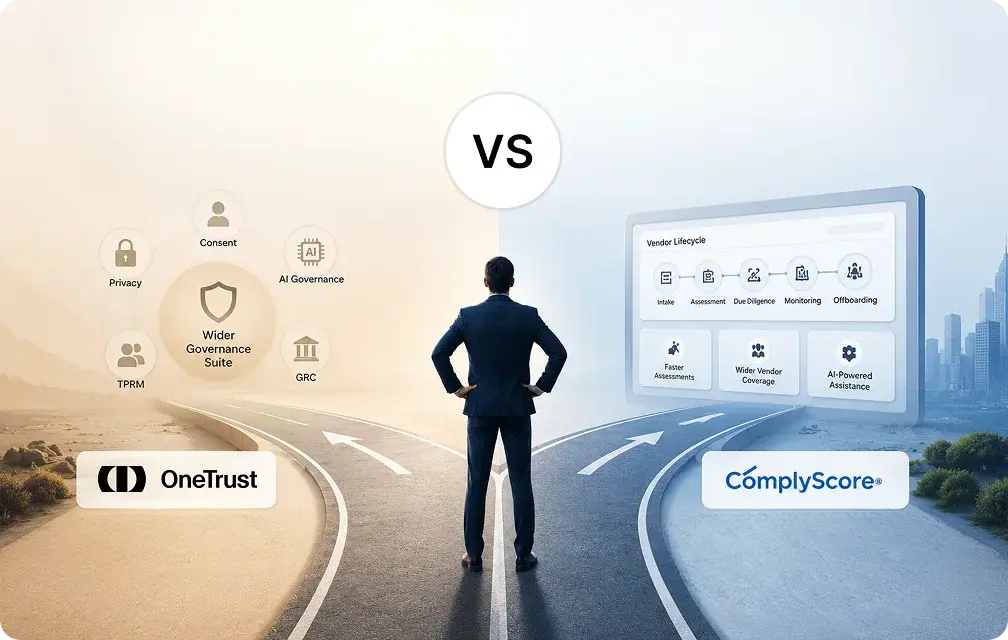
ComplyScore® is a purpose-built third-party risk management platform that runs the full vendor lifecycle out of the box. OneTrust offers third-party risk as one module inside a wider governance suite. The right pick depends on whether you want a focused TPRM tool or a broad platform you configure and maintain.
Trusted partner to market-leading brands










.png?width=130&height=14&name=download%20(1).png)
.png?width=130&height=24&name=images%20(1).png)
At a Glance: ComplyScore® and OneTrust TPRM Compared
Both platforms cover the third-party risk lifecycle. The clearest way to choose between them is to match the platform to the program you are building.

OneTrust is the stronger choice when
 Third-party risk is one part of a wider privacy, consent, and governance program you want to consolidate under a single vendor.

ComplyScore® is the stronger choice when
 Third-party risk is the program you are buying for, and you want assessment, due diligence, and monitoring working without a long configuration project.
How to Evaluate Any TPRM Platform Before You Sign
Most TPRM evaluations go wrong in the same place. Teams score demos on feature count, then discover after purchase that the features they ranked highly need months of configuration to switch on.
A better evaluation tests for fit, not for breadth. Four criteria separate a tool that works from a tool that looks good in a demo.
Run every shortlisted vendor against those four. The ranking that results will look different from the one your demo notes produced, and it will hold up better after the contract is signed.

Scope fit
A platform built for your actual job, vendor risk, behaves differently from a module added to a privacy suite.

Time to value
Ask how long until a real vendor moves through a real assessment, not how long until login access.

Included versus gated
Due diligence, monitoring, and data feeds are common upsells, and the base price rarely tells the whole story.

Ongoing burden
A configurable platform is only an asset if your team has the people to configure and maintain it.
Product Focus: Purpose-Built Platform or Governance Module
The real question behind a TPRM purchase is who owns the tool after go-live. One enterprise rental company we talked to described its OneTrust experience as too heavy and too hard to manage, then built an internal system to fill the gaps, which became technical debt its security team did not want to maintain.
ComplyScore® is built only for third-party risk and vendor management, and the lifecycle from intake through close-out reporting comes wired out of the box. OneTrust sells third-party risk management as one product within a suite that also covers AI governance, consent, privacy automation, and tech risk, per its product and pricing pages captured in May 2026.

Intake and Vendor Profile Enrichment
What happens at vendor intake sets the tone for the rest of the lifecycle. A platform that asks the business user to type in every detail puts the data-quality burden on people who do not own vendor risk.
OneTrust brings vendor data in three ways: bulk import, live integrations with systems such as SAP Ariba, ServiceNow, Coupa, Workday and Jira, or a self-service portal where a business user submits an onboarding request and answers dynamic risk questions. The platform then generates a vendor profile from that input and the configured data feeds.
ComplyScore® enriches the vendor profile automatically from a company name and country, pulling from public registries, sanctions sources, business databases, and certification trust centers before any questionnaire goes out. The risk team starts with a populated profile and an inherent risk tier already calculated.
OneTrust
OneTrust brings vendor data in three ways: bulk import, live integrations with systems such as SAP Ariba, ServiceNow, Coupa, Workday and Jira, or a self-service portal where a business user submits an onboarding request and answers dynamic risk questions. The platform then generates a vendor profile from that input and the configured data feeds.
ComplyScore®
ComplyScore® enriches the vendor profile automatically from a company name and country, pulling from public registries, sanctions sources, business databases, and certification trust centers before any questionnaire goes out. The risk team starts with a populated profile and an inherent risk tier already calculated.

If your team wants the platform to do the discovery work, ComplyScore® goes further at intake. If you want business users to drive intake through procurement workflow, OneTrust is built for it.

Assessment Depth and AI Assistance
Most TPRM platforms now use AI somewhere in the assessment workflow. The honest question is what each does with it, and where a human stays in the loop.
OneTrust offers out-of-the-box and custom assessments with dynamic skip logic, and its AI DocScanning reads uploaded evidence to auto-fill answers, with every AI-generated response citing the source page in the original document and a required human attestation before sign-off.
ComplyScore® prefills questionnaires aligned to SIG, SOC 2, ISO 27001, NIST, HIPAA, and others with real-time guidance to the vendor on which controls are met or missing. AI reads evidence documents, flags gaps and discrepancies, and an analyst signs off before the assessment closes.
OneTrust
OneTrust offers out-of-the-box and custom assessments with dynamic skip logic, and its AI DocScanning reads uploaded evidence to auto-fill answers, with every AI-generated response citing the source page in the original document and a required human attestation before sign-off.
ComplyScore®
ComplyScore® prefills questionnaires aligned to SIG, SOC 2, ISO 27001, NIST, HIPAA, and others with real-time guidance to the vendor on which controls are met or missing. AI reads evidence documents, flags gaps and discrepancies, and an analyst signs off before the assessment closes.
Both products keep humans in the loop. The difference is upstream: ComplyScore® invests more in pre-engagement enrichment and inherent risk scoring before an assessment is sent; OneTrust invests more in configurable assessment templates and document parsing once vendors respond.

Built-In Due Diligence or a Separate Product
Pre-engagement due diligence is where many programs lose time, screening a vendor before any contract exists. The structural question is whether that capability ships inside your TPRM platform or arrives as another line item.
OneTrust sells Third-Party Due Diligence as a separate product, screening for sanctions, watchlists, state-owned entities, politically exposed persons, and adverse media through its Dow Jones and Factiva partnership. It is a strong screening capability, oriented to legal and ethics risk specifically.
ComplyScore® includes third-party due diligence in the platform. A dual-model AI reads public and external data to produce a baseline risk report covering financial, cyber, and regulatory signals, from a company name and country, with no vendor questionnaire required.
OneTrust
OneTrust sells Third-Party Due Diligence as a separate product, screening for sanctions, watchlists, state-owned entities, politically exposed persons, and adverse media through its Dow Jones and Factiva partnership. It is a strong screening capability, oriented to legal and ethics risk specifically.
ComplyScore®
ComplyScore® includes third-party due diligence in the platform. A dual-model AI reads public and external data to produce a baseline risk report covering financial, cyber, and regulatory signals, from a company name and country, with no vendor questionnaire required.
If you want one platform to produce a holistic baseline risk report, ComplyScore®’s approach is broader at the base; if you want deep sanctions and adverse-media screening as a discrete capability, OneTrust’s TPDD goes deeper there.

Continuous Monitoring and the External Data Question
Continuous monitoring is where pricing pages get vague. Both platforms integrate with external feeds, and what matters is what is included versus what is a separate subscription with the data provider.
OneTrust’s Third-Party Risk Exchange is a separate product which integrates SecurityScorecard, RiskRecon, and HackNotice out of the box, with data refresh ranging from event-driven for breach alerts to daily for security ratings and every four hours for sanctions data.
ComplyScore® routes monitoring signals into owned tasks with owners, due dates, and SLAs, and connects to security and financial feeds you already license at no extra subscription charge.
OneTrust
OneTrust’s Third-Party Risk Exchange is a separate product which integrates SecurityScorecard, RiskRecon, and HackNotice out of the box, with data refresh ranging from event-driven for breach alerts to daily for security ratings and every four hours for sanctions data.
ComplyScore®
ComplyScore® routes monitoring signals into owned tasks with owners, due dates, and SLAs, and connects to security and financial feeds you already license at no extra subscription charge.
Confirm with each vendor what depth your program actually needs and which feeds you pay for separately.

Implementation and Time to Value
The gap between purchase and a working program is where TPRM projects quietly fail. A platform that takes two quarters to configure is two quarters of risk you are still managing in spreadsheets.
OneTrust offers modular, configurable deployment that maps to your existing workflows, with extensive customization of templates, lifecycle stages, risk scoring, and integrations. Gartner Peer Insights reviewers note a steep learning curve and configuration effort to reach full value, particularly for teams new to the platform.
ComplyScore® ships the lifecycle pre-wired, with role-based homepages, questionnaires that start prefilled, and monitoring feeds that switch on at launch. Atlas Systems enables assessment cycles running under ten days, and the platform is proven at deployments spanning tens of thousands of vendors, 30-plus countries, and multiple ERP systems.
OneTrust
OneTrust offers modular, configurable deployment that maps to your existing workflows, with extensive customization of templates, lifecycle stages, risk scoring, and integrations. Gartner Peer Insights reviewers note a steep learning curve and configuration effort to reach full value, particularly for teams new to the platform.
ComplyScore®
ComplyScore® ships the lifecycle pre-wired, with role-based homepages, questionnaires that start prefilled, and monitoring feeds that switch on at launch. Atlas Systems enables assessment cycles running under ten days, and the platform is proven at deployments spanning tens of thousands of vendors, 30-plus countries, and multiple ERP systems.
Configurability is genuine value when you have the team to use it, and a cost when you do not.