ComplyScore® Launches World’s First Headless TPRM, Bringing Conversational AI to Compliance Management. 













































Top 10 Bitsight Alternatives and Competitors


30 min read | Last Updated: 23 Oct, 2026
A security rating tells you how a vendor's internet-facing assets look from the outside today. It can't tell you whether that vendor reviews privileged access every quarter, encrypts the data you send it, or would pass a DORA audit of your outsourcing arrangements. Most teams searching for Bitsight alternatives have hit that boundary, or they want a second view on a score they keep having to explain to vendors.
The stakes keep rising. The Verizon 2026 Data Breach Investigations Report found third parties involved in 48% of breaches, up 60% year over year. This guide compares 10 Bitsight competitors on what they actually do, where each one fits, and where each one stops, so you can match the tool to the specific gap in your program.
Why Do Teams Look Beyond Bitsight?
Bitsight built its name on outside-in security ratings, and the product has grown well past a single score. According to Bitsight's own materials, ratings run from 250 to 900 and refresh daily, and its Vendor Risk Management product adds tiered questionnaires (SIG, NIST CSF, ISO 27001, and CAIQ), AI summaries of SOC 2 reports, and a vendor network of more than 75,000 profiles. In 2024, Bitsight also acquired threat intelligence firm Cybersixgill for $115 million.
So the reasons buyers compare alternatives tend to be specific to their program, and they usually fall into four patterns:
- They want ratings from more than one provider. Each provider sees different data, so some teams triangulate before acting on a score drop
- They need assessments mapped to a named regulation. A DORA register of information, HIPAA business associate oversight, or India's DPDP Act each require evidence structured in a particular way
- They want vendor risk and internal compliance in one system. Bitsight's public product pages focus on third parties, with no module for assessing your own internal controls
- They need more than cyber. Financial health, sanctions, contract terms, and concentration risk sit outside a ratings-first workflow
The right alternative depends on which of these four gaps you are trying to close. A team that wants a second rating needs a very different tool from a team preparing for a regulator's TPRM review.
How We Evaluated These Tools
We assessed each platform against six criteria drawn from what TPRM and GRC leaders weigh most often when they replace or supplement a ratings tool. Every fact about a vendor comes from that vendor's own website, product documentation, marketplace listings, or press releases. We excluded review scores, user quotes, and unverified pricing.
|
Criterion |
What we looked for |
|
Assessment depth |
Questionnaire library, AI-assisted evidence review, and how much manual chasing remains |
|
External monitoring |
Native security ratings, breach alerts, threat intelligence, or the ability to ingest third-party feeds |
|
Framework mapping |
Pre-built mapping to standards and regulations such as ISO 27001, NIST CSF 2.0, DORA, and HIPAA |
|
Remediation tracking |
Workflows that assign, follow up, and close vendor findings with an audit trail |
|
Breadth of risk |
Coverage beyond cyber, such as financial, compliance, contract, and concentration risk |
|
Integrations |
Connections to ticketing, GRC, ERP, and procurement systems |
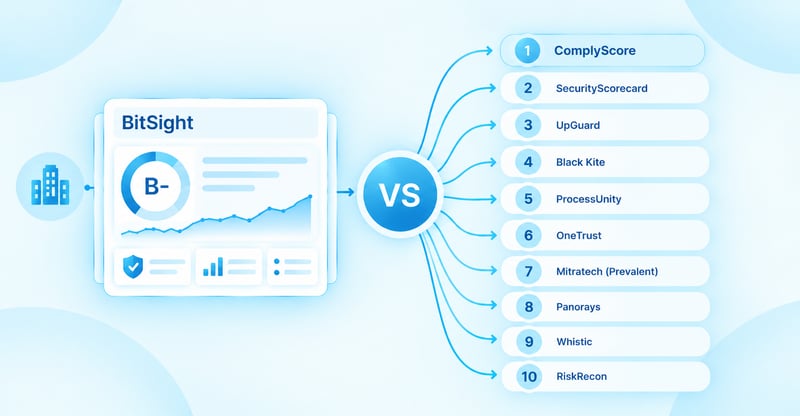
After ComplyScore®, the list runs from ratings-first tools to assessment-first platforms. That order groups tools by how they work and carries no quality ranking.
What Are the Main Bitsight Alternatives?
The main Bitsight alternatives are ComplyScore®, SecurityScorecard, UpGuard, Black Kite, RiskRecon, Panorays, ProcessUnity, OneTrust, Mitratech (Prevalent), and Whistic. Ratings-first tools compete on security scores, while assessment-first platforms focus on questionnaires, evidence review, and regulatory mapping.
| Platform | Core approach | Internal self-assessment module | Notable capability | Typical fit |
| ComplyScore® | End-to-end TPRM: due diligence, assessments, monitoring, and vendor management | Yes, on the same control library as vendor assessments | Zero-touch assessments, 30+ frameworks, and Headless TPRM for chat or voice workflows | Regulated enterprises managing vendor risk and internal compliance together |
| SecurityScorecard | Ratings-first (A to F grades) | Monitoring of your own rating only | Questionnaire responses checked against ratings | Teams wanting easy-to-read grades across many vendors |
| UpGuard | Ratings plus assessments | Not described | Remediation planner that projects score impact | Security teams running assessments and ratings in one tool |
| Black Kite | Ratings plus risk quantification | Not described | Open FAIR financial exposure estimates | Teams reporting cyber risk in dollar terms |
| RiskRecon | Ratings-first | Not described | Benchmarking within a Mastercard division | Teams wanting a ratings feed for an existing TPRM workflow |
| Panorays | Questionnaires plus attack surface | Not described | Mapping of third- to Nth-party connections | Teams focused on supply chain depth |
| ProcessUnity | Workflow-first TPRM | Not described | Global Risk Exchange of attested assessments | Programs that want configurable workflows and shared assessments |
| OneTrust | TPRM inside a broader GRC suite | Through separate GRC modules | 25+ built-in frameworks and 500+ plugins | Organizations already standardized on OneTrust |
| Mitratech (Prevalent) | Assessments plus monitoring | Not described | Shared networks of completed assessments | Teams wanting assessments and expert services together |
| Whistic | Trust center and assessment network | Trust center for publishing your own posture | Exchange of published vendor trust profiles | Buyers whose vendors already publish trust centers |
The 10 Bitsight Alternatives Compared
Here are the 10 platforms, starting with ComplyScore® and moving from ratings-first to assessment-first tools. Each entry covers what the platform does, who it suits, and where it may fall short.
ComplyScore®
ComplyScore® by Atlas Systems is an AI-assisted risk and compliance management platform with two core modules. Its third-party risk management module covers the vendor lifecycle from onboarding through monitoring and offboarding, while its self-assessment module applies the same control library to your internal compliance posture. Gartner named ComplyScore® a Representative Vendor in the 2025 Market Guide for TPRM Technology Solutions.
Why it might work for you: A score tells you a vendor’s posture changed, but your team still has to work out what that means for the contract, the controls, and the regulator. ComplyScore® handles everything after the score, running due diligence, assessments, monitoring, and remediation for each vendor in one workflow. Its self-assessment module then checks your own controls against the same frameworks.
Top features
- Vendor management covering intake requests, a self-service vendor portal, duplicate detection, bank detail validation, configurable approvals, document expiry tracking, and ERP integration with systems such as Oracle, JD Edwards, and Infor LN
- Third-party due diligence reports built from public and subscribed sources, covering ownership, financials, litigation, sanctions, adverse media, and cyber posture, with every source listed in an appendix
- Zero-touch assessments, where a vendor’s name and country start the process and the platform gathers evidence, pre-fills questionnaires, and pre-assesses controls so vendors answer only the gaps, with sub-10-day assessment cycles [Atlas Systems proprietary data]
- AI-assisted evidence review that reads SOC 2 reports and other uploads, flags missing controls and exceptions, and suggests remediation for analyst approval
- Continuous monitoring across cyber, financial, operational, regulatory, and reputational signals, with alerts converted into assigned tasks
- Self-assessment of your internal controls, data flows, consent and notice mechanisms, and breach readiness, using the same control library as vendor assessments
- 30+ frameworks out of the box, including ISO 27001, NIST CSF 2.0, DORA, HIPAA, PCI DSS 4.0, NIS2, and India’s DPDP Act, plus custom frameworks
Pros
- Covers vendor risk and internal compliance in one platform, policy engine, and audit trail
- Targeted threat intelligence works with your existing Bitsight, SecurityScorecard, or RiskRecon subscriptions and switches on deeper monitoring only when a breach, credit downgrade, or regulatory action occurs, so you pay for premium data where the risk justifies it
- Headless TPRM lets your team check risk scores, pull vendor status, and run assessment workflows by chat or voice inside ComplyScore® instead of clicking through screens
- Optional managed services, with Atlas analysts running assessments, monitoring escalations, and remediation follow-up inside your instance
- Proven at scale: Enviri Corporation runs ComplyScore® across more than 45,000 vendors in over 30 countries and three ERPs
Cons
- Third-party due diligence for vendors in countries such as China is less detailed than for vendors in India, because far less company information is available in the public domain.
Where it may not fit: ComplyScore® doesn't produce its own security rating. If you only need an outside-in score for board reporting or cyber insurance discussions, a ratings provider on its own involves less setup.
SecurityScorecard
SecurityScorecard is the closest like-for-like Bitsight competitor, and "Bitsight vs SecurityScorecard" is one of the most common comparisons buyers run. It assigns organizations A to F letter grades, and its AWS Marketplace listing says it monitors 10 risk factor groups across more than 12 million companies.
Why it might work for you: Letter grades are easy for executives and procurement teams to read without a security background. If your main goal is a second rating source, or a format that non-technical stakeholders grasp quickly, SecurityScorecard covers that need directly.
Key features
- A to F security ratings across 10 risk factor groups
- Questionnaires that are auto-validated against ratings data
- Threat intelligence from a proprietary sensor network
- API access and a Splunk app
Pros
- Simple grading format for board and procurement audiences
- Tiered pricing published on AWS Marketplace
Cons
- Ratings rely on externally observable data, so they can't confirm whether internal controls work
- Public materials don't describe regulation-specific assessment workflows such as a DORA register of information
UpGuard
UpGuard combines security ratings with vendor assessments in one product. It scores each vendor and each of the vendor's domains, with drill-down into individual risks.
Why it might work for you: If your security team runs vendor assessments itself and wants ratings, questionnaires, and remediation in one place, UpGuard keeps that loop tight. Its remediation planner shows how fixing an issue would change the vendor's score, which gives vendors a concrete reason to act.
Key features
- Vendor-level and domain-level security ratings
- 30+ questionnaire templates, including ISO 27001, NIST CSF, SIG, DORA, and GDPR
- AI document analysis of SOC 2 reports with source-tracked findings
- Integrations with Jira, Slack, ServiceNow, Zapier, and a public API
Pros
- Ratings and questionnaires share one data model
- Remediation planner links fixes to score changes
Cons
- The Vendor Risk features page centers on cybersecurity, so financial, sanctions, or contract risk need separate tools
- Internal compliance self-assessment isn't described as a Vendor Risk capability
Black Kite
Black Kite pairs third-party cyber risk intelligence with cyber risk quantification. It applies the Open FAIR model to vendor and supply chain scenarios to estimate exposure in dollars.
Why it might work for you: When your board or CFO asks what a vendor's weakness could cost, a letter grade doesn't answer the question. Black Kite's financial estimates give you numbers to put in front of finance and leadership.
Key features
- Open FAIR-based financial impact estimates
- Ransomware Susceptibility Index®, a predictive ransomware risk indicator
- FocusTags® alerts that map active threats to vendors in your ecosystem
- AI questionnaire management and control mapping, including DORA
Pros
- Translates cyber posture into financial terms
- Threat-led alerts tied to specific vendors
Cons
- Public materials focus on cyber risk, so broader due diligence needs other tools
- Quantification depends on modeling assumptions your team should validate before reporting figures
RiskRecon
RiskRecon, a division of Mastercard, provides security ratings and reporting based on publicly available data and its own analysis techniques. It offers continuous monitoring, benchmarking against industry peers, and prioritization of vendor risk.
Why it might work for you: If you already run assessments in a separate TPRM platform and need a ratings feed to sit alongside them, RiskRecon fills that role. Mastercard ownership may also matter to financial services buyers evaluating vendor stability.
Key features
- Security ratings and detailed security reporting
- Continuous monitoring of vendor security practices
- Benchmarking against industry standards
- Risk prioritization to guide mitigation
Pros
- Focused ratings product that slots into existing workflows
- Backed by a large financial services parent
Cons
- Ratings-centric, so questionnaires, evidence review, and remediation workflows sit in another system
- Public materials don't describe regulatory framework mapping
Panorays
Panorays combines security questionnaires with external attack surface evaluation to assess third-party cyber risk. It also maps and ranks connections from third parties through to Nth parties.
Why it might work for you: If your concern is the vendor behind your vendor, Panorays gives you visibility into supply chain depth.
Key features
- Standard and custom security questionnaires with AI-assisted validation
- External attack surface evaluation alongside questionnaire responses
- Mapping of third- to Nth-party connections
- An incident response portal and self-guided vendor remediation plans
Pros
- Supply chain depth beyond direct vendors
- Remediation responsibility shared with vendors
Cons
- Public listings don't detail integrations with ticketing, GRC, or ERP systems
- Cyber focus means non-cyber risk domains need separate handling
ProcessUnity
ProcessUnity is a workflow-first TPRM platform. In January 2024, it combined its configurable platform with the CyberGRX exchange, now the Global Risk Exchange, which the company says holds standardized, attested assessments and cyber data on nearly 300,000 third parties.
Why it might work for you: If many of your vendors already have assessments in the exchange, you can start from existing evidence instead of sending a fresh questionnaire.
Key features
- Global Risk Exchange of attested, standardized assessments
- AI tools including Auto Inherent Risk, Predictive Risk Profiles, and Policy Evaluator
- Configurable workflows on a single third-party data core
- Performance and control effectiveness tracking
Pros
- Shared assessments reduce duplicate vendor outreach
- Configurability fits complex program designs
Cons
- Exchange value depends on how many of your vendors participate
- Internal compliance self-assessment isn't part of its public TPRM positioning
OneTrust
OneTrust offers third-party management as part of a broader trust, privacy, and GRC platform. Its UK government marketplace listing describes automated onboarding questionnaires, 25+ built-in frameworks, and 500+ pre-built plugins.
Why it might work for you: If your privacy or GRC team already runs on OneTrust, adding third-party management keeps data, users, and reporting in one vendor relationship.
Key features
- Automated supplier onboarding questionnaires and risk profiles
- Support for any control framework, risk category, or scoring method, with 25+ frameworks built in
- Reassessment automation tied to contract expirations
- 500+ pre-built plugins for cross-system workflows
Pros
- Natural extension for existing OneTrust customers
- Wide framework and plugin library
Cons
- Buyers who don't use other OneTrust modules take on a large suite for one use case
- Native security ratings aren't part of the listing, so external monitoring relies on integrations
Mitratech (Prevalent)
Mitratech acquired Prevalent in October 2024, and the Prevalent platform now sits within Mitratech's software portfolio. Mitratech describes the platform as combining vendor assessments with external monitoring of cyber and business risk.
Why it might work for you: If your team is small and wants software plus expert support, the combination of assessments, monitoring, and services can reduce the internal lift.
Key features
- Vendor assessments covering security, privacy, and compliance controls
- External intelligence on vendor cyber and business risk
- Shared networks of completed vendor assessments
- Reports that map vendor controls to compliance mandates
Pros
- Assessments, monitoring, and services from one provider
- Network of completed assessments for faster starts
Cons
- Product direction under a new parent is still settling, so confirm the roadmap during evaluation
- Public materials give limited detail on AI-assisted evidence review
Whistic
Whistic approaches third-party risk through vendor trust centers and an assessment network. Vendors publish security content once, and buyers draw on the Trust Center Exchange, which Whistic says holds thousands of published vendor profiles.
Why it might work for you: If your vendors already maintain trust centers, Whistic lets you begin with reviewed evidence instead of a blank questionnaire.
Key features
- Trust Center publishing and controlled evidence sharing
- Trust Center Exchange of published vendor profiles
- Whistic AI with four task agents and a browser agent for control testing
- Vendor breach monitoring with severity-rated alerts
Pros
- Reuses vendor-published evidence across buyers
- AI outputs include sources and explanations
Cons
- Value drops for vendors that don't publish trust centers
- Monitoring covers breach alerts, so continuous security ratings would come from a separate provider
How Do You Choose the Right Bitsight Alternative?
Your choice gets easier once you name the gap you need to close. The table below maps the most common reasons for leaving or supplementing Bitsight to the type of tool that addresses each one.
| If your main gap is... | Consider | Why |
| Acting on ratings you already pay for | ComplyScore® | Ingests Bitsight, SecurityScorecard, and RiskRecon scores and turns rating drops into assessments and remediation tasks |
| Due diligence beyond cyber | ComplyScore®, Mitratech (Prevalent) | Financial, legal, sanctions, and adverse media checks alongside security posture |
| Regulatory mapping plus internal compliance | ComplyScore® | Shared control library across vendor assessments and self-assessment |
| Vendor onboarding tied to your ERP | ComplyScore®, OneTrust | Intake, approvals, and document tracking connected to procurement and ERP systems |
| Extra assessment capacity for a lean team | ComplyScore®, Mitratech (Prevalent) | Software paired with analyst or expert services |
| A second rating source | SecurityScorecard, RiskRecon | Direct ratings comparisons built on different data |
| Cyber risk in financial terms | Black Kite | Open FAIR exposure estimates |
| Ratings and questionnaires in one tool | UpGuard, Panorays | One data model for scores and assessments |
| Reusing existing vendor evidence | ProcessUnity, Whistic | Exchanges of attested assessments or trust profiles |
| Consolidating on an existing GRC suite | OneTrust | Third-party management alongside privacy and GRC modules |
Run a short pilot before you commit. Pick 20 vendors across your critical, high, and medium tiers, then measure three things over 30 days: time from intake to risk decision, the share of findings closed with evidence, and how many alerts your analysts dismissed as noise. Those numbers will tell you more than any feature checklist, including this one.
Find the Gap Before You Pick the Tool
Bitsight fits teams whose main need is an outside-in security score. The alternatives above suit programs that also need a second rating source, financial quantification, shared assessments, or regulatory evidence a score can't provide.
If your gap is turning ratings into decisions, with framework-mapped assessments and internal compliance in the same system, see how ComplyScore® compares with Bitsight feature by feature. You can also explore the AI third-party risk management platform or book a 30-minute demo to test it against your own vendor list.
FAQs
What are the main alternatives to Bitsight?
The main Bitsight alternatives are SecurityScorecard, UpGuard, Black Kite, and RiskRecon for security ratings, and ComplyScore®, ProcessUnity, OneTrust, Mitratech (Prevalent), Panorays, and Whistic for assessment-led third-party risk management. Your choice depends on whether you need scores, assessments, or both.
Is Bitsight a vulnerability scanner?
No. Bitsight rates organizations using externally observable data about their internet-facing assets and security behavior. It doesn't scan inside your network the way an authenticated vulnerability scanner does, so the two tools answer different questions and often run side by side.
What is a good Bitsight score?
Bitsight ratings range from 250 to 900 and update daily. A score of 740 or higher falls in the Advanced tier, 640 to 730 is Intermediate, and 630 or below is Basic. Most vendor risk programs set minimum thresholds by vendor tier.
How much does Bitsight cost?
Bitsight doesn't publish pricing. Its pricing is quote-based and depends on the products you buy, the number of vendors you monitor, and contract length. Request quotes from two or three providers with the same vendor count to compare fairly.
Can you use Bitsight and a TPRM platform together?
Yes, and many programs do. Platforms such as ComplyScore® ingest Bitsight ratings as one monitoring signal, normalize them alongside other providers, and tie rating drops to assessments, findings, and remediation tasks, so scores trigger action instead of sitting in a separate dashboard.