ComplyScore® Launches World’s First Headless TPRM, Bringing Conversational AI to Compliance Management. 











































10 Vanta Alternatives and Competitors to Consider


24 min read | Last Updated: 03 Nov, 2026
Vanta connects to your cloud, identity, and HR tools and runs automated tests on them. Those tests check the systems you connect, and many audit questions sit outside those systems. Does your breach response plan match your written policy? Do your consent notices match how data really flows?
Picture a hypothetical security lead with a green dashboard and an auditor who asks for a data-flow map and proof that the breach plan got tested. The tests passed, but the evidence for those requests lives in spreadsheets and email threads. Self-assessment closes that gap.
Self-assessment checks your controls, policies, and evidence against the standards you choose, such as SOC 2, ISO 27001, GDPR, or India's DPDP Act. It repeats that check all year instead of once before an audit.
If you are searching for Vanta alternatives, you likely want that kind of continuous self-assessment, or you want to see how other approaches compare. This guide compares 10 options, including ComplyScore® from Atlas Systems, using public information only. Each entry covers what the tool does, why it might work for you, and who it fits best.
What Are the Main Alternatives to Vanta?
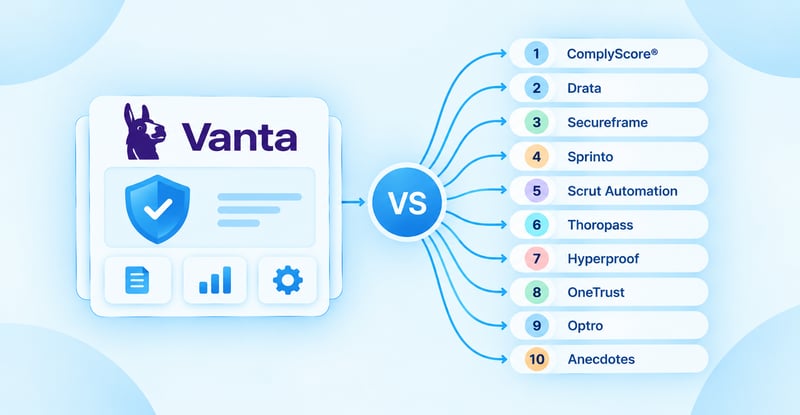
The main Vanta alternatives are ComplyScore®, Drata, Secureframe, Sprinto, Scrut Automation, Thoropass, Hyperproof, OneTrust, Optro, and Anecdotes. Self-assessment platforms check controls against your own standards. Automation tools run tests on connected systems, and GRC suites add audit and vendor oversight.
Why Do Teams Look for Vanta Alternatives?
Three patterns come up most often when teams reopen their shortlist. Each one points to a different kind of replacement.
Product pages emphasize tool-connected tests
Vanta's public pages focus on automated tests that run against connected tools. They describe cloud, identity, and HR integrations in detail. They do not describe checking controls against your own internal standards, data flows, consent practices, or regional privacy laws such as DPDP. If your program leans on self-assessment, ask Vanta to show it in a demo.
Price follows frameworks, headcount, and add-ons
Vanta does not publish fixed tiers. A Vendr marketplace page updated in February 2026 reports a median buyer cost of $20,000 a year across 377 purchases, with a range from $7,500 to $57,163. Vendr also lists add-ons such as vendor risk management at $5,000 to $15,000 a year and a Trust Center at $3,000 to $8,000. Vendr describes these as observed deal ranges, not list prices.
Audit fees sit outside the platform fee
Vendr notes that third-party audit fees are not part of Vanta's platform price. You budget the software and the audit separately. Teams that want one contract for both often compare Thoropass, or a platform that gives auditors direct access to evidence.
Decide whether you need automated tests on connected tools or ongoing self-assessment against your own standards before you shortlist, because each points to a different tool.
How We Evaluated These Vanta Alternatives
We built this list from public information only: vendor websites, product pages, press releases, and review platforms such as G2 and Gartner Peer Insights. We ran no hands-on trials. When a vendor makes a performance claim, we attribute it to the vendor and do not repeat it as fact.
Here are the six criteria we applied to every tool:
• Self-assessment and control verification: How the tool checks controls against your own standards
• Evidence collection: Automation depth, integrations, and how current the evidence stays
• Framework coverage and configurability, including custom controls and regional or AI frameworks
• Audit readiness: Reports, auditor access, and role-based permissions
• Audit support model: Software only, auditor directory, or in-house audit
• Fit by company size and program maturity, from a single framework to multi-framework programs
How Do These Vanta Alternatives Compare?
|
Tool |
Core focus |
Frameworks (vendor-stated) |
Evidence and audit prep |
Vendor risk |
Best fit |
|
ComplyScore® |
Self-assessment and risk and compliance management |
Configurable to SOC 2, ISO 27001, HIPAA, GDPR, DPDP, and AI frameworks |
Continuous control verification, dated evidence, separate auditor login |
Full lifecycle with headless chat access |
Audit-ready self-assessment |
|
Drata |
Trust management |
SOC 2, ISO 27001, ISO 42001, GDPR, HIPAA, PCI DSS, DORA, FedRAMP, CMMC, and custom |
Compliance automation, Trust Center |
Third-party risk module |
Shared control library |
|
Secureframe |
Compliance automation |
40+ (CEO-stated) |
Custom Integrations, vCISO-curated tests |
Vendor reviews |
Custom and hybrid stacks |
|
Sprinto |
Compliance automation |
25+ automated, 200+ digitized |
Evidence collection, audit partner network |
Risk intelligence module |
Cloud-hosted teams |
|
Scrut Automation |
Compliance and risk |
70+ |
Evidence collection, Audit Center |
Vendor risk module |
Guided onboarding |
|
Thoropass |
Compliance plus audit |
SOC 1, SOC 2, ISO 27001, HITRUST, PCI DSS |
In-house audit |
Risk assessment module |
Software and auditor from one vendor |
|
Hyperproof |
Compliance operations and GRC |
100+ templates |
Hypersyncs evidence, audit management |
Third-party risk module |
Multi-framework operations |
|
OneTrust |
Privacy, GRC, and third-party management |
Spans privacy and GRC |
Compliance automation, internal audit |
Due diligence and risk exchange |
Enterprises consolidating tools |
|
Optro |
Enterprise GRC |
Frameworks and controls library |
Internal audit and SOX controls |
Third-party risk module |
Enterprise audit and SOX teams |
|
Anecdotes |
Compliance data platform |
Custom frameworks |
Continuous monitoring on system data |
Not detailed publicly |
Mature programs |
Which Vanta Alternatives Are Worth Evaluating?
Below are the 10 tools, starting with ComplyScore®. Each entry covers positioning, fit, features, pros, and best fit.
1. ComplyScore® by Atlas Systems
ComplyScore® is an agentic risk and compliance management platform. Its compliance self-assessment tool verifies cloud controls, internal data flows, consent practices, and breach readiness against current evidence, so your audit pack stays ready all year.
Why it might work for you: Choose it when evidence collection resets every audit cycle. ComplyScore® checks controls against what is deployed today, collects dated evidence, and produces close-out reports from the workflow itself. Atlas Systems reports audit readiness in under 30 days and 70 to 80% less manual evidence effort.
Key features:
• Continuous verification of cloud controls, including access, encryption, audit logging, and data retention
• Evidence collection with auto-evidence integration into internal applications and a single source of truth
• Policy management that checks evidence against uploaded policies and highlights discrepancies
• Configuration for SOC 2, ISO 27001, HIPAA, GDPR, DPDP, and AI frameworks, with custom controls and framework updates pushed from the backend
• Internal data flow mapping, consent and notice verification, and breach readiness documentation
• Maker-checker workflows with assigned owners, deadlines, and audit trails
• Dashboards you can share with management
Pros:
• A separate auditor login with role-based access, so auditors review all evidence inside the platform
• Headless architecture lets you work through chat or voice commands inside the product instead of navigating screens, and you still log in to ComplyScore®
• 40 to 60% lower cost per assessment cycle through automated control verification
• Third-party risk management and vendor management on the same platform, including due diligence and continuous monitoring, which Enviri Corporation runs across 45,000+ vendors in 30+ countries
• Targeted threat intelligence on vendors
• Optional managed services for teams without dedicated analysts
2. Drata
Drata describes itself as an agentic trust management platform. Its product page lists compliance automation, a Trust Center, AI questionnaire assistance, third-party risk management, and enterprise GRC.
Why it might work for you: Drata fits teams that want a single control library mapped across frameworks. Its site names SOC 2, ISO 27001, ISO 42001, GDPR, HIPAA, PCI DSS, DORA, FedRAMP, and CMMC, plus custom frameworks.
Key features:
• Compliance automation with a mapped control library
• Trust Center and AI questionnaire assistance
• Third-party risk management
• AI agent governance
Pros:
• Wide framework list, including AI and defense-sector standards
• Trust, risk, and compliance modules under one vendor
Best fit for: Engineering-led teams that want to reuse one set of controls across several frameworks.
3. Secureframe
Secureframe is a compliance automation platform for frameworks such as SOC 2, ISO 27001, HIPAA, PCI DSS, and GDPR. Its CEO has said it supports over 40 frameworks out of the box.
Why it might work for you: If your stack includes on-premises, hybrid, or custom-built systems, Custom Integrations lets you ingest data from tools that have no native connector.
Key features:
• Custom Integrations with custom schemas and automated tests
• API endpoints for frameworks, tests, and vendors
• A test library curated by vCISOs
• Risk assessment and questionnaire automation
Pros:
• Flexible data ingestion for unusual tech stacks
• Pre-built frameworks you can adapt or extend
Best fit for: Teams with legacy or home-built systems that need automated tests beyond standard cloud connectors.
4. Sprinto
Sprinto describes an autonomous compliance platform. Its pricing page lists 25+ frameworks automated out of the box, 200+ digitized, and continuous monitoring across 300+ integrations.
Why it might work for you: Sprinto publishes plan tiers with feature lists, so you can compare scope before a sales call.
Key features:
• Automated evidence collection
• A Trust Center and an AI security questionnaire
• A risk intelligence module
• An audit partner network
Pros:
• Foundation and Growth plan structure visible on its site
• A dedicated customer success manager and quarterly reviews on the Growth plan
Best fit for: Cloud-hosted companies that want to see plan scope before they talk to sales.
5. Scrut Automation
Scrut offers AI "Teammates" that draft policies, collect evidence, assess vendor risk, and prepare audit packages. Its site lists 70+ frameworks and 150+ integrations.
Why it might work for you: Scrut pairs its software with implementation managers and InfoSec managers, which helps teams that lack in-house compliance expertise.
Key features:
• Compliance automation and an Audit Center
• Access reviews and asset inventory
• Cyber risk and vendor risk modules
• A Trust Center with questionnaire drafting
Pros:
• Hands-on onboarding and policy support
• A module set that reaches past evidence collection
Best fit for: Small security teams that want guided setup and expert help while they build a compliance program.
6. Thoropass
Thoropass combines compliance automation with its own audit services. Its site lists Thoropass Audit, penetration testing, access reviews, security questionnaires, risk assessment, and a Trust Center.
Why it might work for you: It suits teams that want software and the auditor from one vendor. Its "one audit, multiple frameworks" process aims to cut duplicate evidence requests across SOC 2, ISO 27001, HITRUST, and PCI DSS.
Key features:
• An in-house audit with an audit lifecycle platform
• Evidence collection and control mapping
• Pentesting and access reviews
• A single dashboard for multi-framework evidence requests
Pros:
• One contract from readiness through audit
• Multi-framework audit coordination
Best fit for: Teams that want a single accountable vendor for readiness and the audit report.
7. Hyperproof
Hyperproof is a GRC platform with modules for compliance, risk management, audit, third-party risk, and policy management. Its site lists 100+ framework templates, and its Hypersyncs integrations collect evidence.
Why it might work for you: It fits compliance operations teams that run many frameworks and want controls, risks, and audits in one system of record.
Key features:
• Cross-framework control mapping
• A risk register linked to controls
• Audit management and policy management
• Solutions for healthcare and manufacturing
Pros:
• A large framework template library
• Risk and compliance connected in one workflow
Best fit for: Mid-size and larger teams with a named compliance owner and several active frameworks.
8. OneTrust
OneTrust covers privacy, GRC, third-party management, and AI governance. OneTrust says IDC named it a Leader in the 2025 MarketScape for Worldwide GRC Software.
Why it might work for you: It suits large organizations that want privacy, GRC, and compliance automation under one vendor across several regions.
Key features:
• Technology risk and compliance, including certification automation
• Internal audit management
• Third-party due diligence and a Third-Party Risk Exchange
• Privacy and AI governance modules
Pros:
• A wide product range across privacy and GRC
• An established presence in enterprise GRC
Best fit for: Global enterprises that want to retire several point tools and standardize on one suite.
9. Optro
Optro is the new name for AuditBoard, announced on March 9, 2026. It describes itself as a GRC Intelligence Platform for audit, risk, infosec, and compliance teams. Optro says more than half of the Fortune 500 use it.
Why it might work for you: It fits enterprises with internal audit and SOX programs that want controls, risk, and audit in one connected platform.
Key features:
• Internal audit and SOX controls management
• Enterprise risk and compliance
• Third-party risk and business continuity
• AI agents for GRC insights
Pros:
• An audit-led design for large internal audit teams
• ERP data integrations with SAP, Oracle NetSuite, and Workday
Best fit for: Public companies where internal audit and SOX drive the compliance agenda.
10. Anecdotes
Anecdotes sells a Compliance OS that collects system data and structures it for GRC work. It says it designed the product for practitioners who run mature programs, beyond first-time compliance work.
Why it might work for you: It suits teams that want control over where raw evidence lives. Anecdotes says its data delegation model keeps raw data and secrets inside your own perimeter.
Key features:
• Automated evidence collection from business systems
• Custom frameworks
• AI agents for GRC workflows
• Continuous control monitoring
Pros:
• A customer-controlled data perimeter, per Anecdotes
• A free 30-day trial advertised on its site
Best fit for: Security and GRC leads with mature programs who want custom frameworks and data kept in-house.
How Do You Choose Between These Vanta Alternatives?
Match the tool to the job before you compare feature lists.
|
Your priority |
Tools to shortlist |
|
Continuous self-assessment against your own standards |
ComplyScore®, Anecdotes |
|
Evidence collection with policy checks |
ComplyScore®, Drata, Secureframe, Sprinto |
|
Self-assessment of data flows, consent, and breach readiness |
ComplyScore® |
|
Audit preparation with a separate auditor login |
ComplyScore® |
|
Frameworks beyond SOC 2, such as DPDP, GDPR, and AI |
ComplyScore®, Scrut Automation, Hyperproof |
|
Fast setup of automated tests on connected tools |
Drata, Secureframe, Sprinto |
|
Software and auditor from one vendor |
Thoropass |
|
Enterprise internal audit and SOX programs |
Optro, OneTrust |
|
Guided onboarding with security experts |
Scrut Automation |
Pro tip: Ask your two finalists to load one framework from your current program. Track hours to the first audit-ready report and the number of manual steps. For a wider view of the category, see our guide to compliance management tools.
Which Vanta Alternative Fits Your Team?
Vanta works well for teams whose goal is broad automation across connected tools. If you want continuous self-assessment, dated evidence, and audit-ready reporting across several frameworks, ComplyScore® covers that work in one platform.
Start with the priority table above and test two finalists on your own controls. To see self-assessment in action, request a demo of ComplyScore®.
FAQs
What is the best alternative to Vanta for self-assessment?
It depends on your core job. ComplyScore® suits teams that want continuous self-assessment, evidence collection, and audit-ready reporting configured to their own frameworks. Drata, Secureframe, and Sprinto suit automated tests on connected tools, and Hyperproof, OneTrust, and Optro suit enterprise GRC.
How much does Vanta cost?
Vanta sells by quote and does not publish fixed tiers. Vendr reports an observed median of $20,000 a year across 377 purchases as of February 2026, with a range from $7,500 to $57,163. Your price shifts with frameworks, headcount, and add-ons, so request a quote for your exact scope.
Can ComplyScore® replace Vanta?
Yes, for teams that use Vanta for continuous compliance and audit preparation. ComplyScore® verifies controls, collects dated evidence, checks policies, and generates audit reports, configured to SOC 2, ISO 27001, HIPAA, and other frameworks. If you also rely on Vanta's Trust Center or questionnaire automation, list those needs in your evaluation.
What should you look for in a Vanta alternative?
Check framework configurability, evidence automation depth, continuous monitoring, auditor access, and how pricing changes as you add frameworks. Then run two finalists on one framework from your current program and compare the hours each takes to produce an audit-ready report.
Is switching from Vanta hard?
Plan the move between audit cycles. Export your evidence and policies first, confirm your auditor accepts the new platform's evidence format, and run both tools in parallel for one control period. Ask vendors for migration support in writing before you sign.
Author
Shubham Sharma
Shubham Sharma is a risk and compliance writer at Atlas Systems, where he covers vendor risk assessment, regulatory reporting, and audit preparation. He specializes in helping organizations in financial services and healthcare build structured, scalable vendor oversight programs. His work translates complex compliance obligations into clear, actionable guidance for risk managers and procurement teams. He contributes regularly to the ComplyScore® blog on topics spanning vendor tiering, risk scoring, and remediation tracking.