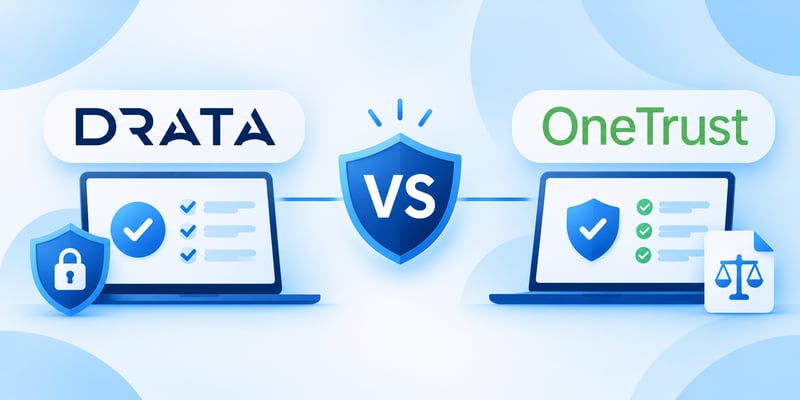
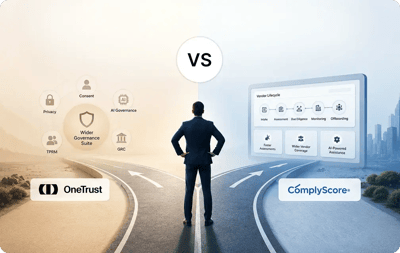
Teams comparing Drata and OneTrust are usually choosing between two different jobs: passing the next audit with as little effort as possible, or running privacy, risk, and vendor programs across a large enterprise. Drata fits the first job, and OneTrust fits the second. Pick the wrong one and you either outgrow the tool as your program widens, or pay for modules your team never opens.
Both platforms automate evidence and risk work, and they differ sharply in scope. ComplyScore® adds a third path for teams that want audit readiness that holds between audits.
Drata vs OneTrust: Which One Should You Choose?
Drata suits teams that need fast, automated evidence for SOC 2, ISO 27001, and similar audits. OneTrust suits enterprises that run privacy, consent, risk, and third-party programs on one suite. Teams that want audit-ready compliance that holds between audits should add ComplyScore® to their shortlist.
Your priority decides the answer:
|
Your priority
|
Best fit
|
Why
|
|
Fast evidence automation for a certification audit
|
Drata
|
Automated evidence collection, continuous control monitoring, and an Audit Hub for auditor requests
|
|
Privacy, consent, and data subject request programs
|
OneTrust
|
Cookie and mobile consent, privacy operations, and request automation in one portfolio
|
|
Privacy, risk, and third-party programs under one vendor
|
OneTrust
|
Tech risk, third-party risk, due diligence, and AI governance sit beside privacy
|
|
Audit readiness that holds between audits
|
ComplyScore®
|
Continuous checks on what is deployed in your cloud, so evidence stays current
|
|
Auditors who need one place to check everything
|
ComplyScore®
|
A separate auditor login with role-based access
|
|
A framework list that keeps changing
|
ComplyScore®
|
Configurable to SOC 2, ISO 27001, HIPAA, GDPR, DPDP, and AI frameworks
|
What Does Drata Do Best?
Drata positions itself as a trust management platform, and its enterprise page lists SOC 2, ISO 27001, HIPAA, GDPR, FedRAMP, CMMC, ISO 42001, PCI DSS, HITRUST, NIST AI RMF, DORA, and custom frameworks. The platform automates evidence collection and monitors controls continuously. It also includes a branded Trust Center for sharing your security posture with buyers.
Drata has added AI questionnaire assistance, an agentic third-party risk assessment, and an Audit Hub where auditors send evidence requests and approve responses. Its center of gravity stays on certification-style compliance, so a program that also needs consent management or enterprise-wide privacy operations will need other tools beside it.
What Does OneTrust Do Best?
OneTrust groups its portfolio into consent and preferences, privacy automation, AI governance, tech risk and compliance, and third-party management. The consent tools cover websites, mobile apps, OTT apps, and connected TVs, while privacy operations and data subject request automation handle the back office. IDC named OneTrust a Leader in its 2025 Worldwide GRC Software MarketScape. That breadth carries a scoping cost. A team that needs only SOC 2 evidence would use a small slice of the suite, and you decide early which modules to license.
How Do Drata and OneTrust Compare Feature by Feature?
Gaps marked “Not described” are worth pressing in a demo.
|
Category
|
Drata
|
OneTrust
|
|
Core focus
|
Trust management and compliance automation
|
Privacy, tech risk, third-party risk, and AI governance suite
|
|
Frameworks
|
SOC 2, ISO 27001, HIPAA, GDPR, FedRAMP, CMMC, ISO 42001, PCI DSS, HITRUST, NIST AI RMF, DORA, custom
|
Compliance Automation across frameworks and business scopes; list not stated on its products page
|
|
Evidence collection
|
Automated collection with continuous control monitoring
|
Not described on its products page
|
|
Auditor workflow
|
Audit Hub for evidence requests and approvals
|
Not described
|
|
Privacy and consent
|
Not described
|
Consent management, privacy operations, and data subject request automation
|
|
Third-party risk
|
Third-party risk management with AI-assisted reviews and an agentic assessment
|
Third-party risk management, due diligence, and a risk exchange covering thousands of vendors
|
|
AI features
|
Questionnaire assistance, agentic assessment, AI governance
|
AI Governance solution across the AI lifecycle
|
|
Trust center
|
Branded, self-serve Trust Center
|
Not described
|
How Much Do Drata and OneTrust Cost?
Drata’s platform page describes no pricing model and points buyers to plans, so expect a sales quote scoped to your headcount, frameworks, and add-ons.
OneTrust prices by solution package, and its package terms tie usage to metrics such as average daily unique visitors for consent management. Your cost moves with the modules you switch on and the volume that runs through them.
Pro tip: Ask each vendor to quote the same scope: frameworks, entities, modules, audit support, trust center, and implementation. Compare the Year 1 all-in figure, because a low entry price that excludes auditor tooling or integrations understates the real cost.
Neither vendor hands you a starting number, so build the comparison on identical scope.
Where Does ComplyScore® Fit Between Drata and OneTrust?
Drata gets a team certified quickly, and OneTrust covers a wide enterprise footprint. ComplyScore® by Atlas Systems works the stretch between audits. It checks what is deployed today, so your evidence stays current when an auditor, regulator, or customer asks for it.
You can run it as your self-assessment and compliance platform on its own, and it can replace either tool for that job. A built-in trust center lets customers and auditors check your compliance posture without waiting on email requests. Atlas Systems data from ComplyScore® programs shows audit readiness in under 30 days and 70 to 80 percent less manual evidence effort.
When policy documents and your cloud disagree
A policy document describes the configuration you intended. ComplyScore® continuous compliance automation verifies access controls, encryption settings, audit logging, and data retention as they run today. Its AI also reads uploaded ISO and SOC 2 evidence, maps it to the right control groups, and flags gaps so your team skips the hunt.
When auditors need one place to check everything
Auditors get a separate login with role-based access, so they review all evidence inside the platform instead of waiting on email threads. Maker-checker workflows assign owners and deadlines to each control task and keep an audit trail behind every decision.
When your framework list keeps growing
The platform configures to SOC 2, ISO 27001, HIPAA, GDPR, DPDP, and AI frameworks, so a new regulation becomes a configuration task instead of a tool change. Teams under India's DPDP Act or an AI governance mandate can add that framework beside the ones they already run.
When your vendors need the same governance
The vendor module runs separately when you want it. Zero-touch assessments start from a vendor name and country, and one due diligence report brings together financial, sanctions, legal, adverse media, and cyber signals. Enviri Corporation selected ComplyScore® to manage 45,000+ vendors across 30+ countries and three ERP systems.
ComplyScore® checks what is deployed today, so your audit pack stays ready all year.
How Do Drata, OneTrust, and ComplyScore® Compare Side by Side?
|
Dimension
|
Drata
|
OneTrust
|
ComplyScore®
|
|
Core focus
|
Trust management and compliance automation
|
Privacy, tech risk, third-party, and AI governance suite
|
Risk and compliance platform with continuous self-assessment
|
|
Evidence approach
|
Automated collection with continuous control monitoring
|
Compliance Automation across frameworks and scopes
|
Continuous verification of cloud controls, plus AI mapping of uploaded evidence
|
|
Auditor access
|
Audit Hub for requests and approvals
|
Not described
|
Separate auditor login with role-based access
|
|
Framework flexibility
|
Listed frameworks plus custom
|
Frameworks through Compliance Automation
|
Configurable to SOC 2, ISO 27001, HIPAA, GDPR, DPDP, and AI frameworks
|
|
Control task ownership
|
Control ownership in risk registers
|
Not described
|
Maker-checker workflows with owners, deadlines, and audit trails
|
|
Third-party risk
|
AI-assisted reviews and an agentic assessment
|
Onboarding to offboarding, due diligence, and a risk exchange
|
Full vendor lifecycle with zero-touch assessments and due diligence reports
|
Drata vs OneTrust: What Is the Final Verdict?
In the Drata vs OneTrust decision, Drata fits teams that want automated evidence for a certification audit, and OneTrust fits enterprises that want privacy, consent, risk, and third-party programs from one vendor. If your goal is audit readiness that holds between audits, ComplyScore® covers that job directly.
Before you decide, see how ComplyScore® compares with OneTrust and how it ranks in our Drata alternatives guide. Or book a 30-minute demo and see it on your own controls.