ComplyScore® Launches World’s First Headless TPRM, Bringing Conversational AI to Compliance Management. 



































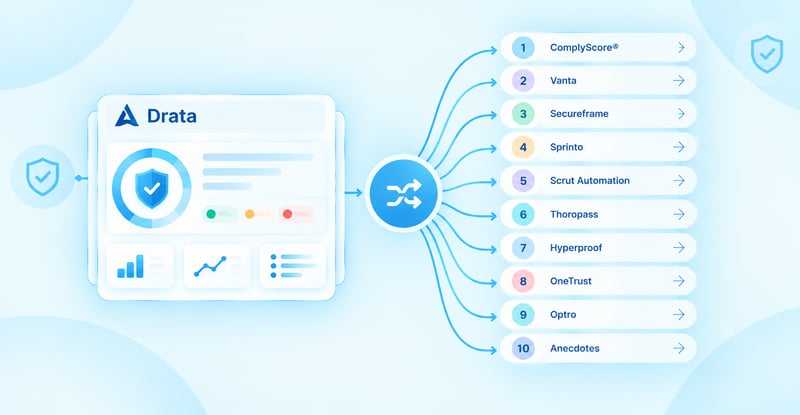
10 OneTrust Alternatives and Competitors


27 min read | Last Updated: 28 Oct, 2026
Many teams buy OneTrust for one job, such as privacy assessments or vendor reviews, and end up administering a platform that spans five governance domains. When renewal comes, they want to keep the module they use and drop the rest.
If you are searching for OneTrust alternatives, the right answer depends on which module you want to replace. This guide compares 10 options, including ComplyScore® from Atlas Systems, using public information only. Each entry covers what the tool does, who it suits, and where it may fall short.
What Are the Main Alternatives to OneTrust?
The main OneTrust alternatives are ComplyScore®, ServiceNow IRM, Archer, LogicGate, ProcessUnity, Prevalent, Hyperproof, Optro, TrustArc, and Securiti. Pick by module: privacy tools suit consent and data subject requests, GRC platforms suit controls and audits, and third-party risk tools suit vendor programs.
OneTrust describes its platform as an AI-ready governance platform that covers privacy, data, third-party, tech risk, and AI governance, with consent and data use modules alongside. That breadth explains both its appeal and the reasons buyers look elsewhere.
Why Do Teams Look for OneTrust Alternatives?
Three patterns come up most often when teams reopen their shortlist. Each one points to a different kind of replacement.
Costs grow as you add modules
OneTrust publishes no pricing, and G2 rates its perceived cost at the highest level. In G2's comparison with Securiti, reviewers of OneTrust Privacy Automation say costs can add up as modules are added. A team that starts with one module should model the cost of the second and third before signing.
Setup and learning curve take time
On G2, reviewers of OneTrust Tech Risk & Compliance cite complex implementation and difficult setup, with six mentions each across 108 reviews. Reviewers of Privacy Automation cite learning difficulty and complexity. The mention counts are small, so treat them as a pattern to test in your own trial.
Reporting can feel light for mature programs
SelectHub's comparison says OneTrust GRC reporting feels light for complex needs and that tailoring workflows may take configuration or coding. SelectHub is an aggregator, so verify this against your own reporting requirements in a demo.
Decide which OneTrust module you use most before you shortlist, because each module has a different set of strong alternatives.
How We Evaluate These OneTrust Alternatives
We built this list from public information only: vendor websites, product pages, press releases, and review platforms such as G2 and Gartner Peer Insights. We ran no hands-on trials. When a vendor makes a performance claim, we attribute it to the vendor and do not repeat it as fact.
Here are the six criteria we applied to every tool:
• Module coverage against OneTrust's main areas: privacy, GRC, and third-party management
• Time to implement, based on public review data where it exists
• Usability and the administration effort reviewers describe
• Pricing transparency
• Reporting and audit trail
• Strength of the public evidence, including rating counts and sample size
How Do These OneTrust Alternatives Compare?
|
Tool |
Core focus |
Privacy |
GRC and compliance |
Third-party risk |
Best fit |
|
ComplyScore® |
Risk and compliance |
Regulation mapping and assessments |
Continuous self-assessment, evidence, audit readiness |
Full TPRM and vendor lifecycle management with headless access |
Teams replacing GRC and third-party modules |
|
ServiceNow IRM |
Enterprise risk on a workflow platform |
Separate Privacy Management product |
Policy, control testing, resilience |
Third-party risk module |
Organizations on ServiceNow |
|
Archer |
Integrated risk management |
Not detailed on pages reviewed |
Regulatory and corporate compliance |
Third-party risk module |
Large regulated enterprises |
|
LogicGate |
No-code GRC |
Data privacy application listed |
Controls, regulatory, internal audit |
Third-party risk application |
Teams that want configurable workflows |
|
ProcessUnity |
Third-party risk |
Privacy risk domain assessments |
Cyber, AI, and resiliency domains |
Core product |
Vendor risk programs |
|
Prevalent |
Third-party risk |
Not detailed on pages reviewed |
Not a stated focus |
Core product |
Focused vendor lifecycle programs |
|
Hyperproof |
Compliance operations and GRC |
Not detailed on pages reviewed |
160+ frameworks per G2 |
AI-native module launched April 2026 |
Multi-framework compliance programs |
|
Optro |
GRC intelligence |
AI governance; privacy not listed in scope |
Audit, risk, controls, compliance |
Agentic TPRM product |
Audit-led enterprise teams |
|
TrustArc |
Privacy |
PIAs, DPIAs, data mapping, consent, DSAR |
Not a core focus |
Vendor risk through data mapping |
Privacy-first teams |
|
Securiti |
Privacy and data security |
DSAR, consent, PIAs, RoPA, data mapping |
Compliance management listed |
Vendor assessments |
Privacy operations teams |
Which OneTrust Alternatives Are Worth Evaluating?
Below are the 10 tools, starting with ComplyScore®. Each entry covers positioning, fit, features, pros, and cons.
1. ComplyScore® by Atlas Systems
ComplyScore® is a risk and compliance management platform. It governs compliance inside your organization through continuous self-assessment, and it extends the same policy engine and audit trail to every vendor you depend on.
Why it might work for you: Choose it if you use OneTrust for risk and compliance and third-party management and want both under one policy engine. Its regulation mapping covers GDPR, DPDP, the UK Data Protection Act 2018, CCPA, and HIPAA, so privacy obligations appear as assessed controls and tracked gaps. Atlas Systems reports full audit readiness in under 30 days and 70 to 80% less manual effort.
Key features:
• Compliance self-assessment for ISO 27001, SOC 2, GDPR, DPDP, and NIST CSF, with evidence collection and audit-ready reports
• Vendor lifecycle management from intake through offboarding, with auto-enriched profiles and self-registration
• Zero-touch assessments, with AI-prefilled questionnaires, evidence review, and tiering that sets assessment depth by engagement
• Third-party due diligence reports that cover financial, compliance, legal, reputational, geopolitical, and cybersecurity risk
• AI third-party risk management software that applies AI across vendor intake, assessment, due diligence, and monitoring, so your analysts review findings instead of keying in data
• Continuous monitoring of financial, cyber, and regulatory signals, with findings routed to owners and deadlines
Pros:
• One policy engine and one audit trail across self-assessment and vendor risk, so you configure rules once
• Headless TPRM architecture lets you and your other systems query vendor risk and self-assessment status through API, chat, or voice commands
• Average vendor onboarding under 10 days, down from 45 to 60
• Targeted threat intelligence on vendors
• Optional managed services for teams without dedicated analysts
2. ServiceNow IRM
ServiceNow describes IRM as a way to connect risk and compliance across IT, cyber, and business operations in one system. It runs on the ServiceNow AI Platform, so risk work uses the same workflows as the rest of your ServiceNow estate.
Why it might work for you: It suits organizations that already standardize on ServiceNow and want risk and compliance work to share workflows with IT and security operations.
Key features:
• Enterprise risk, tech and cyber risk, and operational risk management
• Compliance and continuous assurance, including policy management and control testing
• Operational resilience and AI governance
• AI agents that, per ServiceNow, assess controls and route remediation work
Pros:
• Connection to ITSM and SecOps, per SelectHub
• Wide module list on one platform
Cons:
• SelectHub reports a steep learning curve, less customizable reporting, and difficult integration with HR and finance systems outside ServiceNow
• G2 reviewers mention complex setup and cost, with two mentions each across 119 reviews, and report an average four-month implementation from eight responses
3. Archer
Archer says Forrester named it a Leader in The Forrester Wave for Third-Party Risk Management Platforms, Q1 2026. Its cloud-native Archer Evolv offering ties third-party risk into enterprise risk, controls, policies, and regulatory change.
Why it might work for you: It fits large regulated organizations that want one governed ecosystem across several risk domains.
Key features:
• Regulatory and corporate compliance management
• Third-party risk with continuous monitoring and relationship mapping, per Archer
• Integration of issues, controls, policies, and remediation in one framework
• AI governance
Pros:
• Wide coverage across risk domains, per Archer
• Workflow-connected integrations that update risk scores, per Archer
Cons:
• G2 shows 3.6 out of 5 from 20 reviews, with an ease of use score of 6.8 against 8.0 for ServiceNow GRC
• Two single-mention cons on G2 cite difficult customization and inadequate reporting, so confirm both in a demo
4. LogicGate
LogicGate sells Risk Cloud, a GRC platform it describes as no-code. Its page lists more than 30 applications across governance, risk management, and compliance and audit, including a data privacy application.
Why it might work for you: It suits teams that want to configure their own workflows and frameworks without engineering help.
Key features:
• Controls compliance and regulatory compliance management
• Third-party and enterprise risk management
• Pre-built frameworks including ISO 27001, SOC 2, NIST CSF, GDPR, HIPAA, and CCPA
• Automated gap analysis and evidence monitoring
Pros:
• G2 shows 4.6 out of 5 from 191 reviews, with an ease of use score of 8.8
• Reviewers cite customizability
Cons:
• Five G2 reviewers cite a learning curve, so plan for admin training
• G2 shows no reviewer-based implementation time, and LogicGate's own claim of days-long deployment applies to time-sensitive cases only
5. ProcessUnity
ProcessUnity focuses on third-party risk. Its platform covers intake, due diligence, monitoring, and remediation, with AI agents for tasks such as questionnaire autofill and evidence review.
Why it might work for you: It suits teams replacing OneTrust's third-party module and wanting assessments across cybersecurity, AI, privacy, and resiliency domains.
Key features:
• Assessment autofill and an evidence evaluator that maps vendor documents to controls
• A risk index that combines controls data with external threat intelligence
• Two-way connectors to systems such as SAP, ServiceNow, and Salesforce
• Continuous monitoring and a Global Risk Exchange data set
Pros:
• Gartner Peer Insights shows 4.7 out of 5 from 161 ratings
• One reviewer calls it quick to implement
Cons:
• Reviewers say workflow configuration takes careful planning and is not plug-and-play
• Its pages center on third-party risk, so teams that also use OneTrust for GRC controls need a second tool
Comparing ProcessUnity for vendor risk? ComplyScore® covers the same lifecycle with no-code templates and adds contract and credential tracking
6. Prevalent (Mitratech)
Prevalent is Mitratech's third-party risk platform. It covers the vendor lifecycle from sourcing and onboarding through monitoring, remediation, and offboarding.
Why it might work for you: It fits teams where vendor risk is the main concern and who want a narrower tool than a broad suite.
Key features:
• Vendor portals, messaging, and standardized questionnaires
• AI FastTrack Assessment, which builds a new questionnaire from up to 15 prior assessments
• A library of more than 800 assessment templates
• Vendor Threat Monitor across adverse media, sanctions, and financial signals
Pros:
• The Digital Project Manager rates it 4.5 out of 5 and cites an intuitive interface and responsive support
• Mitratech says customers report a 50% reduction in manual assessment work
Cons:
• The same review calls it narrower than broad GRC platforms
• It also notes limited customization against competitors and a learning curve for advanced features
Weighing Prevalent for vendor risk? ComplyScore® adds dynamic tiering, contract tracking, and HIPAA, HITRUST, GDPR, and DPDP alignment
7. Hyperproof
Hyperproof is a compliance operations and GRC platform. G2 lists 160+ supported frameworks with control mapping across them, and Hyperproof launched an AI-native third-party risk module on April 28, 2026.
Why it might work for you: It suits teams that run several frameworks and want evidence reuse across them.
Key features:
• Control mapping and reuse across frameworks
• AI agents that find evidence and test high-frequency controls
• Risk management and policy management
• Third-party risk in three tiers, from a free trial to an advanced tier with vendor intake and lifecycle management
Pros:
• G2 shows 4.5 out of 5 from 223 reviews
• G2 reviewers report an implementation time of about three months
Cons:
• The third-party module launched in 2026, so its public review history is short
• The pages we reviewed center on compliance and risk, so privacy-led teams should confirm coverage
• G2 lists perceived cost at its highest level
8. Optro
Optro is the new name for AuditBoard, announced on March 9, 2026. It describes itself as a GRC intelligence platform spanning audit, risk, and compliance.
Why it might work for you: It fits audit-led enterprises that want controls, risk, and third-party oversight in one connected platform.
Key features:
• Audit, controls management, and cyber risk management
• Compliance products for regulations and cross-framework mapping
• AI governance
• Agentic third-party risk, with vendor tiering and pre-filled questionnaires
Pros:
• G2 shows 4.6 out of 5 from 1,639 reviews under the AuditBoard listing
• More than 150 out-of-the-box integrations, per Optro
Cons:
• G2 reviewers tag limited functionality (71 mentions), limited customization (54), and not intuitive (54)
• Privacy does not appear in the product scope on the pages we reviewed
9. TrustArc
TrustArc is a privacy platform. Its pages list assessments for PIAs, DPIAs, and TIAs, data mapping, cookie and preference consent, and individual rights automation.
Why it might work for you: It suits privacy-first teams that need consent and data subject request tooling and no broader GRC suite.
Key features:
• Assessment Manager for privacy impact and AI risk assessments
• Data Mapping and Risk Manager, which TrustArc positions for vendor risk
• Cookie Consent Manager and Consent and Preference Manager
• Individual Rights Manager for data subject requests
Pros:
• G2 reports an implementation time of about two months from 20 responses
• Support scores 8.7 on G2
Cons:
• G2 reviewers cite poor customer support (16 mentions) and a learning curve (15)
• Its focus is privacy, so GRC controls and audit programs need another tool
10. Securiti
Securiti sells a PrivacyOps platform for data subject requests, consent, privacy impact assessments, RoPA, data mapping, and breach management. Its separate data security products sit alongside it.
Why it might work for you: It suits privacy operations teams that want request handling and data discovery in one system.
Key features:
• Data subject request intake, identity verification, and fulfillment
• Cookie, first-party, and third-party consent management
• Privacy impact assessments and automated RoPA reports
• A sensitive data catalog for data mapping
Pros:
• G2 shows 4.6 out of 5 from 112 reviews, against 4.3 from 154 for OneTrust Privacy Automation
• Ease of setup scores 8.5 against 7.8, and support scores 9.3 against 8.6
Cons:
• G2 reviewers cite complexity (11 mentions) and a learning curve (10)
• Reviewers say pricing can run high for smaller deployments, and pricing is quote-based
How Do You Choose Between These OneTrust Alternatives?
Match the tool to the module you want to replace before you compare feature lists.
|
Your priority |
Tools to shortlist |
|
Replace OneTrust GRC and compliance work |
ComplyScore®, Hyperproof, LogicGate, Archer |
|
Continuous self-assessment against GDPR, DPDP, or ISO 27001 |
ComplyScore®, Hyperproof, LogicGate |
|
Third-party risk and vendor lifecycle |
ComplyScore®, ProcessUnity, Prevalent, Optro |
|
Own controls and vendors under one policy engine |
ComplyScore®, ServiceNow IRM, Archer |
|
Consent, cookie banners, and data subject requests |
TrustArc, Securiti |
|
Privacy impact assessments with data mapping |
TrustArc, Securiti |
|
Already standardized on ServiceNow |
ServiceNow IRM |
|
Audit-led enterprise programs |
Optro, Archer |
Which OneTrust Alternative Fits Your Team?
If you use OneTrust mainly for privacy operations, TrustArc and Securiti match that job most directly. If you use it for GRC, compliance, and vendor oversight, ComplyScore® replaces those modules on one platform with one audit trail.
Start with the priority table above and test two finalists on your own workflows. To see continuous self-assessment and vendor risk working together, request a demo of ComplyScore®.
FAQs
What are the best alternatives to OneTrust?
It depends on the module you use. ComplyScore®, Hyperproof, LogicGate, and Archer suit risk and compliance work, and ProcessUnity and Prevalent suit third-party risk. TrustArc and Securiti suit consent, data subject requests, and privacy assessments.
Is OneTrust only a privacy tool?
No. OneTrust describes its platform as covering privacy, data, third-party, tech risk, and AI governance, with consent and data use modules. Buyers can license one module and add others later.
How much does OneTrust cost?
OneTrust does not publish list prices. G2 rates its perceived cost at the highest level, and reviewers say costs add up as modules are added. Ask for a quote by module and confirm renewal terms before you sign.
Can I replace only one OneTrust module?
Yes. Most alternatives focus on one or two domains, so teams often keep one OneTrust module and move the rest. Map your data flows first, and run the new tool in parallel for one cycle before you cancel.
What is the difference between GRC tools and third-party risk tools?
GRC tools govern your own controls, policies, and audits. Third-party risk tools assess and monitor your vendors. ComplyScore® covers both on one platform, while tools such as ProcessUnity and Prevalent focus on vendors.
Author
Sirish Pallevada
Sirish Pallevada is Chief Revenue Officer at ComplyScore®, where he leads go-to-market strategy for the AI-powered third-party risk management platform. He works directly with GRC directors, CISOs, and vendor risk leaders across banking, healthcare, and technology to understand how regulated enterprises are modernizing vendor risk and compliance programs. He holds a Post Graduate Diploma in Management from IIM Indore and a certification in supply chain management from APICS. His perspective in ComplyScore® content draws on frontline conversations with hundreds of compliance and risk buyers on where manual vendor risk processes break down and what autonomous TPRM adoption actually looks like inside large enterprises.