ComplyScore® Launches World’s First Headless TPRM, Bringing Conversational AI to Compliance Management. 

































10 SecurityScorecard Alternatives and Competitors


26 min read | Last Updated: 28 Oct, 2026
A security score shows what a vendor exposes to the outside world. It cannot show how that vendor runs access reviews, handles incidents, or protects your data inside its own walls. Teams that stop at the score often spend renewal season debating a grade instead of closing a gap.
If you are searching for SecurityScorecard alternatives, you probably want more than a rating. This guide compares 10 options, including ComplyScore® from Atlas Systems, using public information only. It also walks through how to move from ratings alone to a full third-party risk process.
What Are the Main Alternatives to SecurityScorecard?
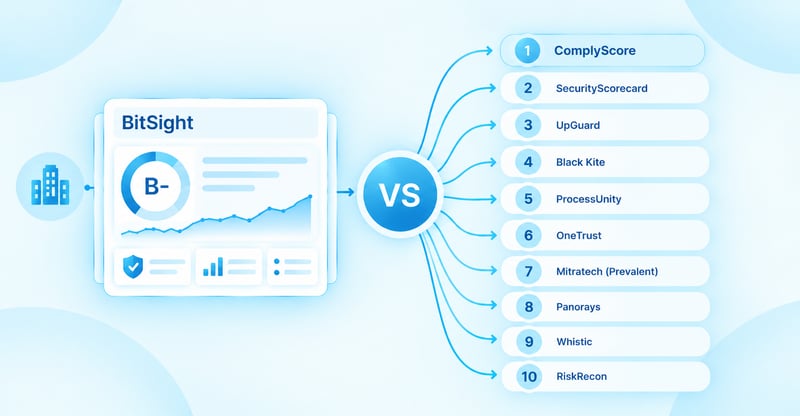
The main SecurityScorecard alternatives are ComplyScore®, Bitsight, Black Kite, RiskRecon, UpGuard, Panorays, ProcessUnity, Prevalent, Whistic, and OneTrust. Ratings-led tools suit security teams, and program-led platforms suit teams that also need assessments, due diligence, and vendor lifecycle control in one place.
SecurityScorecard monitors vendor scores in real time, and its TPRM page lists questionnaire management, AI gap analysis, and fourth-party visibility alongside it. The question is how much of your program you want to run on a score.
Why Do Teams Look for SecurityScorecard Alternatives?
Three patterns come up most often when teams reopen their vendor risk shortlist. Each one points to a different kind of replacement.
Score changes can be hard to explain
On G2, SecurityScorecard holds 4.3 out of 5 from 92 reviews. Reviewers praise dashboards and ease of use. They also cite unclear reasons behind score changes and scoring issues such as false positives, with four mentions each. The counts are small, so test this in your own trial.
Reporting can feel basic
Four G2 reviewers say reports are too basic for custom or executive needs. If your board or regulators ask for evidence of how you tier, assess, and remediate vendors, a score dashboard covers only part of the answer.
A score answers one question
SecurityScorecard itself pairs ratings with questionnaires and AI gap analysis on SOC 2 reports, which shows that scores alone leave questions open. Teams that rely on a rating still need somewhere to tier vendors, collect evidence, and track remediation to closure.
Decide whether you want a better score or a better process before you shortlist, because the strongest tools for each job differ.
How We Evaluate These SecurityScorecard Alternatives
We built this list from public information only: vendor websites, product pages, press releases, and review platforms such as G2 and Gartner Peer Insights. We ran no hands-on trials. When a vendor makes a performance claim, we attribute it to the vendor and do not repeat it as fact.
Here are the six criteria we applied to every tool:
• Ratings and monitoring depth, including fourth-party visibility
• Assessment and due diligence workflow
• Vendor lifecycle coverage from intake to offboarding
• Risk domains beyond cyber, such as financial, privacy, and regulatory
• Time to implement, based on public review data where it exists
• Strength of the public evidence, including review counts
How Do These SecurityScorecard Alternatives Compare?
|
Tool |
Core approach |
Assessments and due diligence |
Vendor lifecycle |
Beyond cyber |
Best fit |
|
ComplyScore® |
Program-led TPRM |
Zero-touch assessments and AI due diligence |
Intake to offboarding |
Financial, legal, privacy, geopolitical |
Compliance and risk teams |
|
Bitsight |
Ratings-led |
AI assessments mapped to frameworks |
Vendor network profiles |
Cyber focus |
Security-led teams |
|
Black Kite |
Ratings-led |
Compliance mapping, gap-based questionnaires |
Monitoring focus |
Cyber and ransomware focus |
Ransomware-focused teams |
|
RiskRecon |
Ratings-led |
AI questionnaires via Whistic |
Lifecycle in one view, per vendor |
Cyber focus |
Asset-weighted prioritization |
|
UpGuard |
Ratings plus questionnaires |
Questionnaires and attack surface |
Assessment workflow |
Cyber focus |
Mid-sized security teams |
|
Panorays |
Ratings plus questionnaires |
AI questionnaires blended into one rating |
Remediation workflow |
Cyber focus |
One blended risk rating |
|
ProcessUnity |
Program-led TPRM |
AI agents for due diligence and evidence |
Intake to remediation |
Cyber, AI, privacy, resiliency |
Dedicated vendor risk teams |
|
Prevalent |
Program-led TPRM |
AI FastTrack assessments |
Sourcing to offboarding |
Cyber, financial, ESG signals |
Vendor-risk-first teams |
|
Whistic |
Program-led TPRM |
AI assessments and trust center |
Assessment and monitoring |
Cyber and compliance |
Teams that also answer customers |
|
OneTrust |
Suite |
Intake, assessment, mitigation |
Intake to reporting |
Privacy and tech risk modules |
Existing OneTrust customers |
Which SecurityScorecard Alternatives Are Worth Evaluating?
Below are the 10 tools, starting with ComplyScore®. Each entry covers positioning, fit, features, pros, and who it suits best.
1. ComplyScore® by Atlas Systems
ComplyScore® is a risk and compliance management platform. Its third-party module governs the whole vendor relationship, from due diligence and assessment to monitoring and offboarding, on one policy engine and one audit trail.
Why it might work for you: Choose it when you want to keep an outside-in ratings feed as one input and build the process around it. ComplyScore® takes in ratings signals from security ratings providers and adds assessments, due diligence, and remediation tracking. ComplyScore® does not issue its own outside-in rating. Atlas Systems reports vendor onboarding under 10 days, down from 45 to 60
Key features:
• Vendor lifecycle management from intake through offboarding, with auto-enriched profiles and self-registration
• Zero-touch assessments, with AI-prefilled questionnaires, evidence review, and tiering that sets assessment depth by engagement
• Third-party due diligence reports that cover financial, compliance, legal, reputational, geopolitical, and cybersecurity risk
• Continuous monitoring of financial, cyber, and regulatory signals, with findings routed to owners and deadlines
• AI third-party risk management software that applies AI across intake, assessment, due diligence, and monitoring, so your analysts review findings instead of keying in data
Pros:
- Pulls security ratings from providers such as SecurityScorecard, RiskRecon, and Shodan into each vendor record, so scores sit beside assessments, due diligence, and remediation.
- Headless TPRM architecture lets you and your other systems query vendor risk through API, chat, or voice commands
- Targeted threat intelligence on vendors
- Optional managed services for teams without dedicated analysts
- Self-assessment on the same platform, so you can govern your own controls with the same policy engine
- 70 to 80% less manual effort across the vendor lifecycle
Best fit for: Compliance, risk, and audit teams that want assessments, due diligence, and monitoring in one governed workflow. Due diligence on vendors in countries such as China draws on thinner public data than for India, so plan on extra manual review there.
2. Bitsight
Bitsight pairs daily external security ratings with a vendor risk layer. Its page lists a Vendor Network of 75,000+ profiles and AI-automated assessments mapped to frameworks such as NIST CSF 2.0 and ISO 27001.
Why it might work for you: It suits teams that want ratings depth first and a growing assessment layer second.
Key features:
• Daily ratings with historical data
• Automatic fourth-party discovery
• AI summaries of SOC 2 reports and automated control mapping
• A Dynamic Vulnerability Exploitability score for zero-day events
Pros:
• G2 shows 4.5 out of 5 from 76 reviews
• Bitsight says its ratings are independently validated and that customers cut onboarding time by 70% on average
Best fit for: Security-led teams that want deep outside-in ratings with fourth-party visibility.
Bitsight leads with security ratings, while ComplyScore® runs the full vendor lifecycle from due diligence to remediation
3. Black Kite
Black Kite is a cyber risk intelligence platform built around ratings and a Ransomware Susceptibility Index. It adds compliance mapping and automated questionnaires that start from monitoring data.
Why it might work for you: It suits teams that focus on ransomware exposure and want to see how ratings are calculated.
Key features:
• Cyber ratings with a documented methodology, per Black Kite
• Ransomware Susceptibility Index
• Vendor compliance mapping to frameworks and custom questionnaires
• Nth-party visibility and concentration risk monitoring
Pros:
• Questionnaires contact vendors only about identified gaps, per Black Kite
• AI analysis of vendor documentation and control mapping
Best fit for: Security teams focused on ransomware and supply chain exposure.
4. RiskRecon
RiskRecon, owned by Mastercard, monitors vendors continuously and rates their security posture. Its assessments run on technology from Whistic, which brings AI questionnaires into the same view.
Why it might work for you: It suits teams that want findings ranked by what each vendor asset exposes, such as logins, transactions, or card data.
Key features:
• Continuous monitoring across third- and fourth-party providers
• Machine learning that attributes assets to each vendor
• Findings ranked by severity and asset value
• AI questionnaires, powered by Whistic
Pros:
• RiskRecon says its ratings are independently verified to 99.1%
• A free 30-day trial covers up to 50 vendors, per RiskRecon
Best fit for: Security teams that prioritize remediation by asset value.
5. UpGuard
UpGuard combines vendor risk assessments, security ratings, and attack surface monitoring in one product.
Why it might work for you: It suits mid-sized teams that want ratings and questionnaires together without a separate workflow tool.
Key features:
• Security ratings and continuous monitoring
• Questionnaires and assessment workflows
• Attack surface monitoring
Pros:
• G2 shows 4.5 out of 5 from 768 reviews
• Reviewers cite ease of use (267 mentions) and responsive support (109)
Best fit for: Mid-sized security teams that want one tool for ratings and basic assessments.
ComplyScore® can replace UpGuard when you also need contract tracking, credential monitoring, and analyst-run assessments
6. Panorays
Panorays merges AI questionnaire results, external attack surface findings, inherent risk, and your own risk policies into a single rating it calls Risk DNA.
Why it might work for you: It suits teams that want one blended view and not a score and a questionnaire result in separate places.
Key features:
• AI questionnaires with auto-fill
• Continuous external attack surface monitoring
• Automatic remediation tasks with deadlines
• Mapping of third-, fourth-, and nth-party relationships
Pros:
• G2 shows 4.3 out of 5 from 52 reviews, with ease of use cited 27 times
• Panorays says Forrester named it a Leader in The Forrester Wave: Cybersecurity Risk Ratings Platforms, 2026
Best fit for: Teams that want one blended risk rating that reflects their own policies.
7. ProcessUnity
ProcessUnity focuses on third-party risk. Its platform covers intake, due diligence, monitoring, and remediation, with AI agents for questionnaire autofill and evidence review.
Why it might work for you: It suits dedicated vendor risk teams that want assessments across cybersecurity, AI, privacy, and resiliency domains.
Key features:
• Assessment autofill and an evidence evaluator that maps vendor documents to controls
• A risk index that combines controls data with external threat intelligence
• Two-way connectors to systems such as SAP, ServiceNow, and Salesforce
• Continuous monitoring and a Global Risk Exchange data set
Pros:
• Gartner Peer Insights shows 4.7 out of 5 from 161 ratings
• One reviewer calls it quick to implement
Best fit for: Dedicated vendor risk teams that will invest planning time in configurable workflows.
Get ProcessUnity’s lifecycle coverage with ComplyScore® templates that your compliance team configures without code
8. Prevalent (Mitratech)
Prevalent is Mitratech's third-party risk platform. It covers the vendor lifecycle from sourcing and onboarding through monitoring, remediation, and offboarding.
Why it might work for you: It fits teams where vendor risk is the main concern and who want a narrower tool than a broad suite.
Key features:
• Vendor portals, messaging, and standardized questionnaires
• AI FastTrack Assessment, which builds a new questionnaire from up to 15 prior assessments
• A library of more than 800 assessment templates
• Vendor Threat Monitor across adverse media, sanctions, and financial signals
Pros:
• The Digital Project Manager rates it 4.5 out of 5 and cites an intuitive interface and responsive support
• Mitratech says customers report a 50% reduction in manual assessment work
Best fit for: Teams where third-party risk is the primary program and broader GRC sits elsewhere.
ComplyScore® adds dynamic tiering, contract tracking, and HIPAA, HITRUST, GDPR, and DPDP alignment to Prevalent-style lifecycle coverage
9. Whistic
Whistic combines AI-assisted vendor assessments with vendor monitoring and a trust center that publishes your own security documents.
Why it might work for you: It suits teams that assess vendors and also answer security questionnaires from their own customers.
Key features:
• AI assessments that summarize SOC 2 reports and validate answers with source citations
• Automation Orchestrator with four AI agents
• Vendor monitoring for breaches and risk changes
• Trust Center and a Trust Catalog of vendor trust centers
Pros:
• G2 shows 4.6 out of 5 from 58 reviews
• Whistic says customers move assessments from eight weeks to one week
Best fit for: Teams that run both sides of the questionnaire exchange, vendors in and customers out.
10. OneTrust
OneTrust sells third-party management as one module of a wider governance platform. Its platform page describes automating vendor work from intake and risk assessment through mitigation and reporting.
Why it might work for you: It suits organizations that already run OneTrust privacy or risk modules and want vendor risk in the same suite.
Key features:
• Vendor intake, risk assessment, mitigation, and reporting
• Tech risk and compliance and privacy modules on the same platform
• Modules you can add over time, per SelectHub
Pros:
• G2 shows 4.6 out of 5 from 108 reviews for Tech Risk & Compliance
• One vendor for privacy, risk, and third-party work
Best fit for: Enterprises that already use OneTrust and want to consolidate vendors.
Want TPRM without a privacy suite? ComplyScore® typically goes live in four to six weeks once your data is ready
How Do You Move From Security Ratings to a Full TPRM Process?
Keep your ratings feed as one signal and build the process around it. Here are the six steps, each with what to do, what to measure, and what to adjust.
Step 1: Tier your vendors by criticality
Score each vendor by data access, business impact, and regulatory exposure. Measure the share of vendors tiered, and aim for 100% of your critical group. If tiering stalls, start with your top 50 by spend.
Step 2: Set ratings thresholds
Decide which score drops trigger a review, and track alerts per vendor and the share that turn out to be false positives. If noise runs high, alert on changes only for tier 1 and tier 2. Read more in our guide to vendor risk scoring.
Step 3: Assess your top tiers
Send standardized questionnaires to critical vendors and validate answers against evidence. Measure response rate and days to complete. If vendors stall, send only the questions that apply to their tier.
Step 4: Add due diligence at onboarding
Run financial, legal, and compliance checks before a contract goes live. Measure days from request to approval. If onboarding slows, run due diligence in parallel with contract negotiation.
Step 5: Route findings to owners
Assign every finding an owner and a deadline. Measure median days to remediate and the count of overdue items. If items age, escalate automatically at 30 days.
Step 6: Run both approaches for one quarter
Keep your current ratings tool active while the new process runs. Count the findings the process caught that ratings missed. Cancel the old tool only after that count justifies the move.
How Do You Choose Between These SecurityScorecard Alternatives?
Match the tool to the job before you compare feature lists.
|
Your priority |
Tools to shortlist |
|
Assessments, due diligence, and lifecycle in one workflow |
ComplyScore®, ProcessUnity, Prevalent |
|
Ratings plus a process around them |
ComplyScore®, Panorays, UpGuard |
|
Risk domains beyond cyber, such as financial and privacy |
ComplyScore®, ProcessUnity, OneTrust |
|
Deep outside-in ratings and fourth-party visibility |
Bitsight, Black Kite, RiskRecon |
|
Ransomware exposure focus |
Black Kite |
|
Vendor assessments plus a customer-facing trust center |
Whistic |
|
Already standardized on OneTrust |
OneTrust |
Which SecurityScorecard Alternative Fits Your Team?
If you want a stronger score, Bitsight, Black Kite, and RiskRecon compete directly on ratings. If you want a process that tiers vendors, collects evidence, runs due diligence, and tracks remediation, ComplyScore® covers that work on one platform.
Start with the priority table above and test two finalists with 20 of your own vendors. To see assessments, due diligence, and monitoring in one workflow, request a demo of ComplyScore®.
FAQs
What are the best alternatives to SecurityScorecard?
It depends on your goal. Bitsight, Black Kite, and RiskRecon suit ratings-led programs. ComplyScore®, ProcessUnity, Prevalent, and Whistic suit teams that want assessments, due diligence, and lifecycle control in one workflow.
Is SecurityScorecard a TPRM tool?
SecurityScorecard started with security ratings and now lists questionnaires, AI gap analysis, and fourth-party visibility on its TPRM page. Many teams still pair it with a workflow platform for tiering, due diligence, and remediation.
How much does SecurityScorecard cost?
SecurityScorecard does not publish list prices, so request a quote for your vendor count. Ask what questionnaire volume and monitoring depth the quote includes, and confirm renewal terms before you sign.
Can I keep security ratings and add a TPRM platform?
Yes. Many teams keep a ratings feed as one signal and run assessments, due diligence, and remediation in a separate platform. ComplyScore® takes in ratings signals and adds that process layer.
How do I switch from security ratings to a full TPRM process?
Tier your vendors first, then add assessments, due diligence, and remediation tracking. Run the old and new approaches in parallel for one quarter and count the findings the process caught that ratings missed.
Author
Sirish Pallevada
Sirish Pallevada is Chief Revenue Officer at ComplyScore®, where he leads go-to-market strategy for the AI-powered third-party risk management platform. He works directly with GRC directors, CISOs, and vendor risk leaders across banking, healthcare, and technology to understand how regulated enterprises are modernizing vendor risk and compliance programs. He holds a Post Graduate Diploma in Management from IIM Indore and a certification in supply chain management from APICS. His perspective in ComplyScore® content draws on frontline conversations with hundreds of compliance and risk buyers on where manual vendor risk processes break down and what autonomous TPRM adoption actually looks like inside large enterprises.