A regulated enterprise answers to several rulebooks at once. They include data protection laws such as GDPR and India’s DPDP Act, security standards such as SOC 2 and ISO 27001, sector rules from its regulators, and the security terms written into customer contracts. Each one adds obligations, and each obligation depends on controls that can weaken quietly as systems, teams, and data uses change.
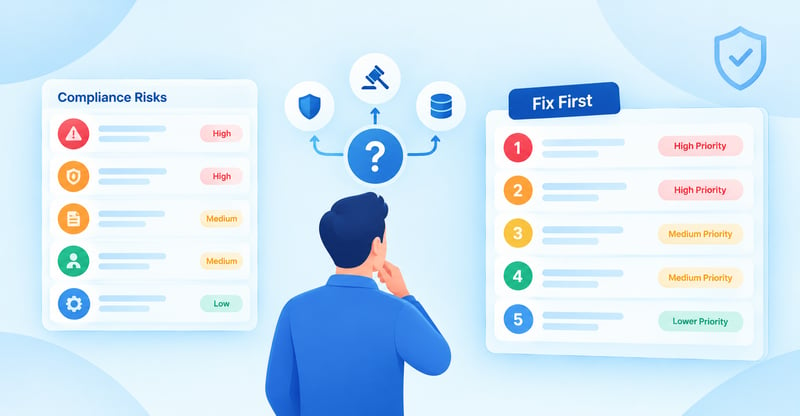
The result is a long list of gaps competing for the same small team. Some carry real exposure, such as a regulatory penalty, a failed certification, or a lost customer contract, while others would barely register in an audit. Without a consistent way to tell them apart, effort tends to go to whichever gap is most visible or most recent, and the riskiest ones can wait for months.
Compliance risk management gives you that consistent way to decide. You keep a register of what you owe, map each obligation to the controls that meet it, score every gap on the same likelihood and impact scale, and record whether each one gets fixed, offset, accepted, or stopped. The result is a set of priorities you can defend to your board, auditors, and regulators, because every decision has a score, an owner, and a reason behind it.
Key takeaways
- Compliance risk is the likelihood and impact of failing a legal, regulatory, or contractual obligation
- Build an obligation register first, then map each obligation to controls once and reuse those controls across frameworks
- Score every gap on the same likelihood and impact scale so priorities hold up under scrutiny
- Each gap gets one of four treatments: remediate, add a compensating control, accept for a set period, or stop the activity
- Report risk to leadership in four numbers, built from live data
What Is Compliance Risk Management?
Compliance risk management is the ongoing process of identifying the laws, regulations, and standards you must meet, assessing where controls could fail, prioritizing gaps by likelihood and impact, and deciding how to treat each one. The goal is to spend remediation effort where exposure is highest.
It sits inside your broader compliance management program as the part that decides priorities. Compliance risk management tells you what to fix first, and your monitoring program tells you whether the fix is still holding.
The financial stakes keep rising. IBM’s 2026 Cost of a Data Breach Report puts the global average breach cost at $4.99 million, a 12% increase over the previous year and a record high.
How Compliance Risk Relates to Other Risk Types
Compliance risk overlaps with several neighboring disciplines, and the table below shows where each one starts and stops.
|
Risk type
|
What it covers
|
Typical owner
|
|
Compliance risk
|
Failing a legal, regulatory, or contractual obligation
|
Chief Compliance Officer or GRC lead
|
|
Regulatory risk
|
New or changed rules that alter your obligations
|
Legal and regulatory affairs
|
|
Operational risk
|
Losses from failed processes, people, or systems
|
Chief Risk Officer
|
|
Third-party risk
|
Vendors and partners failing obligations on your behalf
|
Vendor risk or procurement
|
If your team already runs a risk and control self-assessment for operational risk, compliance risk management applies the same discipline to a different set of obligations. Regulations, standards, and contracts set the yardstick, and auditors check it.
Where Does Compliance Risk Come From?
Compliance risk builds up from ordinary change inside the business. Here are six common sources, with the warning sign that usually appears first.
|
Source
|
What it looks like
|
Early warning sign
|
|
Regulatory change
|
A new rule adds obligations, such as India’s DPDP Rules, which set specific breach reporting steps under the DPDP Act
|
The obligation register was last updated before the effective date
|
|
Control drift
|
A logging setting gets disabled during a cloud migration
|
A control with no check since the change
|
|
Purpose creep
|
Customer data collected for support gets reused for analytics
|
A data use with no matching consent or notice
|
|
Ownership gaps
|
A control owner leaves and nobody inherits the control
|
Controls with no named owner
|
|
Organizational change
|
An acquisition or new business line brings new jurisdictions
|
Entities missing from your compliance scope
|
|
Third-party change
|
A vendor starts processing a new category of your data
|
A contract or data flow with no updated assessment
|
Most of these sources are changes your organization already knows about, so the cheapest early warning is a rule that every change event triggers a risk review. A migration ticket, a reorg announcement, or a signed acquisition should each open a review of the obligations and controls they touch.
How Does the Compliance Risk Management Process Work?
The process runs in five stages, and each one produces an artifact you can show a regulator or your board. Each stage below lists what to do, what it should produce, and the metric that tells you it is working.
1. Build an obligation register
List every law, regulation, standard, and contractual commitment that applies to your organization, broken down by entity and jurisdiction. For each obligation, record its source, the entities and systems in scope, the effective date, a named owner, and the next review date.
Include customer contracts from the start, since security addenda can carry stricter terms than the regulation behind them. For example, a contract might require breach notice to the customer within 24 hours, while GDPR allows up to 72 hours to notify the supervisory authority.
- Artifact: Obligation register
- Metric: Share of obligations with a named owner and a review in the last 12 months
2. Map obligations to controls once
Frameworks overlap heavily, so access reviews, encryption, logging, and incident response appear in nearly every standard in different wording. Write each control once and map it to every obligation it satisfies.
Here is an illustrative mapping for four common controls, with references checked against the source texts. Confirm the mapping with your own legal and audit advisors before you rely on it.
|
Control
|
SOC 2 (2017 TSC)
|
GDPR
|
India DPDP Act, 2023
|
|
Quarterly access review
|
CC6.2, CC6.3
|
Art. 32(1)(b)
|
Sec. 8(5)
|
|
Encryption of data at rest
|
CC6.1
|
Art. 32(1)(a)
|
Sec. 8(5)
|
|
Security event logging
|
CC7.2
|
Art. 32(1)(b)
|
Sec. 8(5)
|
|
Breach notification procedure
|
CC7.3, CC7.4
|
Art. 33 and 34
|
Sec. 8(6)
|
- Artifact: Control library with cross-framework mapping
- Metric: Share of obligations mapped to at least one control
Pro tip: Map controls to the strictest version of each requirement. If a customer contract requires 12-month log retention and your internal standard says 90 days, the control should state 12 months, so one control satisfies both.
3. Score the risk of each gap
Rate every gap on likelihood and impact from 1 to 5, then multiply the two. Likelihood rises when a control runs manually, the underlying system changes often, or the control has failed before. Impact rises with penalty exposure, data sensitivity, customer contract terms, and the number of frameworks the control supports.
|
Score
|
Risk band
|
Suggested remediation window
|
|
15 to 25
|
High
|
7 to 14 days, with an executive sponsor
|
|
8 to 12
|
Medium
|
30 to 60 days
|
|
1 to 6
|
Low
|
Next scheduled review, within 90 days
|
These windows are starting points. Adjust them to the risk appetite your board has approved, and record the reasoning so a regulator can see why a gap sits in its band.
Pro tip: Add one point of impact for every additional framework a control supports. A failed access review that maps to four frameworks can produce four separate findings, so it deserves a higher place in the queue.
- Artifact: Scored gap register
- Metric: Count and trend of high-risk gaps
4. Choose a treatment for every gap
Every scored gap needs a recorded decision, and remediation is only one of four options. Here is how to choose among them.
|
Treatment
|
When it fits
|
What to record
|
|
Remediate
|
The control can be fixed inside its risk band window
|
Owner, due date, and escalation path
|
|
Compensating control
|
The fix takes longer, and another control can cover the gap meanwhile
|
Which control compensates, and until when
|
|
Accept
|
Exposure sits inside your approved risk appetite
|
Approver, rationale, and an expiry date
|
|
Avoid
|
The activity creates more exposure than it is worth
|
Which process or data use stops, and when
|
Every accepted risk needs an expiry date, because an acceptance with no end date turns into a permanent gap that nobody revisits. Review expiring acceptances monthly, and send each one back to its approver for renewal or remediation.
Pro tip: Don't close a finding when the ticket closes. Close it when your monitoring shows the control operating again, and keep the original finding in the history.
- Artifact: Treatment log with approvals
- Metric: Remediation SLA adherence and the number of risk acceptances past their expiry date
5. Report risk to leadership
Executives need four numbers each month: open high-risk gaps, the trend since last month, overdue remediation, and risk acceptances due for renewal. Add one line per framework on the status of the next external review.
Build the report from live data. If producing it takes a week of collation, the data behind it is already a week old.
- Artifact: Monthly compliance risk report
- Metric: Time to produce the report
The Process at a Glance
|
Stage
|
Artifact
|
Metric to track
|
|
Obligation register
|
Register by entity and jurisdiction
|
Obligations with owner and recent review
|
|
Control mapping
|
Cross-framework control library
|
Obligations mapped to a control
|
|
Risk scoring
|
Scored gap register
|
High-risk gaps and trend
|
|
Treatment
|
Treatment log with approvals
|
SLA adherence, expired acceptances
|
|
Reporting
|
Monthly risk report
|
Time to produce
|
Once a gap is treated, continuous compliance monitoring confirms that the control keeps working and that its evidence stays current for auditors.
How Do You Set a Compliance Risk Appetite?
Risk appetite is the amount of compliance exposure your leadership will accept in pursuit of business goals. Without a written appetite, every acceptance decision rests on one person’s judgment, and regulators tend to ask whose judgment it was.
Keep the statement short and testable. Here is a starting structure:
|
Element
|
Example statement
|
|
Zero tolerance
|
No open high-risk gaps on controls that protect regulated personal data
|
|
Tolerance with limits
|
Medium-risk gaps may stay open up to 60 days with an owner and plan
|
|
Acceptance authority
|
Only the CCO can accept a medium risk; only the risk committee can accept a high risk
|
|
Review cycle
|
The board reviews the appetite annually and after any material regulatory change
|
Which Metrics Show Compliance Risk Is Under Control?
Five metrics give a clear read on whether risk is shrinking, and the table includes starting targets you can adjust to your risk appetite.
|
Metric
|
What it tells you
|
Starting target
|
|
Obligation coverage
|
Share of obligations mapped to at least one control
|
100% for in-scope frameworks
|
|
High-risk gaps
|
Count of gaps scoring 15 or more
|
Falling month over month
|
|
Remediation SLA adherence
|
Share of gaps closed inside their risk band window
|
90% or higher
|
|
Expired acceptances
|
Accepted risks past their expiry date
|
Zero
|
|
Repeat findings
|
Gaps that recur after treatment
|
Zero on high-risk controls
|
Where Do Compliance Risk Programs Usually Break?
Each pitfall below starts as a reasonable shortcut that stops scaling as frameworks and entities multiply.
|
Pitfall
|
Why teams start there
|
Fix
|
|
Scoring by gut feel
|
Fast when the gap list is short
|
Use one likelihood and impact scale for every gap
|
|
One framework at a time
|
Each audit has its own team and deadline
|
Map controls once and score gaps across frameworks
|
|
Open-ended risk acceptance
|
Easier than a hard remediation conversation
|
Give every acceptance an approver and an expiry date
|
|
A register nobody owns
|
It gets built for one audit, then left alone
|
Assign an owner and review date to every obligation
|
|
Reports built by hand
|
No live source of truth
|
Report from the same system that holds scores and treatments
|
How ComplyScore® Supports Compliance Risk Management
The process above works in spreadsheets until the second or third framework arrives. From that point on, mappings, scores, and treatment decisions grow faster than a small team can keep consistent.
ComplyScore®’s continuous compliance automation software keeps the full process in one place for your own organization:
- Framework library: Start from 30+ frameworks, including ISO 27001, SOC 2, GDPR, HIPAA, DPDP, and DORA, or configure your own, and map each control once
- AI-assisted gap review: AI reads uploaded policies, reports, and certificates, maps them to controls, and flags gaps for your team to confirm or reject
- Governed treatment: Gaps route to owners with deadlines and automatic escalation, with over 90% SLA adherence on findings tracked this way
- Live reporting: Dashboards show open gaps, trends, and overdue items without manual collation
Teams cut manual effort by 70 to 80% and cost per assessment cycle by 40 to 60%. You can also use our headless architecture to ask for open gaps or overdue items through chat inside ComplyScore® instead of clicking through screens.
Make Every Compliance Decision Defensible
Compliance risk management pays off when every gap has a score, a treatment, and a named decision-maker. Start with the obligation register, score what is open on one scale, and give every accepted risk an expiry date.
When you’re ready to see it on your own obligations and controls, book a ComplyScore® demo.