Your vendor list keeps growing, and your team still spends days chasing questionnaire answers and reading ratings that do not explain what to fix. Panorays and UpGuard both promise to shorten that work, and they take different routes to it. One leans on tailored questionnaires and vendor context, the other on continuous scanning and a security rating.
Every vendor you assess costs your team hours, and the tool you pick decides whether those hours go to chasing answers or acting on findings. ComplyScore® adds a third option for teams whose vendor risk reaches past cyber findings, with assessments that start before a vendor replies.
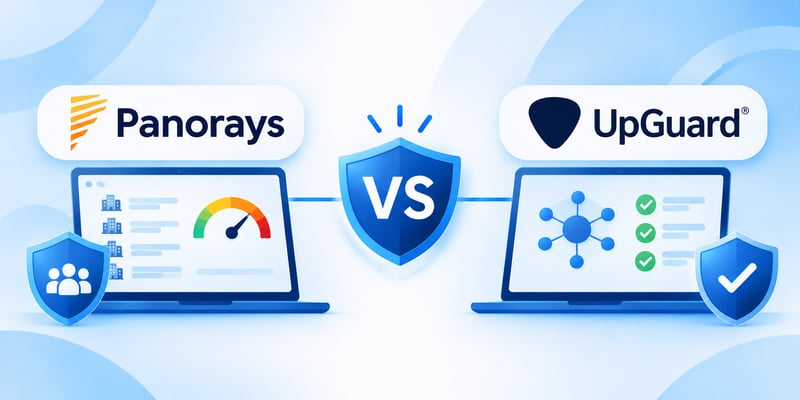
Panorays vs UpGuard: Which One Should You Choose?
Panorays suits teams that want questionnaires tuned to each vendor's criticality, backed by external scans. UpGuard suits teams that want a daily security rating with remediation workflows. Teams that need vendor risk beyond cyber should add ComplyScore® for zero-touch assessments.
Your priority decides the answer:
|
Your priority
|
Best fit
|
Why
|
|
Questionnaires tailored to each vendor relationship
|
Panorays
|
Combines dynamic questionnaires, external attack surface assessment, and business context
|
|
A security rating that updates every day
|
UpGuard
|
Scans for 70+ risk vectors and refreshes ratings continuously
|
|
Remediation tracking tied to the rating
|
UpGuard
|
Remediation workflows, a planner, and risk waivers that adjust vendor scores
|
|
Vendor assessments that start without a questionnaire
|
ComplyScore®
|
Zero-touch assessments begin from a vendor name and country
|
|
One due diligence view across financial, legal, sanctions, and cyber signals
|
ComplyScore®
|
A single report instead of separate checks
|
|
Governance across the full vendor lifecycle
|
ComplyScore®
|
Onboarding through offboarding on one policy engine and audit trail
|
What Does Panorays Do Best?
Panorays combines automated questionnaires with external attack surface assessments and business context. The questionnaires adapt to how critical each vendor is to you. The company says more than 500 enterprises use the platform.
Its questionnaire module includes built-in SIG and CAIQ templates and lets you build your own, so your team can match question depth to vendor criticality. Suppliers also get a free account to respond. The scope stays centered on cyber risk, so financial, legal, and sanctions checks need separate tools.
What Does UpGuard Do Best?
UpGuard organizes its Vendor Risk features around monitoring, questionnaires, and remediation workflows. Its scans cover 70+ risk vectors, and each vendor gets a profile with a twelve-month security performance view. A questionnaire library and builder sit beside the ratings, and risks found in responses feed the vendor score.
UpGuard also offers remediation requests, a remediation planner that shows how fixes change a rating, and risk waivers for accepted exceptions.The platform leads with cyber ratings, so non-cyber due diligence stays outside its core.
How Do Panorays and UpGuard Compare Feature by Feature?
|
Category
|
Panorays
|
UpGuard
|
|
Core focus
|
Third-party cyber risk with business context
|
Vendor cyber risk monitoring and security ratings
|
|
Assessment approach
|
Dynamic questionnaires plus external attack surface assessment
|
Continuous scanning plus security questionnaires
|
|
Questionnaires
|
Built-in SIG and CAIQ, custom builder, criticality-based questions
|
Questionnaire library and custom builder
|
|
Security rating
|
Risk rating for each vendor relationship
|
Daily-updated rating across 70+ risk vectors
|
|
Remediation
|
Remediation tracking with vendors
|
Remediation workflows, planner, and risk waivers
|
|
Vendor portal
|
Free supplier account
|
Free vendor account with a shared profile
|
|
AI features
|
AI-driven validation of questionnaire responses
|
AI-based Security Profiles and document analysis
|
|
Non-cyber risk
|
Not described
|
Not described
|
How Much Do Panorays and UpGuard Cost?
Panorays lists its entry plan as contact-sales on G2, so expect a quote that scales with the number of vendors you assess and the modules you switch on.
UpGuard shows tiers on its Vendor Risk pricing page, which helps you size a budget early. Your final cost still moves with vendor count and add-ons such as managed assessments.
Pro tip: Ask both vendors to quote the same scope: vendor count, assessments per year, questionnaire volume, integrations, and support. Compare the Year 1 all-in figure, because a low entry price that excludes remediation workflows or onboarding understates the real cost.
Where Does ComplyScore® Fit Between Panorays and UpGuard?
Panorays and UpGuard both begin with cyber signals. ComplyScore® by Atlas Systems begins with the vendor itself, so your team sees financial, legal, sanctions, and cyber risk in one view and starts assessments with no questionnaire to chase.
When you want assessments without waiting on vendors
Zero-touch assessments start from a vendor name and country. The platform pulls public and licensed data, scores the vendor, and gives you a first-pass assessment before a single email goes out. Your analysts spend their time on exceptions instead of reminders.
When you need a profile before you need a questionnaire
Profile intelligence builds a vendor profile from external data, so your team knows who the vendor is, where it operates, and what changed recently. That context decides how deep an assessment should go, which saves effort on low-risk vendors.
When cyber ratings leave gaps in your due diligence
One due diligence report combines financial, sanctions, legal, adverse media, and cyber signals, so you see exposure that a security rating misses. ComplyScore® vendor risk management then runs the full lifecycle from onboarding to offboarding on one policy engine and one audit trail.
When your vendor count outgrows spreadsheets
Enviri Corporation selected ComplyScore® to manage 45,000+ vendors across 30+ countries and three ERP systems. Atlas Systems also offers headless access, so your own systems of record can query vendor risk data through API without opening the platform.
ComplyScore® covers the vendor risk that cyber ratings do not reach, from the first assessment to offboarding.
How Do Panorays, UpGuard, and ComplyScore® Compare Side by Side?
|
Dimension
|
Panorays
|
UpGuard
|
ComplyScore®
|
|
Core focus
|
Third-party cyber risk with business context
|
Cyber ratings and remediation workflows
|
Full vendor lifecycle and continuous self-assessment
|
|
Assessment start
|
Dynamic questionnaire plus attack surface scan
|
Scan-based rating, then questionnaire
|
Zero-touch assessment from vendor name and country
|
|
Vendor profile
|
Business context per relationship
|
Vendor summary and risk profile
|
Profile intelligence from external data
|
|
Due diligence
|
Cyber-focused
|
Cyber-focused
|
Financial, sanctions, legal, adverse media, and cyber in one report
|
|
Lifecycle coverage
|
Assessment and monitoring
|
Monitoring, questionnaires, remediation
|
Onboarding through offboarding, with continuous monitoring in between
|
|
Access model
|
Platform and API
|
Platform and API
|
Platform plus headless API access
|
Panorays vs UpGuard: What Is the Final Verdict?
In the Panorays vs UpGuard decision, Panorays fits teams that want questionnaires tuned to each vendor relationship, and UpGuard fits teams that want a daily rating with remediation workflows. If your vendor risk reaches past cyber, ComplyScore® covers that job directly.
Pro tip: Run a 30-day proof on 25 real vendors. Track the hours per assessment, the share of vendors assessed without a manual follow-up, and the days from finding to closed remediation. If the numbers lag, fix vendor tiering before you blame the tool.
Before you decide, see how ComplyScore® compares with UpGuard, or book a 30-minute demo and see it on your own vendor list.