Contractors can introduce risks that extend well beyond on-site safety. Insurance gaps, financial instability, regulatory issues, and changing business conditions can all affect whether a contractor remains suitable to work with. Managing these risks requires more than prequalification and safety checks; it calls for oversight that continues throughout the contractor relationship.
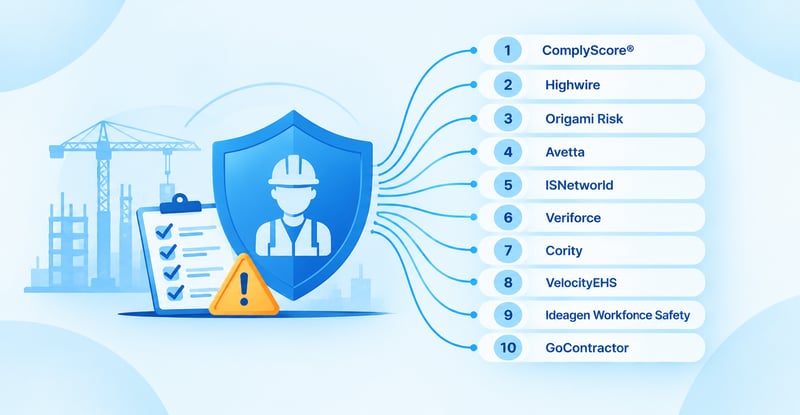
The 10 contractor risk management platforms in this guide approach that responsibility differently. Some specialize in safety, workforce credentials, and site access, while others extend into insurance verification, financial due diligence, and continuous monitoring. We compare their capabilities, strengths, and limitations to help risk, procurement, and EHS teams identify the right fit.
What Is Contractor Risk Management Software?
Contractor risk management software helps companies prequalify, onboard, monitor, and review contractors before and during work. It collects safety, insurance, financial, and compliance records, scores risk, tracks expirations, and gives risk, procurement, and EHS teams one view of who is cleared to work.
Three architectures dominate the category, and the difference decides which platforms belong on your shortlist.
|
Architecture
|
Examples in this list
|
Strongest at
|
Best fit
|
|
Risk and governance platforms
|
ComplyScore®, Highwire, Origami Risk
|
Financial, insurance, and due diligence signals tied to approval workflows
|
Risk and procurement teams that own contractor exposure
|
|
Hiring-client networks
|
Avetta, ISNetworld, Veriforce
|
Standardized prequalification and worker credentials that contractors reuse across clients
|
Industrial buyers with large contractor pools
|
|
Safety suites and field tools
|
Cority, VelocityEHS, Ideagen Workforce Safety, GoContractor
|
Permits, inductions, site access, and training
|
Site operators who manage contractors on their own premises
|
Most buyers need pieces of more than one architecture. A manufacturer with contractors in 30 countries cares about vendor-master sync and sanctions screening before it cares about a QR-code check-in. A pipeline operator cares about worker credentials first.
How We Evaluated These Platforms
Five criteria shaped the comparison:
Prequalification and document verification: how the platform collects and checks contractor records
Insurance certificate tracking: whether it reads certificates and chases renewals
Financial and cyber risk signals: whether it brings in data beyond submitted documents
Continuous monitoring: whether risk updates between annual reviews
ERP integration and multi-country onboarding: whether approved contractors reach your systems and your regions
The list assigns no numeric ratings, because public data cannot support them. Safety-led platforms emphasize site-level controls, which this comparison does not score, so each entry names those strengths.
How Do the Platforms Compare at a Glance?
|
Platform
|
Prequalification and document verification
|
Insurance certificate tracking
|
Financial and cyber risk signals
|
Continuous monitoring
|
ERP integration and multi-country onboarding
|
|
ComplyScore®
|
Zero-touch assessments, AI-assisted document validation, headless TPRM chat and voice commands
|
AI extracts coverage and expiry, automated renewal reminders
|
Financial, cyber, and regulatory signals from public and subscribed data
|
Threshold alerts routed to owners
|
ERP vendor-master sync, multi-language portal, country localization
|
|
Highwire
|
Safety, financial, backlog, experience, and surety profile
|
Supports SDI, OCIP, and CCIP programs
|
Backlog, capacity, and surety analysis
|
Ongoing financial risk monitoring
|
Not highlighted
|
|
Origami Risk
|
Subcontractor prequalification scoring through TradeTapp in a published case
|
Certificate tracking, renewal reminders, accounts payable link
|
Not highlighted
|
Not highlighted
|
Not highlighted
|
|
Avetta
|
Prequalification with risk-ranking algorithm
|
Insurance and workers’ compensation verification
|
Business and cyber risk module
|
Ongoing compliance and risk tracking
|
Not highlighted
|
|
ISNetworld
|
RAVS document review and verification
|
Not highlighted
|
Not highlighted
|
Not highlighted
|
Not highlighted
|
|
Veriforce
|
Prequalification, worker credentials, operator qualification
|
Not highlighted
|
Not highlighted
|
Compliance tracking
|
Not highlighted
|
|
Cority
|
Automated prequalification
|
Not highlighted
|
Not highlighted
|
Risk and compliance analytics
|
Not highlighted
|
|
VelocityEHS
|
Vetting and approval workflows
|
AI review of certificates of insurance
|
Not highlighted
|
Real-time compliance visibility
|
Not highlighted
|
|
Ideagen Workforce Safety
|
Contractor portal and credential checks
|
Not highlighted
|
Not highlighted
|
Real-time site oversight
|
Not highlighted
|
|
GoContractor
|
Subcontractor document review and worker records
|
Not highlighted
|
Not highlighted
|
Credential expiry alerts
|
Multi-language onboarding, access control integrations
|
“Not highlighted” means the vendor’s public pages did not describe the capability. It does not prove the capability is missing, so confirm with each vendor before you shortlist.
The 10 Best Contractor Risk Management Platforms
Here are the ten platforms, starting with ComplyScore® and followed by the nine others. Each entry covers what the platform does, who it suits, and where its public positioning leaves gaps.
ComplyScore®
ComplyScore® is a risk and compliance platform from Atlas Systems. Its third-party module covers vendors, suppliers, and contractors through one governed lifecycle, from intake and due diligence to monitoring and offboarding.
Why it might work for you: If your contractors sit inside a wider third-party population across countries and ERPs, one third-party risk management software platform can carry the same policy, tiering, and audit trail for all of them. Enviri selected ComplyScore® for global vendor lifecycle management across 45,000+ vendors in 30+ countries and three ERPs, as described in this public case study.
Key features
• Vendor lifecycle management from self-registration or proxy onboarding through offboarding
• Zero-touch assessments that start from a vendor name and country
• Third-party due diligence reports built from public and subscribed data
• Continuous monitoring with threshold alerts routed to owners
• Insurance certificate validation that extracts coverage limits and expiry dates, with automated renewal reminders
Pros
• Headless TPRM lets teams run assessments and pull reports through chat or voice commands inside the platform
• A self-assessment module covers your own controls next to vendor risk
• Configurable approval routing to Compliance, Procurement, Finance, and Health and Safety
• ERP vendor-master sync, so approved vendors reach your systems
• Vendor onboarding averages under 10 days, down from 45 to 60 days
Cons
• Third-party due diligence for countries such as China is less thorough than for India, because public data transparency is limited
Highwire
Highwire is a contractor risk management platform built for owners, general contractors, and capital project teams. Its prequalification builds one contractor risk profile from financials, safety data, backlog and capacity, project experience, and surety information.
Why it might work for you: Teams that manage subcontractor failure risk will find financial inputs such as backlog, capacity, and surety in the core workflow. The platform also supports SDI, OCIP, and CCIP programs, which suits owners who run wrap-up insurance.
Key features
• Prequalification across financials, safety, project experience, and surety
• Financial review of backlog and capacity
• Ongoing financial risk monitoring
• Links from prequalification to inspections, incidents, and contractor evaluations
Pros
• Financial depth suited to construction subcontractors
• One risk profile across safety, finance, and experience
• Support for SDI, OCIP, and CCIP programs
Cons
• Built around construction owners and general contractors, so backlog and surety inputs apply less to other contractor types
• The pages reviewed do not detail ERP vendor-master sync or multi-country onboarding
Origami Risk
Origami Risk is a cloud platform that combines risk, insurance, safety, and compliance management. Construction customers use it to track subcontractor insurance and prequalification inside a wider risk program.
Why it might work for you: A published case study from Choate Construction shows the pattern. Origami Risk’s case study reports more than 5,000 active subcontractors tracked in one place, with annual prequalification for every subcontractor on contracts above $50,000. Linking certificate status to accounts payable lets the contractor withhold payment from subcontractors without current insurance.
Key features
• Certificate of insurance tracking with automated renewal reminders
• Accounts payable integration tied to certificate status
• Subcontractor prequalification scoring through a TradeTapp integration in the published case
• Broker and insurer access to subcontractor records
Pros
• Fits teams where insurance, claims, and contractor compliance sit with one risk group
• Payment controls tied to insurance status
• Broker and insurer access to subcontractor records
Cons
• Prequalification scoring in the published case relies on a partner integration
• Contractor workflows are one use case inside a broader risk and insurance suite
Avetta
Avetta is a supply chain risk management platform that centers on contractor and supplier prequalification. The Avetta One platform adds business and cyber risk, insurance verification, and worker-level compliance.
Why it might work for you: Procurement and EHS teams that want hiring-client standards applied to contractors, subcontractors, and workers in one place will find the model familiar. The platform also covers subcontractor prequalification.
Key features
• Prequalification with a risk-ranking algorithm based on service type and industry standards
• Business and cyber risk visibility on financial stability and cybersecurity posture
• Insurance and workers’ compensation verification, with broker access
• Worker compliance verification with a mobile app that works offline
• Subcontractor prequalification alongside contractor records
Pros
• Financial, cyber, and safety signals on one platform
• Worker-level credentials alongside company-level prequalification
• A reported network of 500+ hiring clients and 130,000+ suppliers across 120+ countries [FLAG: confirm on Avetta’s site; figure comes from a third-party profile]
Cons
• Contractors typically pay for membership, so a contractor that serves hiring clients on different networks may carry more than one [FLAG: third-party analysis, confirm]
• The pages reviewed do not describe ERP vendor-master sync
ISNetworld
ISNetworld, from ISN, is a contractor and supplier information management platform used by hiring clients in capital-intensive industries. Contractors submit health, safety, quality, risk, and regulatory information, and ISN’s Review and Verification Services (RAVS) team checks it for accuracy and relevance.
Why it might work for you: Hiring clients that want a standard verification layer without staffing their own document reviewers can hand that work to RAVS. ISN reported completing more than 2,500 RAVS 360 assessments in the first five months of 2025, and those assessments engage front-line workers on safety culture and training.
Key features
• RAVS document review and verification
• RAVS 360 assessments on safety culture and worker knowledge
• A learning management system with 750+ accredited courses from 14 providers
• The Empower worker app for contractor subscribers
Pros
• Independent verification of submitted documents
• An incident management tool
• Depth in safety culture assessment
Cons
• Contractors pay an annual subscription based on employee count plus a one-time account setup fee per country, per ISN’s FAQ, and hiring clients pay separately by region
• The pages reviewed do not describe financial or cyber risk signals
Veriforce
Veriforce provides contractor management and workforce qualification for energy, utilities, and industrial sectors. Its platform combines contractor prequalification, worker competency, training, and compliance tracking.
Why it might work for you: Pipeline operators and utilities that need operator qualification records next to contractor safety data can keep both in one place.
Key features
• Contractor prequalification against industry-specific criteria
• Worker credential and operator qualification tracking
• Training and evaluation
• Dedicated account teams and industry experts alongside the software
Pros
• Focus on energy, utilities, and industrial sectors
• A software-plus-service model
• Company-level and worker-level compliance in one record
Cons
• Specialized in energy and utilities, so criteria libraries match those sectors more closely than manufacturing or services
• FitGap notes the platform requires upfront decisions on which compliance elements to enforce and how to tier contractors [FLAG: third-party editorial, confirm]
Cority
Cority is an EHS platform, and CorityOne includes contractor management that runs from prequalification through post-job review. The module ties qualifications, permits, training, and performance to one record.
Why it might work for you: Safety teams already on Cority can extend one system to contractors. Cority says the module identifies high-risk contractors so teams can prioritize interventions that prevent serious injuries and fatalities.
Key features
• Automated prequalification
• Qualifications, permits, training, and performance in one system
• Mobile field management where contractors complete risk assessments and close actions
• Risk and compliance analytics
• Permit-to-work integration
Pros
• Safety lifecycle from qualification to post-work evaluation
• Embedded AI that Cority says surfaces contractor risk patterns
• Mobile access for contractors in the field
Cons
• Contractor management sits inside the CorityOne EHS+ platform, so it arrives with a broader suite
• The contractor page focuses on safety, permits, and training and does not describe financial screening or ERP vendor-master sync
VelocityEHS
VelocityEHS Contractor Safety and Permit to Work verifies contractor qualifications, manages inductions, and controls permits before work begins.
Why it might work for you: EHS teams that review certificates of insurance and OSHA logs by hand can use machine learning review, which VelocityEHS says processes both up to 7 times faster. Contractors also submit their own documentation through a self-service portal.
Key features
• Machine learning review of certificates of insurance and OSHA logs
• Permit-to-work management
• Contractor self-service portal
• Centralized records for contractors, subcontractors, and individuals
• Site maps that show contractor and visitor status
Pros
• Permit-to-work and contractor vetting on one platform
• Contractors enter their own records
• Real-time visibility into who is due on site
Cons
• OSHA log review reflects US regulation, which matters less for contractors outside the US
• VelocityEHS publishes no list prices, and eight G2 reviewers called the pricing structure cost-prohibitive
Ideagen Workforce Safety
Ideagen Workforce Safety, formerly Ideagen Damstra, is a workforce and contractor safety platform. Ideagen acquired Damstra in 2024.
Why it might work for you: Site operators that manage contractors and employees under one set of access rules can use one platform for both. The contractor portal collects compliance documents, while certifications and site access live in the same record.
Key features
• Contractor portal for compliance documents
• Credential and certification tracking
• Induction management
• Permit-to-work and site access
• Workforce data tied to safety and compliance records
Pros
• Contractors and employees share one safety record
• Real-time oversight of site activity
• Fit for high-risk, site-based industries
Cons
• FitGap reports a steeper learning curve because of the breadth across workforce, safety, and contractor management [FLAG: third-party editorial, confirm]
• Positioned for site-based industries, so off-site vendor risk gets less attention in its public materials
GoContractor
GoContractor, a Safety Plus company, provides digital onboarding and qualification for workers and subcontractors on construction sites.
Why it might work for you: General contractors that need workers registered, trained, and verified before they arrive can run that through one portal. Supervisors scan a QR code to check a worker’s qualifications in the field.
Key features
• Online registration and orientation in multiple languages
• Subcontractor document review for prequalification
• Credential expiry alerts
• QR-code check-in, check-out, and field spot checks
• Integrations with access control and construction management systems
Pros
• Worker-level focus suits crews that rotate between sites
• Multi-language onboarding
• Automated alerts for expiring credentials
Cons
• The product page does not mention insurance tracking or reporting
• Pricing is available on request only, and the page does not say who pays
How Do You Choose the Right Platform?
Match the platform to your largest exposure first, then check how it handles the other side.
|
If your priority is
|
Look at
|
|
Insurance certificates alongside financial and cyber due diligence
|
ComplyScore®, Avetta, Origami Risk
|
|
Contractors inside a wider vendor population across countries and ERPs
|
ComplyScore®
|
|
Risk updates between annual reviews with alert routing
|
ComplyScore®, Avetta
|
|
Site safety culture and worker training
|
ISNetworld, Cority, VelocityEHS
|
|
Permit-to-work and site access
|
VelocityEHS, Ideagen Workforce Safety, GoContractor
|
|
Subcontractor financial stability on construction projects
|
Highwire
|
|
Pipeline and utility operator qualification
|
Veriforce
|
|
Worker-level compliance across large networks
|
Avetta, ISNetworld, Veriforce
|
Run two checks before you sign. Ask each vendor to demonstrate your own contractor list, and ask who pays, because contractor-funded models shift cost to your suppliers.
Choosing a Contractor Risk Management Platform
Start with your largest exposure, then test how each contractor risk management platform covers the rest. If your contractors sit inside a multi-country vendor population, explore vendor lifecycle management software that carries one policy across all of them, or request a demo of ComplyScore® and see it run against your own contractor list.