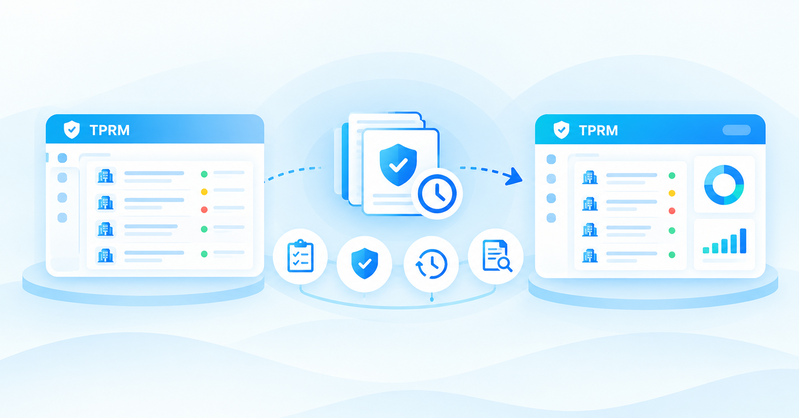
When your TPRM contract approaches its end date, the biggest worry about switching usually sits in the old platform: three years of assessments, approvals, and evidence that an auditor may ask for long after the contract ends. Some teams replacing older tools have already found archived records missing and had to rebuild vendor profiles by hand, and nobody wants to discover that kind of gap during an exam.
A clean TPRM data migration moves the records your team works with every day, keeps the rest in an archive you can search, and starts early enough that your contract end date never forces shortcuts.
What Should Move to the New Platform, and What Should Stay in an Archive?
In a TPRM data migration, move active vendors, open findings and remediation tasks, and assessments that are still valid. Keep closed assessments, offboarded vendors, and the old platform’s audit log in a read-only archive linked to each vendor, so you can answer audit questions without moving years of history.
|
Data
|
Where it goes
|
Why
|
|
Active vendors, contacts, and risk tiers
|
Move
|
Your team works with them every day
|
|
Open findings, remediation tasks, and approved exceptions
|
Move
|
Their deadlines keep running during the switch
|
|
Assessments still within their review period, with evidence
|
Move, keeping the original dates
|
Vendors avoid being reassessed early
|
|
Closed assessments and offboarded vendors
|
Archive
|
Rarely needed, but they must be retrievable
|
|
The old platform’s audit log
|
Export and archive
|
Approval history cannot be recreated in a new system
|
Moving everything can feel safer, but older records usually carry inconsistent tiers, duplicate vendors, and questionnaires your program no longer uses. Cleaning them up eats the weeks you need for testing.
One recent ComplyScore® deployment covering tens of thousands of vendors moved only master data, open items, and the last two years of inactive vendors, and kept older history in the source archive.
If an acquisition has left you with a second set of assessments done to a different standard, handle them the same way. Archive the originals, then run fresh due diligence on the inherited vendors so everyone is scored on one scale.
Move what has a live deadline or a live review date, and archive the rest where you can find it in minutes.
Why Do Audit Trails Need Their Own Plan?
An audit trail records who did what, and when, inside one system. Your new platform can record the date you imported a vendor, but it cannot recreate an approval your CISO gave in the old tool two years ago.
Here is how to protect that history before you lose access:
- Export the full audit log and each vendor’s approval history along with the current records
- Store the export read-only, with each vendor’s history linked to its new record
- Open a sample of 20 archived records before the old contract ends to confirm they are complete and readable
- Negotiate read-only access to the old platform for at least one quarter after you switch
Test your archive while you still have access to the old platform, because a gap found after termination is very hard to close.
When Should You Start Planning Around Your Contract End Date?
Start about a year out. Budget approval, an RFP, vendor selection, and a four- to six-week implementation all have to fit before the old contract ends, and internal approvals in regulated firms can take months on their own.
|
Time before contract end
|
What to do
|
|
12 to 15 months
|
Read your exit clause, list every integration and data feed, and secure budget
|
|
9 to 12 months
|
Issue the RFP with your migration questions included
|
|
4 to 6 months
|
Select the platform and sign
|
|
2 to 3 months
|
Run the six-week cutover
|
|
Up to 3 months after
|
Keep read-only access to the old platform
|
Your exit clause tells you the notice period, the export formats available, any fees for bulk export, and how long read access lasts after termination. US bank regulators’ 2023 interagency guidance on third-party relationships expects banks to plan how they would exit a third-party relationship, and your TPRM platform is one of those relationships.
Ask every shortlisted vendor three migration questions in writing:
- Will your team help load our data, or do we load it ourselves?
- What file formats can you import, and what happens to fields that do not match?
- How will our existing integrations, such as risk rating or financial data feeds, connect from day one?
Buyers often leave the first question until implementation planning, which is the worst time to learn the answer.
Your exit clause sets every other date in the plan, so read it before you write the RFP.
What Does a Six-Week Cutover Look Like?
Six weeks fits most portfolios of a few hundred vendors once you have agreed what moves.
|
Week
|
What happens
|
Done when
|
|
1
|
Export your data and agree what moves
|
The active vendor list is signed off
|
|
2
|
Remove duplicate vendors and set up tiers, workflows, and questionnaires
|
Each vendor has one record
|
|
3
|
Load vendors, documents, and current assessments into a test environment
|
Counts match the export
|
|
4
|
Test with real vendors and review any tier changes
|
Every tier change is explained and approved
|
|
5
|
Take a final export, load production, and export the old audit log
|
Every open finding is accounted for
|
|
6
|
Go live, tell vendors, and switch the old platform to read-only
|
The first new assessments are running
|
Check three numbers at every load: active vendors, open findings, and attached documents. If the open findings count is off by even one, stop and find the missing item, because it carries a deadline nobody is watching.
During the switch, reassess only vendors whose review falls due in the cutover window, whose tier changes under your new scoring, or who were flagged by monitoring since their last review. Everyone else keeps their original review date.
If you run several business units or ERPs, go live one division at a time. The first division is working before the next one starts, and any problems surface on a smaller set of vendors.
Match the open findings count before go-live, because every other gap can be fixed after launch.
What Will Auditors Ask After the Switch?
Expect four questions, and prepare the evidence for each before go-live.
|
Auditor question
|
Evidence to have ready
|
|
Was every critical vendor covered on the day you switched?
|
Vendor lists from both systems, matched and signed off
|
|
Why did this vendor’s risk tier change?
|
A comparison of old and new scoring, with approval
|
|
Where is the approval for an assessment done in the old tool?
|
The archived audit log, linked to the vendor
|
|
Did any finding or exception lapse during the move?
|
An open-items match report from go-live day
|
The third-party risk audit readiness checklist covers the evidence auditors expect beyond the migration itself.
If you can pull these four answers within an hour, your migration will hold up in an audit.
How Does ComplyScore® Help With a Platform Switch?
With the plan in place, the remaining work is loading clean data, getting vendors through their next assessment quickly, and keeping a record auditors can follow. Here is how ComplyScore® handles each:
- Bulk vendor upload: Load your vendor list from a file, with duplicate checks on company names and web domains, and run due diligence across the full list sorted by risk score
- Prefilled assessments: Questionnaires arrive prefilled from previous assessments and data already on file, so vendors review and update instead of starting over
- Phased go-live: Launch one division or region at a time, and let your team complete updates on behalf of vendors who will not use the portal
- Audit trail and audit packs: Every step from intake to offboarding carries a timestamped record, and audit packs bring assessments, evidence, findings, and approvals together in one export
Implementations typically run four to six weeks. ComplyScore® is a Representative Vendor in the 2025 Gartner Market Guide for TPRM Technology Solutions, and you can see each stage of the platform on the vendor lifecycle management software page.
Start With Your Exit Clause
A TPRM data migration goes well when you move only what has a live deadline, protect the old audit trail as a tested archive, and start planning about a year before your contract ends. Read your exit clause this quarter, because it sets every date that follows.
When you are ready, book a ComplyScore® demo and walk through the cutover plan with your own vendor list.