Your vendor questionnaire tells you what a supplier chooses to share. The news tells you what that supplier would rather keep quiet. In our conversations with risk leaders this year, one healthcare group said regulator breach reports reach it two to three weeks after an incident, and a US equipment maker learned about a major supply shock a full month after it happened.
Adverse media screening closes that gap. This guide covers what counts as adverse media, where it comes from, how the screening process works for third parties, and the traps that bury teams in false alerts.
What Is Adverse Media Screening?
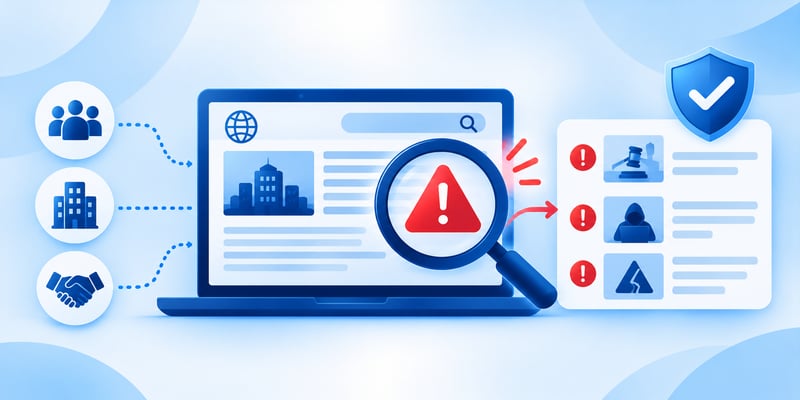
Adverse media screening is the process of checking news, regulatory, legal, and other public sources for negative information about a person or company. Teams use it to spot links to fraud, bribery, sanctions breaches, lawsuits, data breaches, or labor abuses before signing a contract and throughout the relationship.
You will also hear it called negative news screening. Banks first built the practice for anti-money laundering (AML) and know-your-customer (KYC) checks on customers, and most guides still treat it that way. This guide applies it to vendors, suppliers, distributors, and agents, where risk enters your business through the contracts you sign.
Why Does Adverse Media Screening Matter for Third-Party Risk?
Vendors rarely volunteer bad news on a questionnaire. Lawsuits, enforcement actions, and allegations surface first in court records, regulator notices, and local press, often months before a renewal cycle would catch them.
US banking regulators set this expectation in their 2023 Interagency Guidance on Third-Party Relationships. It asks banks to review a third party's history of litigation and complaints during due diligence, and to keep watching its legal compliance and the external conditions around it once the relationship starts.
The US Department of Justice applies a similar test to companies in every industry. Its Evaluation of Corporate Compliance Programs, updated in September 2024, asks whether a company tracks red flags from third-party due diligence and manages third-party risk throughout the relationship or mainly at onboarding.
Adverse media screening is one input to third-party due diligence, alongside financial, legal, cyber, and ownership checks. If your only adverse media check happens at onboarding, you are screening a snapshot of a relationship that can run for years.
What Counts as Adverse Media?
Below are the nine categories that matter most when you screen third parties. The weight each one carries depends on what the vendor does for you and which data or systems it touches.
|
Category
|
What to look for
|
Why it matters to you
|
|
Financial crime and fraud
|
Money laundering, fraud, embezzlement, or tax evasion allegations
|
Payment fraud and AML exposure through the relationship
|
|
Bribery and corruption
|
Bribery probes, kickback allegations, or ties to public officials
|
Liability for agents and intermediaries who act on your behalf
|
|
Sanctions and export controls
|
Sanctions breaches or dealings with restricted parties and regions
|
Blocked payments, penalties, and frozen shipments
|
|
Regulatory enforcement
|
Fines, license suspensions, consent orders, or product recalls
|
Weak controls that can spill into your own compliance record
|
|
Litigation
|
Lawsuits, judgments, or insolvency filings
|
Service disruption and contract disputes
|
|
Cyber incidents
|
Data breaches, ransomware attacks, or leaked credentials
|
Your data or systems may sit inside the incident
|
|
Financial distress
|
Layoffs, missed payments, credit downgrades, or plant closures
|
Delivery failure and sudden supplier exit
|
|
ESG and labor
|
Forced labor, unsafe working conditions, or environmental violations
|
Reputational damage and supply chain due diligence duties
|
|
Ownership and leadership changes
|
Mergers, new owners, or executive arrests and departures
|
The vendor you assessed may no longer match the vendor you work with
|
Pro tip: Ask business owners which categories would stop them from using a vendor at all. Those become your high-severity triggers, and everything else routes for review.
Where Does Adverse Media Come From?
Good coverage blends several source types, because each one catches risk at a different speed and with different reliability.
- Global and regional news: Fast and broad, with plenty of noise and duplicate stories
- Local-language press: Often the first and only place a smaller supplier's problems appear
- Regulator and government notices: Enforcement actions, recalls, license changes, and breach disclosures
- Court and insolvency records: Lawsuits, judgments, and bankruptcy filings
- Licensed risk data providers: Curated databases that many teams already subscribe to
- Social media and forums: Early signals that need confirmation from a stronger source
Reliability and speed pull in opposite directions. One manufacturing risk team told us that authoritative sources often publish later than less credible ones, which leaves a window where the only signal comes from a weak source. Treat a single social post as a prompt to dig deeper, and act on findings that a credible outlet or official record confirms.
How Is Adverse Media Screening Different From Sanctions and PEP Screening?
Sanctions screening checks a third party against official lists of restricted parties. Politically exposed person (PEP) screening checks for people in prominent public roles. Adverse media screening covers everything those lists miss.
|
Aspect
|
Adverse media screening
|
Sanctions screening
|
PEP screening
|
|
What it checks
|
News and public records for negative events
|
Government lists of restricted parties
|
People in prominent public roles and their close associates
|
|
Source format
|
Articles, filings, and notices in many languages
|
Structured lists
|
Structured databases
|
|
Typical output
|
Findings that need human judgment
|
A match or no match
|
A match that raises the level of due diligence
|
|
When it fires
|
Any time a story breaks
|
When a list updates or a new party appears
|
When a role changes or a new party appears
|
|
Main challenge
|
Relevance, namesakes, and volume
|
Name variations and ownership chains
|
Keeping role and family data current
|
Sanctions and PEP screening answer a yes-or-no question. Adverse media screening asks what is happening with a company that should change your decision. Run all three together, because a news story about sanctions evasion can appear long before any list update.
How Does the Adverse Media Screening Process Work?
Here is a step-by-step process you can run on any vendor population. Each step includes a metric to track, so you know when it is working.
1. Scope screening by vendor tier
Screen every vendor at onboarding, then set monitoring depth by risk tier. Critical and high-risk vendors get continuous monitoring across all categories, while low-risk vendors can run on a lighter periodic check.
Track: Share of critical vendors under continuous monitoring. Reach full coverage there before you widen the net.
2. Resolve the right entity
One supplier can carry a dozen records in your ERP, and a common company name can match hundreds of unrelated firms. Confirm the legal entity, registration number, country, and key directors before you search, so every result ties back to the company you actually contract with.
Track: Share of hits your analysts dismiss as namesakes. A high rate points to weak entity data.
3. Build your risk taxonomy and search terms
Map the nine categories to keyword sets in each language your vendors operate in. Weight terms by severity, so an indictment outranks a lawsuit filing, and a lawsuit filing outranks a customer complaint.
Track: Alerts per vendor per month, by category.
4. Triage every finding
Decide for every hit whether it concerns the right entity, whether a credible source confirms it, and whether it is material to your relationship. Record who decided, why, and which source they relied on.
Track: Share of findings closed with a documented rationale.
5. Escalate and remediate
Route material findings to the people who can act on them. Cyber incidents go to information security, legal actions go to legal, and supply disruptions go to procurement and the business owner.
Each confirmed finding should end in an action, such as a vendor inquiry, a contract review, a reassessment, or an exit plan.
Track: Open findings by age and severity.
6. Monitor continuously
Risk keeps moving between assessment cycles. Continuous vendor risk monitoring replaces the annual snapshot with alerts as stories break, which matches the DOJ's focus on managing third-party risk across the full relationship.
Track: Median time from a story's publication to your team's first review.
7. Keep an audit-ready record
Store the search criteria, sources, hits, decisions, and actions in one record per vendor. When an auditor or examiner asks how you vetted a supplier, that record answers the question without a scramble through inboxes.
Track: Share of vendors with a complete screening record.
Why Does Adverse Media Screening Break Down?
Most programs stall on noise, coverage, or follow-through. Here are the traps we see most often and how to fix each one.
|
Trap
|
What it looks like
|
Fix
|
|
Ad hoc browser searches
|
Analysts paste vendor names into a search engine or chatbot and skim the results
|
Use defined sources, a fixed taxonomy, and a saved record of every search
|
|
Namesake overload
|
Hundreds of hits for common company names
|
Resolve the entity first and match on registration data, location, and directors
|
|
English-only coverage
|
Problems reported in local press never reach your team
|
Add local-language and regional sources for every country you source from
|
|
Onboarding-only checks
|
Clean at signing, then unknown for years
|
Move critical vendors to continuous monitoring
|
|
Stale data
|
Reports flag events that no longer reflect the vendor's business
|
Date-stamp every finding and re-verify before you act
|
|
Alerts without owners
|
Findings pile up in a shared inbox
|
Route alerts by category to named owners with response deadlines
|
The first trap is more common than most teams admit. A global energy engineering firm we spoke with ran its due diligence through web searches and a chatbot, then found the results could not stand up to a compliance review. An alert nobody acts on leaves you with a documented risk you ignored, which can look worse in an audit than no alert at all.
What Does a Mature Adverse Media Program Look Like?
You know your program works when it can answer four questions quickly.
- Coverage: Every critical vendor sits under continuous monitoring
- Speed: Your team reviews material stories within days of publication, well before the next assessment cycle
- Precision: Analysts spend their time on relevant findings, and the namesake dismissal rate keeps falling
- Proof: Every decision carries a source, an owner, and a date
Where Does ComplyScore® Fit?
If you have tiered your vendors and defined your taxonomy, yet your analysts still spend most of the week clearing irrelevant hits, manual collection and triage have become the bottleneck.
ComplyScore® is an AI-native risk and compliance platform that runs adverse media screening inside its vendor due diligence software and continuous monitoring.
- Due diligence before first contact: ComplyScore® generates a due diligence report that covers media and reputation, sanctions and watchlists, litigation, financials, and cyber findings, with a source citation behind each one
- Entity resolution: The platform lists every matching entity for a company name in a given country, so you select the right one before screening starts
- Configurable monitoring: You choose the risk domains and sources to watch, including regional sources and the data subscriptions you already hold, and you set the monitoring frequency
- AI triage and routing: ComplyScore® separates material signals from routine news, rates severity, proposes a remediation action, and routes each alert to the team that owns it
Where Should You Start?
Adverse media screening gives you the part of a vendor's story that a questionnaire rarely captures. Start with your critical vendors, resolve each entity, and put them under continuous monitoring with a clear owner for every alert category, then extend coverage tier by tier.
When you are ready to run that across your full vendor portfolio, explore our AI third-party risk management software or book a 30-minute demo with our TPRM experts.