Third-party relationships expose US businesses to cybersecurity, operational, financial, and compliance risks. Regulatory expectations from US banking regulators, NYDFS, and the SEC increasingly emphasize risk-based oversight, ongoing monitoring, and documented evidence. While none mandates a specific TPRM tool, organizations need effective processes to demonstrate how they manage third-party risk.
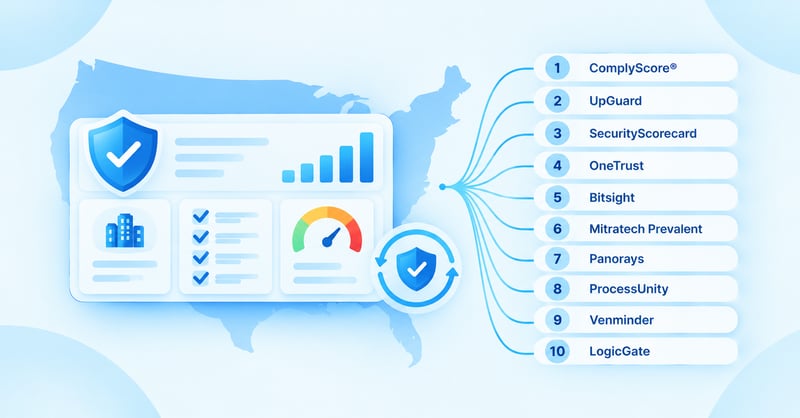
Choosing a TPRM platform requires more than comparing features. It means evaluating regulatory alignment, assessment automation, due diligence, continuous monitoring, integrations, and cost. This guide compares 10 TPRM tools for US companies in 2026, including ComplyScore® by Atlas Systems, using the same criteria for every platform and highlighting their respective limitations.
How We Evaluated These TPRM Tools
We used public information only for every vendor. Sources include vendor websites, pricing pages, press releases, analyst announcements, and public review sites. We did not run demos, and we did not speak with any vendor’s customers.
Five criteria shaped the comparison:
US regulatory fit: Does the vendor publish mappings or content for the Interagency Guidance, NYDFS, or SEC disclosure rules?
Assessment automation: How much work does the tool remove from questionnaires, evidence review, and scoring?
Due diligence and monitoring: Does the platform include them, or does it sell them as separate add-ons?
US system integrations: Can it connect to the procurement, ERP, GRC, and ticketing systems you already run?
Cost and effort transparency: Does the vendor publish pricing or a realistic implementation timeline?
One rule governed the write-up: We listed each tool for what it does best, not for how many features it has. A cyber ratings platform and a bank-focused vendor management suite solve different problems, and a fair comparison says so.
What Do US Rules Expect From a TPRM Tool?
The Interagency Guidance, NYDFS 23 NYCRR 500.11, and SEC Regulation S-K Item 106 each expect a documented, risk-based process: inventory vendors, tier them, assess and vet them, monitor them, and keep evidence. Your tool must produce that evidence on demand.
Three rules do most of the shaping:
Interagency Guidance on Third-Party Relationships: The Federal Reserve, FDIC, and OCC issued it on June 6, 2023. It sets principles for a risk-based lifecycle covering planning, due diligence, contracting, ongoing monitoring, and termination. Read the Federal Register notice for the full text.
NYDFS 23 NYCRR 500.11: Covered entities need a written third-party service provider policy. It must cover risk assessment, minimum cybersecurity practices, due diligence, and periodic assessment. The regulation text is public.
SEC Regulation S-K Item 106(b)(1)(iii): Public companies must describe whether they have processes to oversee and identify cybersecurity risks from third-party service providers. The SEC adopted the rule in July 2023, and it took effect in December 2023. See the SEC release.
The trap here is subtle. A tool can score vendors well and still fail an exam if it cannot show who reviewed what, when, and what happened next. Ask every vendor to show you an audit trail, not a dashboard.
TPRM Tools Compared at a Glance
The table below summarizes how each tool approaches TPRM. Details sit in the entries that follow.
|
Tool
|
Core approach
|
Best fit
|
Due diligence
|
Monitoring
|
Pricing visibility
|
|
ComplyScore®
|
Full TPRM lifecycle with AI enrichment
|
Mid-size to large regulated enterprises
|
Included
|
Included, feeds into owned tasks
|
Quote-based
|
|
OneTrust Third-Party Management
|
Part of a wider privacy and GRC suite
|
Teams already on OneTrust
|
Separate module
|
Separate exchange
|
Quote-based
|
|
ServiceNow TPRM
|
Workflow on the ServiceNow platform
|
ServiceNow-centered enterprises
|
Via integrations
|
Fourth to nth party view
|
Quote-based
|
|
Mitratech Prevalent
|
Assessments plus managed services
|
Teams that want outsourced assessment work
|
Via vendor intelligence
|
Included
|
Custom
|
|
ProcessUnity
|
Assessments plus a shared exchange
|
Programs that reuse assessments
|
Via partners
|
Included
|
Quote-based
|
|
Diligent (3rdRisk and Third Party Risk Intel)
|
AI-led profiling and due diligence
|
Teams that prioritize sanctions and adverse media
|
Included
|
Continuous
|
Request pricing
|
|
Panorays
|
Questionnaires plus external attack surface
|
Cyber-first security teams
|
Limited
|
Bundle-based
|
Quote-based
|
|
UpGuard
|
Cyber ratings plus questionnaires
|
Security teams that need fast visibility
|
Limited
|
Daily ratings
|
Published tiers
|
|
Bitsight
|
Security ratings leader
|
Teams that measure cyber posture
|
Limited
|
Core strength
|
Partly published
|
|
Venminder
|
Software plus managed services
|
Banks and credit unions
|
Included
|
Included
|
Quote-based
|
10 Best TPRM Tools for US Companies
Here are the 10 tools in the same format: what it does, where it fits US rules, who should use it, and where it falls short. The order is not a ranking.
1. ComplyScore® by Atlas Systems
Best for: Regulated enterprises that want one platform for intake, due diligence, assessment, and monitoring.
ComplyScore® runs the vendor lifecycle through five modules: business intake, vendor management, due diligence, risk management, and continuous compliance and risk monitoring.
Its AI Profile Intelligence enriches a vendor record from little more than a name and country. The platform then tiers each vendor by how deeply your business engages with it, which keeps low-risk vendors from clogging your queue.
Assessments arrive prefilled and aligned to common frameworks such as SIG, SOC 2, ISO 27001, NIST, and HIPAA. Due diligence is included rather than sold separately. Monitoring signals become tasks with owners and SLAs, and the platform connects to ratings feeds you already license, such as SecurityScorecard, RiskRecon, and Dun & Bradstreet, at no extra charge.
Atlas states a typical implementation takes four to six weeks, and Gartner listed ComplyScore® as a Representative Vendor in its 2025 Market Guide for TPRM.
2. OneTrust Third-Party Management
Best for: Organizations that already run OneTrust for privacy or GRC.
OneTrust sells third-party management as part of a broader suite. Vendor risk data can sit next to privacy, ethics, and governance workflows, which helps when one team owns all three. OneTrust also states it was named a Leader in the 2026 Gartner Magic Quadrant for Third-Party Risk Management Tools for Assurance Leaders, citing its AI-driven approach.
Extra capabilities arrive as separate pieces. The Third-Party Risk Exchange brings in ratings data from SecurityScorecard, RiskRecon, and HackNotice, and Third-Party Due Diligence draws on Dow Jones content.
Where it falls short: The modular structure can raise total cost and scope. OneTrust publishes quotes only, so you cannot size a budget before a sales call.
3. ServiceNow Third-Party Risk Management
Best for: Enterprises that already run IT, security, or procurement workflows on ServiceNow.
ServiceNow renamed Vendor Risk Management to Third-Party Risk Management in its v17.x releases. The product adds a vendor portal, tiering, fourth to nth party monitoring, and a risk concentration map. Teams activate it through the ServiceNow Store, so it builds on the platform you already govern. Forrester named ServiceNow a Leader in its Q1 2024 Wave for GRC platforms.
Where it falls short: The value depends on your existing ServiceNow footprint. Without it, you take on platform setup and ongoing admin work that a purpose-built tool avoids. Pricing is quote-based.
4. Mitratech Prevalent
Best for: Teams that want a vendor to run part of the assessment workload.
Mitratech acquired Prevalent in October 2024. The platform builds a fourth-party profile for each vendor and uses AI to extract answers from uploaded documents. Vendor intelligence networks supply external risk data. Managed services can take over questionnaire collection and review. Prevalent offers more than 750 assessment templates, plus checklists that map to rules such as SEC and NYDFS requirements.
Where it falls short: Pricing is custom, and the managed services path adds ongoing cost. The acquisition also means product direction now sits inside a larger legal and compliance suite.
5. ProcessUnity
Best for: Programs that want to reuse vendor assessments instead of starting from scratch.
ProcessUnity integrated the Global Risk Exchange, formerly CyberGRX, in January 2024. ProcessUnity states the exchange holds more than 18,000 attested assessments and 360,000 risk profiles as of February 2025. When a vendor already completed an assessment for another customer, you can reuse it and skip a fresh questionnaire. On G2, ProcessUnity’s TPRM platform holds a 4.5 rating from 54 reviews.
Where it falls short: The exchange runs on a separate subscription. Budget for it as its own line item, and confirm which of your vendors already participate.
6. Diligent
Best for: Teams that care most about ownership, sanctions, and adverse media checks.
Diligent combines 3rdRisk, an AI-native TPRM solution it acquired, with Third Party Risk Intel, which it launched on March 30, 2026. The pairing profiles vendors automatically, maps ownership, screens sanctions lists and adverse media, and monitors continuously. Diligent also states it was named a Leader in the 2026 Gartner Magic Quadrant for Third-Party Risk Management Tools. Its page describes risk tiering, relationship mapping for fourth-party and concentration risk, case management with audit-ready logs, and branded vendor portals. Diligent says most implementations connect within two to four weeks.
Where it falls short: Pricing sits behind a request form. Diligent’s public page leans toward due diligence and screening depth, so confirm how it handles security questionnaires at your volume.
7. Panorays
Best for: Security teams that want questionnaires and outside-in attack surface data in one place.
Panorays pairs vendor questionnaires with external attack surface assessment. The result is a cyber-first view of each vendor, which suits CISOs who own the vendor risk program. Panorays lists three quote-based bundles: Inventory, Assessment, and Monitoring. It no longer lists a free tier.
Where it falls short: The cyber focus leaves less room for financial, ownership, or sanctions diligence. Public pages do not state usage limits for each bundle, so ask for them in writing.
8. UpGuard
Best for: Security teams that want daily ratings and quick visibility.
UpGuard offers daily security ratings, questionnaires, and a Trust Exchange where vendors share their security posture. Vendors can use free accounts. On G2, UpGuard shows 726 reviews. A few reviewers mention vague notifications and missing customization, integration, or analytics features.
Where it falls short: UpGuard centers on cybersecurity. If your regulators expect financial, operational, and compliance diligence on vendors, you will need another process alongside it.
9. Bitsight
Best for: Teams that need a trusted external measure of vendor cyber posture.
Bitsight is a ratings leader, and many boards and insurers recognize its scores. Vendor intake and risk assessment capabilities appear in the higher tiers on its pricing page, which gives buyers more visibility than quote-only vendors. G2 shows a 4.5 rating from 76 reviews.
Where it falls short: A rating measures observable security hygiene, not your contract terms, resilience plans, or data handling. Treat it as one input to a TPRM program, not the program itself.
10. Venminder
Best for: Banks and credit unions that want software plus expert help.
Ncontracts acquired Venminder in 2024. Venminder pairs software with managed services designed around the needs of financial institutions, which maps closely to the Interagency Guidance. G2 shows a 4.7 rating from 115 reviews.
Where it falls short: Venminder runs as a stand-alone tool. Non-financial enterprises may find the content and workflows narrower than a broader GRC platform.
How to Choose the Right Tool for Your US Program
Start with your regulator, not the feature list. A community bank answering to the Interagency Guidance needs different proof than a public software company answering to the SEC. Match the tool to the evidence you must show.
Use this four-step test before you sign:
Map your rules. List which of the three rules apply to you and what evidence each one requires.
Run one real vendor. Ask each finalist to take a live vendor through intake, tiering, assessment, and a monitoring alert. Time every step.
Ask for the audit trail. Request an export showing reviewer, decision, date, and follow-up for that vendor.
Price the whole program. Add exchanges, due diligence content, ratings feeds, and managed services to the base quote.
Pro tip: Measure assessment cycle time before and after the pilot. If a tool does not cut your cycle time by at least a third, the automation is not doing the work you are paying for.
Trap to avoid: Do not buy a ratings tool and call it a TPRM program. Ratings show you what an attacker can see, not whether the vendor meets your contract or your regulator’s expectations.
If you need intake, due diligence, assessment, and monitoring in one place, explore ComplyScore®. You can also read our guide to risk management software for a broader view.
Conclusion
The best TPRM tools for US companies share one trait: they turn a regulator’s principles into evidence you can produce in minutes. Define your rules first, pilot with a real vendor, and price the full program before you sign. For a platform that covers intake through monitoring, see how ComplyScore® works.