If you win oil and gas work in Latin America or the Middle East through a local agent, your energy clients will hold you responsible for how that agent behaves. Large energy companies write anti-bribery requirements into their supplier terms, and those requirements extend to the agents and partners you appoint.
TechnipFMC’s published integrity expectations for suppliers and subcontractors show what this looks like in practice. Suppliers must carry out appropriate due diligence so that their own sub-suppliers and business partners meet the same standards, notify TechnipFMC before retaining any intermediary to deal with government officials on its work, and make their records available for review on request.
For a mid-size engineering or services firm, that changes what anti-bribery due diligence has to do. Checking the agent covers only half the job, because you also need to show your client, your auditors, and possibly a regulator what you checked, what you found, and how you acted on it.
What Do Energy Clients Expect From Your Agent Due Diligence?
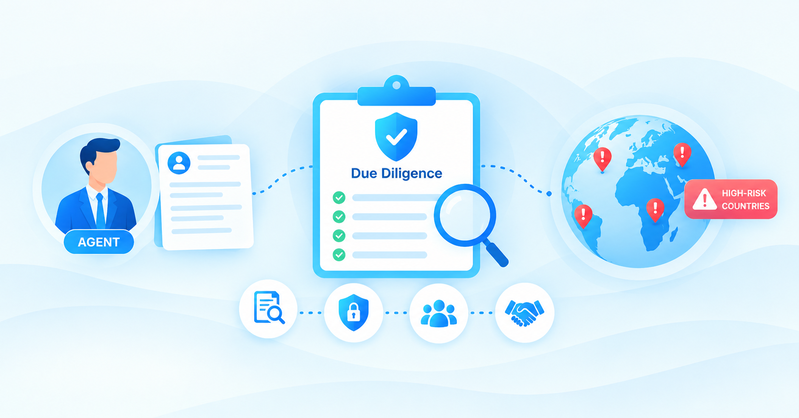
Energy clients expect anti-bribery due diligence on every agent working near their business: independent checks on sanctions, litigation, adverse media, and ties to officials, a documented reason for using the agent, fees that match real services, and a dated record of how you resolved each red flag.
Client requirements usually reach you through three channels:
- Pre-qualification questionnaires that ask how you vet your own intermediaries before a contract award
- Supplier codes of conduct that make anti-bribery rules mandatory and extend them to your sub-suppliers and business partners, as in the TechnipFMC expectations above
- Contract clauses covering anti-corruption warranties, audit rights, and termination on breach
A policy document answers only the first question a client’s compliance team asks. The harder request is the file on a named agent, and an undated search printout will not satisfy a team that reviews supplier integrity for a living. If you need a refresher on the core steps, start with this guide to third-party due diligence.
Treat every agent file as something a client’s compliance team will eventually read, because the bigger the engagement, the more likely that becomes.
Why Do Agents and Intermediaries Carry the Highest Bribery Risk?
Agents sit exactly where bribery happens: between your company and the officials who award contracts, clear customs, or approve permits. Their fees also give a ready channel for disguising a payment as a commercial cost.
A July 2026 case shows how ordinary the pattern looks from the inside. The US Department of Justice resolved a foreign bribery case against The Scoular Company for more than $10 million after customs brokers acting on its behalf paid Mexican border officials about $2,000 per train. The brokers billed those payments back as reinspection fees, and Scoular’s remediation included risk-based screening of third parties plus anti-corruption and audit clauses in their contracts.
The legal exposure has not gone away, although US priorities have shifted:
- United States: DOJ guidelines issued in June 2025 reprioritized FCPA enforcement toward cartel-linked conduct, harm to US competitors, and national security, while the statute itself stayed unchanged and resolutions continued into 2026
- United Kingdom: The Bribery Act makes a company that carries on business in the UK liable for failing to prevent bribery by anyone performing services on its behalf, unless it can show adequate procedures
Both regimes reach agents directly, and both reward companies that can prove what they checked.
Regulators and clients treat an agent’s improper payment as your exposure, so your checks need to cover the agent as closely as your own staff.
Which Red Flags Should Weigh More in Latin America and the Middle East?
The 2025 Corruption Perceptions Index from Transparency International put the global average at 42 out of 100, its lowest yet, with more than two-thirds of countries scoring below 50. Country scores alone tell you little about a specific agent, though, so weight red flags by the structural features of the deal.
Here are the deal features that raise bribery risk in energy work across both regions, and the red flags worth weighting higher in each case.
|
Deal feature
|
Red flags to weigh higher
|
|
Your end customer is a national oil company or other state-owned entity
|
Agent claims close ties to decision-makers, or an official recommended the agent
|
|
Local rules or customer practice push you toward a local agent or partner
|
No competitive selection, no visible staff or office, and an agent formed shortly before the bid
|
|
The work depends on customs, visas, inspections, or permits
|
Expediting fees, “facilitation” line items, and invoices for vague administrative services
|
|
Compensation is a success fee or commission
|
Fee out of line with the services, requests for advance, cash, or third-country payments
|
|
The agent proposes sub-agents or local subcontractors
|
Unnamed parties, refusal to accept anti-bribery clauses or audit rights
|
The Scoular brokers fit the third row exactly. A routine border fee became the payment channel, and the invoices looked normal until someone asked what the fee actually paid for.
Trap to avoid: Clearing an agent because the country scores reasonably well. A low-risk country with a state-owned customer and a success fee can still produce a high-risk engagement.
Score each engagement by its deal features, and let those features decide how deep your checks go.
What Should an Anti-Bribery Due Diligence Report on an Agent Cover?
A defensible agent file combines two layers. Independent checks show what public records say about the agent, while direct questions capture what only the agent can tell you.
|
Layer
|
What it covers
|
Why it matters
|
|
Independent checks
|
Sanctions and anti-money laundering watchlists, litigation, adverse media, financial health, and geopolitical exposure
|
Confirms facts without relying on the agent’s own word
|
|
Direct from the agent
|
Services to be performed, compensation and payment terms, relationships with public officials, and sub-agents
|
Covers the questions regulators ask about third parties
|
|
Your own decision
|
Business rationale for using an agent at all, red flag resolution, and approval by a named owner
|
Shows that a person weighed the findings before signing
|
The middle row mirrors the questions in the US Department of Justice guidance on evaluating corporate compliance programs, which asks whether a company has a business rationale for each third party, whether the contract describes the services, and whether compensation matches the work performed. A report that skips those questions leaves the core of that guidance unanswered.
Advanced tweak: Ask the agent to describe, in writing, exactly what they will do for their fee. Vague answers like “relationship management” or “local support” deserve a follow-up before approval.
Every source in the independent layer should carry a link and a date, so anyone reviewing the file can verify it without redoing the search.
What Records Prove Your Due Diligence Was Real?
UK enforcement now tests behavior as well as policy. The Serious Fraud Office’s refreshed compliance guidance, published in November 2025, says it will examine how policies translate into conduct on the ground. A due diligence file therefore has to show what your team checked, what it found, and when each decision was made.
Keep these five items in every agent file:
- The due diligence report, with sources, dates, and the version you relied on
- A written business rationale and the agreed scope of services
- How each red flag was resolved, with the evidence behind the decision
- Approval by a named owner, dated before the contract signature
- Contract clauses covering anti-corruption warranties, audit rights, and the next review date
A ready-made due diligence checklist helps you keep that structure consistent across every agent, so a file built in São Paulo looks the same as one built in Abu Dhabi.
If a reviewer can follow your decision from first search to signed contract without asking a single question, the file has done its job.
Do You Need a Full TPRM Platform to Check 15 Agents a Year?
Not always. A firm that appoints 10 to 20 agents a year mainly needs independent, well-sourced reports and a consistent record, while a program with hundreds of third parties, recurring questionnaires, and ongoing monitoring needs a full platform behind it. A common gap sits in between: teams relying on manual web searches that leave no dated trail and cannot show which sources they checked.
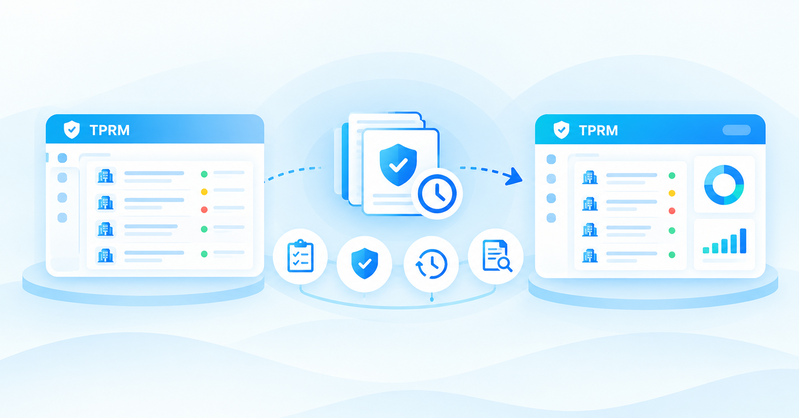
The automated due diligence reports in ComplyScore® fit both ends of that range:
- Due diligence reports in minutes: Enter an agent’s name and location, and ComplyScore® generates a report of 30 to 300 pages covering legal cases, financial information, sanctions, anti-money laundering, adverse media, and geopolitical risk
- Traceable sources: Every report includes an appendix of source links, so your file shows exactly what was checked
- Depth by criticality: Configurable report templates let you run deeper checks on high-risk engagements and lighter ones elsewhere
- Documented risk scoring: Inherent risk scores give you a dated, explainable record of why an agent received the review it did
- Continuous monitoring: Sanctions screening against OFAC, EU, and UN lists and adverse media alerts flag changes between reviews
ComplyScore® subscriptions can be sized to the number of due diligence reports you need each year, which suits firms with a small, high-risk agent network. Report depth depends on the public records each jurisdiction makes available, so the agent’s direct answers and your follow-up questions remain part of every file.
ComplyScore® is a Representative Vendor in the 2025 Gartner Market Guide for TPRM Technology Solutions.
Match the tool to your volume, but never let low volume become a reason for an undocumented check.
Turn Every Agent Check Into Evidence Your Clients Will Accept
Anti-bribery due diligence on agents works when it combines independent checks, direct answers from the agent, and a dated record of every decision. Energy clients can ask to see that record at pre-qualification, and regulators on both sides of the Atlantic now look for proof that procedures operate in practice.
Start with the agents attached to your next bid, and rebuild their files against the five-item list above. To see how a sourced report fits into that file, request a ComplyScore® demo.