Organizations rely on suppliers for more than products and services. Third parties may access sensitive data, internal systems, and critical business operations, exposing organizations to cybersecurity, regulatory, financial, and operational risks. Yet traditional procurement risk management primarily focuses on supplier qualification, sourcing, cost, and contractual obligations. These checks are essential, but they don't provide a complete picture of supplier risk.
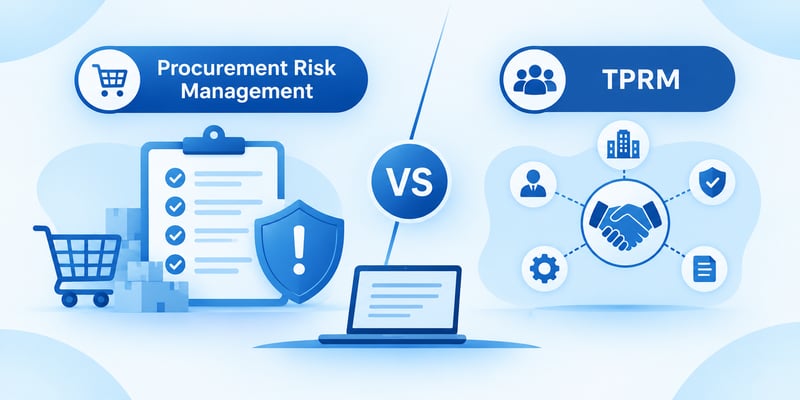
This is where third-party risk management (TPRM) comes in. Procurement software helps organizations qualify suppliers and manage purchasing decisions, while TPRM extends oversight across the vendor lifecycle through risk assessments, due diligence, continuous monitoring, and remediation. Procurement determines who an organization buys from; TPRM helps determine whether it remains safe to depend on them.
What Procurement Risk Management Covers Today
Procurement risk management reduces the risks that arise while you buy, such as supplier failure and contract gaps. It centers on sourcing and spend. Third-party risk management extends that view across the supplier lifecycle, adding cybersecurity, compliance, financial health, and monitoring after onboarding.
Most procurement teams manage these risks with a familiar toolkit:
- Supplier qualification questionnaires at registration
- Scorecards for delivery, quality, and cost
- Contract clauses and approval workflows
- Dual sourcing and category strategies
- Supplier master data inside the ERP
This toolkit works because procurement owns the buying decision, and a procurement risk management program built on it protects price, continuity, and supply. The boundary appears when the supplier also touches your data, your systems, or your regulators. Verizon's 2026 Data Breach Investigations Report found third parties involved in 48% of breaches, up 60% year over year. Delivery and cost scorecards were not designed to surface that kind of exposure.
What Procurement and ERP Modules Do Well
Oracle Fusion Cloud Supplier Qualification Management shows what a strong procurement-side module looks like. Per Oracle's official data sheet, it manages supplier qualification information, gathers supplier data through questionnaires, scores suppliers against predefined criteria, and supports supplier selection in sourcing events. It also alerts users when relevant supplier information becomes available and tracks expiring qualifications.
Oracle's separate Risk Management and Compliance product covers a different area. Its product page describes internal financial controls, separation of duties, ERP transaction monitoring, and SOX/ICFR compliance, and it does not list vendor due diligence or continuous vendor monitoring among its capabilities.
Qualification inside the ERP keeps supplier master data, purchase orders, and invoices in one place, which is where those records belong. Few teams gain anything by moving them elsewhere.
Pro tip: Keep the ERP as the system of record for suppliers, and let any risk layer you add read from it. A second supplier database creates reconciliation work without adding insight.
Where Third-Party Risk Management Starts
TPRM covers the whole supplier lifecycle: onboarding, due diligence, risk assessment, continuous monitoring, and remediation. A qualification gate and a risk program differ in four ways.
Timing: One gate versus a lifecycle
Qualification closes when the supplier is approved. Risk keeps moving after that, because a sanctions listing, a breach disclosure, or a lapsed certificate can surface in any week. A TPRM program tiers suppliers by inherent risk at the start, sets review frequency by tier, and reopens assessment when a new signal arrives.
Data: Stated answers versus outside signals
Questionnaires capture what a supplier says about itself. Due diligence adds what the outside world says: sanctions lists, adverse media, cyber exposure, and financial distress.
Ownership: One team versus several
Procurement runs sourcing, while information security, compliance, legal, and the business owner each hold part of the risk picture. A TPRM platform gives them one shared record of the supplier.
Evidence: A record regulators can inspect
Auditors ask what you assessed, what you found, and what you did about it. A TPRM record keeps inherent risk, residual risk, evidence, and remediation in one trail.
Hypothetical example: a cloud hosting vendor and a facilities contractor carry different inherent risk, so the hosting vendor receives a deeper questionnaire and more frequent reviews.
Qualification decides whether to buy, and third-party risk management decides whether you can keep depending on the supplier.
Procurement Qualification vs TPRM Platforms: Side by Side
|
Capability
|
Procurement qualification (Oracle Fusion SQM as the example)
|
TPRM platform (ComplyScore®)
|
|
Primary purpose
|
Qualifies suppliers for sourcing and procurement
|
Governs third-party risk across the vendor lifecycle
|
|
Inherent risk scoring
|
No native scoring engine described, with risk captured implicitly in survey answers
|
Scores inherent risk before assessment, with weights by risk domain and vendor category
|
|
Questionnaires
|
Questions assigned by supplier type, country, and goods or services
|
Depth that adapts to risk tier, with pre-built framework libraries such as ISO 27001 and NIST CSF
|
|
Due diligence
|
Procurement researches suppliers manually
|
Automated report drawing on financial, legal, sanctions, cyber, and reputational sources
|
|
Sanctions and adverse media
|
Not described in Oracle's published documentation
|
Screening against global sanctions lists and adverse media
|
|
Continuous monitoring
|
Alerts when relevant supplier information becomes available, plus expiring qualifications
|
Round-the-clock scanning for external risk signals, with alerts that can trigger reassessment
|
|
Residual risk
|
Before-and-after risk change not described
|
Residual risk calculated after remediation
|
|
Regulator-ready reporting
|
Stores supporting documents
|
Audit-ready reports mapped to specific regulations
|
The table reflects Oracle's published documentation as of November 2026. Absence from that documentation means Oracle does not describe the capability, and customers may configure workarounds.
Certificate and qualification expiry tracking appears on both sides, so that need alone does not justify new software. The gap opens in rows four to six, where outside data does the work: due diligence, sanctions screening, and monitoring all depend on signals that no supplier questionnaire can supply.
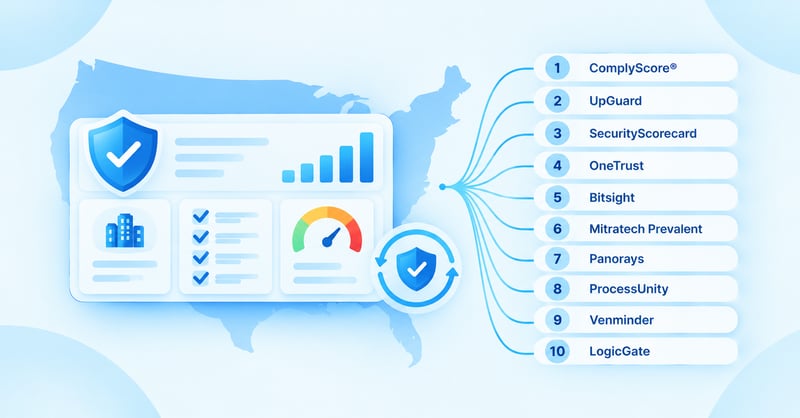
The deciding question is whether any part of your supplier risk depends on information the supplier will not volunteer. Buyers weighing platforms can compare options in this roundup of supplier risk management tools.
How the Two Work Together
The ERP keeps running procurement and finance, and the risk layer sits around it. Enviri Corporation shows the pattern at scale: it manages more than 45,000 vendors across more than 30 countries on three ERPs (Oracle, JD Edwards, and Infor LN), and it uses ComplyScore® for vendor management across that footprint.
A workable handoff follows five steps in order:
- Procurement identifies a candidate supplier, and the TPRM platform scores its inherent risk before engagement.
- Due diligence and a tiered assessment run alongside sourcing.
- Approved suppliers enter the ERP for purchase orders and invoices as usual.
- Continuous monitoring watches each supplier for the length of the contract.
- A detected signal reopens the assessment and notifies the vendor manager.
Scoring risk before the supplier exists in the ERP keeps high-risk vendors out of the supply chain until someone has reviewed them. That ordering is the practical difference from surveys that begin after supplier creation.
Pro tip: Assign one named owner to each risk tier before you connect any systems. Alerts without an owner become another inbox nobody checks.
Why Regulators Expect More Than Qualification
Regulation has moved from asking whether you vetted a supplier to asking whether you oversee it. The EU's Digital Operational Resilience Act, applicable since January 17, 2025, requires financial entities to manage ICT third-party risk as part of their wider ICT risk framework and to keep a register of information on their contractual arrangements. The NIS2 Directive lists supply chain security, including the security aspects of relationships with direct suppliers, among its minimum risk-management measures.
Frameworks such as ISO 27001, SOC 2, and GDPR add their own supplier expectations. All of them ask for documented oversight across the relationship, and a qualification record from onboarding day documents only its start.
Evidence that spans the full supplier lifecycle is what separates an audit-ready program from a well-run sourcing process. A TPRM platform produces that evidence as a by-product of the work, because every assessment, finding, and remediation lands in one trail.
How ComplyScore® Fits Alongside Your ERP
ComplyScore® is a rules-first, AI-assisted risk and compliance platform from Atlas Systems, a company with more than two decades of enterprise technology experience. Its third-party risk module covers the lifecycle that procurement modules leave open:
Atlas Systems customers report sub-10-day assessment cycles and 70 to 80% less manual effort. ComplyScore® is a Representative Vendor in the 2025 Gartner Market Guide for TPRM Technology Solutions.
ComplyScore® adds the third-party risk management layer and leaves procurement, purchasing, and finance where they run today.
Book a ComplyScore® demo to see it run beside your ERP.