Enterprise buyers evaluating a risk platform now ask sharp questions about its AI: which models run underneath and whether customer data trains them. The same organizations often run dozens of AI tools nobody ever questioned, some bought on a corporate card and others switched on quietly inside software approved years ago.
That gap has a name, and the numbers behind shadow AI keep climbing. In a Gartner survey of 302 cybersecurity leaders, 69% said they suspect or have evidence that employees use prohibited public GenAI tools, and Gartner predicts more than 40% of enterprises will face security or compliance incidents linked to unauthorized shadow AI by 2030.
Shadow AI sits on both sides of your organization’s boundary. Governing it takes two disciplines working from one rulebook: continuous checks on your own AI controls, and third-party risk management for every vendor whose AI touches your data.
What Is Shadow AI?
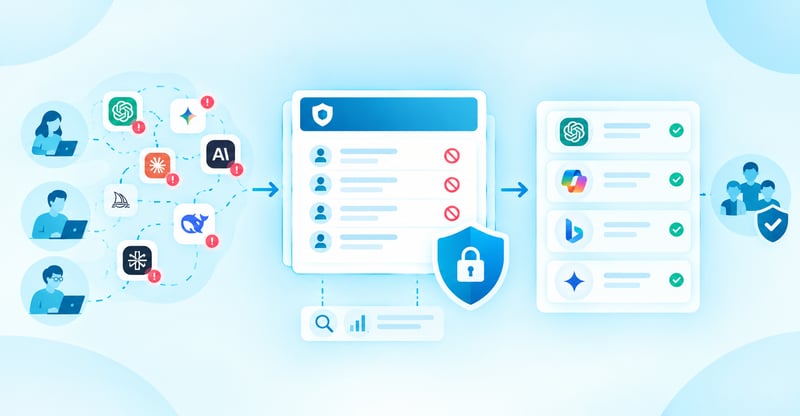
Shadow AI is the use of AI tools, models, or features without approval or oversight from IT, security, or compliance teams. It appears inside your organization when employees adopt AI apps on their own, and outside it when vendors add AI to services you already approved, sending your data to models nobody assessed.
Unlike a file-sharing app that simply stores a copy, an AI tool processes your data, may retain it, and may learn from it. Each shadow AI tool handles your data under terms nobody in your organization has read, whether it arrived through an employee’s browser or a vendor’s release notes.
Where Does Shadow AI Show Up in Your Organization?
Shadow AI tends to enter through three doors, and each one needs a different owner to close it.
AI tools employees adopt on their own
Writing assistants, meeting transcribers, and browser extensions arrive through free tiers and personal sign-ups, usually out of goodwill, such as an analyst pasting a customer file into a public model to finish a report faster. Because the tool never reaches procurement, it never reaches your vendor register either.
Models wired into internal workflows
Engineering and analytics teams increasingly call model APIs directly from scripts, spreadsheets, and internal apps, sometimes with keys bought on a team card. These integrations rarely appear in your data flow records, so your internal compliance evidence describes an environment that has already changed.
AI features added to vendors you already approved
CRM, HR, and ticketing platforms have shipped AI assistants over the past two years, often enabled by default and powered by a model provider you have no contract with. If a vendor passed your assessment before its AI features existed, your risk file answers questions about a different product. That model provider now sits in your data chain as a fourth party, a risk this guide to AI third-party cyber risk covers in depth.
Which Shadow AI Risks Matter Most for a Regulated Enterprise?
The shadow AI risks that carry regulatory weight fall into five groups, and each has a first control you can put in place this quarter.
|
Risk
|
How it shows up
|
First control
|
|
Data leakage through prompts
|
Staff paste customer, patient, or deal data into public chat tools
|
Data loss prevention rules for AI domains, plus an approved alternative
|
|
Your data used for model training
|
Default terms let the provider train on your inputs
|
Enterprise tier with a training opt-out confirmed in writing
|
|
Unreviewed model subprocessors
|
A vendor routes your data to a model provider you never assessed
|
AI subprocessor disclosure and advance notice of model changes
|
|
Excessive access through plug-ins
|
AI add-ons hold OAuth tokens to email, drive, or CRM data
|
Quarterly review of OAuth grants, with revocation for unused tokens
|
|
Regulatory exposure
|
PHI processed without a BAA, or customer financial data shared outside GLBA safeguards
|
Map each AI tool to the data categories and regulations it touches
|
The plug-in row is the easiest to underestimate. IBM’s 2026 breach study traced 27% of breaches targeting AI models or applications to compromised APIs, applications, or plug-ins. Rank shadow AI by the data flowing into each tool, since the same assistant carries trivial risk on marketing copy and serious risk on patient records.
Why Do AI Bans and Annual Reviews Miss Shadow AI?
Three structural gaps keep shadow AI hidden, even in mature compliance programs.
- Annual reviews trail monthly releases. Vendors ship AI features faster than assessment calendars cycle.
- Policies go untested. An acceptable-use policy documents intent, and auditors increasingly ask for evidence that the control actually operates.
- Slow intake invites workarounds. When approval takes weeks, employees choose the free tier and move on, and outright bans push usage onto personal devices you cannot see.
How Do You Find Shadow AI Inside and Outside Your Organization?
Discovery works best when you combine three sources, because each one catches what the others miss.
Signals from identity, spend, and network data
Ask your security team for SSO logs, OAuth consent grants, expense lines, and proxy traffic to known AI domains. Expense data is the most underused source: a monthly filter on card transactions for AI vendors surfaces paid tools that never touched procurement. Track one metric from day one, the share of discovered AI tools recorded in your inventory.
Changes in vendor terms, privacy notices, and subprocessor lists
Vendors that add AI usually update their subprocessor list or privacy notice around the release. Assign each critical vendor an owner who reviews those documents quarterly, and treat a new model provider on a subprocessor list as a signal to reopen that vendor’s file.
A short AI attestation for every vendor
Send existing vendors three questions: which AI features touch your data, which model providers sit behind them, and whether your data trains any model. Any vendor that confirms AI use moves into a fuller review built on an AI vendor risk questionnaire. Attestation response rate becomes your second metric.
How Do You Govern Shadow AI Once You Find It?
Discovery gives you a list, and governance turns that list into decisions you can defend to an examiner.
Triage every finding within a set window
Sort each tool into approve, restrict, or retire within a set deadline, such as ten business days. Approve tools with enterprise terms and a training opt-out, limit others to non-sensitive data during review, and retire the rest after pointing users to an approved alternative. Days from discovery to decision becomes your third metric.
Test your internal AI controls continuously
Map internal controls such as the AI inventory, acceptable use, data loss prevention rules, and model API key management to a framework like NIST AI RMF or ISO/IEC 42001, then verify them on a rolling basis. Keep internal data flow records current enough to show which teams send which data to which models.
Route AI vendors through a fast intake lane
Give employees a request path that returns a decision in days, with tiering based on the data the tool will touch. Standard AI contract terms covering data use, training opt-out, and model change notice should travel with every approval. A fast, predictable intake lane shrinks shadow AI more reliably than any ban.
How ComplyScore® Governs Shadow AI on Both Sides of Your Boundary
Once discovery surfaces dozens of AI tools at once, spreadsheets and email cannot keep pace with triage and evidence. ComplyScore® picks up where discovery leaves off, applying one policy engine and one audit trail to internal compliance and third-party risk.
- Internal AI controls: Continuous compliance automation verifies your AI controls against the framework you choose, including NIST AI RMF and ISO/IEC 42001, and keeps internal data flow records current
- Fast intake for AI vendors: Vendor profile intelligence enriches new vendor records from public sources, and engagement-aware tiering sets review depth by the data each tool touches; teams onboard vendors 4 to 6x faster [Atlas Systems proprietary data]
- Evidence over effort: AI-prefilled questionnaires draw answers from trust centers and SOC 2 reports, so vendors only answer what is missing
- Continuous monitoring: Risk signals from security, financial, and news feeds become owned tasks with due dates
Every AI finding, internal or external, gets an owner, a deadline, and a dated record, which is exactly what an examiner asks to see.
To see how ComplyScore® connects internal AI controls and AI vendor risk in one program, book a 30-minute demo.