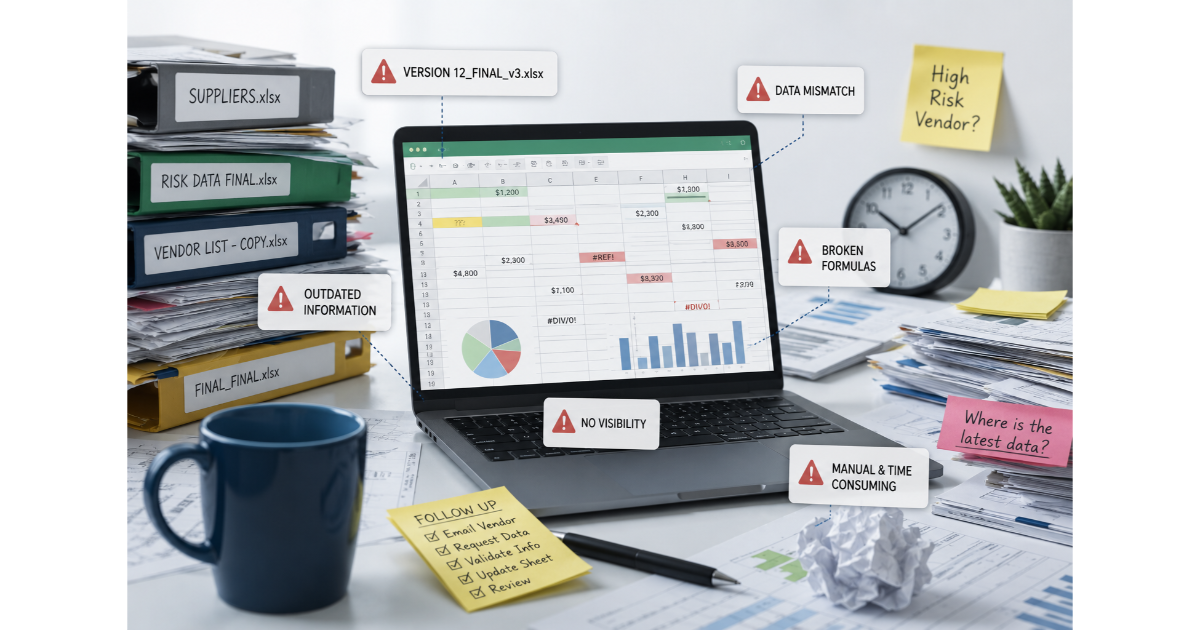
Regulated enterprises spent years building rigorous vendor assessment frameworks. Questionnaires grew longer, evidence checklists grew more detailed, and review cycles tightened. And yet, the risk team managing 250 vendors still runs every assessment through email threads and spreadsheets, with a few full-time analysts who barely keep pace.
The problem is that the tools expect humans to do the work that machines are far better at: reading 200-page SOC 2 reports, tracking certificate expiry dates across hundreds of vendors, and correlating signals from six different data sources before forming a risk judgment.
AI-driven due diligence reverses that equation. Analysts spend their time on judgment calls. The machine handles the evidence.
What AI-Driven Due Diligence Actually Means
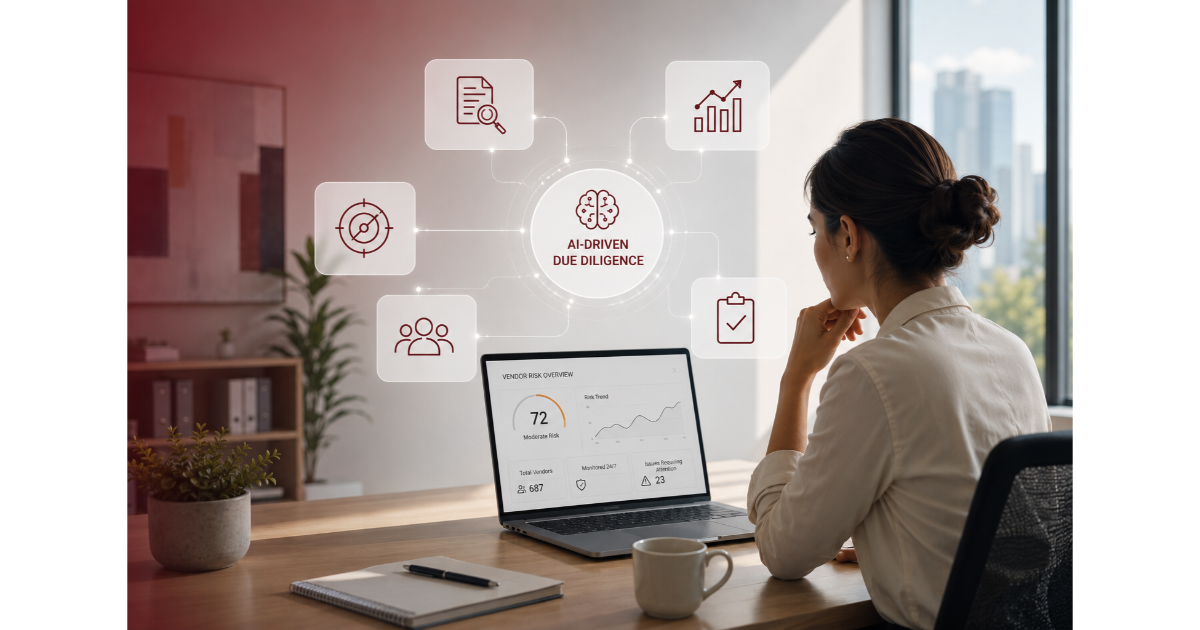
AI-driven due diligence uses machine learning, natural language processing, and automated data enrichment to handle vendor data collection, evidence interpretation, risk scoring, and signal monitoring across the full vendor lifecycle. Unlike traditional assessment workflows, it generates living risk intelligence that updates continuously as vendor conditions change, so your program reflects reality rather than a point-in-time snapshot.
The Part of Due Diligence That Actually Breaks Programs
Most vendor risk programs don't fail because of poor methodology. They fail because the methodology was designed for a vendor portfolio one-fifth the size of the one it's now managing.
A typical due diligence workflow moves through four stages: data collection, evidence review, risk scoring, and analyst judgment. The first three stages are largely mechanical. They require accuracy and consistency, not expertise. But in manual programs, they consume the vast majority of analyst time, which means the fourth stage, the one that requires genuine human judgment, gets whatever hours are left over.
Consider what "evidence review" actually involves at scale:
- A single SOC 2 Type II report runs 50 to 200 pages per vendor
- Insurance certificates need cross-referencing against your own coverage requirements
- Policy documents arrive in inconsistent formats with inconsistent terminology
- The same vendor may submit different documentation to different business units
Multiply that across a portfolio of 250 to 900 vendors, and the math becomes impossible. Teams either slow their review cycles to preserve quality, or compress quality to maintain pace. Neither outcome is defensible to a regulator.
The coverage gap compounds the problem. According to the 2025 EY Global Third-Party Risk Management Survey, only 57% of organizations can monitor operational risk across their full vendor population. Tier 1 vendors get rigorous due diligence. Tier 2 and Tier 3 vendors typically receive a questionnaire and a document checklist, if they receive anything at all.
The 43% flying partially blind are not doing so by choice.
Where AI Changes the Work, Not Just the Speed
The dominant narrative around AI in vendor due diligence focuses on speed. Assessments that took six weeks now take ten days. That's true and worth highlighting. But it understates what actually changes operationally.
Profile intelligence at intake, before the vendor ever answers a question
Before any questionnaire reaches a vendor, AI can pull and normalize data from business registries, financial health databases, sanctions lists, security rating feeds, and public breach repositories.
A vendor record that previously required manual research across six sources arrives pre-enriched and pre-tiered. Tiering errors at intake cascade into every downstream decision: an under-classified vendor receives a lighter assessment than its exposure warrants, and that gap rarely surfaces until it matters.
Document analysis that reads evidence the way an expert would
AI reads SOC 2 reports and extracts control coverage, identifies gaps against specified frameworks, and flags exceptions for analyst review. It cross-references insurance certificates against your requirements and surfaces expiry dates before they become a compliance issue.
The analyst receives a findings draft, not a stack of documents. That shift accounts for a significant portion of the 70-80% reduction in manual effort that mature AI-driven programs report.
Continuous signal correlation between formal assessments
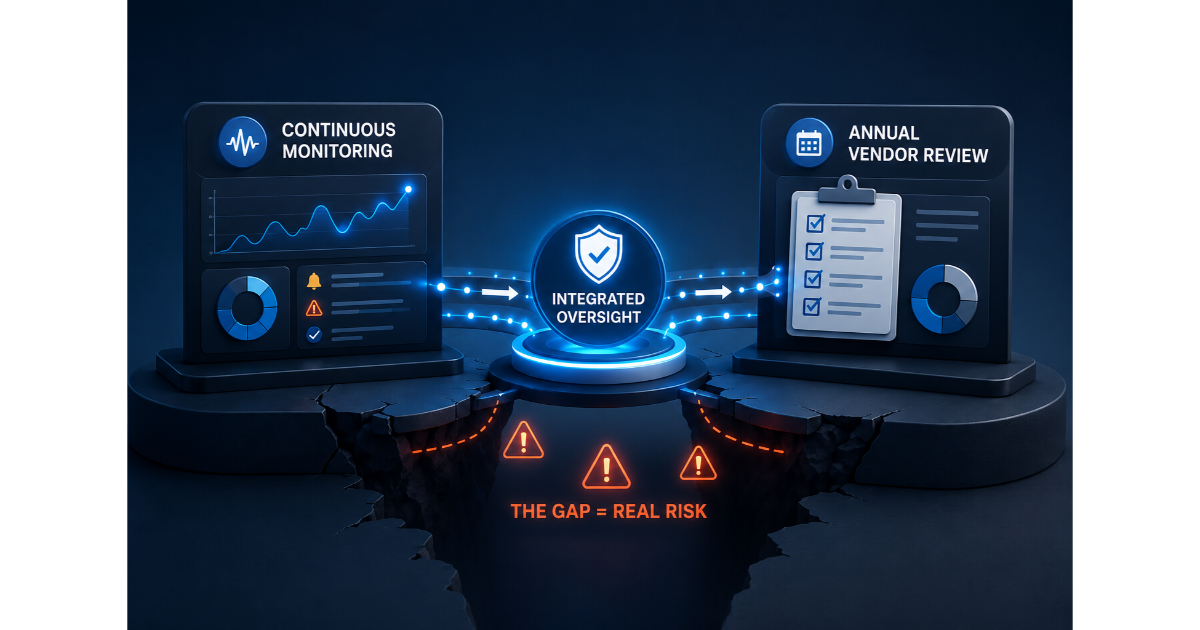
Annual reviews create an illusion of current awareness. A vendor's risk posture can shift materially in weeks: a leadership change in the security function, a disclosed breach, a credit rating downgrade, or a sanctions event at a sub-processor.
AI-powered monitoring ingests these signals continuously, correlates them against materiality thresholds, and routes alerts as actionable tasks with assigned owners and response deadlines. The 2025 EY survey found that 64% of organizations now monitor their vendors' vendors, something that was operationally impossible at scale without automated signal correlation.
Why Tier 2 and Tier 3 Coverage Finally Becomes Viable
The economic argument for AI-driven due diligence doesn't rest on how much faster your Tier 1 assessments run. It rests on whether your program can extend meaningful oversight to vendors that manual processes have always deprioritized.
Engagement-aware tiering makes that possible. Rather than applying a one-size assessment to all vendors, or arbitrarily lightening treatment for lower tiers, AI calibrates assessment depth to actual engagement risk:
|
Tier
|
Assessment depth
|
Monitoring cadence
|
|
Critical (Tier 1)
|
Full evidence review, deep questionnaire, external intelligence feeds
|
Continuous
|
|
Material (Tier 2)
|
Framework-aligned questionnaire, automated document analysis
|
Periodic with threshold alerts
|
|
Lower risk (Tier 3)
|
Targeted self-assessment, automated scoring
|
Exception-based alerts
|
The coverage difference is substantial. Manual programs typically achieve meaningful oversight of 25-30% of their vendor population. AI-driven TPRM programs reach 90%+ coverage without a proportional increase in headcount. For regulated enterprises managing hundreds of third parties, that gap is also a regulatory gap.
What Regulators Are Now Asking For That Manual Programs Cannot Produce
Efficiency is one argument for AI-driven due diligence. Auditability is a stronger one.
Regulators reviewing third-party risk programs don't just want to see that a due diligence exercise was completed. They want documented evidence of what was reviewed, how findings were weighted, who made the risk determination, and when the assessment was last refreshed.
DORA Article 28, enforceable across EU financial entities since January 2025, is explicit on this point. Pre-contractual due diligence on ICT vendors is mandatory, ongoing monitoring of critical providers is mandatory, and documented evidence files must be available for supervisory inspection. Crucially, DORA examiners ask for independent verification documentation. Self-attestation alone does not satisfy the requirement.
AI-assisted due diligence produces the evidence trail regulators expect by design. Every document ingested, every control gap flagged, every analyst approval, and every exception granted carries a timestamp and a full audit log.
How to Introduce AI-Driven Due Diligence Without Rebuilding Your Program
Most programs benefit more from targeted AI adoption than wholesale replacement. The practical move is identifying where the current workflow breaks under volume and introducing AI at those specific pressure points.
A practical sequence covers four areas:
- Fix vendor intake first. Profiles that arrive incomplete or inconsistent propagate errors into tiering, evidence requests, and scoring. Automated enrichment from external data sources corrects this at the source, before any analyst touches the record.
- Pre-populate questionnaires from prior assessments and public data. Vendors routinely re-enter information they provided twelve months ago. AI pre-fill reduces vendor burden and improves response quality by surfacing contradictions between new answers and prior submissions automatically.
- Apply document analysis to the evidence review stage. This is where analyst hours concentrate most heavily in manual programs. Automated reading, gap detection, and findings drafting return that time directly.
- Route monitoring alerts to owners, not inboxes. An alert that lands in a shared inbox and ages for two weeks reduces risk no more than no alert at all. Monitoring output should generate tasks with deadlines and named owners at the moment the signal fires.
Programs that work through these four steps and still hit capacity limits or coverage ceilings have typically reached what process discipline alone cannot solve. ComplyScore® is purpose-built for that point, combining engagement-aware tiering, AI-assisted evidence review, continuous third-party monitoring, and full audit trail documentation in a single platform designed for regulated enterprise TPRM programs.
Organizations with complex, multi-geography vendor portfolios spanning 45,000+ vendors across 40+ countries and multiple ERP environments use ComplyScore® to reach sub-10-day assessment cycles with 90-95% vendor coverage across their full portfolio.
See ComplyScore® in action.

.webp?width=387&height=387&name=headless-tprm%20(1).webp)



















%20(1).jpg)