Third-party involvement in confirmed data breaches doubled to 30% of all incidents in 2025, the single largest year-over-year increase across any major attack vector, according to the Verizon Data Breach Investigations Report.
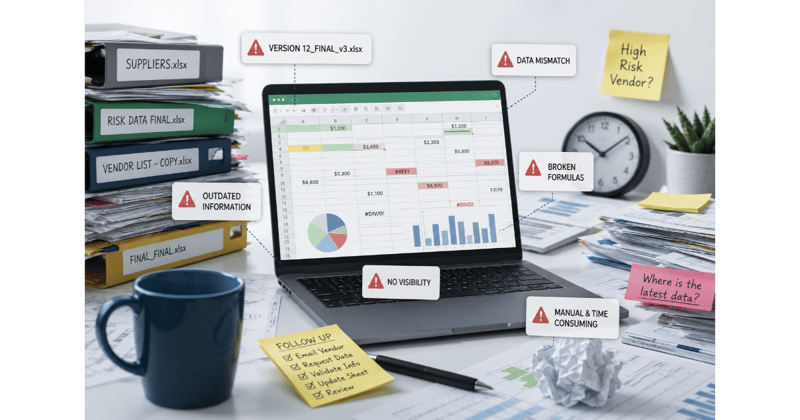
For organizations still running vendor risk on spreadsheets, that number represents a structural exposure, not a staffing problem or a process gap. Spreadsheets were built to organize data. Managing dynamic, multi-vendor risk relationships across regulatory frameworks is a fundamentally different job.
When Spreadsheets Are Still the Right Tool
Spreadsheets aren't the wrong choice for every TPRM program. A team managing under 50 vendors, with a single owner and infrequent reassessment cycles, can run a spreadsheet-based process without meaningful risk exposure. The format is familiar, requires no procurement cycle, and works fine when the vendor portfolio is small enough for one person to hold the full picture in their head.
The failure mode isn't the spreadsheet itself. It's what happens when vendor count, regulatory scope, or team size outgrows what a single manually-updated file can represent accurately. That threshold arrives faster than most programs expect.
The Operational Cost of a Tool Built for Something Else
Spreadsheets appear low-cost because they carry no license fee. The actual cost shows up in analyst hours: every assessment cycle requires manually composing a questionnaire, distributing it, following up on non-responses, reconciling answers against prior cycles, and documenting findings in a format that was never designed to withstand audit scrutiny. For a team managing 200 vendors under tightening regulatory timelines, that process consumes more capacity than the function can sustain without coverage gaps opening somewhere.
When the average data breach costs $4.4M globally (IBM Cost of a Data Breach Report 2024), those coverage gaps carry a precise price tag. The question for any TPRM program is whether the existing tool can detect a vendor problem before a regulator or an incident does — which is exactly what modern TPRM tools are evaluated on.
Four Ways Spreadsheets Break TPRM Programs
Each failure mode below is structural. No amount of discipline or spreadsheet redesign resolves them because they require a different kind of system entirely.
Risk is frozen the moment someone stops updating it
A spreadsheet reflects whatever a vendor looked like at the time of the last manual entry. In the months between that update and today, the vendor could have:
- Disclosed a data breach
- Appeared on a sanctions watchlist
- Lost a key ISO or SOC certification
- Undergone an ownership or leadership change
None of that surfaces until someone runs a manual check, which in most organizations means it surfaces at the next scheduled assessment, quarters later. Regulators under DORA and OCC Third-Party Relationship guidance increasingly expect evidence of continuous monitoring, not point-in-time snapshots filed once a year. A spreadsheet cannot produce that evidence because it has no mechanism to track vendor posture changes over time.
The gap always shows up at the worst time. A vendor's certification lapses in March, nobody updates the tracker, and the first anyone hears about it is when a regulator asks for evidence in October." — Sirish Pallevada, Chief Revenue Officer, Atlas Systems
Accountability fragments when risk data lives across disconnected systems
When vendor risk data is distributed across files owned by different teams with no consolidation mechanism, no function has a complete picture of any single vendor relationship. The practical consequence:
- Contract terms, performance records, and cyber control assessments all live in separate files
- No single owner holds the complete risk picture for any given vendor
- When a regulatory examiner asks for a timestamped record of when a risk was identified, who it was escalated to, and what remediation followed, the answer has to be reconstructed manually from disconnected sources
In many programs, that audit trail cannot be assembled at all because decisions were made over email and never formally captured.
Assessment coverage shrinks as vendor portfolios grow
A two-person risk team managing 80 vendors can sustain a spreadsheet-based program through sheer effort. Give that same team 400 vendors and new regulatory obligations, and coverage is what gives way first:
- Lower-tier vendors go unassessed
- Annual questionnaires replace substantive due diligence
- The program concentrates on tier-one relationships while the broader portfolio goes largely unmonitored
This is a capacity ceiling, and it drops lower with every vendor added to the portfolio. Risk teams managing hundreds of relationships on manual processes consistently describe the same pattern: administrative work, rebuilding vendor profiles, chasing questionnaire responses, and reconciling records leaves no bandwidth for actual risk analysis.
Every engagement gets assessed as if the risk profile is identical
A SaaS vendor processing core financial data and a facilities contractor with physical site access carry categorically different risk profiles. Spreadsheets hold both as rows in the same table with no mechanism to calibrate assessment depth, monitoring frequency, or applicable control frameworks based on what the vendor does or what data they can access.
|
Result
|
Consequence
|
|
Same questionnaire sent to every vendor
|
Low-risk vendors over-assessed; team capacity consumed
|
|
No tiering logic built into the tool
|
High-risk engagements under-scrutinized
|
|
Flat coverage across all vendor types
|
Regulators see no evidence of risk-proportionate treatment
|
Regulators have become specific about expecting risk-proportionate treatment, and a flat spreadsheet offers no way to demonstrate it.
What the Program Looks Like When the Tool Fits the Problem
Replacing spreadsheets doesn't mean hiring more analysts. It means redirecting the existing team's time away from coordination work and toward decisions that actually require human judgment. In a purpose-built TPRM program:
Risk tiering operates at the engagement level
The same vendor onboarded for two different purposes carries two different risk profiles. A cloud provider brought in for file storage gets a lighter review than the same provider brought in to process regulated data — each engagement drives its own assessment scope and monitoring cadence, rather than one static profile per vendor.
Questionnaires pre-fill before they reach the vendor
AI-assisted pre-population draws from prior assessment data and public signals before anything goes out, cutting end-to-end assessment cycles from six to eight weeks down to under three weeks for standard vendors. The vendor spends less time re-entering information you already had, and your team spends less time chasing it.
Continuous monitoring replaces the annual review cycle
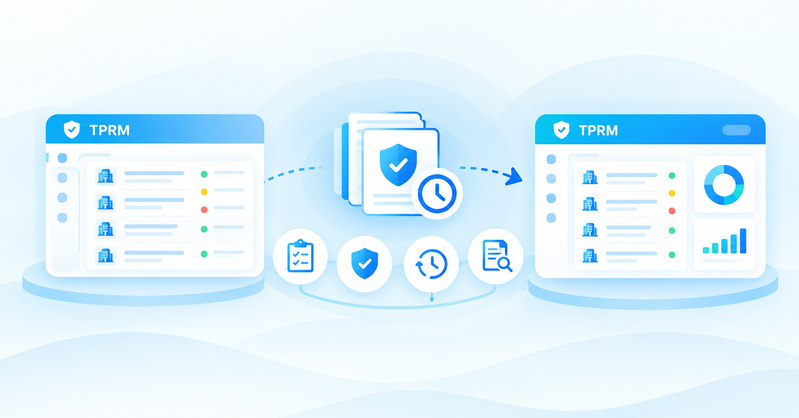
Vendor risk scores update against live signals, including breach disclosures, sanctions changes, financial distress indicators, and adverse media, instead of sitting static between scheduled reviews. A posture change surfaces the week it happens, not the quarter someone gets around to checking.
Alerts route with the remediation task already attached
Threshold-based alerting sends findings to the relevant risk owner with a remediation task already staged, so the team responds to surfaced risk rather than discovering it after the fact during the next audit prep cycle.
A single owner sees the complete picture
Contract terms, assessment history, and monitoring signals for a given vendor live in one record instead of scattered across files. When a regulator asks who identified a risk and when, the answer is a timestamp in the system, not a reconstruction project across old emails.
ComplyScore® by Atlas Systems is built around this model, managing the full vendor lifecycle from intake through ongoing monitoring with engagement-aware tiering, AI-assisted due diligence, and audit-ready evidence trails.
See how it maps to your current vendor program. Request a demo.








.webp?width=387&height=387&name=headless-tprm%20(1).webp)
















































%20(1).jpg)