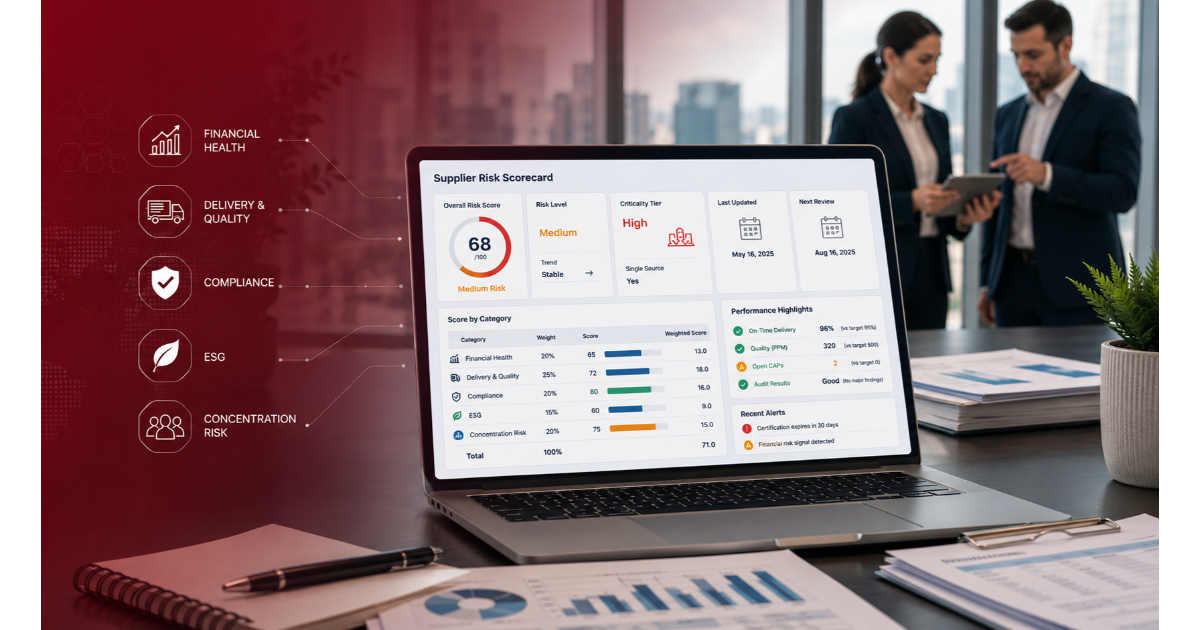
Most TPRM programs assess vendors thoroughly and still miss this risk entirely. Single-source supplier risk does not fail the questionnaire. It passes every control review and shows up clean on every dashboard. It only becomes visible when the supplier goes offline, raises prices by 40%, or gets acquired by a competitor. The exposure was never in the vendor's controls. It was in your dependency on them.
Single-source supplier risk is one of the most common threats inside third-party risk programs and one of the least visible, because most programs are built to evaluate vendors individually, not to ask what happens when one of them disappears.
What Single-Source Supplier Risk Actually Means
Single-source supplier risk is the operational and financial exposure that builds when your organization depends on one vendor for a critical product, service, or function, with no qualified alternative in your current portfolio.
How it differs from sole-source risk:
| |
Single-Source Risk
|
Sole-Source Risk
|
|
Definition
|
You chose to work with one vendor, though alternatives exist
|
Only one vendor in the market can provide what you need
|
|
Fixability
|
More addressable, alternatives exist
|
Harder to fix, market has no substitute
|
|
Why it persists
|
Feels like a deliberate decision, not a vulnerability
|
High exit barriers, market monopoly
|
Both types create serious concentration exposure. Single-source risk tends to linger longer precisely because it looks intentional.
According to Resilinc, 85% of supply chain disruptions originate in the lower tiers of the supply chain, where most organizations lack meaningful visibility. The problem is that traditional risk assessments rarely surface this. They tell you whether a vendor's controls are adequate. They do not tell you how much of your operation collapses if that vendor stops delivering.
Why Standard TPRM Assessments Miss It
Most third-party risk programs assess vendors one at a time. A questionnaire goes out, evidence comes back, a risk score gets assigned, and the vendor moves through the workflow. That process works well for evaluating individual vendor controls. It does not work for identifying portfolio-level dependencies.
The structural gap: No individual vendor assessment will ever surface the fact that you rely on that vendor for 100% of a critical input. The vendor's questionnaire does not ask about your dependency on them. Your risk scoring model rewards their SOC 2 certification, not the absence of a backup option on your side.
The dependency data your program needs sits in three places that most TPRM platforms never touch:
- Purchase orders and ERP records showing which vendors you actually buy from and how much
- Contract inventories revealing which relationships have no backup or exit provisions
- Procurement spend data that flags when one vendor has quietly absorbed all volume in a category
How to Identify Single-Source Supplier Risk in Your Vendor Ecosystem
Identifying single-source risk requires a different question than what most risk assessments ask. Instead of "How secure is this vendor?" the question becomes: "What breaks in our operations if this vendor stops delivering tomorrow?"
Here are the four steps that make that question answerable.
Map critical functions first, then work backward to vendors
Start with your organization's critical business processes: the functions where failure causes direct revenue loss, regulatory exposure, or service disruption. For each one, identify which vendors support it. Any critical function with a single vendor in the supporting column is a single-source dependency, regardless of how well that vendor scores on controls.
Apply a materiality threshold consistently
Procurement teams often know which vendors matter most, but that knowledge rarely makes it into a documented risk register in a useful form. Set a clear threshold and apply it across all business units:
- Flag any vendor that handles more than 30% of a critical function's volume
- Flag any vendor that is the sole provider of a critical input, with no active backup
Cross-reference assessment data with spend and contract data
Pull procurement data into your risk review alongside assessment responses. Single-source dependencies often surface here, particularly when teams discover that a backup vendor exists on paper but has not received an order in 18 months. That makes the primary supplier a sole source, regardless of what the risk register says.
Check for hidden concentration across multiple critical functions
Single-source risk compounds when one vendor supports more than one critical function simultaneously. A cloud infrastructure provider that hosts your application, processes your payments, and manages your backup data is not three separate vendor relationships in risk terms. It is a concentration risk with a multiplier attached.
DORA Article 28 specifically requires financial entities to identify vendors that cannot easily be replaced and vendors covering multiple critical functions, because regulators recognize that the two conditions together are uniquely dangerous.
How to Measure It: Scoring Single-Source Supplier Risk
Once you have identified your single-source dependencies, score them in a way that drives action, not just documentation.
The two dimensions that matter most:
- Criticality: How much operational disruption follows if the vendor fails to deliver
- Replaceability: How quickly and at what cost you could move to an alternative
The vendors in the high-criticality, low-replaceability quadrant are your priority remediation targets.
Use a scoring framework that captures all four key variables:
|
Scoring Dimension
|
What to Measure
|
|
Criticality
|
Revenue impact, regulatory exposure, and recovery time if vendor fails
|
|
Replaceability
|
Time to qualify a new vendor, switching costs, and market availability of alternatives
|
|
Dependency depth
|
Percentage of critical function volume handled by this vendor
|
|
Concentration multiplier
|
Number of critical functions this vendor supports simultaneously
|
Score each flagged single-source vendor across all four dimensions. The composite score gives risk leadership a ranked list of exposures, which is exactly what they need to make a defensible case to the board for remediation investment.
How to Fix It: Remediation That Actually Works
Remediation for single-source supplier risk is not always diversification. The right fix depends on the nature of the dependency.
Qualify a secondary supplier before you need one
The most reliable fix is having a qualified alternative ready to activate. This does not mean splitting volume 50/50 immediately. Shifting 10 to 20% of volume to a backup vendor is enough to:
- Maintain an active commercial relationship
- Keep your qualification current
- Ensure the alternative stays operationally viable
That small shift dramatically changes your risk exposure without overhauling your sourcing model.
Strengthen contractual protections for genuine sole-source situations
When no realistic market alternative exists, the mitigation comes from the contract. Negotiate the following controls directly into the agreement:
- Pricing protections against unilateral increases
- Business continuity obligations with defined SLAs
- Key-person retention clauses for specialized delivery roles
- Exit and transition support requirements if the relationship ends
These are not just procurement best practices in this scenario. They are risk controls, and your risk program should track them accordingly.
Build the visibility layer that makes this sustainable
The hardest part of single-source risk management is not fixing today's dependencies. It is catching new ones before they become entrenched. Every time a backup supplier relationship goes quiet, or a new critical function gets onboarded with a single vendor, the concentration rebuilds. A sustainable fix requires a monitoring layer that flags new concentrations as they form, before they become expensive to unwind.
How ComplyScore® Helps Surface and Manage Single-Source Risk
ComplyScore®, Atlas Systems' AI-driven TPRM platform, is built to close the gap between vendor-level assessments and portfolio-level risk visibility.
What it does for single-source risk specifically:
- Engagement-Aware Tiering adjusts risk scores based on the scope and depth of each vendor relationship, including how many critical functions that vendor supports, rather than treating every vendor as a standalone risk entity
- Executive Risk Dashboards surface concentration metrics across the full vendor portfolio, so dependencies show up in the data before they show up in a disruption
- Continuous monitoring means that when a vendor's financial health, operational signals, or cyber posture changes, the associated dependency risk is recalculated in real time
For organizations that need operational support on top of the platform, ComplyScore®'s TPRM as a Service option provides analyst-led portfolio-level dependency reviews, so risk leadership can stay focused on decisions rather than data collection.
As a Representative Vendor in the 2025 Gartner Market Guide for TPRM Technology Solutions, Atlas Systems brings more than two decades of third-party risk experience to these programs.
See how ComplyScore® can surface the single-source dependencies hiding in your vendor portfolio.
Schedule a demo.



.webp?width=387&height=387&name=headless-tprm%20(1).webp)




























%20(1).jpg)

.webp)
.webp)
.webp)