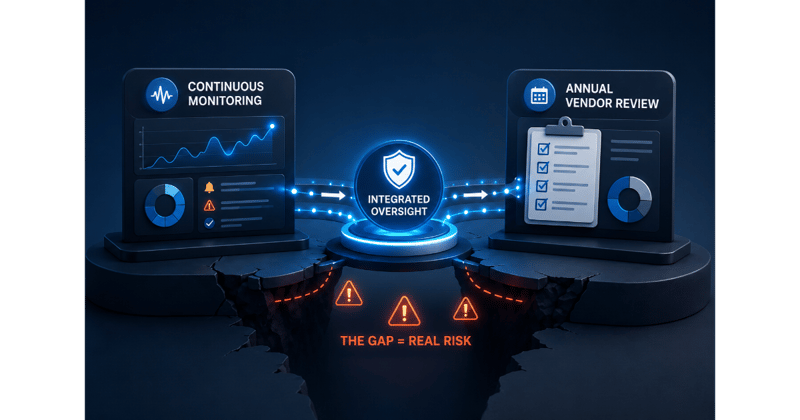
Most third-party risk programs that experience a vendor-related incident had both an assessment on file and a monitoring tool running. The failure point was not the absence of either method. It was that the two never talked to each other.
The debate around continuous monitoring versus annual reviews tends to stop at the wrong question. Both methods have distinct, non-overlapping jobs, and the programs that get this right are not choosing between them. They are building the connective tissue that makes both work.
What Continuous Monitoring and Annual Reviews Each Do
Continuous monitoring and annual vendor reviews serve different functions in a third-party risk program, and understanding that distinction is what allows you to design a program that uses both effectively.
Annual reviews establish and validate the control baseline. A structured assessment, covering security controls, compliance posture, financial health, and contractual obligations, creates the documented foundation against which all future signals are measured. Without this baseline, monitoring alerts have no context. A risk score drop means something only if you know what the score looked like when the vendor was in good standing.
Continuous monitoring detects when that baseline shifts. Between annual cycles, vendor environments change: subcontractors rotate, ownership structures shift, security certifications lapse, and external threat exposure evolves. Continuous monitoring surfaces those changes as they happen, triggering reassessment or remediation before they become incidents.
Together, the two methods cover the full timeline of a vendor relationship: assessment validates the starting state, monitoring watches for drift.
Where Each Method Breaks Down Without the Other
When continuous monitoring runs without an assessment baseline
Monitoring without a documented control baseline produces high signal volume with low actionability. A cyber risk score drop from 780 to 650 requires context to interpret: Was 780 already a borderline score for this vendor? Does the drop reflect a known remediation in progress, or a new exposure? Without an assessment record anchoring the vendor's expected posture, the alert requires manual investigation every time. That defeats the efficiency purpose of automated monitoring entirely.
The practical consequence is alert fatigue. Teams that receive signals they can't quickly contextualize start deprioritizing the queue. The monitoring program is technically running. The protection it was supposed to provide is not.
When annual reviews run without continuous monitoring in between
A point-in-time assessment is accurate on the day it's completed. Vendor environments don't hold still. According to IBM's Cost of a Data Breach Report 2024, the average time to identify and contain a breach is 219 days, far longer than the gap between most quarterly check-ins, let alone annual ones.
Regulatory frameworks have started codifying this reality. DORA requires financial entities to maintain continuous oversight of critical ICT third-party providers, not just document assessments periodically. NIST SP 800-161r1 frames ongoing monitoring as a core supply chain risk management requirement. Annual reviews remain necessary for deep control validation. They were never designed to catch what changes on a random Tuesday.
The Integration Failure Most Programs Don't See Coming
Here is where the conversation needs to shift. Most TPRM programs do run both annual reviews and some form of continuous monitoring. The failure that produces real exposure is architectural: the two activities operate as disconnected workflows.
Assessment data lives in one system. Monitoring alerts land in a separate inbox, often managed by a different team. Contract renewal workflows have no visibility into either. When an alert fires for a vendor whose contract is three weeks from renewal, there is frequently no mechanism to connect those two facts before the renewal decision is made.
A regional bank's TPRM team that we talked to discovered this problem after the fact. Their payment processing vendor experienced a breach that took three weeks to surface through internal channels. By the time it reached the team responsible for vendor decisions, the contract renewal had already been extended. The monitoring signal existed. The assessment history existed. The connection between them, and between either and the renewal workflow, did not.
This architectural disconnect is also why monitoring programs consistently lose the budget argument. The value of continuous monitoring is invisible until an incident occurs, because in a disconnected program, the alerts it generates rarely produce clear, documented outcomes. When budget cycles come around, the team can demonstrate that assessments were completed. They cannot easily demonstrate what the monitoring program prevented.
How to Design the Integration, Not Just the Methods
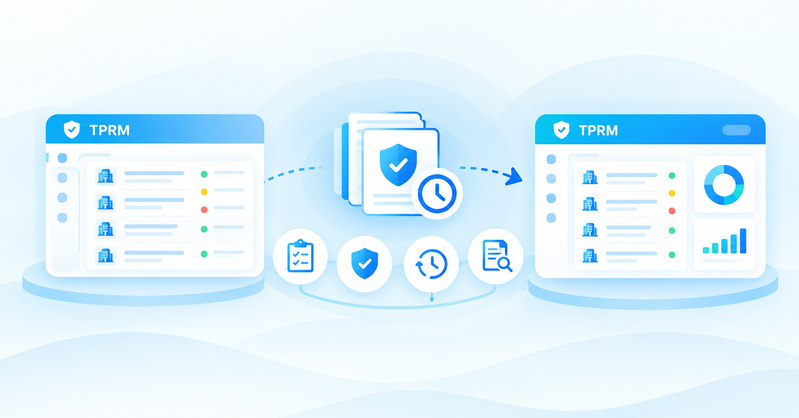
A well-integrated TPRM program treats assessment and monitoring as two phases of a single workflow, not two separate programs. Here is the framework that makes that work in practice.
|
Vendor Risk Tier
|
Assessment Frequency
|
Monitoring Intensity
|
Out-of-Cycle Trigger
|
|
Critical
|
Every 6 to 12 months
|
Real-time signals: cyber, financial, sanctions, adverse media
|
Any score threshold breach; ownership change; breach disclosure
|
|
High
|
Annual
|
Weekly signal aggregation; threshold alerts
|
Sanctions hit; financial distress indicator; regulatory enforcement action
|
|
Medium
|
Annual or biennial
|
Monthly signal review
|
Material adverse media; certification lapse
|
|
Low
|
Biennial
|
Periodic exception-based review
|
Significant service scope change
|
Three design principles make this table actionable rather than aspirational.
Assessment outputs must be accessible to monitoring workflows. When a monitoring alert fires, the relevant risk owner should be able to pull the vendor's most recent assessment, the residual risk score, and any open remediation items in the same view. Without that context, every alert starts a new investigation from scratch.
Monitoring alerts must connect to contract and renewal workflows. A vendor's real-time risk score should be a visible input at contract renewal, not a separate report that someone has to remember to check. If the score has dropped below threshold, the renewal workflow should require documented review before proceeding.
Remediation must close the loop back to both. When a monitoring alert generates a remediation task, completion of that task should update the vendor's risk record, creating an audit trail that links the signal, the response, and the outcome. This is the evidence trail regulators increasingly expect.
Where Technology Makes Integration Feasible at Scale
The integration design above is straightforward to describe and genuinely difficult to operate manually across a vendor portfolio of any scale. Contract terms, assessment records, monitoring signals, and remediation tasks typically live in separate systems. And the effort of connecting them manually grows with every vendor added.
ComplyScore® addresses this at the architectural level. The platform's continuous monitoring module is built on the same vendor record that holds assessment history, residual risk scores, and contract metadata. When a monitoring alert fires, it references the vendor's current risk tier, the last assessment date, and any open remediation items automatically. Score-threshold alerts route to the named risk owner with a pre-staged remediation task, and task completion updates the vendor record in real time.
For organizations managing vendor portfolios in the hundreds or thousands, this is the specific capability that makes the integration framework above operational rather than theoretical.
Atlas Systems brings more than two decades of TPRM experience to this design, and ComplyScore® is recognized as a Representative Vendor in the 2025 Gartner Market Guide for TPRM Technology Solutions.
See how ComplyScore® connects assessment and monitoring into a single vendor risk workflow. Get a demo today.







.webp?width=387&height=387&name=headless-tprm%20(1).webp)












































%20(1).jpg)