




.webp?width=387&height=387&name=headless-tprm%20(1).webp)









































Third-Party Risk Management
ComplyScore® Launches World’s First Headless TPRM, Bringing Conversational AI to Compliance Management. 
ComplyScore® Launches World’s First Headless TPRM, Bringing Conversational AI to Compliance Management.




Fourth-party exposure often hides inside a bigger number. Verizon's 2026 Data Breach Investigations Report found third-party involvement in breaches jumped to 48%, up 60% year-over-year. Most of that exposure sits one layer removed from where security teams are actually looking: the subcontractors and cloud platforms your own vendors depend on. A relationship you never contracted for can still take down your operations, and most risk programs don't monitor that layer at all.
Having a comprehensive third-party risk management program that covers fourth-party risks is vital, as vulnerabilities from these vendors can directly impact your company’s security and operations. This blog post takes a deeper look at fourth-party risk management.
Fourth-Party Risk Management (FPRM) involves identifying and mitigating risks associated with fourth-party vendors. Fourth parties are your vendors’ suppliers, who may introduce many risks that negatively impact your business. They multiply organizational risks, and your organization will bear the consequences for a breach or failure.
For example, if you have 10 third-party vendors, and each depends on 5 suppliers, you’ll be dealing with 50 additional relationships. This huge number of indirect connections requires careful management.
Regulators like the GDPR and NYDFS require you to know your vendors’ suppliers to ensure accountability and protect data privacy. Fourth party risk management helps protect your brand, business operations and reputation by managing risks in your extended supply chain.
The terms get used loosely, but each layer carries a different level of visibility and control. Here's how they compare:
| Third-party | Fourth-party | Nth-party | |
| What it is | The vendor your organization directly contracts with and pays | The vendors and subcontractors your third party relies on to deliver its service | Every additional layer beyond the fourth party, your fourth party's own suppliers |
| Your relationship | Direct and contractual | Indirect, no contract with you | Fully indirect, multiple layers removed |
| Contract coverage | Standard in your vendor agreement | Only covered if you've added fourth-party clauses | Almost never covered contractually |
| Visibility | You can request audits, SOC reports, and questionnaires directly | You depend on your third party to disclose and vet them | Minimal to none without deliberate supply chain mapping |
| Example | A cloud CRM vendor you pay a subscription to | The cloud hosting provider your CRM vendor uses to store your data | A backup subcontractor your CRM vendor's cloud host relies on |
| Who's accountable | You own oversight directly | Your third party is accountable to you, but you have no direct leverage over them | Accountability becomes diffuse and hard to enforce |
Fourth parties, the vendors of your vendors, pose many potential risks that your organization may be unaware of. Even if your company has a robust information security program, an attack on fourth-party services can cause a cascading impact. For instance, if most of your third parties use the same cloud provider and it experiences a ransomware attack, all your third parties will go down, negatively affecting your operational capability.
Regulators, customers, and the public will hold you accountable for vendors’ mistakes, even if a breach or failure occurs at a fourth party. Fourth-party risk management is crucial because it allows for proactive risk mitigation and faster incident response. With a strong fourth-party risk oversight, you enhance your cybersecurity, reduce compliance risks, boost operational efficiency, and improve your brand’s reputation.
Managing fourth parties isn’t easy, but it’s necessary if you want to gain better visibility of your organization’s risk landscape. The good news is you can use different strategies to assess and manage your fourth parties and make your overall TPRM program more effective.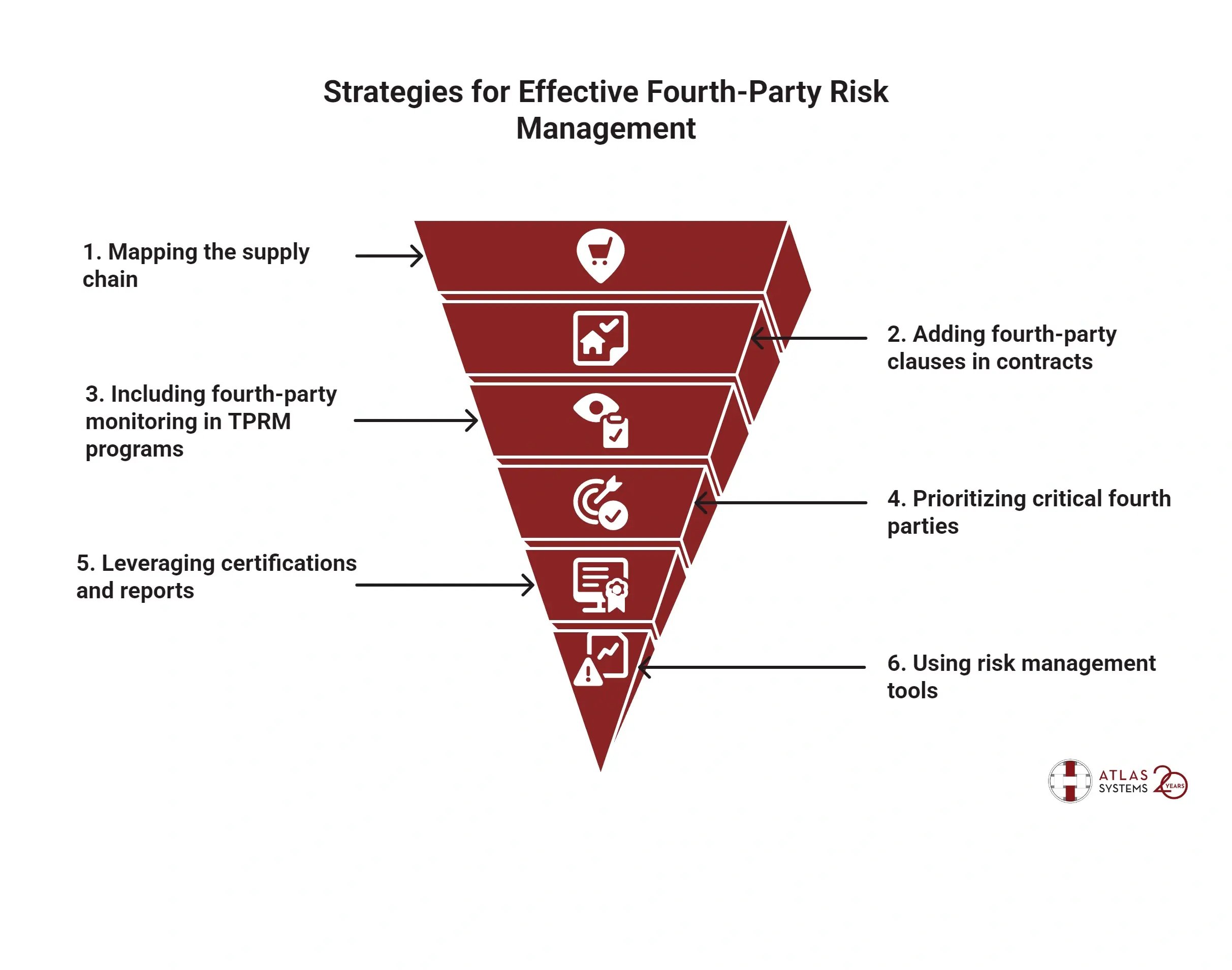
This is the first step towards managing fourth-party risks. Ask your critical vendors to disclose subcontractors and service providers that support them. You can streamline the process by including fourth-party questions in vendor due diligence questionnaires or requesting vendors for detailed third-party risk management reports.
Your contracts with third parties should also cover fourth parties. Add clauses asking vendors to disclose critical fourth-party relationships and to notify you of changes in fourth-party suppliers. They should also extend security and privacy standards to subcontractors and report incidents affecting fourth parties immediately.
Create a comprehensive third-party risk management program that includes fourth-party risks. Regularly assess your vendors’ management practices by reviewing their SOC 2 reports and other security assessments, which is part of a robust SOC 2 vendor management program. Monitoring third-party performance ensures supply chain stability and helps your organization stay compliant.
Fourth parties pose different risks, and you don’t need to monitor every single one. Focus on those associated with critical business functions, such as those that handle sensitive information (financial, health, PII), critical company services (cloud infrastructure, payroll), and regulated processes (HIPAA, PCI, GLBA).
This prioritization is also where supplier risk management platform adds direct value automatically tiering your direct suppliers by financial, operational, and compliance exposure so the highest-risk relationships get the deepest scrutiny without your team manually categorizing hundreds of vendors.
Asking for the right third-party documents can go a long way in enhancing fourth-party risk management. Key documents that reference fourth-party controls include SOC 2 Type II reports, Cloud vendor certifications, penetration test summaries, and third-party risk audits.
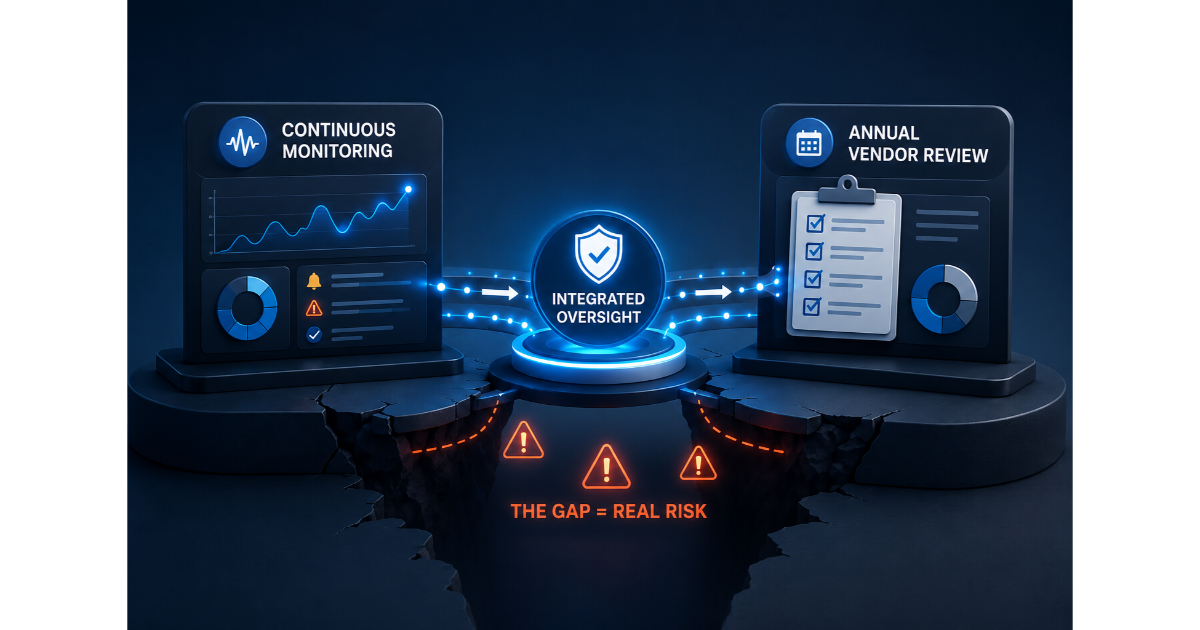
Most third-party risk tools can provide useful oversight into fourth parties, but only if the platform actually enriches vendor records instead of storing what you uploaded. ComplyScore®'s Vendor Profile Intelligence Engine auto-enriches vendor records using open-source data, subscription feeds, and public registries, surfacing subcontractor and ownership relationships a vendor didn't disclose on a questionnaire. Continuous Risk Monitoring then tracks integrated third-party data feeds for breach signals and posture changes, generating an alert when something shifts, so subcontractor issues surface as they happen instead of at next year's reassessment.
Operational risk management system helps you extend this prioritization beyond direct vendors, giving you visibility into the operational risks your critical suppliers are carrying through their own supply chains.
Integrating fourth-party risk management into your organization’s security framework strengthens its overall risk posture. You can proactively address vulnerabilities in your extended supply chain.
Here’s a step-by-step guide to integrate FPRM into your risk management framework:
The first step is to figure out which fourth parties are critical to your operations so you can include them in your framework. Some fourth parties pose very little risk and aren’t worth focusing on. Focus on your vendor’s critical third parties as these are your critical fourth parties. The SSAE 18 report requires third-party vendors to identify subcontractors, making this step a little easier.
Ask your third parties all the important questions regarding critical fourth parties. Find out their disaster recovery plans, cybersecurity posture, SOC reports, and even finances. The goal is to ensure the fourth parties follow the same standards as your third parties.
During onboarding and annual reviews, ask vendors to disclose their critical third parties, like those that support essential services, process your data, or operate in regulated environments. Add fourth-party identification fields to risk questionnaires or vendor due diligence forms.
Add fourth-party governance clauses in your vendor contract to make risk management much more effective. The contract can cover how the third-party vendor should manage their subcontractors and give your company the right to audit the third party and their subcontractors. An update contract makes your vendor accountable for the risks introduced by their own partners.
Update your current third-party risk assessment to include fourth parties. Don’t just assess vendors’ risk profiles; assess the risks introduced by their service providers. High-risk or business-critical fourth parties require more frequent assessments and real-time monitoring, while those with lower risk can be evaluated less often.
Add high-risk fourth-party vendors into your GRC platform or risk register to centralize risk information and avoid managing fourth-party risks in isolation. Connect each fourth party to the relevant third-party vendor to ensure cascading risks are clearly visualized and tracked. Use a cybersecurity rating platform like ComplyScore® for continuous monitoring and set up automated alerts for vulnerabilities or public breaches affecting specific subcontractors.
What happens when a fourth-party vendor is involved in a breach? Will your vendor continue to deliver services as normal? Discuss with vendors to find out how issues involving their suppliers may impact your operations and how they will respond. Your third parties should be contractually obligated to report incidents involving their subcontractors immediately. Ensure your response plans include fourth-party-related scenarios to improve coordination during real events.
Verifying that all fourth parties comply with regulations and meet your security standards can be resource-intensive and time-consuming. Here are the common challenges in managing fourth-party risks.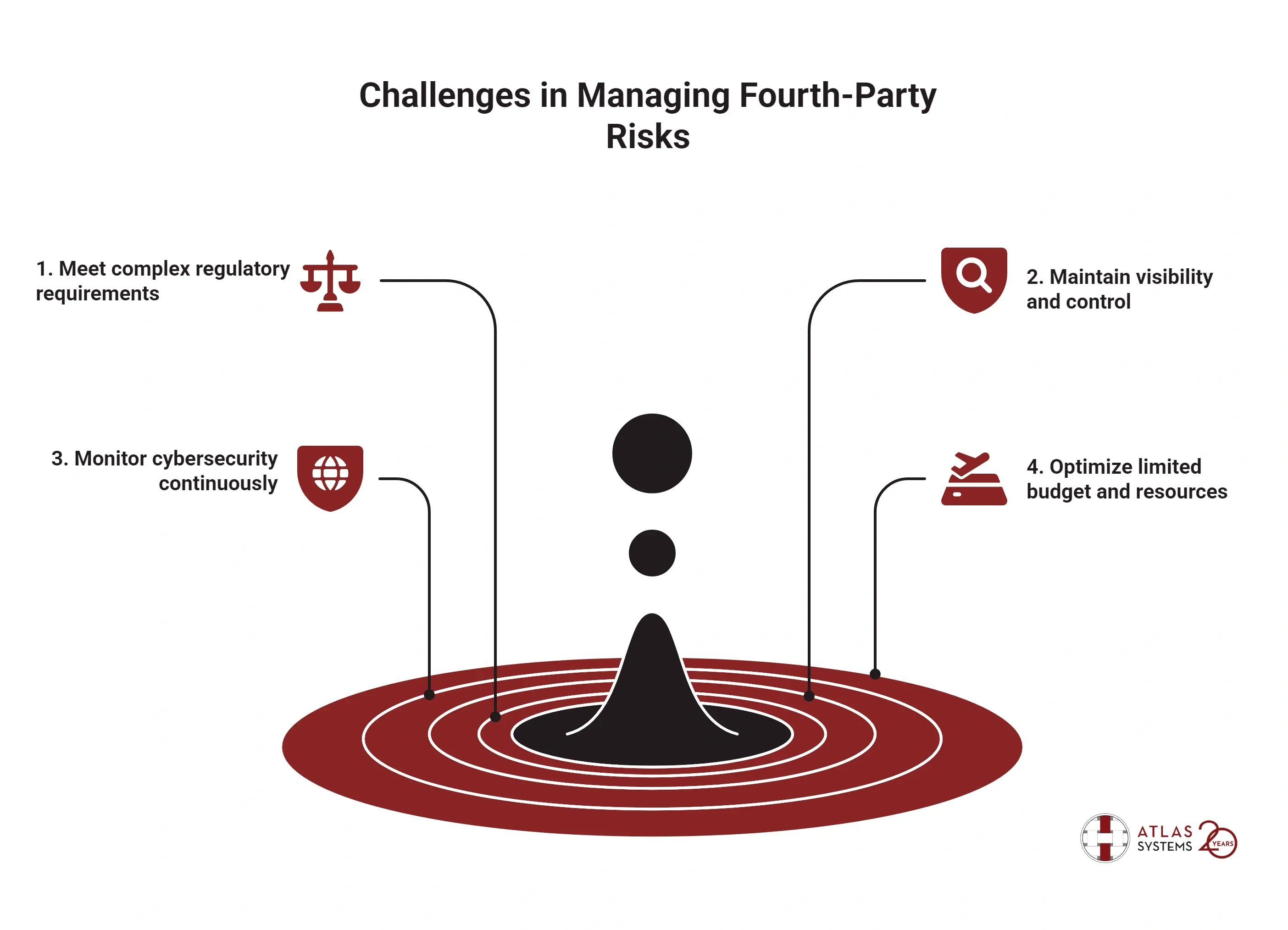
Stringent regulations pose a big challenge in fourth-party risk management. Regulations like DORA mandate resilience for financial services, while GDPR strictly governs data privacy for your entire supply chain. If your fourth parties are scattered worldwide, you’ll need to verify compliance in different jurisdictions. Complying with regulations in different regions can be resource-intensive and stressful.
Fourth parties aren’t directly associated with your organization (no contractual agreements) and are way down the supply chain. This means you can’t ask to review their risk policies or include risk management requirements in a contract. You must rely on third parties to mitigate fourth-party risk. And because third parties have different risk management procedures, you may lack access to accurate, timely information, so vulnerabilities may go undiscovered, leading to non-compliance.
Most organizations lack access to fourth parties and can’t continuously monitor their cybersecurity practices or check their security protocols. They must rely on third parties, which creates serious blind spots. Cybersecurity threats are always changing, so you must be certain that fourth parties are meeting your standards of real-time vigilance.
Small businesses and startups often find it difficult to manage fourth party risks due to limited staff and resources. It stretches their already thin resources. They can’t afford a dedicated governance, risk, and compliance system and use manual processes, which aren’t effective for deeper supply chain monitoring.
TPRM as a service offers a practical path here, giving smaller teams access to certified analysts and a purpose-built platform without the cost of building an in-house program from scratch.
Beneath the polished facade your vendors portray are the relationships they rely on but don’t advertise. You must look past the great sales pitch and contract terms of third parties and assess the service providers they quietly lean on. Fourth parties can introduce cybersecurity, compliance, operational, and reputational risks you may never see coming until it’s too late.
ComplyScore® by Atlas Systems specializes in third-party and fourth-party risk management. Our platform not only manages risks associated with direct vendors but also offers broad coverage for fourth-party risks. With ComplyScore®, you’ll gain better visibility into your extended supply chain and promptly address fourth-party risks.
Mitigate fourth-party risks before they become threats —Explore ComplyScore® today.
Yes, regulatory expectations are increasing, especially in heavily regulated sectors like finance, healthcare, and technology. Most regulators require third-party risk management frameworks to cover fourth-party oversight.
Frequent assessments are necessary to ensure safety and compliance. Perform assessments on fourth parties quarterly or after major incidents or whenever there are changes in business operations.
Yes, regulatory guidelines exist, but most don’t use the term “fourth-party.” The guidelines are embedded within larger third-party risk management frameworks. Examples from major regulators include U.S. Federal Banking Regulators (OCC, FRB, FDIC – Interagency Guidance, 2023) and NIST (SP 800-161 and SP 800-53).
Small businesses can do this by focusing on critical vendors, using contracts to extend oversight, and automating vendor management processes. They will have a holistic understanding of their vendor's ecosystem.
Ask if they have documented risk assessment processes for their subcontractors, how they manage and mitigate potential risks, and their data access and processing practices. Also, find out their remediation plans for identified issues.
Fourth-party concentration risk happens when several of your third-party vendors rely on the same fourth party, often a shared cloud provider or payment processor. If that shared fourth party fails, every third party depending on it goes down at once, multiplying your exposure instead of isolating it.
%20(1).jpg)