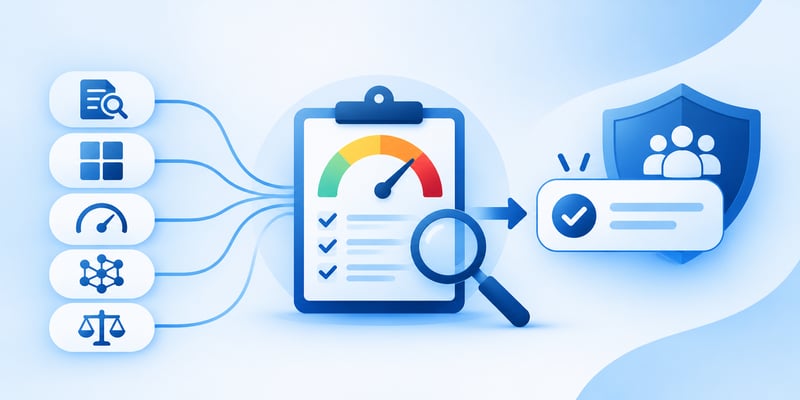
When risk teams evaluate a vendor risk platform, one question comes up in almost every demo: how exactly does it decide that a vendor is high, medium, or low risk? The question is sharper than it sounds, because every organization calculates risk differently, and a score nobody can explain will not survive the first challenge from a CISO or an auditor.
Your risk assessment methodology is the answer to that question. It decides how a questionnaire response, a SOC 2 report, and a credit downgrade combine into one rating, and it determines whether two analysts looking at the same vendor reach the same conclusion.
What Is a Risk Assessment Methodology?
A risk assessment methodology is the method you use to measure risk, typically by rating the likelihood and impact of an adverse event using descriptive ratings, numeric scores, or financial estimates. For vendor risk, it also defines how evidence, controls, and external signals change that rating over time.
Methodology choices sit underneath your framework. A framework tells you which risks to manage, while a methodology decides how big each one is, so the two need separate decisions.
Qualitative, Semi-Quantitative, or Quantitative: Which Fits Vendor Risk?
Three broad approaches cover nearly every methodology in use, and each one earns its place at a different point in the vendor lifecycle.
|
Approach
|
What it produces
|
Where it fits in vendor risk
|
Effort to run
|
|
Qualitative
|
Descriptive ratings such as high, medium, or low
|
Intake triage and low-tier vendors
|
Low
|
|
Semi-quantitative
|
Numeric scores from weighted ratings, such as likelihood multiplied by impact
|
Most vendor assessments and portfolio reporting
|
Moderate
|
|
Quantitative
|
Financial estimates of expected loss
|
Board decisions on your highest-exposure vendors
|
High
|
Semi-quantitative scoring does most of the work in vendor programs because it scales across thousands of vendors while still ranking them. Quantitative analysis, such as the Open FAIR standards for risk taxonomy and analysis, earns its cost on the handful of vendors where you need to express exposure in currency. Use qualitative ratings to sort, semi-quantitative scores to manage, and financial estimates to decide.
Which Dimensions Should Your Vendor Risk Score Measure?
Likelihood and impact form the default pair, yet vendor risk often needs a third dimension. Here is how each one works for third parties.
Likelihood
Likelihood estimates how probable an adverse event is, based on the vendor’s controls, history, and exposure. For vendors, it draws mostly on assessment evidence and external signals such as security ratings, breach history, and financial health.
Impact
Impact measures the damage if the event happens, which depends on your engagement more than on the vendor itself. The same vendor carries low impact on a marketing contract and severe impact when it processes your customer records.
Velocity
Velocity measures how quickly an event’s impact reaches you once it occurs. Some risk teams now ask to add it to their scoring formula, and for good reason: a sanctions designation can halt payments to a vendor the same day, while gradual financial decline gives you quarters to respond.
Two vendors with identical likelihood and impact scores can need very different response plans once you add velocity.
How Much Should Each Piece of Evidence Count?
A vendor’s answer to a questionnaire and an independent auditor’s finding on the same control should not carry the same weight. Build an evidence hierarchy into your methodology so confidence in the data shapes the score.
|
Evidence type
|
Example
|
Confidence
|
Refresh rule
|
|
Self-attestation
|
Questionnaire answer with no attachment
|
Lowest
|
Recheck at each assessment
|
|
Documented evidence
|
Policy, certificate, or penetration test summary
|
Moderate
|
Recheck when the document expires
|
|
Independent assurance
|
SOC 2 Type II report or ISO/IEC 27001 certificate
|
Higher
|
Recheck when the report period ends
|
|
Observed signal
|
Security rating change, breach disclosure, or credit downgrade
|
Varies by source
|
Continuous
|
Score each control as fully satisfied, partially satisfied, or not satisfied based on the strongest evidence available. Then decide in advance what happens to an attested answer that never gets backed by evidence, because leaving that rule undefined is how optimistic answers turn into low risk scores.
How Does a Vendor Move From Inherent to Residual Risk?
A vendor’s risk score should change in three stages as you learn more, with each stage answering a different question.
- Inherent risk at intake: A weighted questionnaire completed by the business owner rates likelihood and impact before any evidence arrives, and the result decides the tier and how deep the assessment goes.
- Residual risk after assessment: Control evidence, remediation, and formally accepted risks reduce or confirm the inherent score, a distinction this guide to inherent risk vs residual risk explains in detail.
- Current risk between assessments: Normalized external signals adjust the residual score so it reflects today’s conditions instead of last year’s assessment.
Accepted risks need an owner and a review date, otherwise residual scores quietly carry exceptions nobody remembers approving. The inherent score also feeds your vendor risk tiering model, which keeps assessment depth tied to the same methodology.
How Do You Make Vendor Risk Scores Explainable?
An explainable score shows its work. Senior security leaders increasingly expect a justification for every rating in a closeout report, so build these habits into the methodology from the start.
- Publish the formula internally, including weights for each question and answer option, so business owners know how their inputs move the score
- Name the key risk drivers behind every rating, such as an unremediated access control finding or a recent credit downgrade
- Trace every external data point to its source, so a reviewer can confirm where an adverse media hit or financial figure came from
- Test calibration twice a year by re-scoring a sample of vendors with a second analyst and checking whether vendors that had incidents scored high beforehand
If two analysts cannot reach the same rating from the same evidence, the methodology needs tightening before the portfolio grows.
How ComplyScore® Scores Vendor Risk
ComplyScore® applies your methodology instead of imposing its own, which matters when your risk committee has already defined how risk is calculated.
- Configurable risk formulas support likelihood and impact, plus additional dimensions such as velocity, with weights for every question and answer option and your own definitions of high, medium, and low
- Inherent risk reports generate a score with a heat map and the key drivers behind it, then recommend next steps such as enhanced due diligence or a SOC 2 Type II request
- AI-assisted evidence review maps uploaded documents to controls and classifies each one as fully, partially, or not satisfied, with analysts validating the result
- Severity normalization translates scores from different intelligence providers into one consistent scale using your thresholds, so a security rating drop and a credit downgrade are prioritized on the same basis
- Closeout reports compare inherent and residual risk, with category-level ratings, findings, and remediation status in one explainable view
Where Should You Start?
Pull five recent vendor ratings and ask a second analyst to re-score them from the same evidence without seeing the original results. Where the ratings differ, you have found the parts of your methodology that depend on individual judgment instead of written rules.
To see your own scoring formula configured on real vendor data, book a 30-minute demo.