
.png?width=200&height=45&name=ComplyScore%20Logo%20Transparent%20(1).png)


.webp?width=869&height=597&name=image%20(5).webp)


-1.png?width=486&height=315&name=IDC%20Banner%20(1)-1.png)



.png?width=300&height=175&name=Rectangle%2034624433%20(2).png)


.webp?width=1280&height=720&name=Medtech%20Breakthrough%20Award%20Winner%20(1).webp)









Third-Party Risk Management
ComplyScore® Launches World’s First Headless TPRM, Bringing Conversational AI to Compliance Management. 
ComplyScore® Launches World’s First Headless TPRM, Bringing Conversational AI to Compliance Management.


Optimize and secure provider data

Streamline provider-payer interactions

Verify real-time provider data

Verify provider data, ensure compliance

Create accurate, printable directories
Reduce patient wait times efficiently.
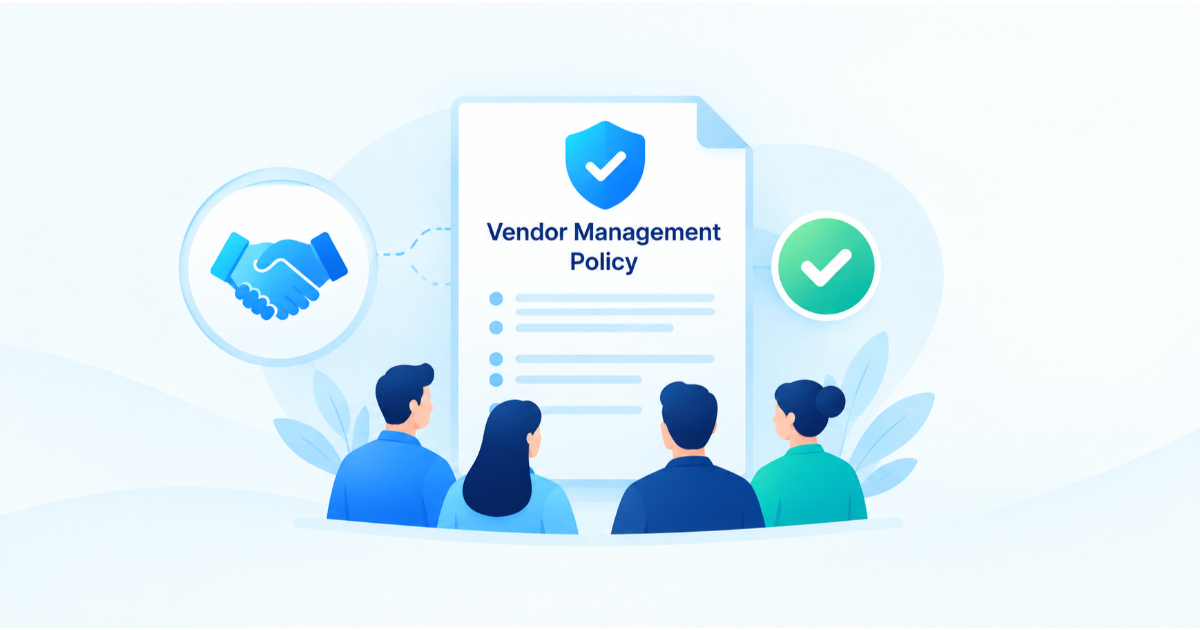
Most vendor management policies get written once, approved, filed in a shared drive, and never opened again until an auditor asks for it. That's not a documentation problem. It's a sign the policy wasn't built around how vendor decisions actually get made day to day, so nobody thinks to check it when a real decision comes up.
A policy that gets used does two things a generic template usually doesn't: it names who decides what, and it gives people a reason to open it before a vendor problem happens, not just after.
Seven areas show up in nearly every workable policy. What separates a policy people reference from one they ignore is usually the specificity inside each section, not whether the section exists.
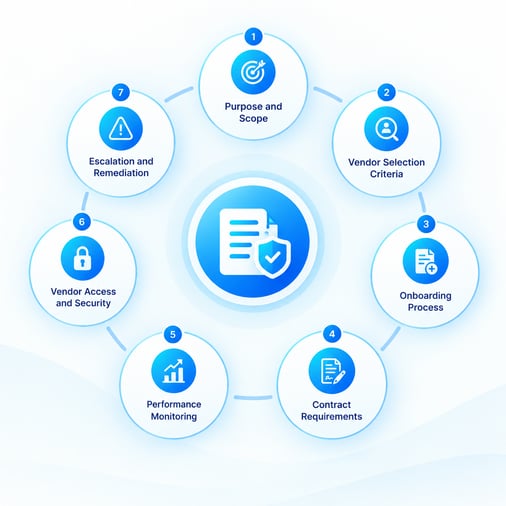
Name who this applies to. "All vendors" sounds complete but usually means procurement assumes it covers contractors too, while legal assumes it doesn't. Spell out whether contractors, consultants, and free-trial software accounts fall under the same policy or a separate one.
This is where policies tend to stay vague ("select reputable vendors with strong security practices") in a way that gives whoever's onboarding a vendor nothing concrete to check. Say a mid-sized company's engineering team signs up for a new analytics tool on a free trial, then upgrades to paid without anyone from security ever seeing it, since the policy never defined a threshold for when procurement review kicks in. Naming a concrete trigger, any vendor touching customer data or billed over a set dollar amount needs review, closes that gap.
This section works best as a sequence with named owners at each step, not a paragraph of intentions. Security reviews access requests, legal reviews contract terms, procurement confirms budget, and the policy should say what order that happens in and who can't proceed without the prior step signing off.
The terms that get missed most often: audit rights, data handling and breach notification timelines, and a termination clause that doesn't leave you locked in past the point you want out. If your legal team has a standard rider for these, the policy should say so explicitly rather than leaving it to whoever's negotiating that week.
State a cadence and an owner. "Vendors will be monitored regularly" gets interpreted differently by everyone who reads it. Quarterly reviews for critical vendors, annual for everyone else, owned by the risk team, is something people can actually follow.
Cover both the initial access grant and the review cycle after. Access that made sense at onboarding often outlives its purpose. A policy that only addresses granting access, not revisiting it, tends to accumulate vendors with more system access than their current relationship justifies.
Name the concrete triggers: a missed SLA, a lapsed certification, a security incident. And say what happens next; who gets notified, what the timeline is, at what point a vendor relationship gets reconsidered entirely.
Once a year at minimum, and sooner if your vendor volume changes significantly or a gap surfaces during an actual incident. A policy written for fifty vendors often stops fitting once you're managing five hundred, since manual review steps that worked at a small scale become the bottleneck that gets skipped under pressure.
Keep every step of your vendor risk policy running as you scale, and see how ComplyScore® cuts manual review effort by 70–80%. Book a Demo

%20(1).jpg)