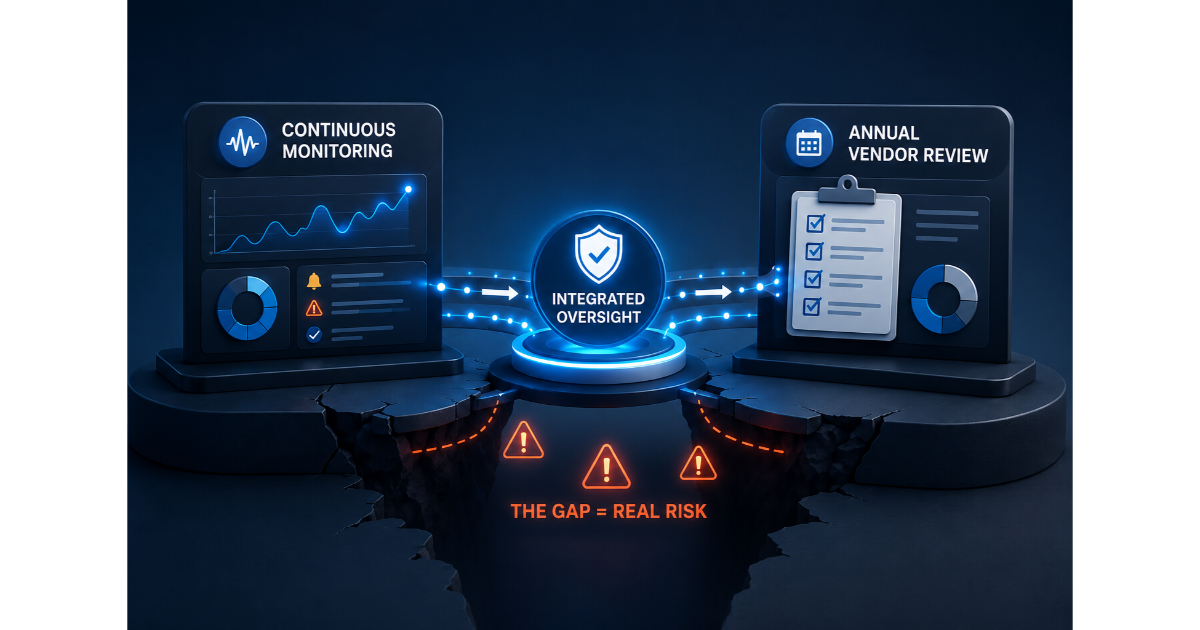
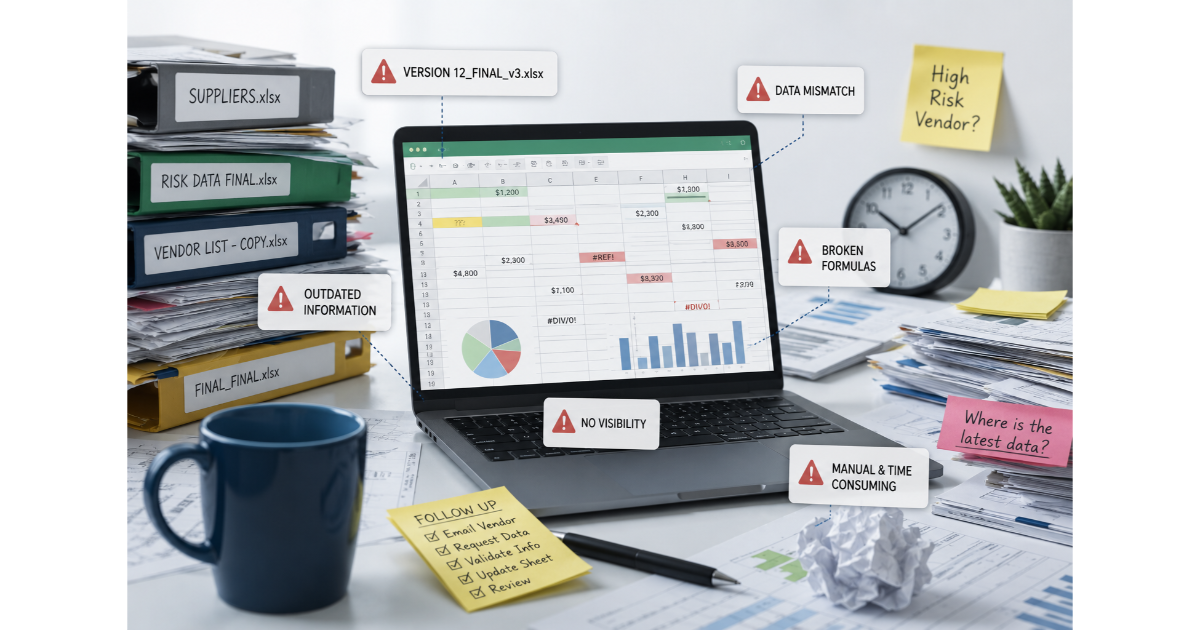
Most vendor onboarding workflows technically define all the steps: intake, review, approval, contract, monitoring. But when a vendor onboarding stalls, the reason usually isn’t a missing step. It’s the handoff between two teams, where the work sat in someone's queue with no owner checking it and no deadline forcing a decision.
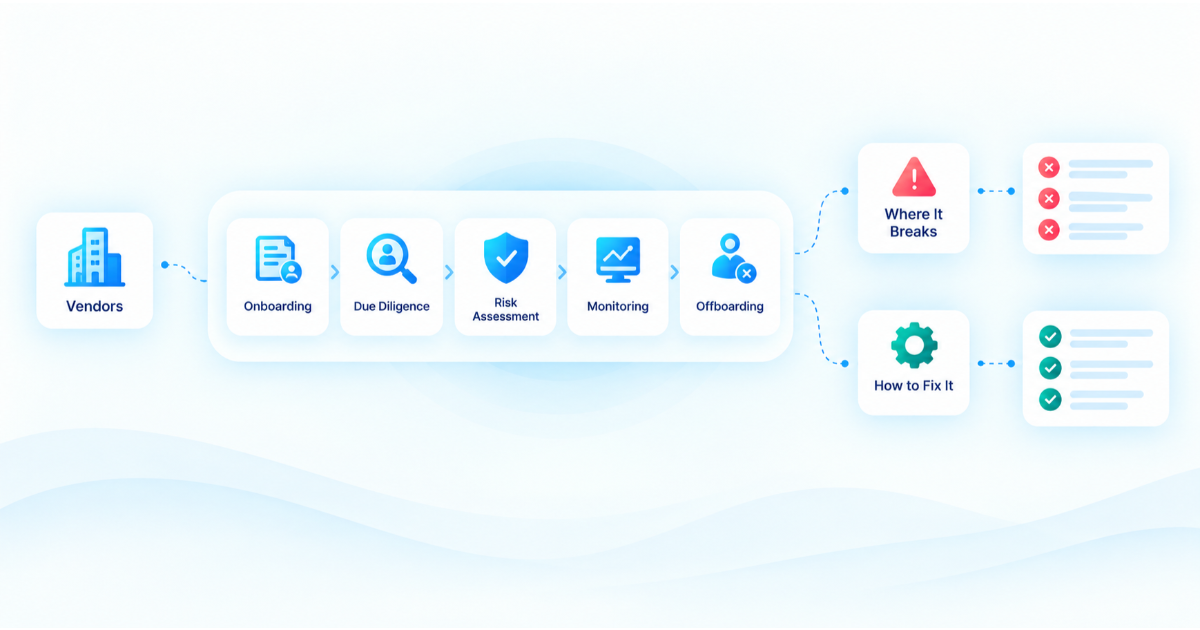
This isn't about redrawing the vendor lifecycle. If you want the full stage-by-stage process, from selection through offboarding, that's already covered in depth here. This is about the narrower, more common failure point, the moments between stages where responsibility isn't clear, and what actually fixes it once you've found it.
What does a workflow handoff actually look like?
A handoff is the exact point where work moves from one person or team to another. Procurement finishes vetting a vendor and passes the file to security. Security signs off and passes it to legal for contract review. Each of those passes is a place where the work can either move forward immediately or sit untouched, depending on whether anyone's specifically responsible for picking it up.
Where workflows most often stall
A new vendor request comes in, often through an email or a form, and needs to land in front of the right reviewer. Picture this scenario: a manufacturing procurement team submits a new supplier's paperwork to a shared security inbox with no assigned reviewer and no SLA. Nobody checks that inbox daily. The vendor's onboarding stalls for three weeks before anyone notices nothing happened.
Once a vendor clears the initial review, someone has to actually approve moving forward, and that person isn't always the same one who did the review. If approval requires a signature from someone in a different department who wasn't looped in early, the request can sit waiting for a meeting that hasn't been scheduled yet.
An approved vendor still needs a signed contract with the right terms in it. If legal wasn't involved during vetting, they're now reviewing a relationship they know nothing about, which slows the contract stage down considerably compared to when legal had visibility from the start.
This is the handoff that gets missed most often. A signed contract doesn't automatically trigger ongoing monitoring, certification tracking, or access reviews unless someone explicitly owns transferring that vendor from "onboarding" to "active and monitored." Picture a vendor that gets fully onboarded and contracted, then never enters the monitoring system because nobody's job description includes making that transfer happen.
Who should own each handoff
|
Handoff
|
Typical owner
|
What "done" looks like
|
|
Intake to review
|
Whoever manages the intake queue
|
Reviewer assigned within a set number of days
|
|
Review to approval
|
The reviewer
|
Approval request sent to a named decision-maker
|
|
Approval to contract
|
Procurement or legal
|
Contract drafted with terms matching the reviewed risk level
|
|
Contract to monitoring
|
Risk or compliance team
|
Vendor added to active monitoring, not just marked "onboarded"
|
The specific names matter less than the fact that every row has one. A workflow where three of four handoffs default to "whoever notices" is a workflow that will stall somewhere eventually.
Fixing each handoff
Naming an owner is the starting point, not the fix on its own. Each handoff needs a mechanism that makes the handoff visible, not just a name attached to it after the fact.
Intake to review. Route new requests to a specific person or rotating queue, not a shared inbox, and attach a deadline, say two business days, for a reviewer to claim it. A request that's still unclaimed after that window should escalate automatically rather than wait for someone to remember to check.
Review to approval. Loop the approver in before the review finishes, not after. If security's review is going to need a specific department's sign-off, naming that approver at the start of the review, not once it's already done, removes the gap where a request waits for a meeting nobody scheduled.
Approval to contract. Bring legal in during vetting for anything above a low-risk tier, not after approval. A contract reviewer who already has context on the vendor moves faster than one starting from zero, and this single change removes most of the delay at this handoff.
Contract to monitoring. Make the transfer to monitoring a required step in closing out the contract stage, not a separate task someone remembers to do later. If your system marks a vendor "onboarded" without a corresponding step that adds them to active monitoring, that's the exact gap where vendors quietly fall out of view.
Building a workflow map you can actually use
Most teams don't need workflow software to start fixing this. A simple map, even a shared document listing each handoff, its owner, and its deadline, closes most of the gap before any tooling gets involved. The value is in forcing the conversation about who owns what, and by when, before a vendor request is sitting unclaimed.
Where automation actually helps
Automation only helps once ownership is already clear and the bottleneck is volume, not confusion. Automating a handoff that has no defined owner just moves the same unclaimed work through a system faster. It doesn't fix the actual gap, it just hides it behind a status update nobody's watching either.
Where automation earns its place, once ownership is defined:
- Routing rules that assign a new request to the right reviewer automatically based on vendor type or risk category, instead of landing in a shared inbox
- SLA timers that track how long a request has sat at each handoff and flag it before it becomes a three-week stall
- Escalation triggers that notify a manager automatically once a handoff passes its deadline, rather than waiting for someone downstream to ask where things stand
- Status visibility across teams, so procurement, security, and legal are looking at the same live status instead of each team's own spreadsheet
The distinction that matters: automation should make a stalled handoff impossible to miss, not just impossible to see.
How ComplyScore® Automates Vendor Workflow Without Hiding the Gaps
Most workflow tools automate the parts that were already working and leave the actual failure points, the unowned handoffs, exactly as invisible as they were on a spreadsheet. A status field that says "In Review" for three weeks straight isn't automation solving the problem. It's automation quietly recording that the problem happened.
ComplyScore® routes each handoff to a named owner automatically based on vendor type and risk tier, tracks how long a request has sat at each stage, and escalates to a manager the moment a deadline passes rather than waiting for someone to notice. The contract-to-monitoring handoff, the one that gets missed most often, happens as a required step in closing out onboarding, so a vendor can't get marked complete without also getting added to active monitoring.
The result isn't a faster version of the same blind spots. It's a workflow where a stalled handoff shows up on someone's dashboard the same day it stalls, not three weeks later when someone finally asks.
If handoffs are where your vendor process is actually losing time, book a demo to see how ComplyScore® handles routing, SLAs, and escalation without adding a second system to maintain.



.png?width=200&height=45&name=ComplyScore%20Logo%20Transparent%20(1).png)


.webp?width=869&height=597&name=image%20(5).webp)


-1.png?width=486&height=315&name=IDC%20Banner%20(1)-1.png)



.png?width=300&height=175&name=Rectangle%2034624433%20(2).png)


.webp?width=1280&height=720&name=Medtech%20Breakthrough%20Award%20Winner%20(1).webp)














%20(1).jpg)