Vendor risk management covers the third parties you pay directly for a product or service. Third-party risk management extends the same oversight to every outside relationship that touches your business, paid or not, including contractors, agencies, and data-sharing partners who never sign a formal vendor contract.
What is TPRM, and how does it differ from VRM?
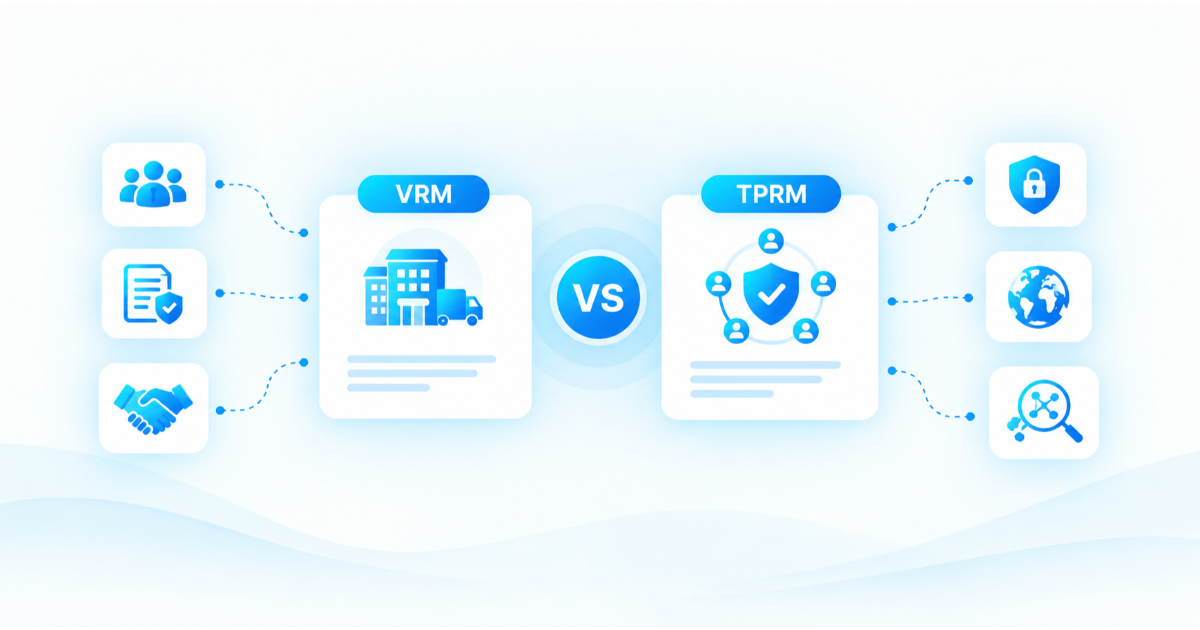
Vendor risk management is a focused practice built around vendors specifically, the companies you contract with for goods or services. Third-party risk management is the wider discipline. It covers vendors too, but also consultants, staffing agencies, marketing partners, and any other external party with access to your systems, data, or operations, whether or not money changes hands directly.
Where the two overlap
| |
VRM
|
TPRM
|
|
Scope
|
Direct, contracted vendors
|
Every external relationship
|
|
Typical owner
|
Procurement, IT security
|
Cross-functional: security, legal, operations
|
|
Assessment focus
|
Contract terms, SLAs, security posture
|
Broader risk categories, including relationships with no formal contract
|
|
Good starting point for
|
Smaller programs, a first risk initiative
|
Regulated industries, complex external ecosystems
|
Most of the actual assessment work, security questionnaires, financial checks, monitoring, looks similar in both. The real difference is which relationships get pulled into scope in the first place.
A scenario where VRM alone falls short
Here's a walkthrough of how this tends to play out, not an account of any specific organization:
A mid-sized healthcare system runs a solid VRM program covering its EHR vendor and its billing platform, both fully assessed and monitored.
A marketing agency the system works with runs through a one-page services agreement rather than a formal vendor contract, so it never gets pulled into the VRM process.
The agency pushes a tracking script to the system's website that mishandles patient data.
VRM never had visibility into that relationship, because it was never scoped as a vendor. A TPRM program would have caught it, since TPRM asks about every external party with access, not only the ones holding a full vendor contract.
Should you run VRM and TPRM as one program or two?
Most organizations start with VRM, since vendors typically represent the largest share of third-party exposure and the practices are more straightforward to stand up. From there, many widen into full TPRM as the program matures, rather than building both from scratch at once. The two aren't competing approaches. VRM is usually the foundation TPRM gets built on top of, not a separate track that needs replacing.
How ComplyScore® Runs VRM and TPRM on One Platform
Widening from VRM to full TPRM usually stalls for a practical reason. The vendor risk program already has a year or more of assessment history, scoring, and monitoring data built up. Extending oversight to contractors, agencies, and other non-vendor third parties often means either bolting on a second tool that doesn't talk to the first, or starting that data over from scratch in a new system built for the wider scope.
ComplyScore® avoids that split. Vendor-specific workflows and broader third-party assessments run on the same platform, using the same scoring model and system of record, so a contractor or agency added under TPRM scope gets assessed and monitored the same way a vendor already does. Nothing about the vendor program's existing history gets orphaned in the process.
That makes the shift from vendor-only oversight to full TPRM a process change, deciding which relationships now fall in scope, not a re-platforming project.
If you're running VRM today and thinking about wider TPRM coverage, book a demo to see what extending scope actually looks like on one platform instead of two.



.png?width=200&height=45&name=ComplyScore%20Logo%20Transparent%20(1).png)


.webp?width=869&height=597&name=image%20(5).webp)


-1.png?width=486&height=315&name=IDC%20Banner%20(1)-1.png)



.png?width=300&height=175&name=Rectangle%2034624433%20(2).png)


.webp?width=1280&height=720&name=Medtech%20Breakthrough%20Award%20Winner%20(1).webp)














%20(1).jpg)