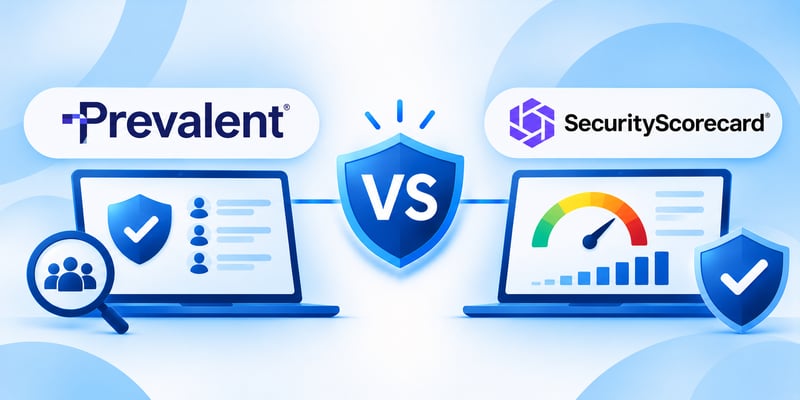
A security rating flags a vendor with exposed systems. Someone still has to send the questionnaire, review the evidence, and chase the fix. SecurityScorecard and Prevalent split that work differently, and the wrong pick leaves your analysts doing the missing half by hand.
SecurityScorecard begins with outside-in ratings, and Prevalent begins with assessment workflow. ComplyScore® by Atlas Systems gives you a third route: keep the rating you already trust and run the full vendor process around it, from first look to offboarding.
Prevalent vs SecurityScorecard: Which One Should You Choose?
SecurityScorecard suits teams that want ratings from its own data and AI-driven monitoring. Prevalent suits teams that want assessment workflow, a deep template library, and sanctions monitoring. Teams that want a single due diligence report covering financial, legal, sanctions, and cyber risk should add ComplyScore®.
Your priority decides the answer:
|
Your priority
|
Best fit
|
Why
|
|
A cyber rating for every vendor and your own organization
|
SecurityScorecard
|
A to F ratings are its core product, backed by its own data collection
|
|
AI-assisted continuous monitoring of the supply chain
|
SecurityScorecard
|
TITAN AI, launched in March 2026, automates monitoring and remediation
|
|
Questionnaire workflow with a deep template library
|
Prevalent
|
800+ assessment templates, scheduling, reminders, and evidence review
|
|
Sanctions and adverse media monitoring
|
Prevalent
|
Tracks 30,000+ adverse media and sanctions sources
|
|
Vendor evidence mapped to DORA, NIS2, DPDP, or MAS TRM
|
ComplyScore®
|
30+ framework mappings turn vendor findings into audit-ready evidence
|
|
A team to run assessments for you
|
ComplyScore®
|
A managed services option, with certified assessors, covers the workload
|
What Does SecurityScorecard Do Best?
SecurityScorecard built its business on security ratings and says it owns 99 percent of the data behind them, which it argues avoids the point-in-time snapshots that come with purchased data. A marketplace listing describes an A to F rating system and says the company continuously rates more than 12 million organizations. Questionnaire responses can be validated automatically against its ratings data.
In March 2026 the company launched TITAN AI, which it describes as an AI-powered platform for continuous, threat-informed third-party risk management. Its product sheet lists a vendor system of record, pre-built questionnaire templates, rules and alerting, and a managed monitoring service called MAX Monitor. Its center of gravity stays on cyber, so financial, legal, and sanctions checks need other tools.
What Does Prevalent Do Best?
Prevalent became part of Mitratech in October 2024, and its product page describes an AI-powered platform that covers onboarding through offboarding. Onboarding includes vendor profiling, inherent risk tiering, and diligence routing by tier. Offboarding adds automated exit procedures and contract close-out workflows.
How Do Prevalent and SecurityScorecard Compare Feature by Feature?
|
Category
|
Prevalent
|
SecurityScorecard
|
|
Core focus
|
Third-party risk workflow across the vendor lifecycle
|
Cyber risk ratings with TPRM workflow on top
|
|
Security ratings
|
Not described as a core product
|
A to F ratings; says it owns 99% of its data
|
|
Questionnaires
|
800+ templates; FastTrack auto-populate from prior responses
|
Pre-built templates; responses validated against ratings data
|
|
Non-cyber monitoring
|
Adverse media, sanctions, PEP, enforcement lists, ESG signals
|
Not described on its product sheet
|
|
Onboarding and offboarding
|
Profiling, tiering, exit procedures, contract close-out
|
Vendor system of record with rules and alerting
|
|
AI features
|
ARIES: document intelligence, assessment auto-populate, false-positive detection
|
TITAN AI for continuous monitoring; ChatSSC assistant
|
|
Managed service
|
Not described
|
MAX Monitor managed monitoring
|
How Much Do Prevalent and SecurityScorecard Cost?
Neither vendor publishes a price, and G2 lists no entry-level pricing for either product. Expect quotes that scale with vendor count, assessment volume, and the modules you license.
SecurityScorecard lists a premium managed monitoring service, MAX Monitor, and Prevalent bundles workflow, content, and monitoring. Ask each vendor which items sit in the base quote and which cost extra.
Pro tip: Ask both vendors to quote the same scope: vendor count, assessments per year, monitoring feeds, integrations, and implementation. Compare the Year 1 all-in figure, because a ratings feed priced separately from workflow adds to the real cost.
Where Does ComplyScore® Fit Between Prevalent and SecurityScorecard?
SecurityScorecard tells you who looks exposed, and Prevalent runs the assessment process. ComplyScore® by Atlas Systems starts earlier. It builds a vendor view from a name and country, so your team sees risk before a questionnaire goes out.
When you want assessments without waiting on vendors
Zero-touch assessments start from a vendor name and country. The platform pulls public and licensed data, scores the vendor, and gives you a first-pass assessment before a single email goes out. Your analysts spend their time on exceptions instead of reminders.
When you need a profile before you need a questionnaire
Profile intelligence builds a vendor profile from external data, so your team knows who the vendor is, where it operates, and what changed recently. That context sets the depth of each assessment, which saves effort on low-risk vendors.
When you already pay for SecurityScorecard
ComplyScore® ingests SecurityScorecard ratings, along with feeds such as RiskRecon, so your existing subscription feeds the same vendor record your assessments use. A rating change sits beside financial, legal, and sanctions signals, and each alert routes to an owner as a task. Keep the rating your security team trusts, and add the workflow around it.
When one report should cover every risk domain
One due diligence report combines financial, sanctions, legal, adverse media, and cyber signals, so you review a vendor once across every domain. ComplyScore® vendor risk management then runs the lifecycle from onboarding to offboarding on one policy engine and one audit trail.
How Do Prevalent, SecurityScorecard, and ComplyScore® Compare Side by Side?
|
Dimension
|
Prevalent
|
SecurityScorecard
|
ComplyScore®
|
|
Core focus
|
Third-party risk workflow
|
Cyber ratings with TPRM workflow
|
Full vendor lifecycle and continuous self-assessment
|
|
Assessment start
|
Questionnaire with FastTrack pre-fill
|
Template questionnaires validated by ratings
|
Zero-touch assessment from vendor name and country
|
|
Vendor profile
|
Profile built from automated feeds
|
Vendor system of record with ratings
|
Profile intelligence from external data
|
|
Due diligence
|
Sanctions, adverse media, PEP, and ESG monitoring
|
Cyber-led
|
Financial, sanctions, legal, adverse media, and cyber in one report
|
|
Security ratings
|
Not described as a core product
|
Core product
|
Ingests SecurityScorecard and RiskRecon feeds
|
|
Access model
|
Platform and API
|
Platform and API
|
Platform plus headless access through chat, Slack, and Teams
|
Prevalent vs SecurityScorecard: What Is the Final Verdict?
In the Prevalent vs SecurityScorecard decision, SecurityScorecard fits teams that need rating depth and AI-driven monitoring, and Prevalent fits teams that need assessment workflow and non-cyber monitoring. If you want assessments that start before vendors respond, with your existing ratings feeding the same record, ComplyScore® covers that job directly.
Pro tip: Run a 30-day proof on 25 real vendors. Track the hours per assessment, the share of vendors assessed without a manual follow-up, and the days from finding to closed remediation. If the numbers lag, fix vendor tiering before you blame the tool.
Before you decide, see how ComplyScore® ranks among SecurityScorecard alternatives, or book a 30-minute demo and see it on your own vendor list.