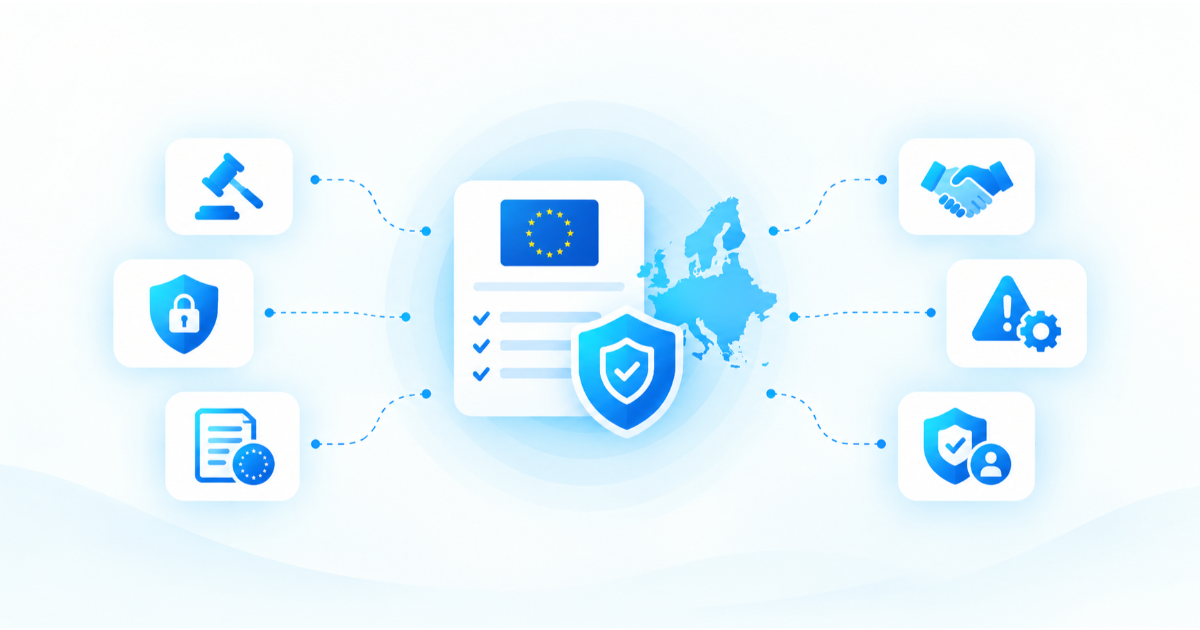
Three regulations most often decide how much vendor oversight a European operation needs: GDPR for data protection, DORA for financial sector resilience, and NIS2 for critical infrastructure and digital services. Which ones apply depends on your industry and where your vendors sit in your operations, not just where your company is headquartered.
Which EU regulations actually touch vendor risk?
- GDPR applies to any organization processing the personal data of EU residents, regardless of where that organization is based.
- DORA applies to financial entities operating in the EU and the ICT vendors that support them.
- NIS2 applies to a wide set of essential and important entities, covering their supply chains as well as their own operations.
All three extend obligations onto the vendors these organizations rely on, not just the organizations themselves.
What does GDPR require of your vendors?
Under Article 28, any vendor processing personal data on your behalf needs a formal data processing agreement in place. That agreement should cover how the vendor handles the data, whether they use their own sub-processors, and how quickly they notify you if something goes wrong.
Visibility into a vendor's sub-processors matters here too. A data breach three layers down your vendor chain is still your problem under GDPR.
What does DORA mean if you work with financial sector vendors?
DORA requires financial entities to maintain a register of their ICT third parties and to assess concentration risk, meaning how much of their critical operations depend on a small number of providers.
Contracts with critical ICT vendors need specific terms built in, including a workable exit strategy if the relationship ends.
What does NIS2 mean for vendors in critical infrastructure adjacent sectors?
NIS2 widens the scope of the earlier NIS directive considerably, covering more sectors and requiring supply chain security assessments as part of an organization's own risk management. It also sets tighter incident reporting timelines.
Vendors supporting an in-scope organization can find themselves pulled into those same reporting expectations by contract, even if NIS2 doesn't apply to them directly.
Do these rules apply if you're not based in Europe?
Often, yes. GDPR applies based on where the data subjects are, not where your company sits. A US company processing EU customer data through an EU vendor is in scope, even with no European office. DORA and NIS2 work similarly for financial and critical infrastructure vendors serving in-scope EU entities. Headquarters location isn't the test any of these three regulations use.
Building one program that holds up across regions
Running a separate compliance process for every region a vendor touches gets unworkable fast. The approach that tends to hold up is a shared core risk framework with region-specific requirements layered on top, rather than parallel programs for the US, EU, and everywhere else. Enterprise supplier risk management covers this governance model in more depth for organizations managing risk across multiple regions and business units.
ComplyScore®'s compliance framework library maps GDPR, DORA, and NIS2 requirements directly to vendor oversight controls, so the regional layer doesn't mean building a separate process from scratch.
Get a Demo Today



.png?width=200&height=45&name=ComplyScore%20Logo%20Transparent%20(1).png)


.webp?width=869&height=597&name=image%20(5).webp)


-1.png?width=486&height=315&name=IDC%20Banner%20(1)-1.png)



.png?width=300&height=175&name=Rectangle%2034624433%20(2).png)


.webp?width=1280&height=720&name=Medtech%20Breakthrough%20Award%20Winner%20(1).webp)














%20(1).jpg)