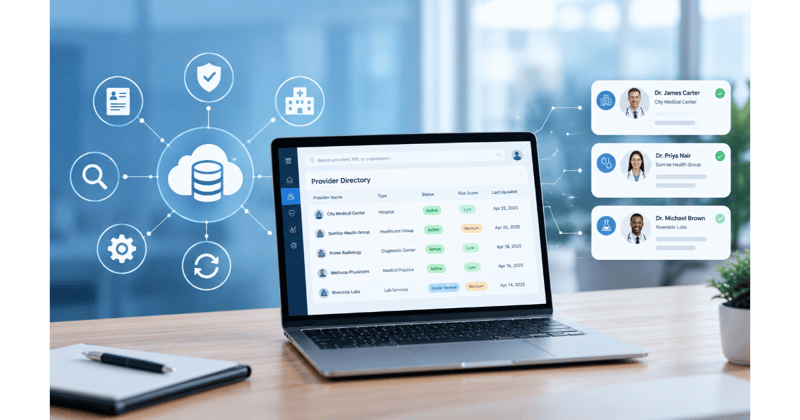
Search "best payer enrollment software" and you'll land on a pile of results for TriZetto Facets, HealthRules Payer, and Optum's claims platforms. Those tools run health plan operations: claims adjudication, member enrollment, benefits administration. If you're a provider organization trying to get your physicians in-network with insurance companies so they can bill for care, none of that applies to you.
The category you actually want sits on the other side of the transaction: software that submits provider applications to payers, tracks status through approval, and keeps rosters current once providers are in-network. That's a different set of vendors entirely, and most comparison content online doesn't separate the two.
This list covers the 9 platforms provider-side enrollment teams evaluate most: tools built for directors of provider enrollment, revenue cycle VPs, and credentialing ops leads managing delegated and non-delegated enrollment across dozens of payer-specific formats.
The evaluation criteria is based on:
- Delegated and non-delegated enrollment support
- Roster-level submission capability
- CAQH and PECOS integration
- Whether credentialing is bundled in
- Fit for your organization's size
Comparison at a Glance
|
Vendor
|
Delegated + Non-Delegated
|
Bulk/Roster Submission
|
CAQH/PECOS Integration
|
Credentialing Bundled
|
Reconciliation vs. Payer Rosters
|
Best-Fit Org Size
|
|
PRIME®
|
Yes
|
Yes
|
Yes
|
Yes (PDM)
|
Yes, automated
|
Mid-market to enterprise
|
|
Assured
|
Yes
|
Limited
|
Yes
|
Yes (CVO)
|
No
|
Growth-stage to enterprise
|
|
MedTrainer
|
Yes
|
Limited
|
Yes
|
Yes
|
No
|
Clinics, FQHCs, ambulatory
|
|
Modio Health
|
Yes
|
Provider-by-provider
|
Yes
|
Yes (light)
|
No
|
Small to mid-size
|
|
symplr Provider
|
Yes
|
Yes
|
Limited detail
|
Yes
|
No
|
Large health systems (300+ providers)
|
|
Verifiable
|
Yes
|
Limited
|
Yes
|
Yes (CVO, API)
|
No
|
Digital health with engineering resources
|
|
CredentialStream
|
Yes
|
Template-based
|
Yes
|
Yes
|
No
|
Large health systems on Epic
|
|
Medallion
|
Yes
|
Yes
|
Yes (partial sync)
|
Yes
|
No
|
Consolidating multiple point tools
|
|
Madaket Health
|
Yes
|
Yes
|
Yes
|
No
|
No
|
Large networks, enrollment volume
|
1. PRIME®
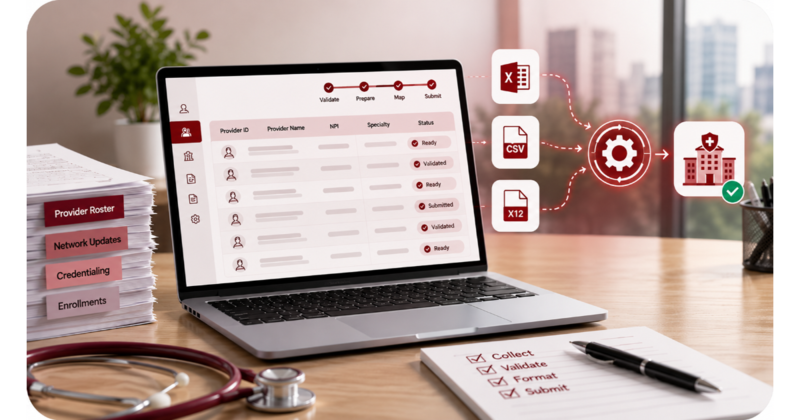
PRIME® by Atlas Systems automates payer enrollment as part of a connected data model rather than a standalone task. It generates payer-specific applications directly from your centralized provider data, tracks every submission through approval, and reconciles incoming payer rosters against your internal records to catch discrepancies automatically.
Why it might work for you: If your team is manually restarting the enrollment process every time a provider adds a facility, or reconciling payer rosters line by line in Excel, PRIME® connects those steps so they don't happen in isolation.
Key features:
- Auto-generates PDF applications from centralized provider data, with payer portal API integration where available
- Automated roster reconciliation against payer-submitted rosters, with configurable correction rules
- Handles both delegated (bulk roster) and non-delegated (individual application) enrollment workflows
- SOC 2 Type 2 and ISO certified, hosted on Microsoft Azure with US data centers
Pros:
- Enrollment and roster reconciliation run on the same data model, so a provider's status doesn't drift between tools
- Handles the multi-payer template variation (different formats even within the same payer brand) that manual processes struggle with
- Built for both delegated and non-delegated payer relationships in one system
2. Assured
Assured positions itself as an NCQA-certified CVO that runs enrollment submissions and verification work directly rather than handing you a self-serve dashboard.
Why it might work for you: If your team wants enrollment and credentialing verification handled end to end rather than managed in-house, Assured's model removes that operational load from your team.
Key features:
- Direct CAQH and PECOS integration for provider data sync
- NCQA-certified CVO handling verification alongside enrollment submission
- Runs as a managed service rather than a self-directed platform
Pros:
- Verification and submission handled by the same organization, reducing handoffs
- NCQA certification gives payers an established compliance signal
Cons:
- Managed-service model means less day-to-day visibility and control for teams that want to run enrollment themselves rather than hand it off
- No public pricing, so cost comparison against self-service platforms requires a direct quote
3. MedTrainer
MedTrainer bundles payer enrollment with credentialing and compliance training in a single platform, aimed at organizations that want enrollment as one piece of broader workforce compliance management.
Why it might work for you: If your organization already needs a compliance training platform and wants enrollment folded into the same system rather than adding a separate point tool, this consolidation is the draw.
Key features:
- Direct CAQH integration to auto-fill payer applications
- Payer-specific template generation
- Simultaneous multi-provider enrollment under a shared tax ID
Pros:
- Enrollment sits alongside credentialing and staff compliance training in one platform
- Payer-specific templates reduce manual reformatting
Cons:
- Enrollment is one module inside a broader compliance suite; organizations that want deep enrollment-specific functionality without the training/compliance bundle may find it thinner than dedicated tools
4. Modio Health
Modio's OneView platform centers on credentialing and document management, with payer enrollment tracked as a parallel process rather than the primary focus.
Why it might work for you: If your main pain point is disorganized credential documents and expiration tracking, and enrollment tracking alongside that is a bonus rather than the core need, OneView's structure fits.
Key features:
- CAQH monitoring with re-attestation alerts
- Prefilled forms populated from stored provider data
- License and DEA renewal tracking with alerts
Pros:
- Good at organizing credential documents and expirables in one place
- Straightforward for small to mid-size teams without dedicated IT support
Cons:
- Independent Capterra reviewers note the platform doesn't always sync automatically with state medical boards, requiring manual data entry to keep records current
- Enrollment functions more as tracking layered on top of credentialing than a dedicated roster-level submission engine
5. Symplr Provider
symplr Provider is built for large, multi-facility health systems that need credentialing, privileging, and payer enrollment managed together at scale.
Why it might work for you: If you're a health system with 300 or more credentialed providers and need enrollment integrated with privileging and OPPE data rather than managed separately, symplr's enterprise scope fits that complexity.
Key features:
- Generates rosters showing adds, deletions, and changes automatically
- CAQH management and application tracking built into the core platform
- Integrates provider enrollment data with privileging and performance data
Pros:
- Built specifically for the scale and complexity of large health systems
- Enrollment sits in the same system as privileging, reducing duplicate data entry across departments
Cons:
- Independent reviews comparing symplr Provider to CredentialStream describe a learning curve and configuration complexity that requires dedicated training
- Sized and priced for enterprise health systems; smaller provider groups may pay for privileging and OPPE features they don't need
6. Verifiable
Verifiable takes an API-first approach, built for teams that want to embed credentialing and enrollment workflows into their own systems, particularly Salesforce, rather than adopt a new standalone dashboard.
Why it might work for you: If your team already has engineering resources and a Salesforce-centered workflow, Verifiable lets you build enrollment into what you already use instead of maintaining a separate tool.
Key features:
Pros:
- API-first design suits organizations that want to build enrollment into existing internal systems
- Deep Salesforce integration reduces the need to maintain data in two places
Cons:
- The API-first model rewards teams with engineering capacity; organizations wanting an out-of-the-box workspace their ops team can log into directly may find the build lift a barrier
7. CredentialStream (HealthStream)
CredentialStream is an enterprise system of record for credentialing, privileging, and payer enrollment, built primarily for large health systems already running Epic.
Why it might work for you: If your organization needs one connected provider record across credentialing, privileging, and Epic, CredentialStream's integration depth is the reason health systems adopt it.
Key features:
- Roster-template tracking for payer-specific enrollment workflows
- HITRUST r2 certified
- Deep integration with Epic and HRIS systems
Pros:
- Strong fit for large health systems that need one system of record across credentialing and enrollment
- Established integration pathways into Epic reduce duplicate data entry
Cons:
- A team Atlas has spoken with describe the platform functioning more as a data repository than an active workflow engine for enrollment tasks
- No conditional (if-then) logic to route enrollment tasks based on payer-specific rules, according to the same prospect conversations
8. Medallion
Medallion consolidates credentialing, enrollment, licensing, and monitoring into one suite, positioned for organizations that want to move off scattered point tools and spreadsheets.
Why it might work for you: If your credentialing, enrollment, and licensing currently live in separate systems and you want one connected platform with shared provider data, Medallion's consolidation is the draw.
Key features:
- Automated form fills and follow-ups for both direct and delegated enrollment
- Payer search functionality to identify enrollment opportunities
- Real-time compliance monitoring across licenses and sanctions
Pros:
- Consolidates credentialing, enrollment, and licensing under one provider data model
- G2 and Capterra reviewers describe the platform as easy for clinicians and admins to use
Cons:
- G2 and Capterra reviewers note limited self-service options for teams that want to manage their own enrollment tasks directly, along with restricted ability to customize profiles, reporting, and data fields
- An independent review site citing named reviewers noted Medallion's CAQH ProView pull does not reliably bring over all fields, requiring manual follow-up
9. Madaket Health
Madaket Health centers on payer-network breadth, built around data-sharing agreements with thousands of payers to support roster-level submissions at scale.
Why it might work for you: If you're enrolling large provider networks across many payers and want breadth of payer connections without a cap on how many you can add, Madaket's network reach is the fit.
Key features:
- Bulk roster submission across shared tax IDs
- CAQH auto-sync to reduce duplicate data entry
- No cap on the number of payers or plans enrolled
Pros:
- Built for enrollment volume across a large payer network rather than a small, curated list
- Roster automation reduces manual work for quarterly payer validations
Cons:
- Leans on payer-network breadth and roster scale rather than the AI-driven pre-submission validation some newer platforms lead with
- Enrollment-focused rather than a bundled credentialing solution, so organizations need a separate system for verification work
Closing
Payer enrollment delays sit directly on top of revenue. The right platform for your team depends on whether you're consolidating scattered point tools, need enrollment tied to a broader data model, or are managing enrollment at network scale.
See how PRIME® connects payer enrollment to roster reconciliation and provider data management in one system: Request a demo.







.webp?width=387&height=387&name=Medtech%20Breakthrough%20Award%20Winner%20(1).webp)




























%20(1).jpg)