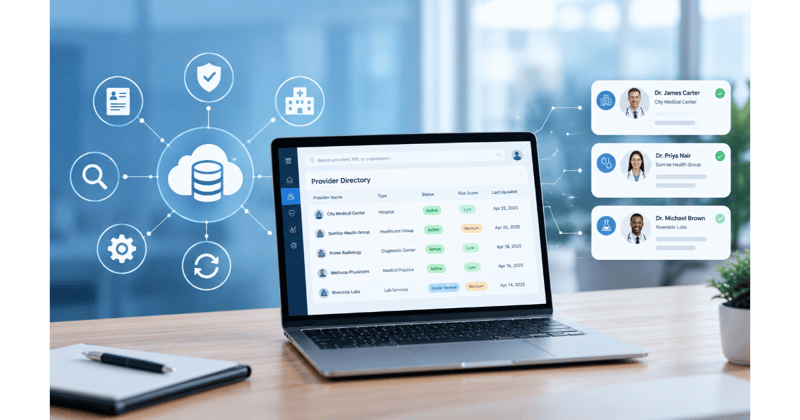
A health plan can have clean provider data and still fail a network adequacy filing. A provider group can pass every credentialing audit and still watch its roster fall out of sync with three different payers. Provider network management sits at the intersection of both problems, and most organizations are still solving it with tools built for only one side.
Provider network management covers how health plans and provider organizations build, contract, credential, monitor, and reconcile a network of contracted providers against regulatory and operational requirements. It spans network adequacy tracking, contracting workflows, credentialing and enrollment, continuous monitoring, and roster reconciliation across payer relationships. Health plans and provider groups both carry pieces of this work, and the platforms below serve one side, the other, or both.
Regulatory pressure has made the gaps in this work harder to ignore. The REAL Health Providers Act tightened Medicare Advantage directory accuracy requirements, and CMS-0057-F is pushing payers and providers toward standardized, API-based data exchange. Platforms that treated network management as a once-a-year compliance exercise are running into that assumption's limits.
This list evaluates each platform against five criteria that matter for that work:
- Network adequacy tracking
- Contracting workflow support
- Roster reconciliation across payer relationships
- Credentialing and monitoring depth
- How much of the network lifecycle runs on one connected system versus separate point tools
Comparison Table
|
Platform
|
Network Adequacy
|
Contracting Workflow
|
Cross-Payer Roster Reconciliation
|
Credentialing and Monitoring
|
Unified Lifecycle
|
|
PRIME® (Atlas Systems)
|
Directory validation feeds adequacy reporting
|
Supports payer enrollment workflows
|
Yes, dedicated module
|
Full: credentialing, enrollment, continuous monitoring
|
Yes, single platform
|
|
symplr
|
Indirect, via credentialing data
|
Contracting supported
|
Limited
|
Full: application through monitoring
|
Yes
|
|
Andros
|
Network development and adequacy monitoring
|
Yes, network development focus
|
Limited
|
Full, NCQA-certified CVO
|
Yes
|
|
Medallion
|
Not a core focus
|
Not a core focus
|
Limited
|
Credentialing, enrollment, licensing, renewals
|
Partial
|
|
Verifiable
|
Not a core focus
|
Not a core focus
|
Limited
|
Credentialing, PSV, monitoring
|
Partial
|
|
Quest Analytics
|
Core strength: CMS and state-recognized adequacy modeling
|
Not offered
|
Not offered
|
Not offered
|
No, adequacy-only
|
|
MacroHealth
|
Network design modeling
|
Contract and pricing modeling
|
Not offered
|
Not offered
|
No, design-only
|
|
Virsys12 (V12 Network)
|
Supported via Salesforce data model
|
Yes
|
Yes
|
Onboarding and credentialing support
|
Yes, on Salesforce
|
|
CertifyOS
|
Network monitoring
|
Not a core focus
|
Yes, via RosterOS
|
Full: credentialing, licensing, enrollment
|
Yes, API-first
|
|
Availity
|
Directory and access compliance
|
Not a core focus
|
Limited, directory-focused
|
PDM and credentialing intake modules
|
Partial
|
PRIME® by Atlas Systems
PRIME® runs provider data management, directory validation, credentialing, payer enrollment, continuous monitoring, and provider-payer roster management on one platform rather than as separate tools that need reconciling against each other. For network teams, this means directory validation results feed directly into the data you need for adequacy reporting, and roster changes flow through credentialing and enrollment status without a manual handoff between systems.
Health plans use PRIME® to keep directory data audit-ready between review cycles instead of scrambling before a CMS or state filing. Provider groups use the same platform to manage payer enrollment and roster submissions across multiple payer relationships without duplicating the same updates five times.
Top features:
- Six-layer provider directory validation framework with direct provider outreach
- Continuous monitoring of licenses, sanctions, and exclusion list changes
- Automated roster submission and reconciliation formatted to each payer's specifications
- Non-delegated enrollment tracking from application through approval
- FHIR-compliant data exchange supporting CMS-0057-F interoperability requirements
Pros:
- One platform covers network data validation, credentialing, and roster reconciliation, removing the reconciliation work between separate systems
- Built for the co-primary payer and provider relationship, not one side only
- Supports both real-time monitoring and audit documentation for regulatory reviews
Symplr
symplr positions its provider offering as a roster-of-record system, running application, contracting, verification, credentialing, privileging, enrollment, and monitoring as one connected flow.
This platform works well for organizations whose primary pain point is credentialing turnaround time or a fragmented provider data source of truth spread across multiple systems.
Key features:
- End-to-end credentialing, privileging, and enrollment workflow
- Centralized roster of record across the provider lifecycle
- Ongoing monitoring integrated into the credentialing flow
Pros:
- Strong fit for credentialing-heavy organizations needing one system of record
- Established platform with broad healthcare operations coverage beyond network management alone
Cons:
- Built primarily to keep the roster clean and compliant, not to model network adequacy or run contract and pricing scenarios
- Network-level analytics are not the platform's core strength
Andros
Andros runs its provider network work through the Andros Arc™ Network Lifecycle Platform, combining provider data management, credentialing, contracting, and monitoring into one connected framework. Its CVO services carry NCQA certification, and the platform extends into provider recruitment, network adequacy, and committee management support for organizations managing multi-state networks.
Key features:
- Network Lifecycle Platform spanning recruitment through adequacy monitoring
- NCQA-certified primary source verification services
- State license verification across multi-state provider networks
Pros:
- Genuinely built around the full network lifecycle, not credentialing alone
- Strong fit for large health plans managing recruitment, contracting, and adequacy in one system
Cons:
- The platform's breadth can feel like more system than needed for organizations wanting a focused credentialing tool without the broader network lifecycle layer
Medallion
Medallion offers credentialing, payer enrollment, provider licensing, and renewal automation, aimed at reducing regulatory complexity for digital health companies, health systems, payers, and provider groups.
Key features:
- Automated credentialing and enrollment workflow
- Real-time license and certification monitoring
- Integrations with existing healthcare systems and third-party databases
Pros:
- Straightforward automation of the credentialing and enrollment workflow specifically
- Serves both payer and provider-side organizations
Cons:
- Network adequacy modeling, contracting workflow, and cross-payer roster reconciliation are not part of its core positioning
Verifiable
Verifiable centers on credentialing automation, primary source verification, and compliance monitoring, with a Salesforce integration that lets organizations manage credentialing inside an existing Salesforce workflow rather than a separate system.
Key features:
- Real-time primary source verification technology
- Salesforce-native integration for credentialing and monitoring
- Serves both provider organizations and health and dental plans
Pros:
- A strong option for organizations already standardized on Salesforce
- Speed-focused primary source verification reduces credentialing turnaround
Cons:
- Network adequacy, contracting, and roster reconciliation across payers fall outside its core scope
Quest Analytics
Quest Analytics builds its Quest Enterprise Services (QES®) platform specifically around network adequacy: access and disruption modeling, gap identification, and provider performance analytics.
Key features:
- CMS and state-recognized network adequacy templates and modeling
- Access and disruption analysis for competitive network positioning
- Provider claims-based performance analytics for network optimization
Pros:
- Good adequacy and access modeling capability, built alongside the regulators who review these submissions
- Useful for organizations whose immediate priority is passing a network adequacy filing with confidence
Cons:
- Adequacy and analytics are the whole platform. It does not run credentialing, enrollment, or roster reconciliation, so organizations need it alongside a separate operational system
MacroHealth
MacroHealth focuses on network design and management, integrating cost, access, and coverage data across medical, dental, vision, and other benefit lines to help organizations model and simulate network changes before committing to them.
Key features:
- Network design and contract pricing modeling
- Cross-source data integration for cost and coverage analysis
- Scenario simulation for network change forecasting
Pros:
- Useful for organizations doing strategic network design work rather than day-to-day roster maintenance
- Strong fit for evaluating network changes before they happen, not just tracking them after
Cons:
- Not built for credentialing, enrollment, or ongoing roster maintenance, so it fills a specific strategic niche rather than full network operations
Virsys12 (V12 Network)
Virsys12 built its V12 Network application on the Salesforce platform to support the many-to-many relationships in payer and provider data models, covering network development, onboarding, credentialing, contracting, and network operations in one system.
Key features:
- Native Salesforce platform supporting complex payer-provider data relationships
- Coverage across network development, onboarding, and contracting
- V12 PDE application for continuous provider data monitoring
Pros:
- Salesforce-native architecture appeals to organizations already invested in that ecosystem
- Covers a genuinely broad span of network operations in one connected system
Cons:
- Implementation and extensibility are tied to the Salesforce platform, which may not fit organizations standardized elsewhere
CertifyOS
CertifyOS runs an API-first provider data infrastructure covering credentialing, licensing, enrollment, and network monitoring, with a dedicated RosterOS module for managing delegated roster submissions across payer relationships.
Key features:
- API-first architecture built for organizations wanting to embed provider data into existing systems
- RosterOS module specifically for delegated roster reconciliation
- Real-time sanctions and network monitoring across primary sources
Pros:
- Good fit for digital health organizations with engineering resources to build against an API-first platform
- RosterOS directly addresses cross-payer roster reconciliation, a gap in several other platforms on this list
Cons:
- The API-first model assumes internal engineering capacity to implement it, which makes it less turnkey than UI-first platforms for teams without that resource
Availity
Availity runs its Provider Data Management and Provider Lifecycle Solution as modules layered onto its national clearinghouse and connectivity network, giving payers a way to manage directory data and credentialing intake alongside their existing eligibility and claims connectivity.
Key features:
- Provider Data Management module scanning claims and billing data for directory changes
- Credentialing Intake module prepopulated from existing provider data
- National-scale connectivity across eligibility, claims, and payer-provider data exchange
Pros:
- Useful for payers who already rely on Availity's clearinghouse and want network management within that same relationship
- Connectivity scale supports directory accuracy checks against real transaction data
Cons:
- Provider Data Management and Credentialing Intake are modules built on top of a connectivity platform rather than a purpose-built network management system, so depth in adequacy modeling and roster reconciliation is more limited than dedicated platforms
Where This Leaves You
Provider network management breaks down when adequacy, contracting, credentialing, and roster reconciliation live in separate systems that do not talk to each other. The platforms above solve different pieces of that problem, and a few solve most of it at once.
If your team is reconciling the same provider changes across separate credentialing, monitoring, and roster tools, schedule a PRIME® demo to see how one connected platform handles that work end to end.







.webp?width=387&height=387&name=Medtech%20Breakthrough%20Award%20Winner%20(1).webp)




























%20(1).jpg)