Most organizations automate roster reconciliation first, because it is the most visible pain point. Staff spend hours comparing spreadsheets line by line, and the fix is easy to picture. But reconciliation is the fourth stage in the roster lifecycle, not the first, and automating it in isolation leaves the three stages that feed it still running on manual work.
This blog breaks down the four stages of provider roster automation and shows what to automate first, based on where your team spends the most time and effort.
The Four Stages of Roster Automation
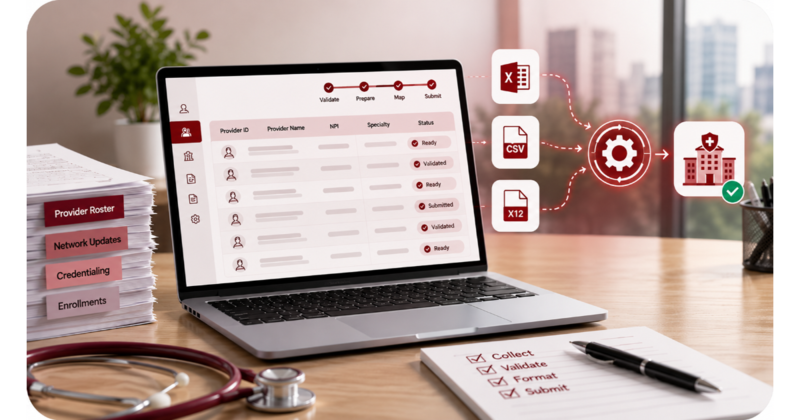
Provider roster automation is the use of software to generate, validate, submit, and reconcile provider roster data without manual reformatting or line-by-line review at each step. Most platforms, including PRIME®, automate all four stages, but organizations rarely have the budget or change-management capacity to implement all four at once.
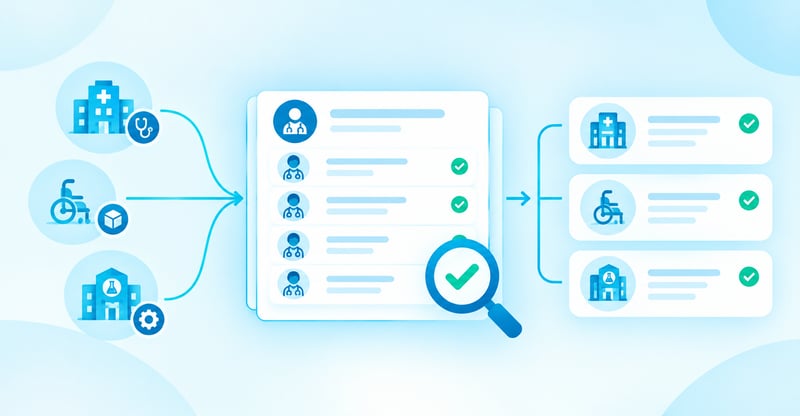
The four stages run in sequence:
- Generation: Pulling current provider data into a payer-specific format
- Validation: Checking that required fields are complete and correctly formatted before submission
- Submission: Delivering the file through the payer's required channel
- Reconciliation: Comparing the payer's response against internal records to catch discrepancies
Each stage depends on the one before it. Automating reconciliation while generation and validation stay manual means your team is still building error-prone files by hand, just reconciling the results faster once those errors surface.
How to Sequence Automation Based on Where You Lose the Most Time
The right starting point depends on which stage is actually consuming staff hours, not which stage feels most urgent. Three patterns show up consistently across health plans and provider organizations.
If you manage more than 15 to 20 payer templates
Organizations coordinating rosters across dozens of payer relationships typically lose the most time in generation, not reconciliation. Every payer requires its own column structure, field naming, and file format, and building each one by hand from a master provider list is where the hours go before reconciliation even starts. Automating generation first, with a template library that maps your source data to each payer's required layout, removes the highest-volume manual step.
If your team manages multiple TINs or delegated entities
Multi-TIN organizations face a validation problem before they face a reconciliation problem. A provider group operating under three tax IDs needs three separate roster views, and manually filtering a master list by TIN before every submission introduces errors that reconciliation later has to catch. Automating validation and TIN-based filtering upstream reduces what reaches reconciliation in the first place.
If payer acknowledgment tracking is your blind spot
Some organizations submit rosters reliably but have no visibility into whether payers actually applied the update. In this case, submission tracking, not generation or reconciliation, is the highest-value automation target. Automated acknowledgment tracking flags submissions that went unconfirmed past a defined window, which prevents the silent data drift that reconciliation exists to catch after the fact.
Why Automating Submission Before Reconciliation Usually Pays Off Faster
Reconciliation automation catches errors after they reach the payer. Submission automation reduces how many errors reach the payer in the first place. A validated, correctly formatted file that fails less often at intake generates fewer rejections, which means less reconciliation volume downstream. Organizations that automate submission before reconciliation typically see their reconciliation workload shrink on its own, simply because fewer discrepancies are entering the pipeline.
This does not replace reconciliation automation. It changes what reconciliation has to catch. For the mechanics of how automated reconciliation itself works, including intelligent provider matching and discrepancy classification, see PRIME®'s roster reconciliation guide.
What PRIME® Automates at Each Stage
PRIME® automates all four stages from a single provider record, rather than treating generation, validation, submission, and reconciliation as separate tools that require their own data feeds.
|
Stage
|
What PRIME® automates
|
|
Generation
|
Payer-specific template library that converts one source record into each payer's required format
|
|
Validation
|
Rule engines that check NPI format, required fields, and TIN scoping before a file leaves your system
|
|
Submission
|
Scheduled delivery through API, SFTP, or portal-compatible files, with acknowledgment tracking per payer
|
|
Reconciliation
|
Automated comparison against payer responses, with discrepancies classified and routed for correction
|
Because all four stages pull from the same governed provider record, an organization does not need to choose one stage and rebuild the others later. The sequencing decision is about implementation order, not about which capability the platform supports.








.webp?width=387&height=387&name=Medtech%20Breakthrough%20Award%20Winner%20(1).webp)