Consider these two scenarios:
- A health plan's operations team spends its week reconciling rosters line by line.
- A health system's credentialing team spends the same week chasing down why three payers still show a provider as terminated.
Both sides are fighting the same broken handoff from opposite ends, and most software in this category only fixes half of it.
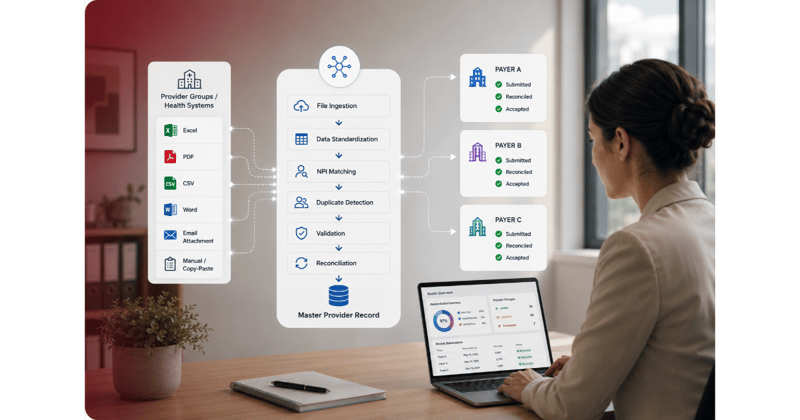
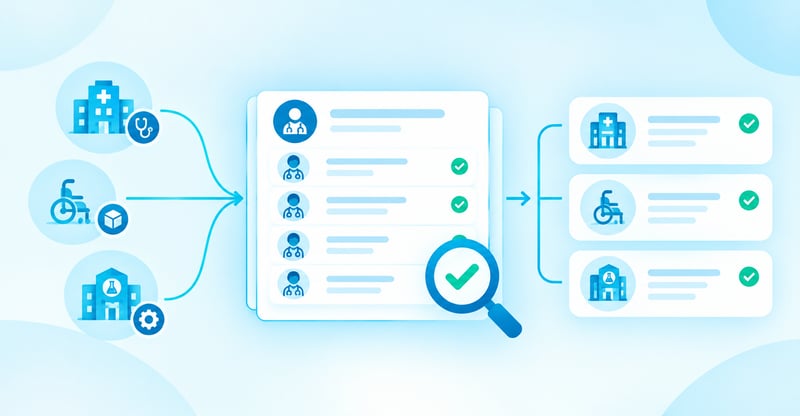
Roster management software automates the ingestion, standardization, validation, and reconciliation of provider roster data as it moves between health systems, provider groups, and health plans. Rosters arrive in a dozen formats from a dozen sources, on a dozen different schedules, and every manual touchpoint is a place for a terminated provider to stay listed or an active one to go missing. That gap is what drives claim denials, member-facing directory errors, and the compliance citations that follow both.
This list evaluates six platforms on how they handle ingestion, reconciliation, and compliance documentation, and specifically on which side of the payer-provider relationship each one actually serves.
Comparison at a Glance
|
Platform
|
Primary Audience
|
Format Ingestion
|
Reconciliation
|
Compliance Documentation
|
|
Atlas PRIME®
|
Health plans and health systems
|
Excel, PDF, CSV, Word, copy-paste
|
Automated, bidirectional
|
CMS, NCQA, state audit packages
|
|
symplr
|
Health plans and health systems (separate products)
|
Varies by product
|
Manual to semi-automated
|
CMS, NCQA, HIPAA
|
|
Medallion
|
Health plans and networks
|
Multiple formats via AI agents
|
Automated, template-based
|
CMS-focused
|
|
HiLabs (MCheck® Roster Automation)
|
Health plans
|
Any format, no pre-processing
|
Automated, rules-based
|
CMS, NCQA, NSA
|
|
CertifyOS (RosterOS)
|
Health plans, self-serve for delegates
|
Any format, up to 10,000 rows/file
|
Semi-automated, user-driven
|
Not publicly detailed
|
|
Verifiable
|
Health plans
|
Configurable templates
|
Automated validation
|
CMS, NCQA, state
|
1. Atlas PRIME®
Atlas PRIME® is built to handle both sides of the same roster transaction from one platform. Health plans use it to ingest delegated and non-delegated rosters, resolve NPI mismatches, and reconcile against a governed provider record. Health systems and provider groups use the same platform to submit rosters to payers and track responses across every payer relationship in one place, instead of a dozen separate spreadsheets and email threads.
If your team is currently doing that tracking manually, or maintaining two different systems to serve your payer relationships on one side and your provider submissions on the other, this is the gap PRIME® closes.
Top features:
- Ingests any format, including Excel, PDF, CSV, Word, and copy-paste text, with automatic normalization
- Automated NPI mismatch resolution and de-duplication against the governed provider record
- Payer-specific template generation for corrections and resubmission, without manual reformatting per relationship
- Delegated and non-delegated roster support in a single workflow
- CMS Medicare Advantage, Managed Medicaid, and NCQA network adequacy documentation, exportable per reconciliation cycle
- Submission and payer-acknowledgment tracking across every payer relationship in one view
Pros:
- Only platform on this list confirmed to serve both the health plan and health system side of the same roster transaction natively
- Ingests unstructured formats (PDF, copy-paste text) that several competitors require pre-processed
- Audit package generation is automatic per cycle, not a manual assembly step
2. Symplr
symplr covers roster-adjacent workflows through three separate products: symplr Payer for health plans, symplr Provider for health systems, and symplr Directory as a shared data hub. If your organization already runs other symplr products for credentialing or workforce management, adding roster capability inside the same vendor relationship can simplify procurement and integration.
Key features:
- symplr Payer: credentialing, contracting, network management, and ongoing monitoring for health plans
- symplr Provider: roster template generation flagging added, deleted, and changed provider records for health systems
- symplr Directory: continuous curation and validation as a shared hub across both sides
- HITRUST-certified, CMS/NCQA/HIPAA/NSA compliance support
Pros:
- Genuine dual-side coverage, not a single-sided tool marketed as broader than it is
- Good customer base with independent third-party ranking evidence
Cons:
- Payer and provider capability live in separate products rather than one unified workflow, so a health system tracking payer submissions and a health plan ingesting delegated rosters won't share a single dashboard unless both products are purchased and integrated
- Public materials describe roster generation and template creation more than automated bidirectional reconciliation at the volume HiLabs or PRIME® document
3. Medallion
Medallion uses AI agents to ingest, standardize, and validate provider rosters, mapping provider data automatically into payer-specific templates. If your priority is reducing the manual reformatting work between your validated provider data and each payer's required roster layout, Medallion's template library is built specifically for that handoff.
Key features:
- AI-standardized ingestion from delegated entities and provider groups
- Automatic mapping to payer-specific roster templates
- NPI mismatch and provider-role discrepancy detection before submission
- Full audit trail on every provider change, update, termination, and deletion
Pros:
- Strong fit for organizations generating high volumes of payer-specific roster exports
Cons:
- Public materials describe roster generation from data already validated inside Medallion rather than bulk multi-format ingestion from external delegated sources at the scale PRIME® document
- Compliance documentation messaging is CMS-focused; NCQA and state-specific audit packaging isn't detailed publicly the way it is for PRIME®
4. HiLabs (MCheck® Roster Automation)
HiLabs' MCheck® Roster Automation is purpose-built for high-volume, health-plan-side roster processing. If your health plan is drowning specifically in delegated roster volume and needs a platform proven at large-plan scale, this is a strong, well-documented option.
Key features:
- Format-agnostic ingestion, no pre-processing required
- Standardizes 260+ data elements per provider record against configurable business rules
- Sub-48-hour turnaround designed to satisfy No Surprises Act update windows
- Validates against NPPES, state licensure databases, and the plan's provider master in real time
Pros:
- Good publicly documented outcome data
- Purpose-built exclusively for the operational reality of payer-side roster volume
Cons:
- Built and marketed exclusively for the health plan side; no documented health-system or provider-group workflow, so organizations managing both directions of the roster relationship need a second tool for the provider side
- HiLabs' own published comparison content on this exact category is a factor worth knowing if you're sourcing vendor claims independently
5. CertifyOS (RosterOS)
RosterOS is CertifyOS's dedicated roster product, letting health plans consolidate multiple delegated rosters into one source of truth. It's self-serve: delegated entities can upload and validate their own roster files, with field matching and suggested error correction built in. If your delegated entities want direct upload access rather than routing every file through your operations team, RosterOS's self-serve model is a good choice.
Key features:
- Self-serve upload and validation for delegated entities directly
- Maps any incoming roster format to the health plan's required schema
- Consolidates multiple delegated rosters into one unified source
- Custom export generation for downstream directory and claims systems
Pros:
- Genuinely self-serve model reduces the health plan operations team's role as a manual intermediary
- Backed by real funding ($69M total) and continued product investment (RosterOS, Provider Hub)
Cons:
- The 10,000-row file limit may require multiple uploads for very large delegated networks in a single reconciliation cycle.
6. Verifiable
Verifiable's Roster Management for Health Plans, built natively on Salesforce, standardizes provider roster imports and enforces data governance rules at the point of intake. If your health plan already runs on Salesforce, or wants a preview-before-commit step that shows the impact of a roster file before it touches production data, this is a specific, checkable differentiator.
Key features:
- Native Salesforce architecture
- Reusable field-mapping templates per delegated partner
- Preview mode showing roster impact before committing changes
- Deduplication and required-field validation enforced at import
Pros:
- Preview-before-commit is a distinct, verifiable safety feature not described this way by other vendors on this list
- Native Salesforce fit is a real advantage for health plans already standardized on that infrastructure
Cons:
- This is a newly launched product; no independent reviews or named customer case studies were found in current public materials
- Requiring or benefiting from a Salesforce environment narrows the fit for health plans on other core systems
See What Roster Management Looks Like When Both Sides Are Covered
Most platforms on this list solve roster management for one side of the payer-provider relationship. Atlas PRIME® is built to handle both from a single platform, whether your team is ingesting delegated rosters as a health plan or tracking submissions across a dozen payers as a health system.
See PRIME® in a live demo.








.webp?width=387&height=387&name=Medtech%20Breakthrough%20Award%20Winner%20(1).webp)