








.webp?width=387&height=387&name=Medtech%20Breakthrough%20Award%20Winner%20(1).webp)
























Roster Management > Provider Roster Management Best Practices
Provider Roster Management Best Practices


5 min read | Last Updated: 17 Sep, 2026
Picture this scenario: A provider changes location on a Tuesday. Billing knows by Wednesday. Scheduling has it updated by Thursday. Eight payers still have the old address three months later, and nobody notices until a claim is denied. The provider data was correct the entire time. What failed was the handoff that was supposed to carry that change from an internal system to eight external ones, and no one had ever been assigned to own it.
This is the pattern behind most roster problems that get diagnosed as data quality issues. The data is usually fine. The organization has no documented answer for who is responsible for getting a change from internal record to payer confirmation, so the handoff depends on someone remembering, and eventually someone doesn't.
Why Roster Practices Break Down Before Roster Data Does
Provider roster management fails at the process level more often than the data level. A provider changes location, and the update reaches billing and scheduling within hours because those teams feel the impact immediately. Payer notification lags because no one owns confirming it happened. The data was accurate. The practice around communicating it was not.
This is the pattern behind most of what looks like a data quality problem. Fixing it requires operational standards, not just better software.
Assign Clear Ownership for Every Stage of the Roster Lifecycle
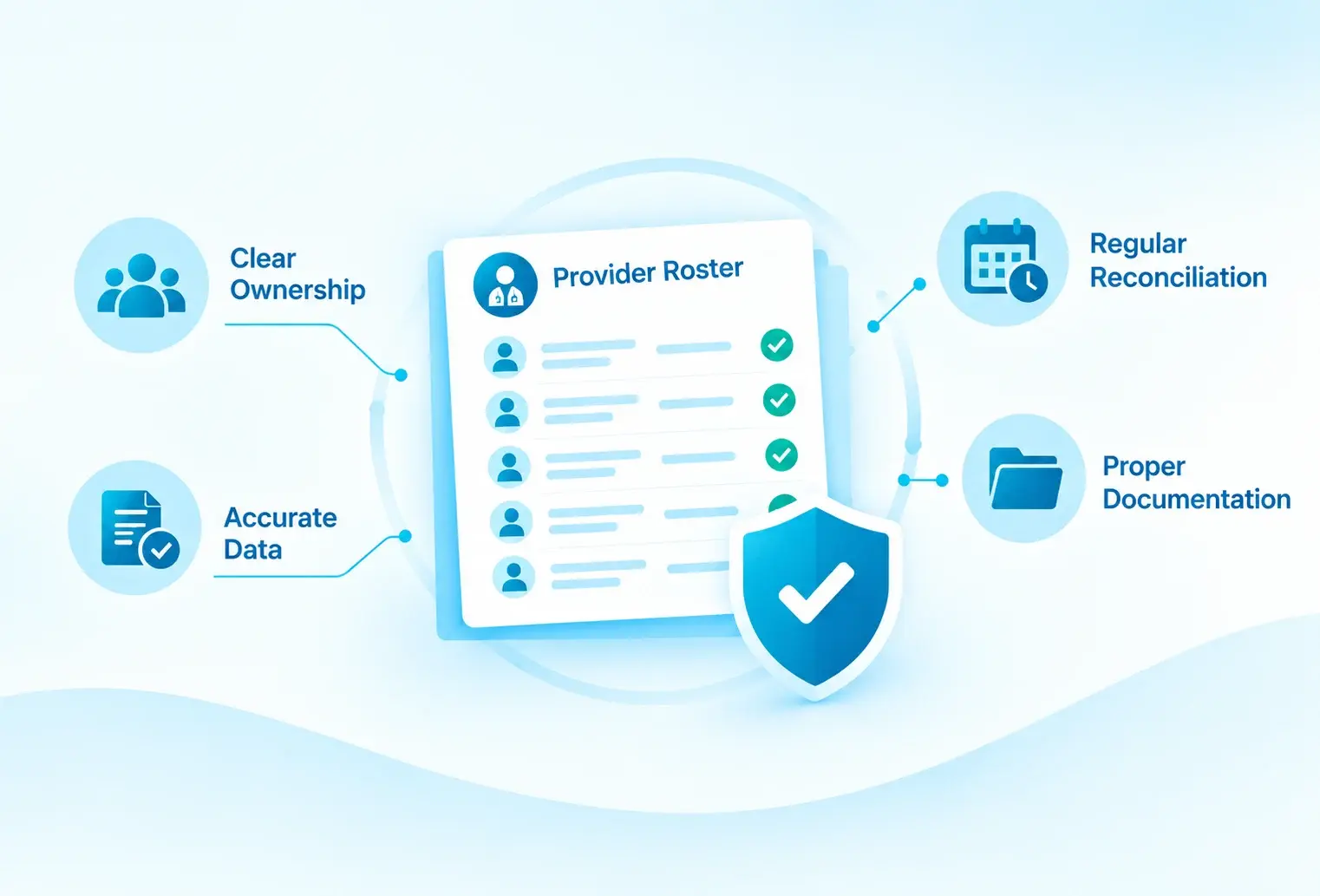
Roster accuracy depends on someone being accountable for each of four functions: capturing provider changes, formatting them for each payer, submitting on schedule, and confirming payer acknowledgment. In many organizations, these four functions sit across credentialing, contracting, and operations without a documented handoff between them.
A working ownership model names one person or team responsible for each function and defines what happens when a handoff is missed. Without this, a provider change can sit unnoticed for weeks because everyone assumed someone else was tracking it.
Set a Reconciliation Cadence Based on Provider Volume, Not Convention
Many organizations reconcile quarterly by default, matching the Consolidated Appropriations Act's minimum requirement rather than their own operational risk. Quarterly reconciliation means any error introduced mid-cycle goes undetected for up to 90 days.
The right cadence depends on provider count and payer relationship count, not on the regulatory floor.
|
Organization profile |
Recommended cadence |
|
Fewer than 100 providers, 5 or fewer payers |
Monthly |
|
100 to 500 providers, or 10 or more payers |
Biweekly to monthly |
|
500 or more providers, or frequent delegated changes |
Weekly or continuous |
Organizations with higher provider turnover or multiple delegated relationships should default to the more frequent end of their range, since delegated data introduces an additional handoff where errors can enter unnoticed.
Document Every Correction, Not Just Every Discrepancy
A discrepancy log without a resolution record only tells you what went wrong. It does not tell you whether the fix held. Effective documentation tracks four things for every discrepancy: when it was found, what correction was submitted, when the payer confirmed it, and whether the same issue recurred in the next cycle.
That last point matters more than most organizations treat it. A discrepancy that reappears after correction usually indicates a process gap upstream, not a one-time data error, and it will keep resurfacing until the upstream cause gets fixed.
Standardize Your Source Data Before You Standardize Payer Formats
Teams often focus on building templates for each payer before fixing inconsistencies in their own source data. Name formatting, address structure, and specialty coding should be standardized internally first. A single governed source record, structured consistently before any payer-specific formatting happens, reduces the errors that templates alone cannot catch.
Organizations managing multiple tax ID structures face this most acutely, since a provider record that varies in format across TINs creates mismatches even when the underlying data is correct.
Build Payer Acknowledgment Tracking Into Every Submission
Submission without confirmation is the most common blind spot in roster management. A file sent is not the same as a file processed. Best practice sets a defined follow-up window, typically 10 to 15 business days, after which an unconfirmed submission triggers direct outreach to the payer rather than waiting for the next reconciliation cycle to surface the gap.
How PRIME® Supports Roster Management Best Practices Operationally
PRIME® enforces ownership and cadence as system rules rather than relying on manual follow-through. Submission tracking flags unconfirmed files automatically, discrepancy logs carry resolution status and recurrence flags across cycles, and a single governed provider record feeds every payer-specific format so source data stays consistent before formatting variation is applied.
See PRIME® in action to walk through how ownership rules and acknowledgment tracking hold up across a full roster cycle.
FAQs
What is the most common cause of provider roster errors?
Provider changes not reaching payers in time, due to unclear ownership of the notification step, causes more roster errors than data entry mistakes. The provider record itself is usually correct. The handoff to payer systems is where accuracy breaks down.
How often should provider rosters be reconciled?
The Consolidated Appropriations Act sets 90 days as the regulatory minimum, but organizations with 100 or more providers or 10 or more payer relationships typically need monthly or more frequent reconciliation to catch errors before they accumulate into claim denials.
Who should own provider roster management within an organization?
Ownership should be explicit and documented across four functions: capturing provider changes, formatting for payers, submitting on schedule, and confirming acknowledgment. Organizations that split these across teams without a defined handoff see the most recurring errors.
Jump to section